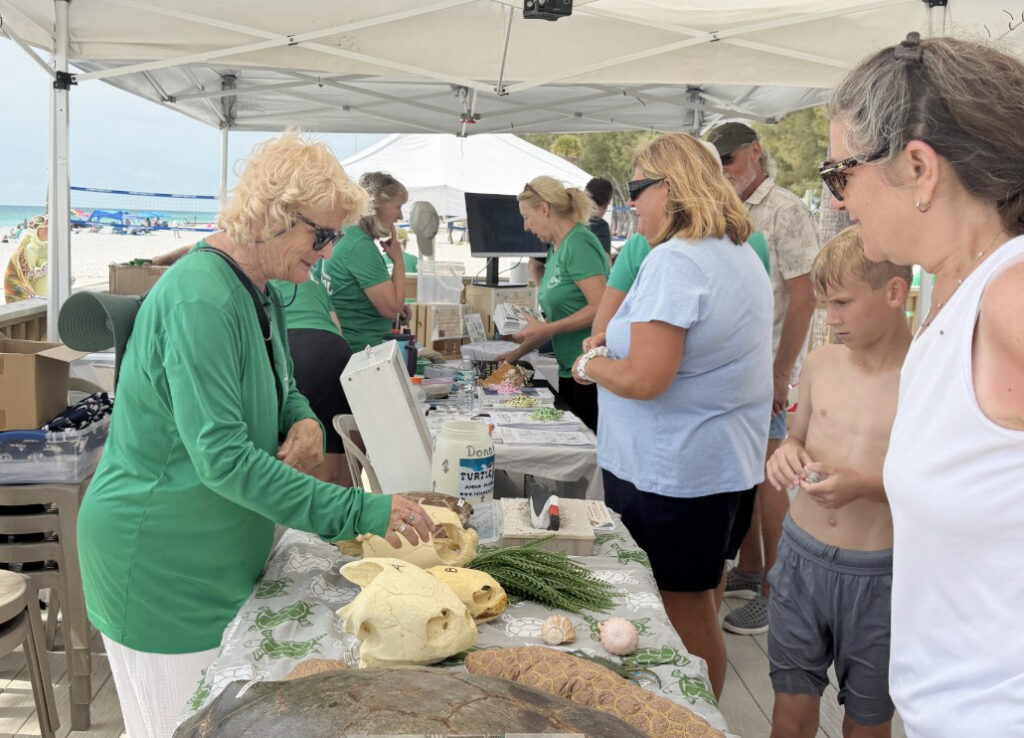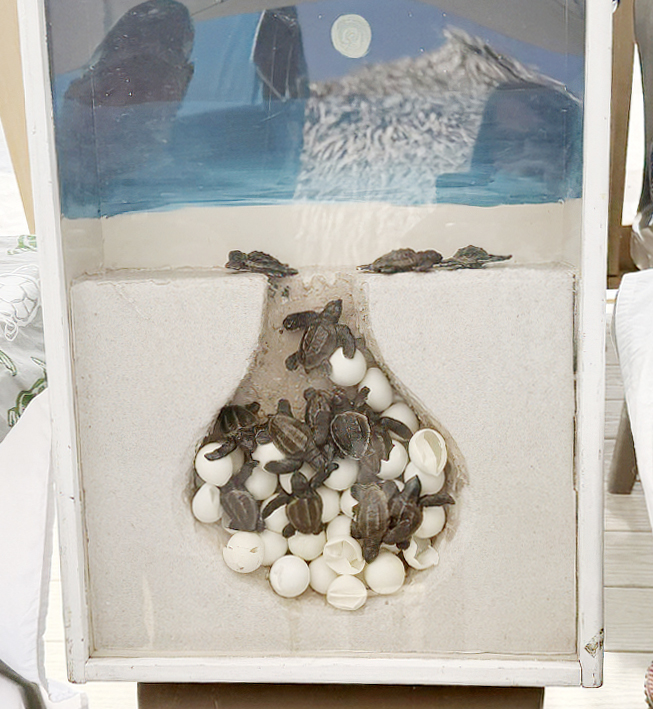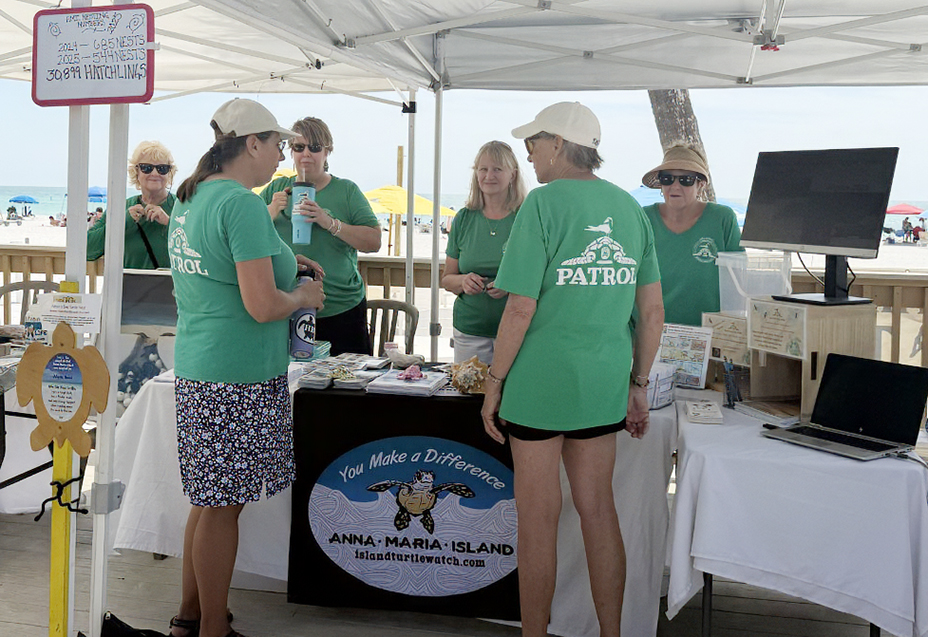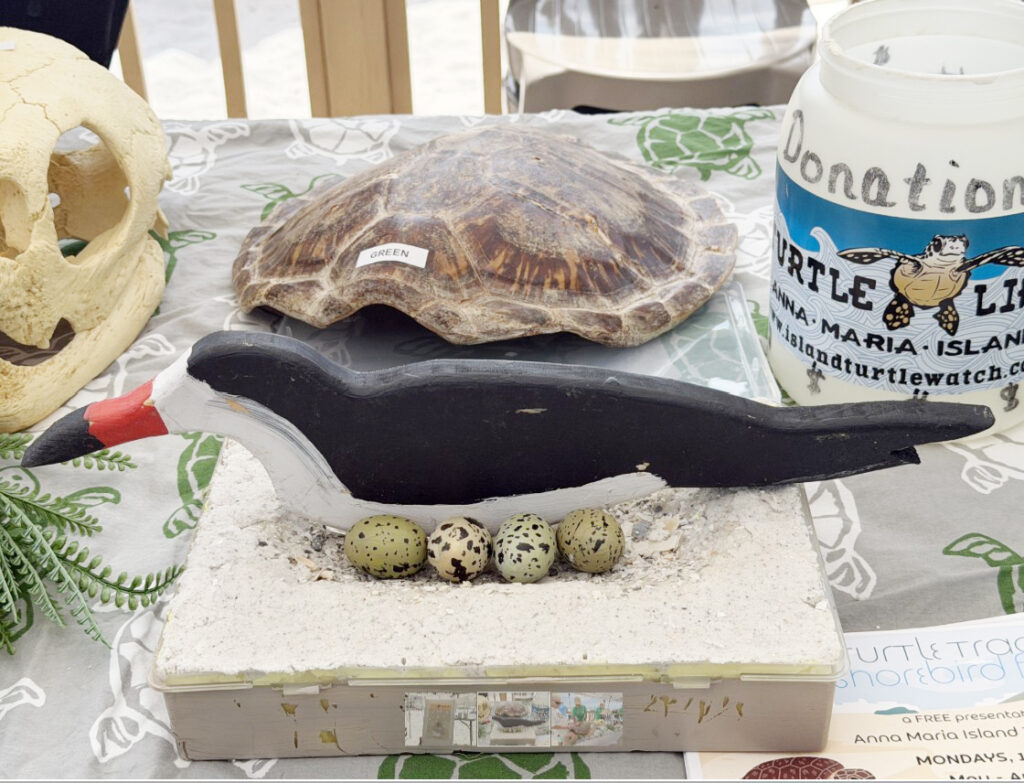

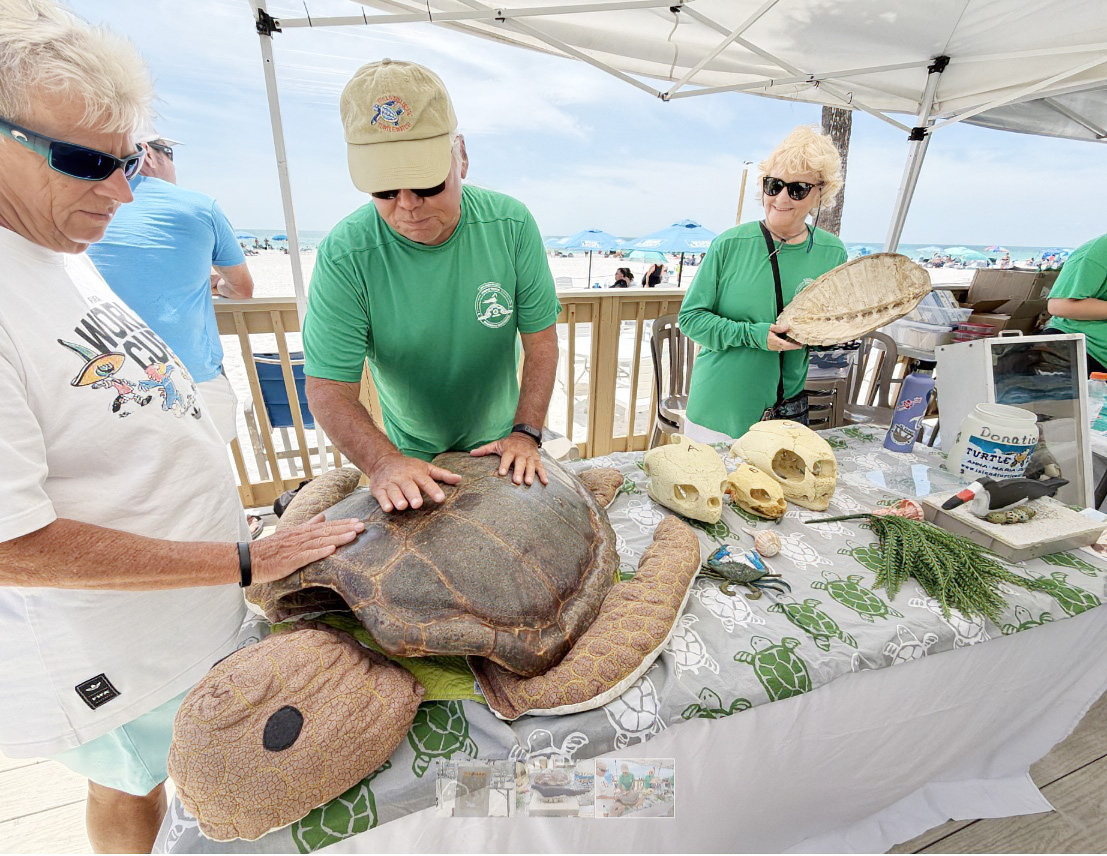
ANNA MARIA – More than 100 beachgoers saw an uncommon sight when a nesting loggerhead sea turtle laid her eggs during the day on June 26, the second daytime nesting in a week.
Anna Maria Island Turtle Watch and Shorebird Monitoring volunteers posted photos and the following on its Facebook page: “What an awesome afternoon in Anna Maria Wednesday! We had a day nester loggerhead! She remained on the beach for approximately one hour. Around 100 people of all ages were very respectful and gave her space. Everyone cheered as she returned to the Gulf!”
“It is not very common to see daytime nesting turtles and we did have two in one week,” Executive Director Kristen Mazzarella wrote in a July 3 email to The Sun. “I do not know what would cause them to nest during the day either. I just know that it is a rare occurrence.”
Mazzarella speculated that with this being a record year for sea turtle nests on the Island, it may just be a matter of numbers or a reaction to disturbances during typical night nesting.
“If you have that many nests, you may see a few daytime nesters,” she wrote. “If a turtle is disturbed and leaves the beach without nesting, she will have to return another time to lay her nest and that might mean nesting at a time that finds her on the beach in the morning or having to come up during the day.”
She reminded visitors to leave the beach to the turtles at night so that people don’t inadvertently disturb a turtle coming ashore or nesting on the beach. Cell phone lights are especially disruptive to sea turtles.
TURTLE TIPS
During sea turtle season, May 1 – Oct. 31, follow these tips to help turtles:
• Turn off lights visible from the beach and close blinds from sundown to sunrise; lights confuse nesting sea turtles and may cause them to go back to sea and drop their eggs in the water, where they won’t hatch. Light can also attract hatchlings away from the water.
• Don’t use flashlights, lanterns or camera flashes on the beach at night.
• Remove all beach chairs and other objects from the sand from sundown to sunrise; they can deter sea turtles from nesting and disorient hatchlings.
• Fill in the holes you dig in the sand before leaving the beach; they can trap nesting and hatching sea turtles, which cannot live long out of the water. You might also accidentally dig into an unmarked nest. To report large holes or other turtle obstacles, call:
• City of Anna Maria code enforcement — 941-708-6130, ext. 111.
• City of Bradenton Beach code enforcement — 941-778-1005, ext. 227.
• City of Holmes Beach code enforcement — 941-778-0331, ext. 260.
• Level sandcastles before leaving the beach; they can block hatchlings from the water.
• Don’t use balloons, wish lanterns or fireworks; they litter the beach and Gulf, and turtles can ingest the debris.
• Do not trim trees and plants that shield the beach from lights.
• Never touch a sea turtle; it’s the law. If you see people disturbing turtles, call the Florida Fish and Wildlife Conservation Commission’s Wildlife Alert hotline at 888-404-FWCC (3922).
ANNA MARIA ISLAND – The traditional May 1 start of the sea turtle nesting season is now April 15, according to Anna Maria Island Turtle Watch and Shorebird Monitoring, whose volunteers began monitoring the beaches this week for signs of nesting.
Residents and beachgoers can help improve the chances of successful turtle nesting and hatching this season by turning off lights visible from the beach and closing blinds or drapes from sundown to sunrise. Lights confuse nesting sea turtles and may cause them to go back to sea and drop their eggs in the water, where they won’t hatch. Light can also attract hatchlings away from the water.
Don’t use flashlights, lanterns or camera flashes on the beach at night; they can disorient turtles.
Remove all beach chairs and other objects from the sand from sundown to sunrise; they can deter sea turtles from nesting, entrap them and disorient hatchlings.
Fill in the holes you dig in the sand before leaving the beach. They can trap nesting and hatching sea turtles, which cannot live long out of the water. You might also accidentally dig into an unmarked nest. To report large holes or other turtle obstacles, call:
• City of Anna Maria code enforcement – 941-708-6130, ext. 111;
• City of Bradenton Beach code enforcement – 941-778-1005, ext. 227;
• City of Holmes Beach code enforcement – 941-778-0331, ext. 260.
Level sandcastles before leaving the beach; they can block hatchlings from the water.
Don’t use balloons, wish lanterns or fireworks; they litter the beach and Gulf, and turtles can ingest the debris.
Avoid trimming trees and plants that shield the beach from lights.
Never touch a sea turtle; it’s the law. If you see people disturbing turtles, call the Florida Fish and Wildlife Conservation Commission’s Wildlife Alert hotline at 888-404-FWCC (3922).
A series of Turtle Talks about living with sea turtles is being planned for May at Holmes Beach City Hall, with dates to be announced soon, Turtle Watch Executive Director Kristen Mazzarella said.
Funding for the educational outreach program comes in part from the Suzi L. Fox Adopt-a-Nest Program. For a $125 tax-deductible donation, a plaque dedicated to a person or organization of the donor’s choice is placed on a sea turtle nest that has been laid on an Island beach. When the nest hatches and data is collected, an adoption package is sent to the donor containing a personalized adoption certificate and the location of the nest, the handmade wooden plaque, information about the nest written on the back of the plaque and a letter of appreciation from the volunteers working on the nesting beaches.
“We do not let you know when your adopted nest will hatch. This is protected information that we do not give out,” according to the Turtle Watch website.
Plaques will be placed on the beach between mid-June through August and remain on the nests for the approximately two-month incubation period.
ANNA MARIA ISLAND – The 2023 turtle nesting season is coming to an early end, partly due to Hurricane Idalia.
“No changes in nest numbers,” Anna Maria Island Turtle Watch Executive Director Kristen Mazzarella said. “That’s not surprising as this is usually the hatching time of year.”
The last nest on the Gulf of Mexico side of the Island hatched on Sept. 19 and volunteers continue to check three remaining nests on the bay side.
“We are still hoping to see a hatch,” she said.
Sea turtle season officially begins on May 1 and ends on Oct. 31.
Volunteers did not conduct patrols on Aug. 30 due to Idalia, but they were out on the beach assessing the status of the nests the following day.
“We had 76 unhatched nests left on the beach when Hurricane Idalia came through. Stakes were lost from all but 12 of them,” Mazzarella said.
“It is possible that some nests may still hatch, although unmarked. Turtle season is not quite over, but we are happy with the results, having allowed nearly 23,000 hatchlings to go out to sea prior to the storm.”
One local celebrity loggerhead turtle, Suzi – named after the late Suzi Fox, longtime executive director of Turtle Watch – was released from Coquina Beach on June 27 after being fitted with a satellite monitor. She is participating in the Sea Turtle Conservancy Tour de Turtles race and is currently swimming in the Gulf of Mexico near Cancun, Mexico.
The hatchling numbers from Suzi’s nest were unavailable due to the storm.
“Unfortunately, we never saw Suzi’s nest hatch prior to the storm, so we don’t have any information on how many hatchlings the nest produced,” Mazzarella said. “It is possible it hatched on one of the rainy days prior to Hurricane Idalia. The rain sometimes makes it impossible to see the hatchling tracks and therefore document the hatch.”
As the season winds down, Turtle Watch focuses on education and outreach.
“We are looking forward to having a booth at the Anna Maria Farmer’s Market in October,” Mazzarella said. “We are still compiling our data and working on coordinating with the schools about outreach programs.”
ANNA MARIA ISLAND – Island sea turtles are getting off to an early start as the first nest of the season on the Gulf Coast of Florida has appeared on Anna Maria Island.
“AMITW got a big surprise early this morning, finding the first loggerhead nest of the season,” Anna Maria Island Turtle Watch and Shorebird Monitoring Executive Director Kristen Mazzarella wrote in an April 18 statement.
The Florida Fish and Wildlife Conservation Commission (FWC) told Mazzarella that the AMI nest was the first found on the state’s west coast. She said it is likely the earliest nest in the history of Turtle Watch.
Turtle season officially begins on May 1 and runs through Oct. 31. Turtle Watch volunteers started to patrol on April 15 at the directive of the FWC. Days later, volunteers found the crawl.
“We are excited to start the nesting season on Anna Maria Island and look forward to a productive season protecting nests and educating the public,” said Mazzarella, who began her new job at Turtle Watch this month.
In 2022, two records were broken by local loggerhead sea turtles. The number of hatched nests in September reached 453, edging out the 2018 record of 447, and a record 35,850 hatchlings exceeded the prior record of 35,788 set in 2018.
ANNA MARIA ISLAND – As Anna Maria Island Turtle Watch and Shorebird Monitoring volunteers begin checking the beaches this week for early sea turtle nesting activity, its new executive director, Kristen Mazzarella, takes over the watch from the late Suzi Fox.
“I envision following in Suzi’s legacy and to keep it going how it has been with the great community involvement,” Mazzarella said. “My goal is to keep the community educated, engaged and involved.”
Kristen Mazzarella will take over leadership duties at Anna Maria Island Turtle Watch and Shorebird Monitoring. – Submitted
Mazzarella has an extensive background with both turtles and shorebirds. She was a senior biologist at Mote Marine Laboratory for 15 years. She was on turtle patrol for 25 years in North and South Carolina and also worked with the Audubon Society for 15 years.
“The group of volunteers (with Turtle Watch) has been very welcoming,” she said. “Manatee County has been amazing; they clearly care a lot about the environment.”
Mazzarella said one of the Turtle Watch board members contacted her during their search for an executive director to see if she was interested in the position.
“I knew Suzi and I had worked with her on various projects,” she said. “I feel that this organization is so important because it’s a conservation program where both the community and the municipalities are very involved.”
There is a core group of 20-25 volunteers who have undergone training with the Florida Fish and Wildlife Conservation Commission (FWC) to conduct nesting beach surveys, but Mazzarella said volunteers are always needed and welcome.
During the nesting beach surveys, which run from mid-April to the end of October, volunteers patrol every day, keeping an eye on each nest until it has hatched, Mazzarella said.
“That training is done for this year, but certainly volunteers are needed to help with outreach and our adopt-a-nest program,” she said.
Fox’s legacy
Fox began as a volunteer for Turtle Watch in the 1990s. In 1996, she became the FWC’s turtle permit holder for the Island, adding nesting shorebird monitoring and protection to her duties.
She eventually took leadership of Turtle Watch as executive director and under her directorship, the organization grew.
May 1 is Suzi Fox Day in Bradenton Beach in honor of Turtle Watch’s late executive director. – Sun File Photo
“In three decades, we monitored 7,339 turtle activities, protected 4,454 nests, 301,694 turtle eggs, and watched 271,680 hatchlings depart to become a future generation of loggerheads that will return to the region as they reach maturity,” according to the Turtle Watch website.
Last season, local loggerhead sea turtles broke two records.
The number of hatched nests reached 453 in September, edging out the 2018 record of 447, and a record 35,850 hatchlings exceeded the prior record of 35,788 set in 2018.
The first official day of turtle nesting season on Anna Maria Island, May 1, will be proclaimed “Suzi Fox Day” in the city of Bradenton Beach.
At the Jan. 5 Bradenton Beach City Commission meeting, the proclamation was issued to honor Fox, who served as the organization’s executive director until her death on Sept. 30, 2022.
The proclamation states in part, “Suzi Fox led the organization and its league of volunteers for sea turtle protection to include protection for critical shorebirds.”
The proclamation credits Fox with reaching out to and educating the public about sea turtle and shorebird habitat.
“Suzi’s actions have led Anna Maria Island to expand on ecotourism opportunities and on further educating the public and future generations about our sea turtle and shorebirds habitat and the crucial role we play in ensuring their existence in the future.”
ANNA MARIA ISLAND – Sea turtle hatchlings have broken the Anna Maria Island record set by the 2018 crop of local loggerheads, with 35,850 hatchlings so far this year.
The number, recorded last weekend by Anna Maria Island Turtle Watch and Shorebird Monitoring, exceeds the previous record of 35,788 hatchlings that made it to the Gulf of Mexico from the Island’s beaches in 2018, and there are more to come.
“It will continue to grow as there are nests to still hatch,” Turtle Watch volunteer Barbara Riskay said.
Turtle Watch breaks down nesting data into three geographical sections. The first, from the Longboat Key Bridge north to Manatee Beach, has had 17,167 hatchlings so far this year. The second, from Manatee Beach north to Bean Point, has had 17,805 hatchlings so far. The third, covering bayside beaches, has had 878 hatchlings so far this year.
The last time turtles set a record on AMI was in 2019, when turtle moms laid a record number of nests – 544. This year’s nesting tally is approaching that record, at 531 nests.
Turtle Watch also counts nests that were not laid, known as false crawls, identified by tracks left by nesting mothers that did not dig nests.
ANNA MARIA ISLAND – Just in time for Mother’s Day, sea turtles that hatched on the Island have begun returning to lay their own nests.
Anna Maria Island Turtle Watch and Shorebird Monitoring (AMITW) identified and marked six turtle nests in the first week of nesting season, which began May 1 and runs through Oct. 31.
These nests are just the beginning; hundreds more are expected this year, which will result in tens of thousands of hatchlings. The record for nests was 544 in 2019, and 2018 saw a record 35,788 hatchlings. However, the majority of the hatchlings will not survive to maturity, primarily due to predators. To maximize their chances of survival, the best thing to do is eliminate obstacles created by humans.
Hatchling turtles are born with an immediate instinct to crawl directly to the water. Obstacles such as beach chairs, trash or deep holes they cannot crawl out of lower their odds of survival. Light from flashlights or camera flashes can disorient both nesting and hatching sea turtles, leading them away from the water, as can light from beachfront buildings.
Five species of sea turtles swim and feed around Anna Maria Island, the most common being the loggerhead, according to Turtle Watch, and all are an integral part of the local ecosystem.
Turtle Tips
During sea turtle season, May 1 – Oct. 31, follow these tips to help turtles:
Turn off lights visible from the beach and close blinds from sundown to sunrise; lights confuse nesting sea turtles and may cause them to go back to sea and drop their eggs in the water, where they won’t hatch. Light can also attract hatchlings away from the water.
Don’t use flashlights, lanterns or camera flashes on the beach at night.
Remove all beach chairs and other objects from the sand from sundown to sunrise; they can deter sea turtles from nesting and disorient hatchlings.
Fill in the holes you dig in the sand before leaving the beach; they can trap nesting and hatching sea turtles, which cannot live long out of the water.
Deconstruct sandcastles before leaving the beach; they can block hatchlings from the water.
Don’t use balloons, wish lanterns or fireworks; they litter the beach and Gulf, and turtles can ingest the debris.
Do not trim trees and plants that shield the beach from lights.
Never touch a sea turtle; it’s the law. If you see people disturbing turtles, call the Florida Fish and Wildlife Conservation Commission’s Wildlife Alert hotline at 888-404-FWCC (3922).
ANNA MARIA ISLAND – The 2021 sea turtle nesting season is over on the Island, with the final known nest hatching Thursday, Oct. 14, according to Anna Maria Island Turtle Watch and Shorebird Monitoring statistician Pete Gross.
In every category, the numbers were better this year than the 20-year average from 2001 through 2020, but the turtles did not beat their all-time high numbers in any category.
Given the Piney Point wastewater discharge in Tampa Bay in April and the resulting – and lingering – red tide, turtle moms did well to beat their 20-year nesting average of 259 nests with a total of 422 this season. They fell short of their 2019 record of 544 nests, however.
The moms made 555 false crawls – or nest attempts – this year, more than the 20-year average of 285, but fewer than the highest count of 568 in 2019.
Turtle hatchlings barely beat their 20-year average of 206 hatched nests with a total of 226 hatched nests this year; their record was 447 in 2018.
The number of hatchlings this year also was higher than the 20-year average of 13,543 baby turtles, with 15,725 making their way to the Gulf in 2021. Their record: 35,788 hatchlings in 2018.
People did well too, with 34 nest disorientations caused by lights, fewer than the 20-year average of 58. Ideally, people would turn off beach-facing lights and keep flashlights and mobile phone lights off the beach during turtle season, from May 1 to Oct. 31.
Spencer Quinlivan is a 9 1/2-year-old animal lover from Pinellas County with a soft spot for sea turtles and shorebirds. He visits the Island regularly, staying in a house owned by his grandparents, and quickly became aware of Anna Maria Island Turtle Watch and Shorebird Monitoring.
A few weeks ago, he decided to raise money as a school project by selling lemonade, bananas and cookies on Pinellas Trail. According to his father, Patrick Quinlivan, it was cool and windy, and not too many people needed to cool down.
“Luckily, there was a busy police station with a lot of foot traffic,” Patrick Quinlivan said. “They all came by and if they weren’t thirsty, they just donated money. He ended up with $215.22.”
The family visited the Island a couple of weeks ago and found Anna Maria Island Turtle Watch and Shorebird Monitoring Director Suzi Fox, who was impressed with Spencer. She arranged a visit to the Manatee County Marine Rescue headquarters, on Sunday, April 28, thanks to rescue chief Joe Westerman, and Spencer got a Turtle Watch ATV ride down the beach in addition to the Marine Rescue ride personnel Morgan Bakulski and A.J. Nelson gave him.
Fox took the money and applied it to AMITW’s education fund, and Spencer went home with a box of promotional and educational items.
“This is what is so right about our Manatee County,” Fox said.
Spencer said he learned a lot about sea turtles.
“I found out that the wrong lights at night are dangerous,” he said. “We have to use the right lights so the turtles don’t come to the shore instead of out to sea.”
At the start of turtle season, Anna Maria Island Turtle Watch and Shorebird Monitoring Director Suzi Fox reported three turtle nests as of Sunday – one on each city’s beach.
The first nest was discovered on May 1, the first day of the turtle season, at Manatee Beach in Holmes Beach with the next one on Thursday, May 2 on Coquina Beach in Bradenton Beach and another nest later in the week at Bayfront Park in Anna Maria.
Fox reminds beachgoers to avoid nests, which are marked with yellow tape.
Fox has been patrolling the beaches with city code enforcement officials at night, looking for lights that might attract hatchlings away from the Gulf and onto dry land where they would likely die. When they hatch, sea turtles head for the Gulf, drawn by the light of the stars and moon. If Gulf-front buildings have lights that are visible to the turtles, they could go toward the lights and die from dehydration or be run over by cars.
It is illegal to touch a hatchling, so if you spot one in trouble, Fox said, call Turtle Watch at 941-778-5638.
Turtle Tips
During sea turtle season, May 1 – Oct. 31, follow these tips:
Turn off lights visible from the beach and close blinds from sundown to sunrise; lights confuse nesting sea turtles and may cause them to go back to sea and drop their eggs in the water, where they won’t hatch. Light can also attract hatchlings away from the water.
Don’t use flashlights, lanterns or camera flashes on the beach at night.
Remove all objects from the sand from sundown to sunrise; they can deter sea turtles from nesting and disorient hatchlings.
Fill in the holes you dig in the sand before leaving the beach; they can trap nesting and hatching sea turtles, which cannot live long out of the water.
Don’t use wish lanterns or fireworks; they litter the beach and Gulf.
Do not trim trees and plants that shield the beach from lights.
Never touch a sea turtle; it’s the law. If you see people disturbing turtles, call the Florida Fish and Wildlife Conservation Commission’s Wildlife Alert hotline at 888-404-FWCC (3922).
Bird tips
During bird nesting season, March through August, follow these tips:
Never touch a shorebird chick, even if it’s wandering outside a staked nesting area.
Teach kids not to chase birds – bird parents may abandon nests if they’re disturbed.
Don’t feed birds – it encourages them to fly at people aggressively and is not good for their health.
If birds are screeching and flying at you, you’re too close.
Avoid posted bird nesting areas and use designated walkways to the beach.
Keep pets away from bird nesting areas.
Keep the beach clean; food scraps attract predators such as raccoons and crows to the beach, and litter can entangle birds and other wildlife.
If you see people disturbing nesting birds, call the Florida Fish and Wildlife Conservation Commission’s Wildlife Alert hotline at 888-404-FWCC (3922).
It’s a trend that’s concerning state and local turtle officials – vacationers are increasingly taking the whole family out to the beach at night to check all the sea turtle nests with cell phone flashlights.
A recent viral video by the Anna Maria Island Chamber of Commerce depicting turtle hatchlings scurrying to the Gulf of Mexico has sparked a rash of souvenir-seekers illuminating nests with cell phone flashlights, which can be deadly for turtles, Anna Maria Island Turtle Watch and Shorebird Monitoring Director Suzi Fox said.
Lights from cell phones and other sources temporarily blind hatchlings trying to find the water, as well as mother turtles, which are still nesting for the next couple of weeks, and beachgoers, she said, adding that no one knows whether turtle vision is permanently impaired by artificial lights.
No one would intentionally shine an LED flashlight in a newborn infant’s eyes, the equivalent of a turtle hatchling, Fox said.
“Those few minutes going to the sea are precious to them,” Fox said, explaining that if they are disoriented by lights, they could crawl away from the water, where they can become dehydrated, be hit by cars or attacked by predators.
At a nest that hatched one night last week, a large family surrounded it, shining cell phone lights at the hatchlings. While the hatchlings made it to the Gulf, their temporary blindness could have caused them to lose their bearings and come back ashore later, she said.
“Did that nest get disoriented? We don’t know, it could have,” she said, adding that recent rains have obliterated hatchling tracks by the time Turtle Watch volunteers arrive at dawn to track them.
The Florida Fish and Wildlife Conservation Commission paid a visit to the Island last week to check nests; sea turtles are protected by state and local laws. Loggerheads are threatened species, one step away from the endangered category.
“You have to click it on and click it off quickly,” she said. “It can’t be a constant light because hatchlings will follow it and it will disorient mothers.”
Eight nests have disoriented so far this season on the Island. Nests are expected to continue hatching through Oct. 31, the end of the turtle season, and possibly beyond.