Tag: Manatees

Three young manatees rehabbing at Bishop Museum

Three young manatees rehabbing at Bishop Museum

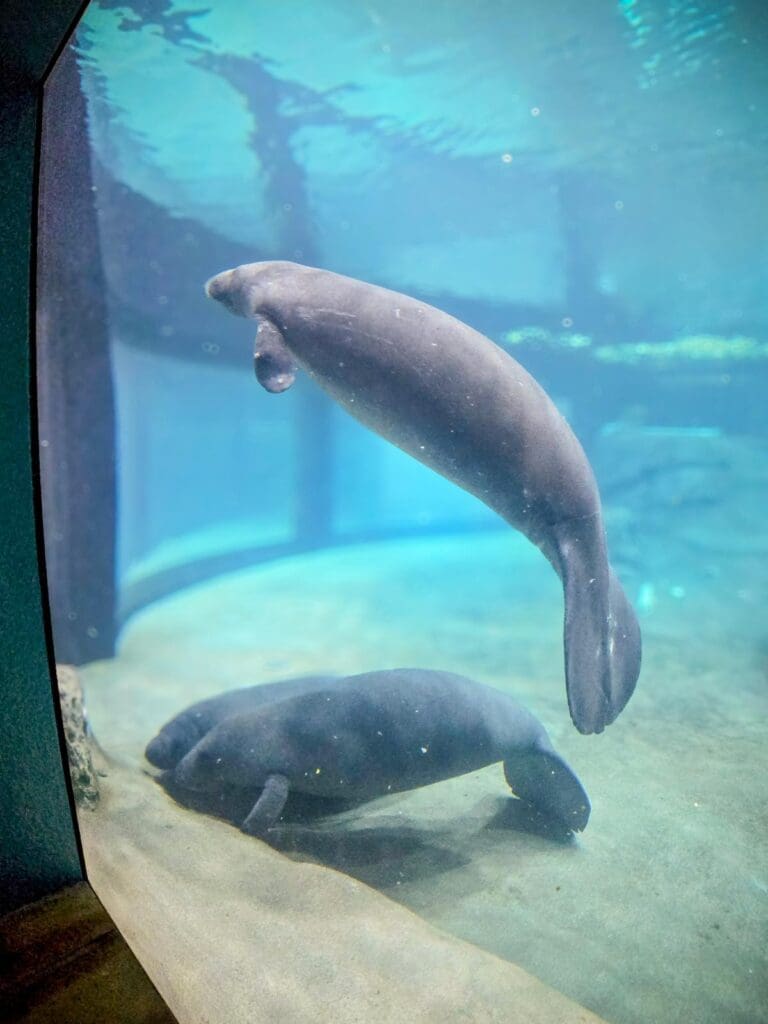
BRADENTON – The Bishop Museum of Science and Nature received three young female manatees for secondary rehabilitation.

The largest of the three, Crane, is recovering from cold stress syndrome, and was rescued from Crane’s Bayou near Longboat Key. At the time of rescue, she weighed 355 pounds and now weighs 450 pounds.

Mandalore is an orphaned calf rescued from Blue Springs in Orange City in February. When she was rescued, she weighed 180 pounds and is now 320 pounds.

Kyber is also an orphaned calf who suffered from prolonged exposure to cold water. Rescued from Crystal River, she weighed 200 pounds and now weighs 310 pounds.

Three young manatees rehabbing at Bishop Museum
The manatees are acclimating to their new surroundings. – Bishop Museum – Submitted

Critical Care is considered the first rehabilitation stage and focuses on medical needs and helping manatees recover from injury or illness. Adult manatees with the greatest knowledge of the wild return to the wild when medically cleared.

Naïve animals with limited understanding of the wild are moved to secondary care. The arrival of Crane, Mandalore and Kyber at the Parker Manatee Rehabilitation Habitat marks the next phase in their recovery process.

“It’s always a big day when we get new arrivals to the Parker Manatee Rehabilitation Habitat, with these three joining the list of over 50 manatees we have cared for and returned to the wild,” said Andrew Sandall, Chief Executive Officer at The Bishop. “It’s a privilege to play such a key role in the conservation of this majestic species and I’m so proud of our team here for their passion and commitment to making sure these manatees get the best care possible during their time with us.”

Visitors to The Bishop can observe these manatees as they continue rehabilitation. Informational displays near the viewing areas will provide details about their individual cases, the rehabilitation process and the physical requirements for release.

The Bishop Museum is located at 201 10th St. W. in Bradenton. Visit the Bishop Museum online at the museum website.

Manatee mortality down

Manatee mortality down

MANATEE COUNTY – The recently released manatee mortality report for 2023 from the Florida Fish and Wildlife Conservation Commission (FWC) shows that statewide deaths for manatees are well below the five-year annual average of 793.

The total number of deaths statewide last year was 556 and is the lowest since 2017 when 538 manatee deaths were recorded. The FWC’s estimate of the state’s manatee population in 2021-22 was between 8,350 and 11,730 manatees.

The leading cause of death last year was watercraft-related, according to the FWC report, which also noted that approximately 20% of the total statewide mortality last year was attributed to a significant red tide bloom in southwest Florida earlier in the year.

In Manatee County there were 19 total deaths recorded – four from watercraft, two perinatal, three natural and 10 not necropsied. The watercraft deaths occurred in the Braden River, Manatee River and Sarasota Bay.

“Population models identify both watercraft collisions and red tide blooms as one of the most significant threats to manatees long-term,” the FWC report stated. “In contrast with the Gulf coast, a high proportion (81%) of Atlantic coast carcasses was fully necropsied for the ongoing health investigation in the Unusual Mortality Event from starvation, but starvation-related mortality was very low (3% of Atlantic coast carcasses) in 2023,” according to FWC.

No mortalities were definitively attributed to Hurricane Idalia, but FWC staff and partners rescued 10 manatees across southwest Florida that had become entrapped after storm-related floodwaters receded.

Manatee Tips


• Obey posted signs for manatee slow-speed zones.

• Wear polarized sunglasses to see manatees in your path.

• If you observe a manatee mating herd – several manatees gathered as males vie to mate with a female – watch from at least 100 feet away. Coming any closer might disrupt the mating or endanger you; adult manatees typically weigh more than 1,000 pounds.

• Look, but don’t touch manatees. Keep your distance when boating, even if you are steering a canoe, kayak or paddleboard.

• Never feed or water manatees as they will become habituated to people, which could put them at risk of injury.

• Stow trash and line when underway. Marine debris that blows overboard can become ingested by or entangled around manatees.

• Report stranded or dead manatees to the Florida Fish and Wildlife Conservation Commission (FWC) Wildlife Alert hotline at 1-888-404-FWCC (3922).


Manatees could again be classified as endangered

Manatees could again be classified as endangered

MANATEE COUNTY – Following petitions from environmental groups, the U.S. Fish and Wildlife Service (FWS) says that reclassifying Florida manatees from a threatened to an endangered species may be justified.

In 2017, the status of manatees was changed from endangered to threatened following signs the species was recovering. Since then, seagrass destruction related to algae blooms on Florida’s east coast has spiked manatee mortality.

“Originally listed as endangered under the Endangered Species Act (ESA) in 1973, manatees have never truly recovered,” according to a prepared statement from the Center for Biological Diversity. “The FWS announced its final rule downlisting the West Indian manatee from endangered to threatened on March 30, 2017, despite hundreds of manatees still dying each year from boat strikes, habitat loss and other causes.”

The ESA defines a threatened species as “any species which is likely to become an endangered species within the foreseeable future throughout all or a significant portion of its range.”

An endangered species is “any species which is in danger of extinction throughout all or a significant portion of its range,” according to the act.

Due to the declining manatee population in recent years, two petitions were submitted to FWS by the Center for Biological Diversity, Harvard Animal Law & Policy Clinic, Miami Waterkeeper, Save the Manatee Club and Frank S. Gonzalez Garcia to increase protections for the mammals.

“Pollution-fueled algae blooms sparked an ongoing mortality event that has contributed to unprecedented Florida manatee mortality approaching 2,000 deaths in 2021 and 2022 combined,” according to the Center for Biological Diversity. “This two-year record represents more than 20% of all manatees in Florida. Manatee experts predict more malnourished and starving manatees with fewer births for years to come.”

Unchecked pollution, wastewater treatment discharges, leaking septic systems, fertilizer runoff and resulting algae blooms and seagrass destruction led to the unprecedented manatee mortality event in the Indian River area in 2021-22.

As of Oct. 6, 476 known manatees died in Florida waters so far this year, according to the Florida Fish and Wildlife Conservation Commission.

One petition requested the reclassification of the West Indian manatee, including the Antillean and Florida manatee subspecies, as endangered species under the ESA. Another petition requested the Puerto Rico population of the Antillean manatee be listed as endangered. Both subspecies are currently classified under the ESA as threatened.

FWS announced on Oct. 11 that reclassifying the West Indian manatee from threatened to endangered may be justified.

“The U.S. Fish and Wildlife Service has completed two 90-day findings on Endangered Species Act petitions to uplist the West Indian manatee and the Puerto Rican population of the Antillean manatee. Based on the Service’s review, both petitions present substantial scientific or commercial information indicating that the petitioned actions may be warranted,” according to a statement from the FWS.

“Today’s decision, known as a 90-day finding, is the first procedural step toward providing much greater protections for the imperiled species. The Fish and Wildlife Service must now conduct a thorough review of the best available science before determining whether to increase protections under the Endangered Species Act,” according to a statement from the Center for Biological Diversity.

A decision is due by Nov. 21.

The environmental groups lauded the decision to review the manatee’s status.

“This is the right call for manatees and everyone who cares about these charming creatures,” said Ragan Whitlock, a Florida-based attorney at the Center for Biological Diversity. “I applaud the Fish and Wildlife Service for taking the next step toward increased safeguards. Manatees need every ounce of protection they can get.”

“We are pleased that the Fish and Wildlife Service recognizes the need to reevaluate its ill-timed decision to downlist the Florida manatee,” said Patrick Rose, an aquatic biologist and executive director of Save the Manatee Club. “There can be no doubt that the service needs to immediately rebuild its manatee recovery program through increased staffing and funding. While the two remaining manatee recovery staff members are doing an incredible job in the face of unprecedented environmental assaults upon the manatees and their habitat, they must have more help right now to forestall this continuing emergency.”

The ESA allows citizens to petition the FWS to add species to the list of endangered and threatened wildlife, remove species from the list, and reclassify species on the list.

“The positive response is a welcome sign of hope for both subspecies of the West Indian manatee, the Antillean manatee and the Florida manatee, to once again thrive and inspire future generations,” said Frank S. González García, a Puerto Rican engineer.

“The service has a long history of working to save the manatee from extinction since it was one of the first species listed under the 1967 precursor to the Endangered Species Act,” FWS Acting Southeast Regional Director Mike Oetker said. “We are committed to ensuring we are getting the most updated scientific information during this status review to protect and recover the species.”

Manatee tips

• Obey posted signs for manatee slow-speed zones;

• Wear polarized sunglasses to see manatees in your path;

• If you observe a manatee mating herd – several manatees gathered as males vie to mate with a female – watch from at least 100 feet away. Coming any closer might disrupt the mating or endanger you; adult manatees typically weigh more than 1,000 pounds;

• Never feed or water manatees as they will become habituated to people, which could put them at risk of injury;

• Stow trash and line when underway. Marine debris that blows overboard can become ingested by or entangled around manatees;

• Report stranded or dead manatees to the Florida Fish and Wildlife Conservation Commission (FWC) Wildlife Alert hotline at 1-888-404-FWCC (3922).

Environmental groups push to return manatees to endangered status

Environmental groups push to return manatees to endangered status

Since the 2017 downlisting of manatees from endangered to threatened status – and with a record number of deaths of the marine mammals – a push is underway to seek restoration of the manatee’s endangered status and the protections that go along with it.

Last month, The Center for Biological Diversity, Harvard Animal Law & Policy Clinic, Miami Waterkeeper and Save the Manatee Club petitioned the U.S. Fish and Wildlife Service (FWS) to increase protections for West Indian manatees. The petition urges the wildlife service to reclassify the species from threatened to endangered under the federal Endangered Species Act (ESA).

“Since the service prematurely reduced protections in 2017, the species has declined dramatically,” according to a press release from The Center from Biological Diversity, a national non-profit conservation organization with a Florida office in St. Petersburg. “Pollution-fueled algae blooms sparked an ongoing mortality event that killed more than 1,110 Florida manatees in 2021 alone. This represents 19% of the Atlantic population and 13% of all manatees in Florida.”

As of October, 726 manatees have died in Florida so far this year. Officials estimate about 6,500 manatees live in waters of the southeastern U.S.

“West Indian manatees from Florida to the Caribbean are facing drastic threats from habitat loss, boat strikes, pollution, climate change and toxic algae blooms,” said Ben Rankin, a student attorney at the Harvard Animal Law & Policy Clinic. “The restoration of full Endangered Species Act protections is an essential first step in conserving this species everywhere it is found.”

Manatees had been protected as “endangered” since 1967 under the ESA. The 2017 reclassification came after the Pacific Legal Foundation, on behalf of Save Crystal River Inc., a recreational boating group, petitioned the FWS, saying the safety measures addressing the manatee’s endangered level of protection were bad for tourism and boating businesses.

Manatees are protected by the Florida Manatee Sanctuary Act, the federal Marine Mammal Protection Act and the ESA. They are listed as threatened under the ESA and designated as depleted under the Marine Mammal Protection Act.

It is illegal to feed, harass, harm, pursue, hunt, shoot, wound or kill manatees.

The West Indian manatee consists of two sub-species: the Florida manatee and the Antillean manatee. The average Florida manatee is about 10 feet long and weighs about 1,200 pounds. Florida manatees can live more than 65 years, however, among the manatees that reach adulthood, only about half are expected to survive into their early 20s, according to the Florida Fish and Wildlife Conservation Commission (FWC).

The pending petition is not the first call to restore the manatee’s endangered status. In June 2021, U.S. Rep. Vern Buchanan (R-Manatee) called on the FWS to upgrade the manatee from threatened to endangered under the ESA.

“Manatees are beloved, iconic mammals in Florida,” Buchanan said. “We should provide these gentle giants with the highest levels of federal protection.”

In Nov. 2021, the FWC and the FWS ad- dressed an unusual mortality event (UME) among manatees along Florida’s Atlantic coast.

“Researchers have attributed the UME to starvation due to the lack of forage in the Indian River Lagoon. Historically, the lagoon has provided essential habitat to manatees year-round, and during the colder winter months many manatees depend on warm water refuges in this area,” according to the FWC.

“Increasing protections for manatees with an endangered listing would provide immediate protection,” said Rachel Silverstein, executive director of Miami Waterkeeper. “With astounding losses of seagrasses around the state, we need to address water-quality issues to give the manatee a fighting chance to survive and thrive.”

FWS has 90 days to evaluate whether the petition to protect the manatee as endangered presents substantial information to indicate that the action may be warranted. If so, the agency must complete a thorough review of the species’ status within 12 months of receiving the petition.

Reel Time: Dangerous seagrass bill advances

Florida Senate Bill 198 (Sen. A. Rodriguez, R- Doral) would allow permits that will impact seagrass and allow for replacing them elsewhere in state waters. Why is that a problem?

I posed that question to Dave Tomasko, the executive director of the Sarasota Bay Estuary Program. Tomasko has more than 30 years of experience in water quality assessments and the development of science-based natural resource plans in the Gulf of Mexico and internationally. With a Ph.D. in biology from the University of South Florida, a Master of Science in marine biology from the Florida Institute of Technology, and a Bachelor of Science in biology from Old Dominion University, Tomasko is uniquely qualified to accurately assess these kinds of proposals.

Dangerous seagrass bill advances
Manatees feed on seagrass, which is theatened by state legislation in Tallahassee this month. – Rusty Chinnis | Sun

“The biggest issue is that the track record of transplanting seagrasses is poor,” Tomasko said. “Even if transplant areas gain some seagrass after planting, those that survive typically have lower densities than what they replaced. Typically, seagrass grows where it can, and for someone to grow new seagrass, something has to change – water quality must improve (very hard) or areas have to be made shallow enough to support seagrass (expensive) or wave attenuation devices have to be installed (also expensive and a nuisance to navigation). Many believe we can’t afford more losses, and so a system that makes it seem ‘acceptable’ for impacts because they can be ‘mitigated’ is not thought to be supportable by the facts or track record of such efforts. Seagrass restoration efforts in Florida have had a history of being both expensive and complex, with few success stories.”

The bill would make the destruction of seagrass permittable in Florida with mitigation banks. The bill might also open the door to allow healthy, undisturbed seagrass areas to be impacted by the construction of boat basins and navigation channels that the Florida Department of Environmental Protection (FDEP) has routinely denied for more than 30 years. There are many other mitigating factors. Considering the massive losses of seagrass in Tampa Bay and Sarasota Bay, as well as statewide, and the unprecedented death of manatees in the Indian River Lagoon, this bill seems almost laughable to this author. Besides holding the potential of being a virtual death sentence for manatees, advancing legislation like this is unwise. To advocate planting seagrass without fixing the underlying impaired water affecting seagrasses statewide seems absurd.

Dangerous seagrass bill advances
Seagrass in the Intracoastal Waterway/Sarasota Bay could be impacted by proposed state legislation. – Cindy Lane | Sun

Despite all these issues, coupled with the apprehensions of environmentalists, the bill was approved by the Environment and Natural Resources Committee by a vote of 3 to 2 on Jan. 18. A House companion bill, HB 349, filed by Rep. Sirois (R-Merritt Island), passed its first committee of reference on Dec. 6, 2021, and is now headed to the Agriculture and Natural Resources Subcommittee.

I had a firsthand experience recently that drove home the potential harm of legislation like this on a trip to the east coast when my friend and fellow conservationist Captain Rodney Smith, of Satellite, took me to a popular manatee viewing area at DeSoto Park in Satellite Beach. The sight of hundreds of manatees grouped together in a shallow canal was mesmerizing. When I expressed my delight at seeing so many manatees at one time, nearby environmental filmmaker Dylan Hansen informed me that just a few years ago there were twice as many manatees there. Suddenly the plight of these manatees came into sharp focus.

Citizens who care about water quality both as a quality of life issue and from an economic perspective must speak out. The best way to do that is to contact your state Senator and your state Representative and encourage them to vote “no” on these potentially disastrous bills. It might have been argued at one time that we need to strike a balance on issues like this, but that time has passed. We’ve kicked the can down the road until we’ve run out of road. Either we take the initiative or we suffer the consequences that inaction may bring.

Coast Lines logo - border

It’s Manatee Awareness Month

November is Manatee Awareness Month, a time to appreciate our large, lumbering state marine mammals and learn how to co-exist with them when we’re boating in their habitat.

In Manatee County, our awareness of manatees is frequently top of mind, and especially so since July, when our beloved Snooty drowned after his 69th birthday party when he swam through a broken access panel and became trapped in an underwater tunnel at the Parker Manatee Aquarium.

Just as tragic, four of the 17 wild manatees that died in Manatee County so far this year were killed by boats, no improvement from the same number in 2016, according to the Florida Fish and Wildlife Conservation Commission (FWC).

Statewide, 450 manatees have died so far this year, 83 of them killed by boats. That’s about 7 percent of the 6,620 manatees spotted in the most recent aerial survey over Florida this year.

We can’t fix red tide. We can’t fix cold water. We can’t fix lots of things that kill manatees. But we can fix this. Here’s how:

  • Obey posted signs for manatee slow-speed zones.
  • Wear polarized sunglasses to see manatees in your path.
  • If you observe a manatee mating herd – several manatees gathered as males vie to mate with a female – watch from at least 100 feet away. Coming any closer might disrupt the mating or endanger you; adult manatees typically weigh more than 1,000 pounds.
  • Never feed or water manatees as they will become habituated to people, which could put them at risk of injury.
  • Stow trash and line when underway. Marine debris that blows overboard can become ingested by or entangled around manatees.
  • Report stranded or dead manatees, or boaters speeding in a manatee zone, to the FWC at 1-888-404-FWCC (3922).

Coast Lines logo - border

Earth Day cloudy, with silver lining

A few storm clouds are gathering over Earth Day this year, but there’s a silver lining.

Manatees

The U.S. Fish and Wildlife Service downlisted manatees under the U.S. Endangered Species Act from endangered to threatened status in March.

Florida manatees should have been exempted from this downlisting, which was based on studies of manatees in Puerto Rico, Mexico, Central America, northern South America and the Greater and Lesser Antilles.

Florida survey counts show increasing population numbers, but ignore the inequitable comparison of single day/single aircraft counts in years past with multi-day/multi-aircraft counts in recent years, which likely resulted in counting animals moreEarth Day than once, both by the same and different spotters.

The agency also did not consider the anticipated loss of artificial winter warm water habitat – primarily power plant closures – on which more than 60 percent of the Florida manatee population depends, nor did it consider the increasing popularity of recreational boating in Florida that further endangers the animals, few of which escape propeller cuts in their lifetimes.

EPA cuts

The Environmental Protection Agency will have less ability to protect the environment with budget cuts announced in March that will reduce staff and cut funding for programs including water and air quality programs, environmental education programs, environmental law enforcement and five programs affecting Florida and the Gulf of Mexico, “returning the responsibility for funding local environmental efforts and programs to state and local entities,” according to a March 21 EPA memo.

BP oil spill

April 20 is the seventh anniversary of the Deepwater Horizon oil spill, which killed 11 people and spilled 200 million gallons of oil over three months into the Gulf of Mexico from Florida to Texas.

The 1.8 million gallons of chemical dispersant used to break up the oil into microscopic particles did not remove the oil from the Gulf, but made it invisible, and is thought by some scientists to be causing as much damage to marine life reproduction and health as the oil itself.

But one light on the horizon is a program by the National Oceanic and Atmospheric Administration (NOAA) and the National Fish and Wildlife Foundation, funded with restoration money provided by BP.

Seven Louisiana longline fishermen were chosen from about half of the 45 eligible vessel owners in the Gulf, some from Florida, who applied for a pilot project to voluntarily use alternative gear for a four-month pilot period ending June 30. If the gear works, a voluntary ban on longline fishing with traditional gear will be implemented six months of each year for the next 5-10 years to allow affected fish species to recover from the disaster.

A silver lining

Local folks have taken to heart the idea of Earth Day founder David Brower in 1970, “Think globally, act locally,” by planting trees and cleaning up Manatee County.

Keep Manatee Beautiful (KMB) is keeping the torch lit with the Great American Cleanup from 9 a.m. to noon on Earth Day, Saturday, April 22, in several locations, including Anna Maria City Hall, 10005 Gulf Drive, Kingfish Boat Ramp on State Road 64 West at the drawbridge in Holmes Beach, and the FISH Preserve, 11601 Cortez Road W. Adopt-A-Highway, Road and Shore groups will be doing cleanups at their adopted sites, including Palma Sola Causeway and Anna Maria Island beaches.

Volunteers on the Island, in Cortez and on the causeway will be thanked with an Earth Day Party at Manatee Public Beach, 4000 Gulf Drive, Holmes Beach, compliments of the Anna Maria Island Beach Café.

KMB also will host National Arbor Day ceremonies on Friday, April 28, when it will plant trees countywide.

In Pope Francis’ encyclical, “Laudato Si, On Care for Our Common Home,” he writes that in damaging the environment, we damage each other and future generations, and invites everyone to make a difference in small ways such as these.

To volunteer, visit https://manateebeautiful.com and www.arborday.org.