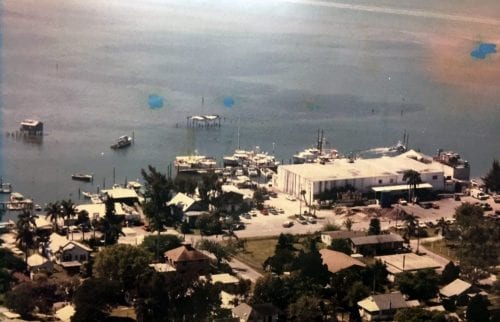
Tag: Cortez

John Stevely

Sponge talk absorbing

CORTEZ – John Stevely holds up a two-toned, blue kitchen pot scrubber.

“This is not a sponge,” he declares.

The manmade commercial product is not as absorbent, durable or sustainable as the real thing, the retired Florida Sea Grant marine biologist told listeners at the Florida Maritime Museum on Wednesday.

Stevely, a board member of FISH (the Florida Institute for Saltwater Heritage), will give short Dock Talks on marine-related subjects at the Cortez Commercial Fishing Festival the weekend of Feb. 16-17.

His talk on sponges was the highlight of the museum’s recent display of sponges from Tarpon Springs, the epicenter of sponge diving in Florida.

sponges
The Florida Maritime Museum displays fruits of the Tarpon Springs sponge diving industry. – Cindy Lane | Sun

The reason natural sponges work better than artificial ones is that they are built to force water into and out of themselves – that’s how they feed, Stevely said. A sponge could fill a residential swimming pool in a day with the amount of water it pumps, all to get about one ounce of nourishment.

Natural sponges can be broken off without killing the whole animal, much like stone crabs can survive having a leg removed.

It doesn’t get more renewable than that, he said.

Sponges are the skeletons of animals, Stevely said, and also are a place where other animals live.

Gold-brown when dead, living sponges have vivid colors, including purple, orange and yellow, and give the water its color variations, he said.

Natural sponges are the preferred tool for window washers, horse groomers and ceramics makers, who use them to shape the wet clay, he said, noting that they also are better bath sponges than anything else.

Before World War II, sponges were the most productive fishery in Florida, Stevely said, with nearly 600,000 pounds of sponges produced in 1906 (think about how light a sponge is to picture that, he said).

But a sponge disease devastated the crop in Florida in 1938, followed by a red tide in 1947.

Then, synthetic sponges began taking over.

In the 1990s, blue-green algae killed many Florida sponges. Today, both blue-green algae and red tide – both harmful algal blooms (HABs) – continue to threaten the sponge population, even more than hurricanes, he said.

Sponges take years to rebound from these events, he said, naming water quality as their primary threat.

Few sponges live in local waters, but they flourish in west central Florida waters around Tarpon Springs and in southern waters off the Florida Keys. Sponge harvesting is now prohibited in the Keys.

Related coverage

Solve the Cortez history mystery

Mullet

Mullet off to slow start

CORTEZ – It’s after Thanksgiving and a cold front has passed through, but what should be mullet season hasn’t really started yet, thanks to red tide, commercial fishermen say.

Mullet are not schooling around the docks or jumping in the Cortez Kitchen off the fishing village like they should be this time of year, said Karen Bell, of A.P. Bell Fish Co.

“We still seem to have concentrations of red tide that are killing fish here,” she said.

Until local mullet begin to spawn, Bell is buying mullet from north Florida, Alabama and North Carolina, she said, recalling that her father used to say that mullet stay in the Manatee River to avoid red tide.

“But when they come out and hit the red tide, we don’t know what will happen,” she said.

“It’s too soon to tell if the red tide has impacted adults, because they have to leave the estuaries to get out for spawning,” said Angela Collins, extension agent for the IFAS Florida Sea Grant Marine Extension Program in Palmetto. Red tide could affect where they swim, and could also impact their larvae, she said.

“I hope they make it out past the red tide before they spawn,” said Charlie Hunsicker, director of the Manatee County Parks and Natural Resources Department, noting that mullet were taking refuge at Robinson and Perico Preserves.

At Robinson on Monday, red tide levels were high, and dead mullet floated along the shoreline.

At Cortez Bait and Seafood, fishermen brought a few mullet in last week, but it was too windy for some boats to be out, Kim McVey said, adding, “I hope red tide won’t affect them.”

Mullet are few and far between at the moment, said Bob Slicker, of the Swordfish Grill and Tiki Bar in Cortez, adding, “But I’m optimistic.”

Mullet fishing tournament Winner

Jeffries wins mullet tournament

CORTEZ – Cortez resident Kenny Jeffries won the Fifth Annual Flippin’ Mullet Sports Bar Mullet Fishing Tournament at the Swordfish Grill in Cortez on Sunday, Nov. 18.

Jeffries was the overall tournament winner with a combined weight of 21.10 pounds for his five largest mullets. For this, he won a $100 Swordfish Grill gift card and $120 cash. He also won the largest fish award for his 4.88-pound mullet, which earned him another $100 Swordfish Grill gift card for catching the biggest fish.

“I’m ecstatic,” said Jeffries, a commercial fisherman from Cortez.

Jeffries fished with his friend, Brandon Ison.

In anticipation of mullet season soon kicking into high gear, Jeffries said, “We’re for the roe to grow in the fish so we can go out and get them.”

“Big Dan” Kennison finished second with a combined weight of 16.53 pounds of mullet. For this, he won a $50 gift card and a shirt.

The smallest fish of the day was 2.61 pounds, caught by Preston Rowden whose combined catch was 15.21 pounds. He won a hat and $20.

“It feels awesome that I’m even here, but next year I’m gonna take it all,” Rowden said.

The mullet were caught with cast nets.

The tournament was organized by Swordfish Grill manager Greg Koeper and bar manager Brandon Rolland.

Bobby Martin won the raffle prize that was a cooler filled with liquor bottles.

Some of the tournament proceeds will be donated to the local Fishing For Freedom chapter.

When addressing the crowd, General Manager Bob Slicker described mullet as a “super fish” because of its variety of uses. Patrons were treated to free samples of fried mullet, fried mullet roe and fried mullet gizzards during the awards ceremony.

After the contest, Slicker expounded on the virtues of mullet.

“It’s an exciting fish. People think mullet are bottom-feeders, but they aren’t, and they have gizzards, so they process their food much like a chicken does, which is unique for a fish. They sell the gizzards overseas and people love them,” he said. “Their meat is high in protein and they’re also looking at its medicinal uses.

“Mullet roe is selling in Italy for $110 to $180 an ounce. They smoke it and do a slight shaving at high-end restaurants. Mullet roe is so high in protein that you can’t eat a lot of it, but it’s a great, strong, smoky flavor, and it just takes a little bit. Cortezian mullet is known around the world as being the best.”

He said Cortez fisherman make $7 to $13 for a pound roe.

“We use the male fish as bait. We use the whole mullet and also sell it as chum,” Slicker added.

“It’s too early to tell” what impact the red tide might have on mullet season, he said. “It doesn’t look like there’s as many fish out there, but they’re as big as they’ve ever been. The ones that got trapped in the red tide died, but a lot of them moved. They’ve spotted the mullet in different spots where the red tide hasn’t been,” Slicker said.

Toy drive

The Swordfish Grill is currently doing a toy drive to assist those in the panhandle city of Port St. Joe who were impacted by Hurricane Michael.

“We brought up a bunch of donated items up there and found out they didn’t have Halloween candy so we got together and handed out 450 Halloween bags. When it comes to Christmas, we thought we’d continue the toy drive we started at the Stone Crab Festival. All month, if people bring toys here, we’ll get them up there,” he said.

celebrating a late friend Fisher Life Celebration

Celebrating a late friend’s love of Florida

CORTEZ – Vermont resident David Fisher dreamed of one day retiring and spending his winters with his wife Sue at their second home in west Bradenton. Those dreams were cut short on Aug. 17, when cancer claimed Dave’s life at the age of 59.

On Friday, Nov. 9, some of Dave’s Florida friends and loved ones will gather in his honor at the Swordfish Grill in Cortez. The befitting drink specials will be shots of Patron tequila and margaritas made with two shots of tequila and no salt – a drink known in North Hero, Vermont as a ‘David Fisher.’ Ted Stevens and the Doo-Shots will provide the live music.

Joining Sue in celebrating Dave’s love of Florida will be his aunt and uncle Ardy and Andy Cochran and his uncle Wayne Clark – fellow-Vermont natives who now live in west Bradenton. Longtime family friends and Michigan snowbirds Jackie and Randy Hansen will also be on hand.

Celebrating life

Dave and Sue were married for 36 years and have two adult daughters, Sarah and Dianna. The couple began vacationing here in the early 2000s after Dave’s mom, Marsha, bought a condominium in the Cortez Villas that would later become theirs.

While visiting three or four times a year, the couple would often start their day with friends and family members for Bloody Marys at the Bradenton Elks Lodge. This tied into their group motto: “You can’t drink all day if you don’t start in the morning.”

They’d later enjoy lunch or dinner, more drinks and maybe some live music at their favorite Cortez and Anna Maria Island establishments.

“He loved his Florida friends and family. It’s going to be totally different without him, but we will laugh and cry together as we remember him and the fun he had. His contagious laugh could be heard across the room and his smile was as bright as the Florida sun,” Sue said.

Dave spent most of his adult life working as a sales rep and regional sales manager for Burlington Drug and he brought his work to Florida with him, interacting with clients and sales reps from afar while vacationing. When Burlington Drug merged with the South Carolina-based J.M. Smith Drug Company in 2016, Dave continued as a regional sales manager.

“He worked so hard back home and he was able to relax more in Florida,” Sue said.

In his downtime, Dave loved to read. He was also an accomplished drone pilot and he brought some of his drones to Florida. He also loved to ride the Segway he’d ship down from Vermont.

Dave and Sue’s last trip to Florida was in January. At the time, Dave suspected something was wrong with his health and when they returned home their worst fears were confirmed.

In early August, Swordfish Grill General Manager Bob Slicker and a friend from Sarasota visited Dave and Sue in Vermont. That week, Dave enjoyed a lovely boat ride on Lake Champlain and despite his failing health he also drove through Vermont’s winding mountain roads for lunch and brewery visits in Stowe.

During Slicker’s last night in North Hero, Dave flew his drone for the last time and captured some beautiful aerial photos of the sunset. He passed away the following week.

Manatee County seal

County Commission candidates discuss campaign issues

MANATEE COUNTY – The winner of the District 6, at-large County Commission race between incumbent Carol Whitmore and challenger Candace Luther will help represent Anna Maria Island and Cortez at the county level.

Manatee County Whitmore
Whitmore

How should County Commission-controlled Tourist Development Council funds be used on Anna Maria Island in terms of projects versus promotion?

Luther: I would focus on projects. Make things better for visitors and residents by making improvements that didn’t have funding previously. Give Visit Florida something to promote.

Whitmore: It’s very strict on how those funds can be spent. We’re still trying to open it up for law enforcement, lifeguards and other things that make life better for Island residents. We need to push for the state not to interfere with our city and county home rule.

What has/can the County Commission do to benefit Island and Cortez residents and businesses?

Luther: Impose a moratorium on phosphate mining, the use of fertilizers containing phosphate for non-farming uses and the use of Roundup and similar glyphosate weed killers. Stop overdeveloping and adding to the traffic and sewage problems we already have. Get the bike trails built so people have alternative transportation.

Whitmore: The red tide cleanup. I worked with Anna Maria Mayor Dan Murphy and pushed for $750,000 in state funding and up to $1.5 million in county funding for the pier replacement. I worked with all three Island mayors to acquire $1 million in surplus beach concession funds and worked with The Center on its $100,000 request for concession funds. We have not raised the millage rate since 2009.

Manatee County Luther
Luther

What has/can the county do to assist the Island’s city governments?

Luther Create an Environmental Science Department to assess all things environmental – whether it be building, infrastructure, runoff drainage and sewers, roadways, chemical use, disposal methods, business operations and the transport of products.

Whitmore: Listen and stay involved. I routinely copy the Island cities’ elected officials on upcoming agenda items and anything related to the Island, so they’re informed of issues that affect them.

What percentage of your campaign contributions have come from the development and real estate communities?

Luther: Zero, not a single dollar. I have done most of this by myself without funding. That proves my dedication and that I am doing this because I truly care about my county and want to make it better.

Whitmore: My supporters are mainly the farming community, medical community and family businesses. Last year I had one fundraiser by the so-called developers that represent thousands of jobs and I have not had one since. I don’t accept contributions from Carlos Beruff or Mosaic, as they are so controversial.

What has the County Commission done to protect the county’s environment and natural resources and what more needs to be done in the next four years?

Luther: Stop phosphate mining in the watersheds of Lake Manatee, the Myakka River and the Peace River. Lake Manatee tested positive for cyanobacteria over a year ago, yet they continue to pollute with weed killer all around the county and residents were never notified of this bacteria in the water supply to my knowledge.

Whitmore: With the help of Swiftmud and other state agencies, the county has been restoring properties along the bays, lakes, rivers and natural shorelines. Manatee County was awarded as the first platinum green government in Florida last month. Manatee County has had a ban on fertilizer for five to seven years now, seagrasses are their healthiest since the 1950s, and we require developers to treat their run-off and hold 150 percent before it hits the bays.

Why should Anna Maria Island and Cortez voters vote for you instead of your opponent?

Luther: I have been out assessing the red tide situation and collecting samples trying to get something done to clean up this mess. Once I get the test results, I can identify the sources and start working on solutions. As an elected official, I should be able to finally get something done. A lot of citizens feel they have been ignored and have not had a voice. That is why I am running for the at-large seat, so I can help anyone in the county. It is time our government starts working for the people again.

Whitmore: My opponent does not know the Island’s politics, elected officials and what’s important to Island residents. My opponent does not know what it’s like to live in a tourism community and the toll it takes on residents. Many years ago, the county would not even visit the Island cites. That changed due to former commissioner John Chappie and myself.

Cortez flea 1024 rope

Old salts enjoy the Cortez Nautical Flea Market

From rigging to radios, all things nautical were on sale at the 21st Annual Cortez Nautical Flea Market at the Florida Maritime Museum on Saturday. Live music by local acts, including one who played for 15 years with Lynyrd Skynyrd (on his turntable at home) entertained the crowds, shopping for dive vests, fishing poles, lures, antique lanterns and vintage anchors.

Bob Hageman was on hand with his fishing poles. - Cindy Lane | Sun

Bob Hageman was on hand with his fishing poles. - Cindy Lane | Sun

Everything from rope to marine radios was for sale or trade at the 21st Annual Cortez Nautical Flea Market at the Florida Maritime Museum on Saturday. - Cindy Lane | Sun

Everything from rope to marine radios was for sale or trade at the 21st Annual Cortez Nautical Flea Market at the Florida Maritime Museum on Saturday. - Cindy Lane | Sun

Handmade cigar box guitars, both acoustic and electric, were a popular item. - Cindy Lane | Sun

Handmade cigar box guitars, both acoustic and electric, were a popular item. - Cindy Lane | Sun

A sailboat sale drew attention at the market. - Cindy Lane | Sun

A sailboat sale drew attention at the market. - Cindy Lane | Sun


Hurricane relief drive taking place in Cortez

CORTEZ – The Swordfish Grill, the Cortez Bait & Seafood Company, The Blessing Bags Project and the Service Industry Relief Festivities (SIRF) organization are teaming up to provide supplies to Floridians impacted by Hurricane Michael.

The relief efforts are set to begin at 9 a.m. on Tuesday, Oct. 16, with two semi-trailers stationed in the plaza parking lot near the Cortez Fish Market (12110 Cortez Road W.) and Cortez Post Office.

The goal is to fill both trailers with donated backpacks filled with donated toys, baby supplies (diapers, baby wipes, etc.), personal hygiene products, first aid supplies, sunscreen, bug spray and other comfort items. Cash donations will also be accepted.

As he did last year after Hurricane Harvey hit Texas, Swordfish Grill General Manager Bob Slicker is helping spearhead the local relief efforts.

“I was sitting there this morning sitting by myself, watching the news and crying and I thought I needed to do something,” Slicker said Monday morning.

Applying lessons learned last year, Slicker said the focus this year is on comfort items that are easier to stage, transport and distribute than the bulkier food, water and clothing that were among the many items collected last year.

The Bradenton/Sarasota-based Blessing Bags Project has a great deal of experience collecting, filling and distributing backpacks to those in need locally, and one Monday afternoon Director Betsy Plante told Slicker 300 backpacks had already been donated to the hurricane relief efforts, but more are needed.

The donated backpacks and supplies will be delivered to Port St. Joe High School in Port St. Joe, where resident Jay Rish is helping to coordinate the distribution efforts. Rish is a friend of Robert DeMino, territory manager for U.S. Foods, the company that supplies the Swordfish Grill and several other local restaurants.

DeMino said Rish is a third-generation Port St. Joe resident and a prominent realtor and developer in the area. Port St. Joe is approximately 12 miles southeast of Mexico Beach, one of the areas hardest hit by Hurricane Michael.

According to Slicker, Rish said there’s already plenty of food and water making its way to the area and the comfort items will be greatly appreciated.

“What we are collecting are the best possible things for now,” Slicker said.

Slicker expects it will take at least a couple of days, maybe a week, to fill the trailers provided by Cortez businessman John Banyas.

“We’ll do it as long as we need to,” Slicker said.

“If you would like to make a cash donation, we will have our good friend Simon Lord purchase supplies for us and get those supplies up there also,” Slicker added.

“I was sitting there this morning sitting by myself, watching the news and crying and I thought I needed to do something.” – Bob Slicker, Swordfish Grill General Manager

Financial donations will be processed through the recently-created, SIRF-affiliated 501(c)(3) non-profit Florida Restaurant Employee Red Tide Relief Fund. The fund was established to provide relief to Cortez and Anna Maria Island restaurant employees and others impacted in future years by red tide outbreaks, hurricanes and the annual slow season.

On Monday afternoon, SIRF set up a wish list at Amazon.com that allows folks to order relief supplies to be delivered to the Swordfish Grill and then loaded onto a trailer headed for Port St. Joe. Visit SIRF online at their recently-launched website.

Slicker said the relief efforts will continue during the 7th Annual Cortez Stone Crab & Music Festival on Saturday, Nov. 10 and Sunday, Nov. 11.

“It’s almost November and the holidays are approaching. Some of those families will not be able to buy toys for their children. Toys probably aren’t on anyone’s priority list, but that’s going to be part of our focus working with The Blessing Bags Project,” Slicker said. “If you come to the stone crab festival, bring a toy to get in. We will make the festival a hurricane relief toy drive.”

Related coverage

Hurricane Michael could make red tide better – or worse

Tourism winter cure campaign set to launch

Reel Time: Reflections

While fishing might seem challenging to the average angler, there are definitely some bright spots in what has been a perplexing season. Seasoned guides like Captains Scott and Justin Moore and Captain Rick Grassett have been catching fish consistently but having to move with the whims of the red tide.

The only areas consistently free of the red tide are regions where low salinity inhibits the formation. Late last week, clear water made an appearance on the beaches of north Longboat Key only to disappear the next morning.  While there are some encouraging signs, everything is still in flux.

This past weekend I participated in the Sarasota Bay Watch Ninth Annual Monofilament Cleanup. I launched at the north end of Longboat with Michael Dolan of Cortez, and Nancy Greenwood and Casey Lamb from the Longbeach Village. We spent the morning removing discarded fishing line, tackle, lures, trash and flotsam from a small rookery at the mouth of Bishop’s Bayou before moving to the Bridge Street Fishing Pier on Bradenton Beach and then Kitchen Key near Cortez.

Reel Time mono team
Nancy Greenhouse, Michael Dolan and Casey Lamb offload the fishing line, tackle and recyclable items they removed from area bird rookeries during Sarasota Bay Watch’s Ninth Annual Monofilament Cleanup this past weekend. – Rusty Chinnis | Sun

After cleaning the bridge fenders at Longboat Pass, we decided to head south along the beach to assess the conditions. We finished in the cove bordering the Longboat Key Club in New Pass. At our last stop, we were greeted by three manatees. Considering what these gentle creatures have been through with the red tide they were a welcome sight! We had lunch at the Sarasota Sailing Squadron with other volunteers before heading back north in the bay.

The ride was a mixed bag of excitement and disappointment. While there were areas that looked healthy with bait and jumping mullet we also crossed water that looked bad, smelled bad and even had us coughing for a brief period.

One thing I do know from experience is that this episode will end, and clean water and life will return to the Gulf and bays.

Having said that, I can’t stress enough the importance of learning the lesson this experience is posing. While red tide is natural, the frequency of occurrence and intensity is not. Man-made nutrients are worsening the effects. It’s critical we don’t forget and elect politicians that vote for common sense policies that protect our waters.

Recently you may have noticed full-page ads in local newspapers paid for by Big Sugar. In the ads, they are dodging responsibility for the nutrient loads and releases of water that are spawning green algae blooms and fueling red tide. While it’s true that they may have been getting more of the blame than they deserve they definitely are part of the problem.

They lobby to have water levels kept artificially high during the dry season to assure they have water to accommodate their agricultural lands. This becomes a problem during wet seasons when excess water cannot be stored and must be sent east and west into the Indian River Lagoon and Pine Island Sound.

Expect more of the same and worse if we don’t address the root causes of the problem. They are understood, and a draft plan is already available that would help alleviate much of the problem. The only thing missing is the political will. That’s where we come in.  Like the old saw says, we’re either part of the solution or part of the problem.

More Reel Time

Reel Time: Sarasota Bay Watch active during red tide

Reel Time on the road: Fishing the South Georgia coast

Reel Time: On the road to St. Marys and Cumberland Island, Ga.

Reel Time: The good, the bad and the ugly

A swordfishing pioneer remembered

CORTEZ – Legendary swordfish and tuna boat captain Warren Cannon passed away recently after a body surfing accident in St. Augustine.

On Saturday, Sept. 29, Cannon’s ashes were scattered in the water off Longboat Pass and his adventurous life was then celebrated at the Swordfish Grill in Cortez.

Cannon, 65, was body surfing at Vilano Beach on Sunday, Sept. 9, when his fatal accident occurred.

“On that beach there’s quite a deep drop. We think what happened was he caught a wave wrong and hit his head on the sand where it rose steeply,” his daughter Chana Cannon said on Sunday.

“He fractured his C5, C4 and C3 vertebrae. The neurosurgeon said he was probably instantly paralyzed and the cause of death was blunt force trauma and drowning. The following day, at 5:25 p.m., he was declared brain dead. He was kept on life support for a few days because he was an organ donor, and he successfully donated his kidneys and liver.”

In addition to Chana, Warren is survived by his partner of 37 years, Katarina Cannon, their daughters, Charlotte Huntley and Johanna Cannon, and their son, Jonathan Cannon. Chana is an attorney in St. Petersburg. Charlotte is a commercial crabber in Cortez. Jon is a firefighter and fishing guide and lives in Palmetto and Hanna owns an Aveda Salon and lives in Parrish.

On Saturday morning, about 50 family members and friends boarded the Eddy Lee Z, captained by Lance Plowman, and headed out to Longboat Pass joined by about 20 other boats.

“We used to live on Anna Maria, and my dad would take trips out into the Gulf out of Cortez,” Chana said. “Mostly he fished out of Gloucester (Massachusetts) and Hawaii, but his roots were in Cortez. That’s why we did the service there. He told Jon he wanted his ashes placed in an outgoing tide. People flew in from Hawaii and Gloucester to honor him. We had a procession of boats that was so beautiful. People wore bright colors, and we threw hundreds of orchids into the water after his ashes, which were in a salt urn. He wouldn’t have wanted a serious, solemn farewell.”

A life at sea

“My dad started when he was about 17 in Cortez with Walter Bell, who gave him his first break running the Rachel Belle. He met my mother when he was 29. They started their swordfish empire, and he quickly became, arguably, the best swordfish captain ever,” Chana said.

“When I was seven, we moved out to Hawaii. He fished there for years and built up the longlining industry there. In Gloucester and Honolulu, he was considered ‘the guy’ when it came to swordfishing. He was a pioneer in the industry. Longlining did not exist when he started. Using hydraulics and gears, he and a few other guys known as highliners created this industry.

“My dad thought it was the last frontier for men in America, and he likened it to the wild west. This was before the Magnuson-Stevens Act (adopted in 1976), so there were no rules and regulations at the time, even in international waters.

“When I was in college, I started writing a book about my dad’s life. Because swordfish and tuna are migratory, my dad likened them to buffalo herds, so the title of my book is ‘The Last Buffalo Hunter.’ I never finished it, because his story wasn’t done, but I intend to now.

“Sebastian Junger, the author of ‘The Perfect Storm,’ used my dad for a lot of the technical information in his book because Billy Tyne, the captain of the Andrea Gail, was my dad’s best friend and first-mate for many years,” Chana recalled. “We were living in Hawaii, and my parents went to the movie premier and met the actors and Sebastian.

“In the first 63 years of his life, my dad was focused on being the best captain he could be, and he wasn’t around much. Fishermen make a hard choice. It doesn’t come without consequences, and there is a void left in their absences. He was a man’s man, and that was hard to turn off when he came home – going from being a captain in life threatening conditions to coming home and playing dad,” she said.

“When my dad retired, he started to let his guard down, and he became a totally different person. In the last six months, he was the dad I’d been waiting for my whole life. He was the first person at the hospital when Jon’s second son was born, and he walked me down the aisle in March. He finally figured out how to live on land. I thought I’d have 20 more years with my dad, and this was a complete shock.”

Son of a sailor

“I was not only his son, but I was one of his employees in a high-risk environment working 20-hour days. I had a different relationship with him than my sisters did,” Jon said. “Him and I were thick as thieves. We had a common bond and that was a love of the water he instilled in me. He had me on the boat before I could walk.”

Jon was 12 when he made his first swordfishing trip.

“I had been offshore several times but going out for multiple days was one of the most amazing things I ever experienced,” he said. “And it just so happened that we caught the second biggest swordfish he ever caught. It was 650-700 pounds.

“He didn’t just target the swordfish. At certain times he would switch to tuna and swordfish would become the by-catch. When my dad first started fishing, they threw yellow tuna and big-eyed tuna overboard because there was no market for them. Now they’re $9-$10 a pound, and that’s what you see in every sushi bar.

“Fishing is a feast-or-famine lifestyle, and that’s what drove him – being the tip of the spear, being the best. This led to some struggles at home. Mom realized she was going to come second because the boat had to come first. And as the brother of three girls, the burden was placed on me at an early age to be the man of the house.”

Jon later spent his summers fishing with his dad, and after high school he went full-time.

“I thought I wanted to be a longline fisherman and take that business over, but after doing it from when I was 18 until I was 23 I realized that one day I wanted to have a family of my own – and I’d seen the stress and strain that put on our family. Some years he would be gone 300 days a year. I realized it wasn’t for me. I was always going to fish, but I wanted to be present in my future family’s life.”

Regarding his father’s now-famous first mate, Jon said, “My dad was in his late 20s and he brought Billy on when he was 19. He fished with him for about 10 years and showed him everything he knew. Then Billy got a spot on the Andrea Gail up in Gloucester, and that tragedy took the wind out of my dad’s sails for a while.”

Regarding Warren’s transition to retirement, Jon said, “You can’t go that hard in that industry for so many years and then just stop because that’s all you know. He closed on some property in north Florida a couple days before his accident and he was happy about that. He wanted to have a nice plot of land and be in nature.”

Jon also saw his dad’s softer side recently.

“My wife, Dana, was giving our two-year old son a bath, and I was giving our newborn a bath in the sink at the same time. He was right over my shoulder the whole time and he said, ‘I missed so much of this.’ His eyes welled up, but he was trying not to show it. He walked away for a minute and then came back. My wife saw it too. It was a really cool moment.”

The Cannon family supports the red tide research taking place at Mote Marine Laboratory in Sarasota and encourages others to make memorial donations in Warren Cannon’s honor. Donations can be made online or by mail via check that includes Warren’s name in the memo section.

This memorial display at the Swordfish Grill contained pictures of Warren Cannon, his family, real swordfish bills and an old family trunk for people to place memory cards in. - Cannon family | Submitted

This memorial display at the Swordfish Grill contained pictures of Warren Cannon, his family, real swordfish bills and an old family trunk for people to place memory cards in. - Cannon family | Submitted

Below, Warren Cannon’s ashes and many of his friends and loved ones rode out into the Gulf of Mexico aboard the Eddy Lee Z, captained by Lance Plowman. - Cannon family | Submitted

Below, Warren Cannon’s ashes and many of his friends and loved ones rode out into the Gulf of Mexico aboard the Eddy Lee Z, captained by Lance Plowman. - Cannon family | Submitted

The Cannon family in 1990, soon after they moved to Hawaii. - Cannon family | Submitted

The Cannon family in 1990, soon after they moved to Hawaii. - Cannon family | Submitted

Warren Cannon and his son Jon caught this large swordfish in the southeast Atlantic Ocean when fishing out of St. Augustine in the mid-2000s. - Cannon family | Submitted

Warren Cannon and his son Jon caught this large swordfish in the southeast Atlantic Ocean when fishing out of St. Augustine in the mid-2000s. - Cannon family | Submitted

The first swordfish boat Warren Cannon owned was the Linnea C and its home port was Anna Maria. - Cannon family | Submitted

The first swordfish boat Warren Cannon owned was the Linnea C and its home port was Anna Maria. - Cannon family | Submitted

In March, Warren Cannon walked his daughter, Chana, down the aisle during her Longboat Key wedding. - Cannon family | Submitted


In March, Warren Cannon walked his daughter, Chana, down the aisle during her Longboat Key wedding. - Cannon family | Submitted

Red Tide Banyas Request

Red tide fishing request denied

CORTEZ – Commercial fisherman and Cortez businessman John Banyas came up short in his attempt to get the state-issued special activity license that he sought to harvest mullet and thread fin herring threatened by red tide.

On Wednesday, Sept. 26, Banyas went to Tallahassee to make his appeal to the Florida Fish and Wildlife Conservation Commission (FWC) during their commission meeting.

“I spoke and they listened to me. They understood exactly where I was coming from and what I saying. The commission thought it was a good idea, and they referred me to their legal counsel after the meeting,” Banyas said after returning home.

“I sat down and talked with them, and we tried to find a way to make it happen. When they reviewed the paperwork and tried to find a legal way to do it, they really couldn’t find one. They said we’d have to change the Florida Constitution and the amendment for the net ban (enacted in the 1990s). The three-mile fishing line is written in the Constitution, so I’d have to try to change the Constitution in order to do it. That isn’t really feasible, so I pretty much ran into a wall, but I feel good about trying,” Banyas said.

“They understood I was trying to help and trying to do the right thing. I got to meet with the FWC commissioners face to face, and they really wanted to help. I showed them the $25,000 check from the recent long table fundraising event we did on the beach that raised money for Mote Marine and START,” he added.

Banyas sought the special activity license to use a 500-square-foot nylon net with a two-to-four-and-a-half-inch mesh size to harvest mullet. He also sought state permission to use one-inch mesh purse seine nets at one mile out instead of three miles out, but only within five miles of a red tide outbreak or an anticipated red tide outbreak, as determined by FWC.

Banyas thinks it makes sense to catch and use the fish before the red tide kills them, and he felt this approached could be used in future years, beyond any red tide outbreaks currently taking place.

Before Banyas attended the FWC meeting, the Bradenton Beach City Commission agreed the city would serve as the license holder for those limited fishing activities. Banyas sought the City Commission’s assistance because a special activity license permit can only be issued to a municipality, a research organization or an educational organization. The village of Cortez is in Manatee County and does not have its own city government.

“My concern is to utilize the fish before they are wasted,” Banyas told Bradenton Beach commissioners in early September. He had already received letters of support from the Manatee County Commission and Congressman Vern Buchanan and had reached out to State Sen. Bill Galvano as well.

Related Coverage

Special license sought to lessen red tide fish kills

Restaurateurs combat red tide

red tide Recovery Meeting

Restaurateurs combat red tide

CORTEZ – Local restaurateurs, food and beverage industry professionals and others gathered at the Swordfish Grill last week to discuss the economic impacts of red tide.

The hour-long informal discussion on Tuesday, Aug. 14, included Swordfish Grill general manager Bob Slicker, manager Adam Sears and owner John Banyas, Anna Maria Oyster Bar president John Horne, Chiles Group CEO Robert Baugh, Bunny and Pirates’ owners Elizabeth Shore and Jeffrey O’Connell, Waterfront Restaurant owner Jason Suzor, Cortez Kitchen owner Joe Oelker, Darwin Brewing Company owner/general manager Matt Cornelius, US Foods territory managers Robert DeMino and Nicholas Horne, Manatee County Parks and Natural Resources Director Charlie Hunsicker, Congressman Vern Buchanan field representative MarDee Buchman and Sen. Bill Galvano aides Macey Moon and Kathy Galea.

The discussion occurred one day after Gov. Rick Scott issued an executive order that provides $500,000 in Visit Florida emergency grant funds to be divided among seven counties to help promote tourism in southwest Florida.

A main topic of conversation concerned using social media to inform the public that the local businesses remain open. There was also talk of discouraging employees from posting pictures of dead fish and beachgoers wearing breathing masks because those images encourage patrons to visit mainland establishments instead.

Baugh said the decline in business is making it hard for some Chiles Group employees’ ability to pay their bills and Slicker said he’s been forced to reduce the number of employees scheduled per shift.

Banyas, who also owns Killer Bait and Cortez Bait & Seafood, said he’s seeing the upcoming mullet season floating by dead in the water. He also questioned whether the state would issue special permits that would allow local fishermen to harvest fish before the red tide kills them.

DeMino questioned why the state doesn’t treat Florida’s fishing industry with the same sense of urgency it places on the agricultural industry. He also questioned what role Mosaic, as the area’s largest phosphate producer, plays in the red tide crisis.

Slicker said the state’s elected officials need to be constantly reminded about red tide’s economic impacts and be pushed to find long-term solutions.

red tide recovery clean beach
A clean, uncrowded stretch of sand awaits visitors who come to the beaches of Anna Maria. – Chantelle Lewin | Sun

Gatherings of support

Tuesday’s discussion prompted organized gatherings at the BeachHouse restaurant on Wednesday, the Swordfish Grill on Thursday, Bunny and Pirate on Friday, the Anna Maria Oyster Bar in Bradenton Beach on Sunday and Gecko’s Dry Dock in Longboat Key on Monday. A similar gathering was planned for The Waterfront Restaurant in Anna Maria on Tuesday, Aug. 21, from 4-8 p.m.

The purpose of the gatherings is to use social media to show folks that businesses remain open while the red tide appears to have subsided some since its arrival in early August.

The BeachHouse gathering included Visit Florida President Ken Lawson, Bradenton Area Convention and Visitors Bureau Executive Director Elliot Falcione, county commissioners Carol Whitmore and Steve Jonsson and Solutions To Avoid Red Tide (START) Chairman Sandy Gilbert.

“I’m here to make sure we are marketing the area post-red tide and come up with a plan to use the $500,000 the governor allocated for post-red-tide marketing in the right way,” Lawson told The Sun. “We’re going to divvy up the money to the counties in the executive order. We have to communicate what’s open, what’s available and what we should do once we get rid of this red tide.”

Lawson and several others spoke while gathered on the BeachHouse patio.

“The most important area we need to focus on together is the public relations side of it,” Falcione said, stressing the need for accurate messaging by company spokespersons.

“This is an economic issue that’s impacting us, it’s not just some rotting fish in the bay,” Baugh said.

Horne suggested organizing a long table dining event on the beach and Slicker suggested it benefit START.

Jason Sato and Katie O’Connor, from Sato Real Estate, discussed the impact red tide is having on vacation rentals.

“Since Aug. 6, we’ve refunded almost $30,000 in reservation fees,” O’Connor said.

Gilbert said Sarasota Bay is much cleaner than it was 20 years ago, but that doesn’t make it immune to red tide.

He mentioned salinity, water temperatures and other water qualities that impact red tide.

“The only thing that varies is the nutrients. The scientists agree that the thing that really makes red tide come alive is the nutrients. What they don’t agree on is where they come from. We live between the two biggest dumps of nutrients in the world: The Mississippi River and the Caloosahatchee (River). Where do you think the water ends up? It ends up out there,” he said. pointing to the Gulf as he spoke.

Related coverage

Red tide resources

Manatee County works to clean impacts from red tide

Governor declares state of emergency due to red tide

Bell Guthrie aerial

Bell submits Butler Act evidence

CORTEZ – The A.P. Bell Fish Co. submitted 44 pieces of evidence on Friday to the Florida Department of Environmental Protection (DEP) that a net camp built by Raymond Guthrie Jr. in May 2017 on submerged land is protected by the Butler Act.

The DEP ordered Guthrie to demolish the 1,200-foot structure last summer, saying it was built on state submerged lands without a permit.

When he did not, the DEP sued him, requesting in February that the 12th Judicial Circuit Court in Manatee County issue an injunction requiring him to remove the structure and pay $16,500 in penalties plus attorney fees and court costs.

The A.P. Bell Fish Co. sued DEP in May asserting its ownership of both the structure, which Guthrie calls a net camp or fish camp, and the submerged land under the structure, which lies just offshore of the fish house. The camps were used for cleaning, drying, mending and storing cotton nets, now obsolete, and sometimes served as homes for fishermen.

Bell also filed a motion to intervene in DEP’s case against Guthrie, claiming that the structure dates to at least the early 1900s, and, with the submerged land, is protected by the 1921 Butler Act.

The act awards title of submerged lands to adjacent waterfront property owners who made permanent improvements on the submerged lands. The law was repealed in the 1950s but continues to affect title to submerged lands that were improved with construction prior to its repeal.

“We have to prove under the Butler Act that the camp existed before May of 1951,” said Joanne Semmer, president of Ostego Bay Environmental Inc. of Fort Myers, a consultant for Bell in the case.

Semmer’s submission, made on Bell’s behalf, contains historic aerial photographs and passages from books showing that a net camp existed in the same place as Guthrie’s as far back as the 1920s, she said. She added that the exhibits also include surveys documenting its existence through the 1940s.

Guthrie historic net camp
An historic photo of the remains of the previous net camp, far right, facing south. – A. P. Bell Fish Co. | Submitted

The Butler Act does not apply even if the structure was built before the repeal of the act because the net camp was never “continuously connected to the upland property,” according to Marianna Sarkisyan, DEP senior assistant general counsel, in her June answer to Bell’s lawsuit.

Semmer says that’s not so, and that the camp was connected to the Bell fish house by a dock, according to her research.

DEP also claims that the “unauthorized enclosed docking structure in dispute is not the original ‘Guthrie Fish Camp,’ ” but a “newly constructed unauthorized structure,” making Bell’s lawsuit a “sham pleading.” Under the Florida Rules of Civil Procedure, a plea is considered a sham when it is “palpably or inherently false, and from the plain or conceded facts in the case must have been known to the party interposing it to be untrue,” according to the document.

While the net camp was rebuilt differently each time it was damaged by a storm, depending on available materials and finances, it remained in the same place and is subject to the Butler Act, Semmer said.

The DEP’s answer also charges that Bell is trespassing on state submerged land and asks the court to enjoin Bell from further trespass, eject Bell from the submerged land and rule that the state owns the submerged land.

Hearings have not yet been set in the cases.

Related Coverage

Bell claims ownership of disputed Guthrie property

Guthrie denies DEP allegations

County supports Guthrie net camp

Guthrie ordered to remove building in bay

Cortez Memorial Day

Memorial Day at Cortez Cultural Center

The Cortez Cultural Center held an old-fashioned hot dog picnic on Memorial Day, with two veterans (top row from left), Bob Landry, who served in Vietnam, as grillmaster, and J.B. Crawford, who served in Korea.

Housed in the historic Monroe cottage, relocated in 2011 from Bradenton Beach to Cortez, the center features exhibits on Cortez veterans, musicians from the fishing village, family genealogies, captains and their boats, movies and books about Cortez, and more.

The center, 11655 Cortez Road W., is open Thursday, Friday and Saturday from noon to 4 p.m. Parking is available at the center, the Florida Maritime Museum and the FISH Preserve. For more information, visit Facebook at Cortez Village Cultural Center, or call 941-705-4656.

Cortez Florida Maritime Museum

Museum to host Coastal Community Celebration

CORTEZ – The Florida Maritime Museum will host its Coastal Community Celebration on Thursday, June 7 from 6 to 8 p.m.

The after-hours event will be a fun and interactive event for adults and families and themed to coincide with World Oceans Day.

The celebration will feature a ribbon-cutting ceremony and the grand opening of the historic Burton/Bratton Store. Beginning at 6 p.m., museum staff will discuss the history of the store, its role in the history of Cortez and its new role as the Folk School at Florida Maritime Museum.

“The Burton Store is a wonderful piece of Cortez history, and we’re very lucky that we still have it,” museum curator Casey Wooster said.

The celebration will also feature the opening of the “Meaning Behind Maritime” exhibit and the official launch of the Cortez Passport program.

“ ‘Meaning Behind Maritime’ is a wonderful exhibit honoring our 10th anniversary as the Florida Maritime Museum. We’re asking our community and visitors to help us find the meaning behind maritime. We want to hear the voices of our community because maritime means so many different things to so many different people. The definition of the word just means related to the ocean or sea,” Wooster said.

“We asked community members, visitors and volunteers to draw and write on these canvasses and define maritime. They’ve drawn pictures and shared memories and stories, and that’s going to be part of the exhibit. It’ll be a wonderful reflection of the community, and then we’re going to have a fully-interactive activity where you define maritime,” she added.

The Coastal Community Celebration will feature demonstrations on castnetting, lionfish, sea turtles, water pollution, shell identification, water salinity and Pip the Pelican. Scott Blum will provide live music.

The Florida Maritime Museum is located at 4415 119th St. W. at the intersection of Cortez Road and 119th Street West. For more information, call 941-708-6120 Tuesday through Sunday, 9 a.m. until 4 p.m.

Cortez passport program

Cortez Passport promotes businesses, historic culture

CORTEZ – The merchants of historic Cortez village unveiled their forthcoming passport promotion at the Florida Maritime Museum on Wednesday, May 16.

The intent is to have passport holders visit at least 12 participating businesses and get their passports stamped. Once 12 stamps are acquired, the passport holder receives a free, Cortez Explorer, jersey-style T-shirt from the Florida Maritime Museum at 4415 119th St. W. in Cortez.

The official passport launch will take place during the Coastal Community Celebration at the museum on Thursday, June 7 from 6 to 8 p.m. After that date, free passports can be obtained at any participating location.

The participating locations are AMI Dolphin Tours, Annie’s Bait & Tackle, Beach’n Rides & Rentals, Bradenton Boat Club, Bunny & Pirates, Cortez Bait & Seafood, Cortez Cafe, Cortez Deep Sea Fishing, Cortez Kitchen, Cortez Surf & Paddle, Cortez Watersports, Flippin’ Mullet Sports Bar, King Triton Excursions, Legend Fishing Charters, O’Shucks Raw Bar & Grill, The Sea Hagg, Seafood Shack, Star Fish Company, Swordfish Grill, The Beach Shop, Tide Tables, Tyler’s Ice Cream, YOLO adventures and WAVES Social Boat Club. The Florida Institute for Saltwater Heritage (FISH), the Cortez Cultural Center and the Florida Maritime Museum and Folk School are also participating in the passport program.

Passport preview

Several participating business owners attended last week’s passport preview party, joined by museum staff, County Commissioner Steve Jonsson and many others.

Museum Supervisor Kristin Sweeting, Tyler’s Ice Cream owner Dan Alderson, Swordfish Grill General Manager Bob Slicker and Seafood Shack Director of Marketing Liza Kubik addressed the attendees.

Before that, Slicker shared his thoughts with The Sun.

“It’s all about community and preserving and promoting the oldest historic fishing village in Florida. This ties in perfectly, and it’s why the idea came up. It also gives us a stronger voice at County Commission meetings. We can all now go as a collective business group. It’s all about keeping Cortez the Cortez we love,” he said.

“From a business perspective, it will draw more people to our business, but we’re fairly busy already. When Dan and I first came up with this, it was more about getting all the businesses together on the same page to give us a voice with issues like the bridge and some of the development taking place. So many people don’t know the museum and some of these businesses are here, so we’re trying to create foot traffic. It’s one-and-a-quarter-mile on foot hitting all these places on the passport and the shirts are pretty cool,” Slicker said.

When addressing the crowd, Sweeting said, “Passport is a cooperative neighborhood initiative created to support the Florida Maritime Museum while also bringing awareness to the area and what it has to offer. The passport will drive traffic to local businesses and non-profits. You don’t have to purchase anything; it’s completely free, but we highly recommend you stay, shop and visit because they’re all great community members.”

Alderson said he walks the village daily, and there’s always something to see.

“Our goal is to make Cortez a destination. We’re hoping to learn through this promotion what works and what doesn’t work, and then keep that momentum going so we have visitors coming here all the time,” he told the audience.

Kubik said her role pertained more to the actual production of the passport.

“We called this a neighborhood initiative because it is truly a neighborhood that has come together to get a message out for the betterment of the entire community. I just got to see the passport today, and I could not be more proud,” she said.

During the event, guests enjoyed appetizers from some of the local restaurants and afterward many enjoyed the ice cream sandwiches provided by Tyler’s Ice Cream.