
Tag: bonefish

Reel Time: Double digits

Fly anglers generally don’t need to catch a lot of fish to consider a trip satisfying. Permit legend Del Brown said it best when I interviewed him in the Florida Keys. He told me never to let the number of fish you catch determine your enjoyment of the day. That was great advice, and while numbers aren’t so important, fly anglers do want to catch that “special” fish. For some fly anglers, it might be a tarpon over 100 pounds, a permit over 30 pounds or a bonefish over 10 pounds.

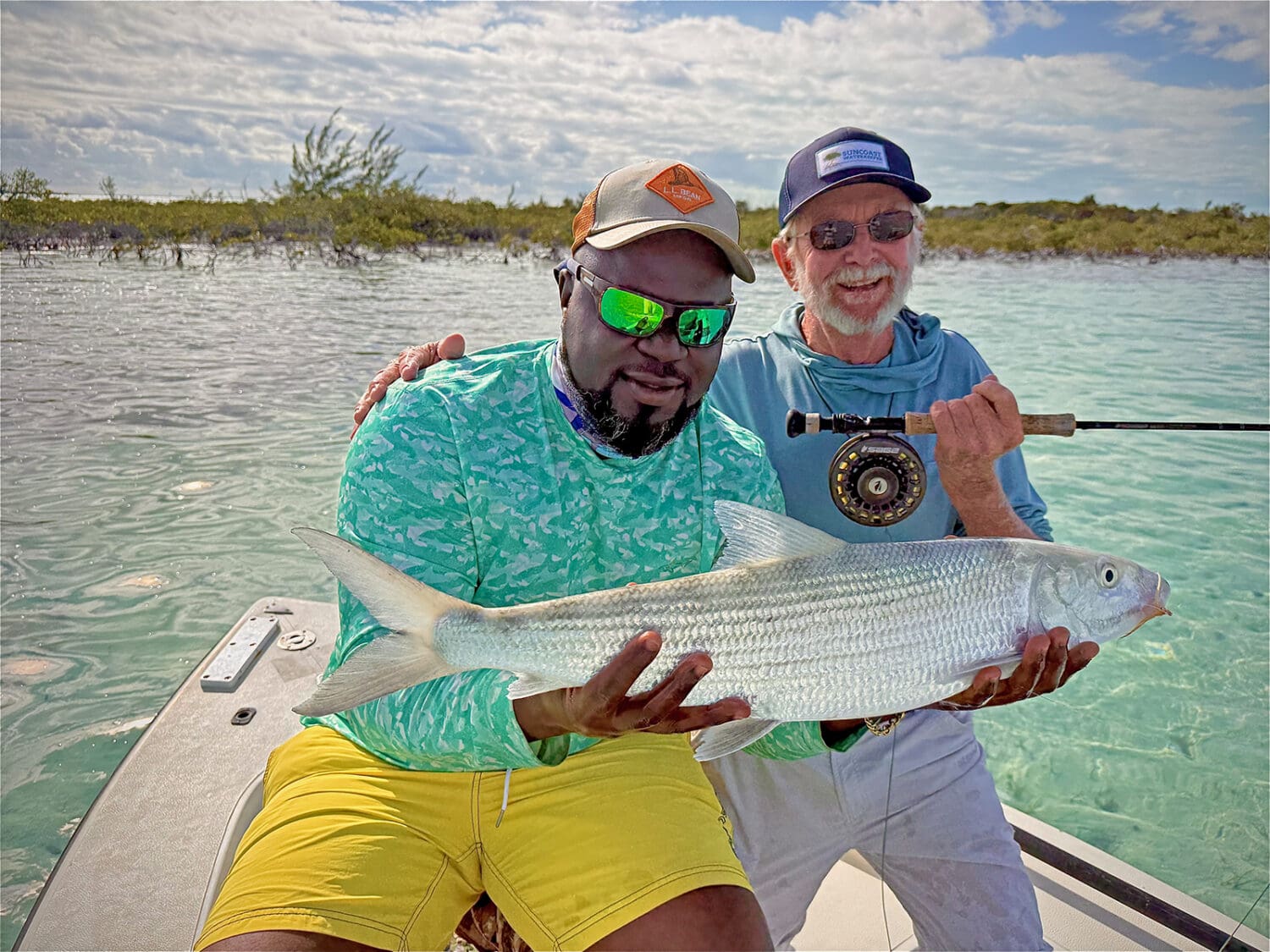
In my opinion the “holy grail” is landing a bonefish over 10 pounds. I’ve landed a few tarpon over 100 pounds, and a permit that pushed 40 pounds, but I had never managed to land a bonefish over 10 pounds. That all changed this past November when I fished the Middle Bight of Andros with Capt. Harry Neymour on a trip to Frankie’s Two Boys Inn.

Neymour’s roots run deep in the lore of bonefishing. His father, Charlie, uncle, Frankie, and grandfather, Ivan, have guided fly anglers in the waters near Behring Point for generations. Harry represents the new generation of the renowned family of fishing guides. On our fourth day of a six day trip, Harry and I were joined by Tampa angler and friend Leigh West.

As we rounded the bend from Cargill Creek onto the flats near Behring Point, Harry made the decision to head south and fish a small island in the middle bight, one he hadn’t fished in over a year. The weather was perfect with a 10-mph northeast breeze in a cloudless sky. Harry poled the boat along the edge of Big Lloyd Cay and after spotting and missing a couple of smaller fish, I heard Harry whisper, “Massive bonefish, 60 feet, one o’clock.”
As I swung my rod in that direction two large bonefish materialized about 40 feet away. Taking a deep breath, I raised my rod to the side to avoid spooking them and after one false cast, launched my fly, which landed about 15 feet from the cruising bones. As the fish approached, I waited for Harry to give me the word to start stripping. While I could see the fish, the Bahamian guides know just when to start a strip to make sure it’s close enough for the bonefish to see but not close enough to spook them. As the fish approached, it was hard to resist starting a strip, but I waited for Harry’s instructions. “Strip, strip, stop.”

There’s nothing more exciting than hearing those words and watching as the bonefish spots the fly and rushes over to inspect the perceived prey. “Strip, strip, stop – he’s got it!” came rapid fire as I did a strip strike and watched as the bone raced away, line and water flying from the spool. In short order, the bonefish was well into my backing as it suddenly changed course and headed for the mangrove shoreline. I applied as much pressure as I dared and used the drag and the rod to keep the fish out of the mangroves. Fortunately, the tide was just low enough to prevent the bonefish from running in or around the twisted roots and after several failed attempts it raced away from the structure towards deeper water. Then it was just a matter of applying constant pressure and working the fish to the boat. As I held my rod high, Harry reached down and expertly lifted the bonefish into the boat, proclaiming it to be close to 13 pounds. Finally, I had my first double-digit bonefish!

If you haven’t fished the Bahamas, I highly recommend the experience. While I’ve had the pleasure to fish multiple locations throughout the Bahamian archipelago, I can’t think of any place I would recommend for new and experienced anglers than Frankie’s Two Boys Inn. While you’re there make sure to ask for a day with Capt. Harry Neymour!

Reel Time: The ups and downs of tides

Reel Time: The ups and downs of tides

I’ve written about tides before, but I’m constantly being reminded of the importance of understanding them to the success of any given fishing trip. Having said that, I must admit that the more I learn about fishing and the behavior of fish, the more I realize how much I don’t know.

There’s a lot of truth to the maxim, “The best time to go fishing is whenever you can,” but understanding and tracking tidal fluctuations and the way they affect feeding fish is going to improve your odds whenever you go fishing.

While there are myriad factors that influence the tides, basically it’s the gravitational pull of the moon on the Earth and its oceans that’s the prime driver. This means that the oceans on opposite sides of the Earth experience high tides as the water is pulled away from the Earth. The other object in the solar system that influences the tide is the sun, which has approximately half the influence of the moon. When the sun and the moon line up at the full and new moon, their combined influence creates the greatest “pull,” creating what is known as “spring” tides. When the sun and moon are at right angles to each other, during the moon’s first and last quarter, they interfere with each other, and we experience weak, or “neap,” tides.

In addition, the tidal ranges are greater when the moon and sun are at perigee, or closest to the Earth.

Wind is another factor that affects tides. In our area, a strong east wind can push tides lower and later, hold up a rising tide. A hard west wind can do the opposite, pushing in a rising tide and holding up a falling one. Experience will teach the angler how to benefit from the myriad tidal dynamics that affect fish and their feeding patterns.

I learned a valuable lesson about tides on trips to the Bahamas in search of bonefish. My first several trips were planned to coincide with a full or new moon to take advantage of the increased feeding activity that generally takes place during these times. Instead, I found that the bonefish I was stalking would disappear into the mangroves as the tide rose, giving me a shorter window to pursue them along the mangrove fringes. Based on that information I planned subsequent trips when “neap tides” slowed the progress and size of the tide, providing many more opportunities for sight fishing.

Recently, I found that there are areas (like the Florida Keys) where you can run east or west to find the tide you want, lower or higher.

Just the opposite is often true when I explore local waters. While I still fish whenever I have the opportunity, I target days of extreme high and low tides because I know they stimulate feeding and concentrate fish. Depending on the time of year and the temperature, you can use the tide to take advantage of the season. In the winter when the waters chill down, I like to seek out locations where a late afternoon falling tide brings warm water off the flats. The holes, slues and channels the water drains into attract gamefish and can provide some excellent action.

When fishing the flats, working from the deep water to shallow on the falling tide and in reverse on the rising tide is a very effective way to target fish. Very low tides (during “spring tides”) provide an excellent opportunity to scan the flats for channels, slues and holes on the flats where fish congregate. Armed with this knowledge, anglers can return when the flats are covered with water and benefit from that awareness. Planning your day to take advantage of these variations can make a real difference in action.

No matter what species you target, you’ll have a better chance at success if you understand and track the tides. They can tell you where to concentrate your effort and help you avoid other less productive areas. Pick up a tide chart at your local tackle shop or download one of several apps on your smartphone. Tides are no guarantee of success, but understanding them will mean you’ll have more ups than downs.

Reel Time on the Road: Frankie's Two Boys Inn

Reel Time on the Road: Frankie’s Two Boys Inn

Over the years I’ve had the pleasure of fishing a lot of destinations in the Bahamas. The fact that it’s so close to Florida coupled with its vast schools of my favorite catch on the fly, bonefish, make it hands down my choice destination. Despite all those opportunities I had never fished what is widely known as the birthplace of bonefishing, the middle bight of Andros Island.

Arguably one of the richest flats fishing locations for bonefish on Earth, the middle bight of Andros holds vast opportunities. I had my first experience there the third week in March when I visited the Bering Point Settlement and Frankie’s Two Boys Inn. I first heard of the lodge from Robert Fischer, a Tampa native and a longtime member of the Tampa Bay Fly Fishing Club. Years ago, Fischer and I fished South Andros, so when I heard he was a veteran of the area and lodge I reached out to him. I wanted to explore that area and, in the process, experience the place where I planned to introduce some friends new to fly fishing to the thrill of bonefishing. In the process of organizing the trip, another new fly-fishing friend, Andy Grosso of Sarasota, signed on as did Fischer and Tony Piazza, a member of the Suncoast Fly Fishers in St Petersburg.

We met at the Tampa International Airport on a Wednesday morning for a flight to Nassau and then to Andros Town. There we were met by a taxi for a 45-minute drive to the lodge on Bering Point. After settling into our rooms, we all met in the lodge’s great room for libations and snacks. The morning began early with coffee at 6 a.m. and breakfast at 7 a.m. As soon as breakfast was complete, anglers made and boxed their choice of sandwiches, chips and fruit, assembled tackle and walked across the street to the lodge’s dock on Cargill Creek. The day’s fishing started at or before 8 a.m. and finished with lines out at 3 p.m. While 3 p.m. sounded a bit early to finish, after experiencing the short run to fishable water, it became clear that the actual fishing time was probably longer here.

Weather and wind were challenging six of the seven days we fished, something I had become accustomed to (well, almost) fishing the Bahamas. Despite the weather and the wind, everyone caught fish including the two anglers fairly new to the sport. Actually, they bested the “old salts.” On the first day, Grosso and I fished the east side of the island with Calvin Bowe and had shots at schools of fish on the flats and at a creek mouth near the lodge. The shots we had were plagued by clouds and wind but we still managed to land, break off and make presentations to numerous bonefish. Our second day was tough as well but we got a wonderful introduction from owner and head guide Frankie Neymour to the vast and unbelievably beautiful middle bight through all-too-infrequent windows in the clouds. When the sun did break through, it revealed a kaleidoscope of varied and eye-popping colorful flats laced with deep azure channels.

The weather improved over subsequent days and the fishing did as well, with everyone at the lodge catching bonefish. I caught my first-ever mutton snapper on fly the third day and Grosso caught one the following day that fed everyone at the lodge. On the fourth day when the weather broke and the sun shined all day, I caught five fish before lunch. Two days after we arrived at the lodge thee more anglers came including an old friend of mine and one that had connections with Grosso. While the fishing and weather were challenging, the camaraderie was excellent and we all looked forward to sharing stories from the flats as well as some very funny jokes at the end of each day. While fishing is the main focus of any trip, the time spent with other passionate anglers really enhances the experience.

I’ll have to admit this was one of the most challenging bonefish trips I’ve ever taken, but also one of the most memorable. The fishing was tough, a combination of weather and the fact that bonefish don’t flood the flats in as great a number during the mercurial change from winter to spring. I was so impressed with the experience as a whole and accounts of fishing there in the late spring and fall that I booked space for six anglers this coming November. Frankie Neymour and his wife, Melinda, run a tight ship and the locals were friendly and accommodating. I can highly recommend this reasonably-priced experience that is sure to please even the most discriminating angler as well as anyone new to or wanting to experience bonefishing. To inquire about availability and book a trip, contact Melinda Neymour at Frankie’s Two Boys Inn at 242-375-2054 or visit their website at www.twoboysinn.com.

Reel Time: Bahamian bones

Reel Time: Bahamian bones

If I had to pick my favorite fish to catch, it would probably be a bonefish. Tarpon are amazing targets, as are redfish, little tunny and snook, but sight fishing for bonefish in the locations they inhabit and the crystal-clear waters in which they swim is incomparable. Not to mention that a well-placed fly is more often than not tracked and inhaled.

From Nov. 10-17, I returned for my seventh trip to South Andros in the Bahamas and my second trip to Mars Bay Bonefish Lodge with my friend Captain Rick Grassett and a group he had been bringing to the lodge (except for a COVID-19 pass in 2020) for the past six years. The lodge is situated near the southeast tip of what is the largest and least populated island in the Bahamas. I’ve been to several other islands in the chain, but South Andros is special. It’s maybe one of the only places I’ve ever been where things had hardly changed in almost 20 years. That went for the fishing as well. There are very few places where you can travel to in a day and then fish all day and sometimes never see another angler. South Andros was like that when I first visited in the late ’90s and it remains that way today.

https://youtu.be/GPC18uDV1CQ

This trip (except for one day with perfect conditions) was challenging, with frequent clouds, some rain and a persistent 20-plus mph east wind. Despite the inclement weather, the guides were able to lead anglers to bonefish every day. On the days when the clouds persisted, we were able to stalk tailing bonefish on the flats while the appearance of the sun led to some terrific sight fishing opportunities. On the final day of the trip, my partner Kirk Grassett and I had our best day, despite some extremely challenging conditions.

One of the reasons anglers travel to this part of the Bahamas, besides the endless flats and solitude, is the number of big bonefish that ply these waters in the early fall. Fly anglers have a very good chance at bones pushing 10 pounds and on every trip, a fish or two in the double digits are landed. That was no exception this trip as one member of our party, Tracey Baker, landed a bonefish that pushed 12 pounds on the first day. I’m still looking for my first 10-pound bonefish, but did manage to land several fish from seven to nine pounds.

The lodge is smoothly run by a Bahamian staff and guides, and is owned and managed by Bill Howard, an expatriate from Nebraska. We stayed at the lodge for seven nights and fished six days. The day started out with a 7 a.m. breakfast, although coffee was on for early risers by 5:30 a.m. We loaded up at 8 a.m. and made a five-minute ride to a nearby boat basin where boats, guides, drinks and lunches were waiting. After an approximately 30-minute ride, we rounded the south end of the “main” island and entered into an angler’s paradise with seemingly endless flats, islands and channels. After seven hours of chasing schools of cruising, tailing and schooling bonefish and dodging sharks and barracuda we returned to the basin at 4:30 p.m.

Back at the lodge, our chefs Cathy, Chrystal and Vaddie treated us to local hors d’oeuvres and libations of our choosing. The food at the lodge was consistently excellent and included fresh local delicacies including lobster, conch, local fish, steaks and rack of lamb. Dinner was served at 7 p.m. and evenings were spent discussing the day’s fishing on the back veranda where cool Bahamian breezes were complemented by a sky ablaze with stars and the occasional satellite. On the nights when the wind abated and the mosquitos pushed us inside, we watched football on a flat-screen TV and anticipated the next day’s fishing.

If you’re interested in experiencing some of the world’s best fishing in a destination that’s literally in your backyard, contact Grassett at 941-350-9790 or check out his website. The lodge can be reached by emailing marsbaybonefishlodge@yahoo.com. Check out their website.