Tag: beach cabanas

New ordinance will regulate beach cabanas and tents 

ANNA MARIA – City officials and city staff are working on a new ordinance that would allow regulated beach tent and beach cabana rentals along the specific stretch of Anna Maria shoreline known as Gulf Front Park, from Oak Avenue to Magnolia Avenue. 

During the Anna Maria City Commission workshop on Jan. 5, Mayor Mark Short, the city commission, city staff and two cabana rental company owners spent more than an hour discussing the draft version of a new parks and recreation ordinance prepared by City Attorney Becky Vose. 

Subject to further revision when presented to the city commission for two more readings and final adoption, the proposed ordinance is expected to take effect on March 1. The first reading of the revised ordinance is scheduled for Thursday, Jan. 22. 

The intent of the new ordinance is to allow, but regulate, the placement and use of temporary beach structures along a specific portion of the Anna Maria shoreline, and do so in a manner that still provides space for other public beachgoers.

The proposed cabana and tent allowances and regulations being discussed would apply to the beach area known as Gulf Front Park, and most of the new regulations would apply to all cabanas, tents and other temporary beach structures, whether they’re privately owned and used or commercially owned and rented to others.

BACKGROUND

In July, Short told city commissioners the city’s current code of ordinances prohibits all commercial beach activity in the coastal conservation zones and recreation open space zones that encompass most of the city’s beach shorelines.
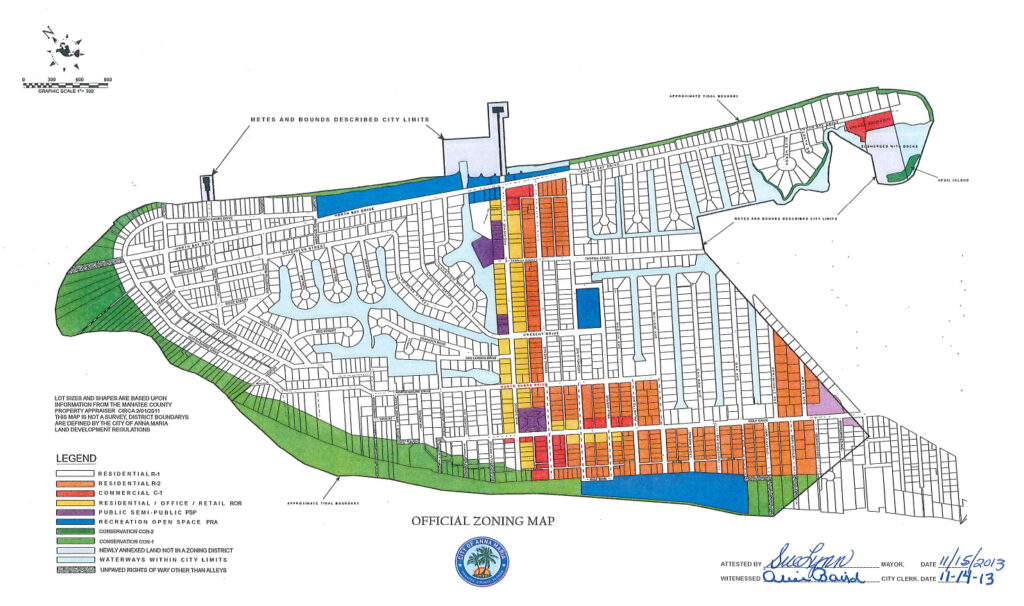
The Anna Maria zoning map shows the coastal conservation zones highlighted in blue and the recreation open space zones are highlighted in green. – City of Anna Maria | Submitted

The long-ago adopted city code also prohibits multi-legged tents and cabanas of any kind (commercial or personal) in the more restrictive coastal conservation zones where only single-pole umbrellas or shade structures are allowed. 

During the July discussion, no one could recall the beach activity regulations ever being enforced; and Short said enforcement would remain suspended until the regulations were revised.

According to the city’s color-coded zoning map adopted in 2013, the largest coastal conservation zone (highlighted in green on the map) extends from Magnolia Avenue to the northern tip of Bean Point and includes the beach area in front of the Sandbar restaurant.

The recreation open space zones (highlighted in blue on the zoning map) include the Gulf Front Park, Bayfront Park and Anna Maria City Pier shorelines.

PROPOSED REVISIONS

The cabana and tent-related code revisions being considered pertain to the Gulf Front Park area, from Oak Avenue to Magnolia Avenue.
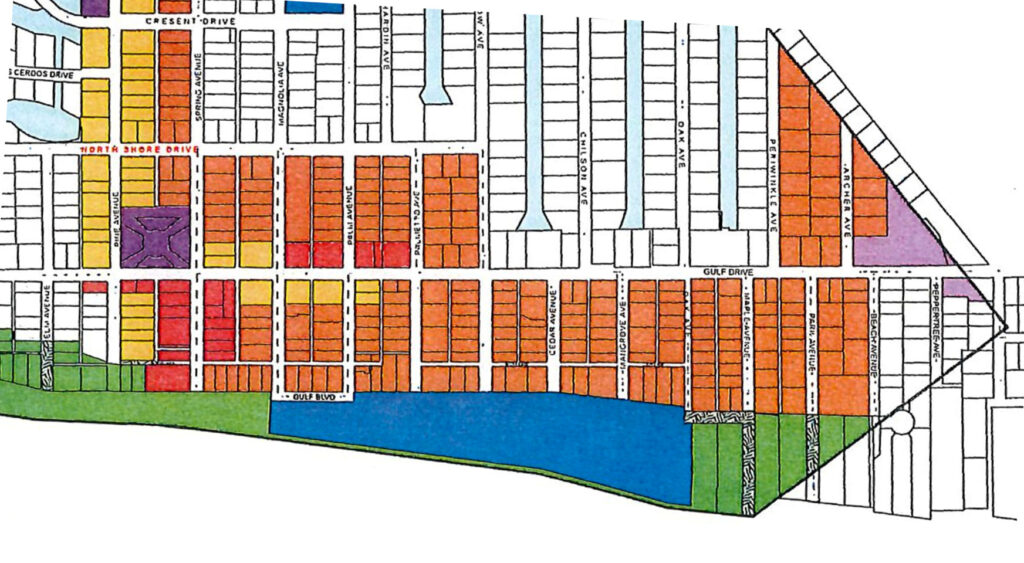
The proposed cabana and tent regulations would apply to the Gulf Front Park beach area highlighted in blue, from Magnolia Avenue to Oak Avenue. – City of Anna Maria | Submitted

The proposed ordinance presented on Jan. 5 initially said, “Temporary Beach Structures are limited to personal tents, cabanas or other sunshade structures which shall not exceed 100 square feet of ground coverage, inclusive of any poles, pegs, tie-downs, anchors, weights, sandbags or the like.”

Code Enforcement Manager Dave DeZutter said he showed the mayor a photo earlier that day of a sail-like tent that was approximately 30 feet long.

Commissioner Gary McMullen said 10-foot-by-10-foot tents are among the smaller tents seen on Anna Maria beaches these days and 12-by-12 tents are more common. He suggested revising the ordinance accordingly.

Commissioner Chris Arendt agreed and said, “It’s not that much larger but it provides a surprisingly larger amount of shade.”

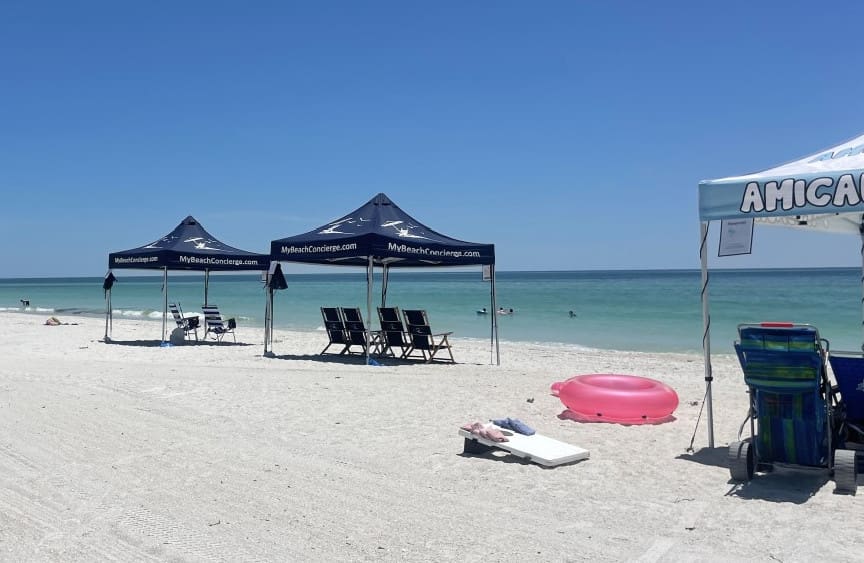
When asked by the commission what size his rented cabanas are, My Beach Concierge owner Peery Heldreth said his cabanas have a 10-by-10 footprint.

Beach Dog Island Essentials owner Doug Egan said his cabanas have 10’ x 10’ frames but the canopies open to 13-by-13. Egan said his support structures would comply with a 12-by-12 ground cover restriction, but his total canopy coverage might not comply with a 144-square-foot total space restriction.
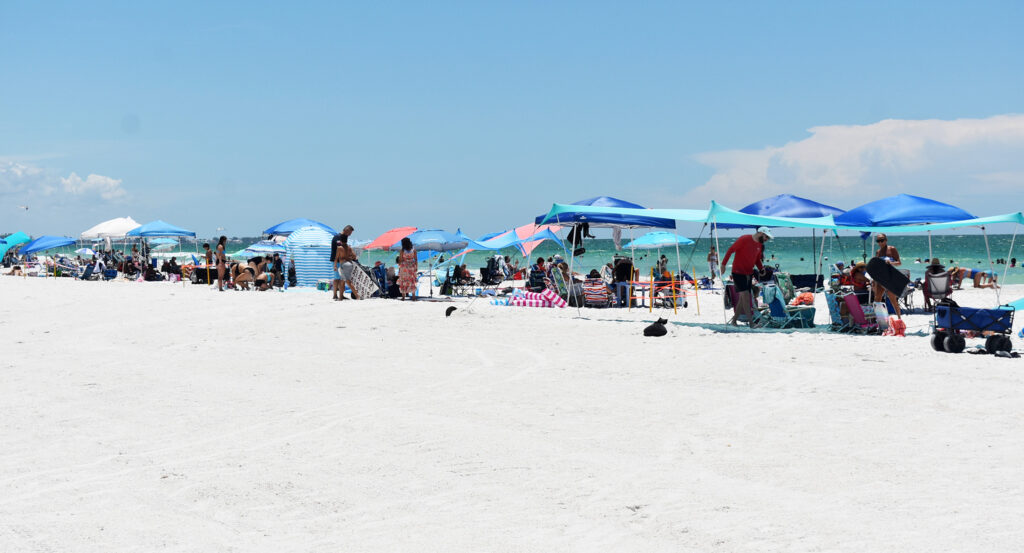
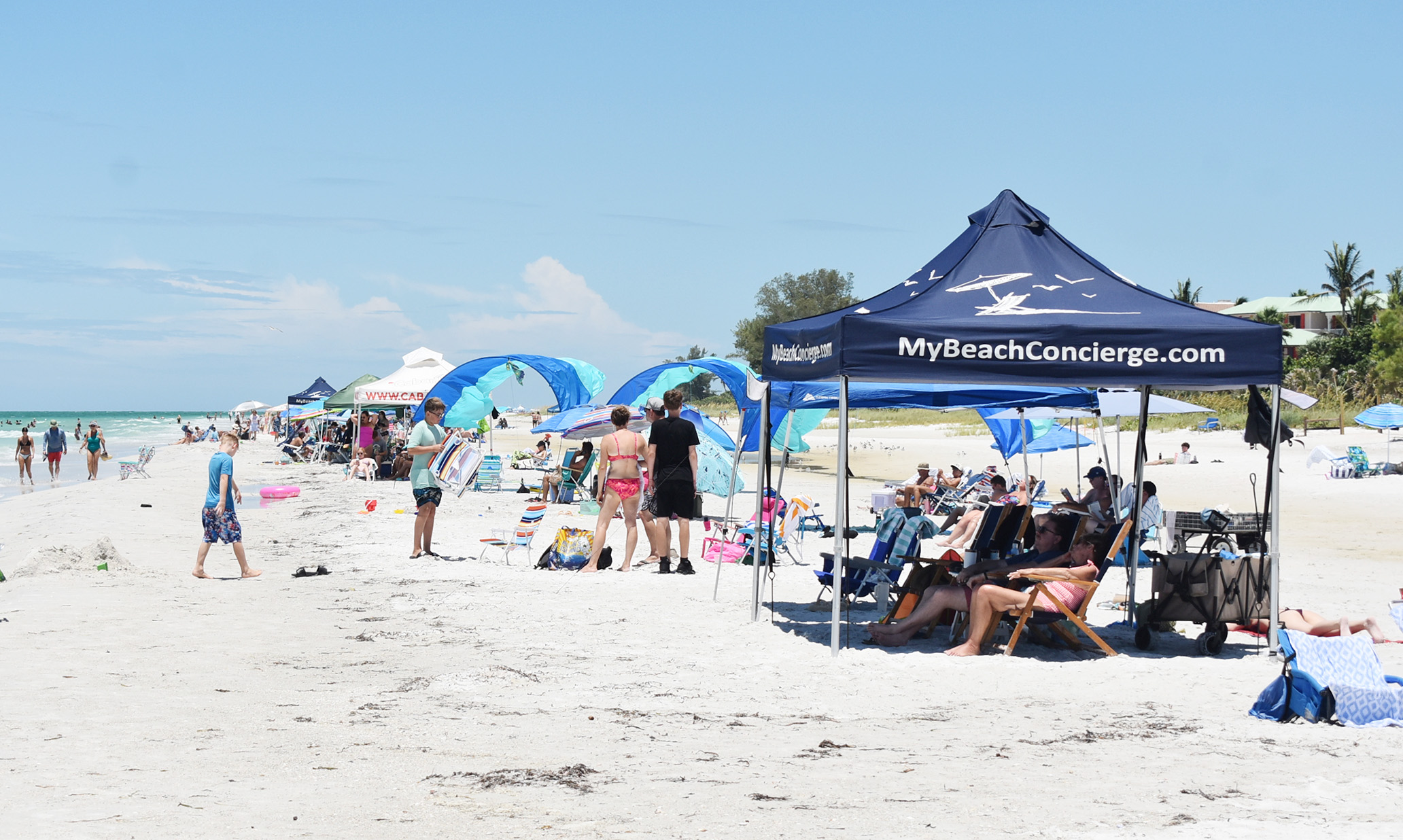
Tents and cabanas are a common sight along Anna Maria’s beach shoreline. – Joe Hendricks | Sun

Regarding the intent of the new regulations, Commission Chair Charlie Salem said, “The reason we’re concerned about that is you’re basically roping off a part of the beach for yourself. We’re trying to make sure the beach isn’t cordoned off for private or public entities for their own use and excluding other people.”

The commission tentatively agreed to increase the proposed space limit to 13-by-13 (169 square feet), but it was noted that regulation could be revised during the formal ordinance adoption process in February.

The 169-square-foot space limit would apply to all temporary beach structures (commercial and personal). The ordinance would also require accessory beach equipment – beach chairs, coolers, towels, baby items – to be contained within the allowed footprint.

The proposed ordinance says, “No more than two commercially rented cabanas may be placed within 50 linear feet of each other, measured in any direction.”

This would allow two rented cabanas to be placed side by side for the same group of users, not to exceed 15 total users.

Short said this restriction would establish a perimeter that prevents five or six cabanas from being set up in a row.

“We have pictures from the day after Christmas of five in a row and five in a row and I personally don’t want to see that,” Short said.

Sgt. Brett Getman, from the Manatee County Sheriff’s Office Anna Maria Unit, said Dec. 26 was perhaps the busiest beach day he’s seen during his six years in Anna Maria.

Getman said the 50 feet of separation between two side by side tents would make it easier for law enforcement, code enforcement and first responders to patrol the beach and respond to emergencies.

The same morning start time restriction that applies to construction workers, landscapers and others would prohibit cabana and tent rental companies from setting up their equipment until 7 a.m. The ordinance will require cabanas, tents and other temporary beach structures to be removed from the beach within a specific, yet to be determined, time period after sunset. 

Beach cabana rentals provide a service for visiting beachgoers and a business opportunity for locals. – Joe Hendricks | Sun

“The intent here is to look forward,” Short said. “I’m not opposed to commercial activity on the beach as long as we control what that activity is, and as long as we can control what the limitations to that activity will be because the majority of the people that come to these beaches bring their own stuff.”

He said the cabana rental companies provide a valuable service, but limitations need to be established so everyone has the ability and flexibility to enjoy the beach.

Short said the existing single-pole structure limitation in the coastal conservation zones might be reviewed as a separate process at some point in the future.

In response to a question from Heldreth, Short said considering changing the zoning in front of the Sandbar restaurant from coastal conservation to a recreation open space zoning designation would be a process that would start with the city’s planning and zoning board.
Holmes Beach officials decline to increase beach cabana regulations

Holmes Beach officials decline to increase beach cabana regulations

HOLMES BEACH – Concerns about advertising and logos placed on rented beach cabanas have been addressed to the mayor’s satisfaction and the city is not taking any additional steps to regulate cabana rentals.

At the request of Commissioner Carol Whitmore, cabana rentals and commercial beach activities were discussed during the Holmes Beach commission’s July 25 meeting as a follow-up to a previous discussion Mayor Judy Titsworth initiated on June 24.

During the June meeting, Titsworth said city’s code compliance officers asked the beach cabana rental compa­nies to remove all advertisements and signage from their cabanas because the city’s sign ordinance prohibits advertising on the beach. The cabana companies were given until June 27 comply. Titsworth also expressed concerns about some cabana rental companies staking out prime beach areas by setting up cabanas that had not been reserved and in advance offering them for rent, and about commercial activity on public lands in general.

When the July 25 discussion began, Whitmore said she wanted to get a better understanding of how the cabana rental companies operate. She also questioned whether the city’s sign ordinance could be amended to assist businesses that provide a beneficial service to beachgoers.

“I think we’re trying to fix a problem that’s not broken,” Commission Chair Dan Diggins said. “I don’t like the idea of putting all these restrictions on people. We don’t do this to the golf cart folks. We don’t do it to Uber Eats. We don’t do it to anybody else, so why would we do it here? It’s a thriving business. They provide a great service to the community and tourism. The equipment is outstanding and most of it’s better than the crap people buy at Walmart and leave in the trash container or leave on the beach for somebody else to clean up.”

Regarding her previously stated beach advertising concerns, Titsworth said, “It’s fixed. We don’t have an issue with renting equipment and putting it on the beach. It was the signs. We have a sign ordinance that doesn’t allow advertising on the beach. They just can’t stake out ground ahead of time with their signs and QR codes saying, ‘rent me.’ ”

Holmes Beach officials decline to increase beach cabana regulations
Mayor Judy Titsworth said her beach cabana advertising concerns have been addressed. – Joe Hendricks | Sun

When addressing the many cabana company owners and employees in attendance, Titsworth said, “You can ruin something by too much of a good thing and I think we’ve all seen that. It’s one thing to have one cabana company that promises not to advertise and start putting stuff out (unreserved). It’s another thing when you walk the beach and see every single company with tents galore. Get rid of the advertising. We’re OK if you’re out there, but the minute you take it too far we’re going to have residents saying ban all tents on the beach. Everyone needs to try to reel it in. Let’s try not to graffiti the beaches.”

Commissioner Terry Schaefer said, “There’s never been opposition to the service. The whole issue was about advertising and pre-placement.”

He noted at least one cabana rental company was recorded placing unreserved cabanas on the beach.

“Not only do I see a benefit, I see providers who really want to engage,” Commissioner Steve Oelfke said.

He questioned if there’s more the city can do to ensure that those who have insurance and properly secure their cabanas aren’t negatively impacted by those who don’t. He also suggested a future commission work session discussion about the bigger issue of commerce on the beach and how to possibly preempt future unwanted beach commerce activities.

“I’m not touching that sign ordi­nance,” Commissioner Carol Soustek said, and she agreed with Oelfke about a beach commerce work session discussion and discussing how other coastal cities address those activities.

During public input, My Beach Con­cierge owner Perry Heldreth restated some comments he made a day earlier at the Anna Maria city commission meeting. He said the cabana rental company he and his wife Rebecca operate island-wide has a business license, a retail sales certificate, a multi-million dollar liability policy and workers’ compensation insurance.

“We try to do everything aboveboard,” he said.

Heldreth said the My Beach Concierge logo is nationally trademarked, similar to Tommy Bahama, and he questioned whether that allows their logo to remain on their Holmes Beach cabanas.

When addressing that question later, Development Services Director Chad Minor said, “If it’s com­mercial advertising, by ordinance, it’s prohibited on our beach.”

Holmes Beach officials decline to increase beach cabana regulations
AMI Cabanas owner Sarah Moreno addressed the mayor and commission.

Unable to wait for the cabana discussion because she had to get to her full-time job in Tampa, AMI Cabanas owner Sarah Moreno spoke during general public comment at beginning of the meeting. Moreno said she’s an Island native and AMI Cabanas is a family business with only 10 ca­banas. She supports de-branding rented cabanas and requiring cabana rental companies to be licensed and insured.

“There are some yahoos out there doing it wrong,” she said. “We are an LLC. We’re licensed. We have insurance. We do it right and we just ask that we are able to continue do it right.”

Related coverage:
Commercial activity on Anna Maria beaches prohibited
Beach cabana rentals under scrutiny
Mayor concerned about beach cabana rentals


Beach cabana rentals under scrutiny

Beach cabana rentals under scrutiny

BRADENTON BEACH – City commissioners held their second discussion about commercial beach cabanas on July 17 and will consider the issue again in a special work meeting to be scheduled.

In response to commissioners’ request on July 10 to look into the legal aspects of private cabana companies setting up on public beaches, City Attorney Ricinda Perry drafted an ordinance regulat­ing the commercial use of the beaches by those companies.

“The draft ordinance establishes not a prohibition against the use but a requirement to obtain a commercial beach use permit,” Perry said. “The city could also limit the number of permits and limit where the cabanas could be set up. An exception would be made for those that have property onsite on the Gulf side where they would have cabana activity in front of their business.”

Perry asked the commission if they would like to have an outright prohibition or have control regula­tions.

“What if we do nothing and leave the rules we have in place?” Commissioner Ralph Cole asked.

“There can be no tents at all neither commercial or private,” Perry said.

“The problem is if they put their tents out there and nobody is under them, they’re taking up space that someone else could be using,” Cole said. “I don’t have a problem with them setting up a tent, if someone called them up and said, ‘please bring me out some shade.’ ”

Vice Mayor Deborah Scaccianoce said, “I don’t agree with a complete prohibition. They can’t be putting up empty cabanas and only should be placed when there is active rental for a cabana.”

Commissioner Scott Bear concurred and said he would like to see only tents that are rented, not those that companies are trying to rent.

“I agree with what’s been said,” Mayor John Chappie said. “First it has to be rented before it’s set up and they would still have to have business permit.”

Cole asked if the private com­panies have liability insurance to cover injuries or damage caused by the tents.

“Is there a way to compel them to have liability insurance and to come back if there’s weather to remove them?” Scaccianoce asked.

Police Chief John Cosby said the majority of people on the beaches bring their own tents and asked who would be responsible for the enforcement of private companies.

“This will be an unfunded mandate,” Cosby said. “There’s no money to enforce it.”

Bear said rules require enforce­ment and he would like to see penalties or fees attached.

Perry presented the key points of the draft ordinance:

  • Submission of a site plan showing location, dimensions and number of structures and that structures may not be set up within 100 linear feet of a beachfront boundary;
  • Proof of insurance naming the city as additional insured;
  • Compliance with the Florida Building Code and Florida Fire Code for temporary structures;
  • Daily set up and take down; removal during storms and requir­ing an inclement weather plan and a contact number;
  • Clear pedestrian access 20 feet from the waterline and turtle nests, avoiding sensitive dune areas; and
  • Payment of applicable fees.

Violations may include im­mediate removal of unpermitted structures, fines up to $250 per violation per day, revocation of permits and referral to state wildlife agencies for violations to wildlife habitat.

Chappie said the commission needed some time to conduct research and said the issue will be discussed further at a work meet­ing, with the date to be determined.

Cabana company weighs in

Peery Heldreth, owner of My Beach Concierge with his wife Becky, addressed some of the commission­ers’ concerns.

Heldreth said his company has a general liability policy, uses com­mercial grade tents with 30-inch ground stakes and 2,400 pounds of tie-down straps.

“This is our fourth season, and we do have a business license,” he said. “We try to do this the right way.”

“There’s a lot of falsehoods that’s being represented I think about the industry,” Heldreth said following the meeting.

“I think one of the points they’re making is we’re setting up without reservations and that is not the case,” he said. “I cannot speak for anybody else’s business how they conduct their business. I’m not aware of anybody doing that but I can’t swear it’s not happening.”

He said his company does not set up tents until he has a valid reservation.

“We take them down at the end of every day for many reasons. The biggest reason is it is turtle season,” he said.

The cabana service caters to three groups according to Heldreth: El­derly or people with disabilities who may not otherwise use the beach, families with children and those who are looking for convenience.

Bradenton Beach commissioners consider beach cabanas

BRADENTON BEACH – Following city commissioners’ discussion on July 10 about commercial beach cabana companies doing business on public beaches, commissioners
asked City Attorney Ricinda Perry to look at legal options and possible modifications to regulations.

“I looked at our existing code and in Article 2 – conduct in public parks – ‘park’ is defined as the beach, and there is an enforcement provision,” Perry said. “When you get down to
Section 46-37, it says no person in a park shall construct or erect any building or structure whether of permanent or temporary character.”

She noted another section, 46-44, which states that no person in a park shall erect, maintain, use or occupy on or in any beach any tents, shelter or structure of any kind without a special written permit.

“What that says to me is there can be no tents of any kind or sun shelter on any part of the beaches because they are covered under that code,” she said.

Commissioner Deborah Scaccianoce said her concern would not be to prevent beachgoers from using personal shelters to stay out of the sun, but was opposed to having private cabana companies using the public beach for financial gain.

“The concern is those concierge companies that don’t have a brick and mortar building, they just have a storage unit with a bunch of cabanas in it and they pull out their cabanas and chairs and set them up,” Scaccianoce said. “The bigger issue is concierge companies lining up 20 cabanas on prime spots on the beach. Nobody’s in them and they’re taking up space on the beach, in the hope that somebody is going to rent them.”

She noted that Holmes Beach has also recently expressed concern about private businesses advertising for financial gain on the beach.

“Holmes Beach is addressing it in a way that has code enforcement going out and watching these cabanas,” Scaccianoce said. “These cabana companies are advertising with their name, phone number, QR codes, and setting up empty tents with chairs that are not rented. If they’re set up in the morning and in the afternoon if they’re still empty they (Holmes Beach) are doing code enforcement.”

Commissioner Ralph Cole noted that resorts put out umbrellas for their guests.

“However that’s worded needs to be fixed so we can protect the businesses that were here for years and years,” Cole said. “The last thing we want to do is ruin our resorts and make people not want to come here because they have to sit on the beach with no umbrella.”
Cole compared the private cabana rental companies to many other businesses on the Palma Sola Causeway.

“I have a problem with someone just showing up on a public beach and starting to rent out Jet Skis,” Cole said. “When I see people up on the causeway, they’ve got banners out and they pay no rent. That’s just what the cabanas are doing. It’s getting out of hand.”

Scaccianoce said she does not support taking opportunity away from resorts or from families coming to the beach with sun shades.

“The issue I’m talking about here is that I think we should be able to police the businesses,” she said.

Mayor John Chappie suggested directing Perry to look at the city’s legal options with the possibility of making modifications to the current code. A motion to that effect passed unanimously.

“I believe all of us want to try to address this and have some type of regulation,” Chappie said.

The Thursday, July 17 city commission meeting agenda includes an update on commercial activity on public property.