

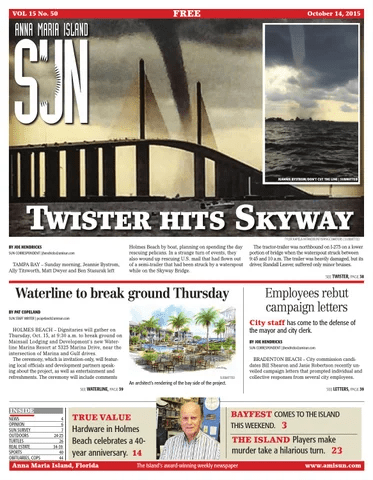
Twister hits Skyway

Second Place
Layout: Front Page Design
2016



Second Place
Layout: Front Page Design
2016


First Place
Spot News Photo
2015

CORTEZ – The U.S. Supreme Court decided 5-4 last week to overturn the 2011 conviction of former commercial fisherman John Yates for destroying undersized grouper in a federal fisheries investigation.
Yates, 62, was charged, convicted and served 30 days in jail for disposing of evidence under a federal law passed in the wake of the Enron fraud scandal that criminalizes destruction of certain types of evidence.
Second Place
That is so… Florida
2016
In an opinion laced with colorful maritime puns and citing Dr. Suess’ “One Fish Two Fish Red Fish Blue Fish,” the court wrote that 72 undersized grouper discovered on the Miss Katie by federal fisheries officers in 2007 are not “tangible objects” under the law, which makes it a crime to “knowingly alter, destroy, mutilate, conceal, cover up, falsify or make a false entry in any record, document or tangible object with the intent to impede or obstruct an investigation.”
“It’s been a long haul, and I’m happy, and I’m glad that somebody finally got the truth out there,”
Yates said last week at Off the Hook, the Cortez recycled furniture business he owns with his wife, Sandy Yates.
Yates holds little hope that he will return to the sea.
“I’d love to, but they forced me into early retirement,” he said, adding that the Cortez fleet is fully stocked with captains. “We own the business, that’s our income now.”
Yates is consulting with attorneys to see if he can recover lost wages, he said, and plans with his wife to take the first vacation they’ve had in several years this summer, inland, in a log cabin.
The Supreme Court decision may help other fishermen in a similar situation, he hopes.
“It would make them look at it a little bit harder if nothing else,” he said.
After oral arguments last year, Yates said he thought the decision would come back 9-0, but “5-4 is as good as 9-0,” he said.
During those arguments, Chief Justice John Roberts, who joined in ruling for Yates last week, told prosecuting attorney Roman Martinez that he made Yates “sound like a mob boss” in describing Yates as launching “a convoluted cover-up scheme to cover up the fact that he had destroyed the evidence. He enlisted other people, including his crew members, in executing that scheme and in lying to the law enforcement officers about it.”
Fisheries officers testified at trial that they told Yates to leave the fish on board as evidence and return to the Cortez docks, where the fish were to be seized. Three fish were missing when the catch was counted at the dock, accounting to court records.
Two justices who appeared to favor Yates in the 2014 arguments voted against him last week – Justice Antonin Scalia, who had asked, “What kind of a mad prosecutor would try to send this guy up for 20 years?” and Justice Anthony Kennedy, who had quipped, “Perhaps Congress should have called this the Sarbanes-Oxley-Grouper Act.”
“I’m happy we got the win, but not with the opinion,” said Sandy Yates, a former legal assistant, adding she was surprised to have “lost Scalia.”
Because the court noted in its opinion that more than 32 months passed before criminal charges were filed against Yates, he may file an abuse of process claim, she said.
“I don’t know if they would pay damages or not, but I would like the justice department to take note that you should not be abusing fishermen with threats of 30 years of prison for undersized fish,” she said.
The court wrote in the majority opinion that by the time Yates was indicted for destroying property to prevent a federal seizure and for destroying, concealing, and covering up undersized fish to impede a federal investigation, “the minimum legal length for Gulf red grouper had been lowered from 20 inches to 18 inches. No measured fish in Yates’ catch fell below that limit.”
The Yates decision could have implications on a case decided last month by the Florida Supreme Court that left the commercial gill net ban in place, she said.
“The fishing industry hasn’t got a good hit in a long time,” she said. “The net ban people need to continue to a higher level.”
In reversing the decision by the U. S. Court of Appeals for the Eleventh Circuit, the justices examined the meaning and context of the term “tangible object” in the federal law under which Yates was charged, using time-honored methods of interpreting statutes and legal precedent.
They also had some fun.
“A fish is, of course, a discrete thing that possesses physical form,” Justice Elena Kagan wrote in her dissent, citing Dr. Seuss’ “One Fish Two Fish Red Fish Blue Fish.”
Kagan also cited a case in which dead crocodiles were used as evidence to support a smuggling conviction, writing, “Congress realizes that in a game of free association with ‘record’ and ‘document,’ it will never think of all the other things – including crocodiles and fish – whose destruction or alteration can (less frequently but just as effectively) thwart law enforcement… and so Congress adds the general term ‘or tangible object’ again, exactly because such things do not spring to mind.”
“Who wouldn’t raise an eyebrow if a neighbor, when asked to identify something similar to a ‘record’ or ‘document,’ said ‘crocodile?’ Justice Samuel Alito wrote, concurring with the majority.
While the verbs in the law – “alters, destroys, mutilates, conceals, covers up, falsifies, or makes a false entry in” – “…could apply to far-flung nouns such as salamanders or sand dunes, the term ‘makes a false entry in’ makes no sense outside of filekeeping,” Ginsburg wrote in the majority opinion.
The court also considered the law’s title, “Destruction, alteration, or falsification of records in federal investigations and bankruptcy,” writing in its opinion that the title “points toward filekeeping rather than fish.”
The court continued, “A fish is no doubt an object that is tangible; fish can be seen, caught, and handled, and a catch, as this case illustrates, is vulnerable to destruction. But it would cut §1519 loose from its financial-fraud mooring to hold that it encompasses any and all objects, whatever their size or significance, destroyed with obstructive intent.”
The court concluded that it would not widen the interpretation of the law to cover destruction of all types of evidence.
“Leaving that important decision to Congress, we hold that a “tangible object” within §1519’s compass is one used to record or preserve information.”

ST. AUGUSTINE – When Rob Whitehurst began looking for the grave of his great-great-grandfather, the Internet was new, with scant information, and research was challenging.
When he learned that John Alexander Whitehurst was buried on Egmont Key in the cemetery next to the lighthouse, it was like striking gold. He recorded his findings on a website, Findagrave.com and laid his search to rest.
Third Place
Investigative Reporting
2015
Years passed. Then in 2015, research by The Sun about the people buried in the Egmont Key cemetery uncovered a handwritten ledger on Ancestry.com showing that 12 people, including Spanish-American War soldiers, an “Indian (Unknown),” and Whitehurst’s great-great-grandfather, had been relocated in 1909 from Egmont Key to the St. Augustine National Cemetery.

The website also pointed to Findagrave.com, and “Rob,” no last name, who was listed as the author of a brief biography of his ancestor. A 50-50 shot that his last name was Whitehurst paid off, and one Google search and two e-mails later, Rob Whitehurst felt like he had struck gold again.
His family had always heard the story that a family member’s remains had been moved, he said, but Whitehurst thought it was probably Daniel Scott Whitehurst, who died in 1862 in Pinellas County at the hands of Confederate forces who attacked him and his cousin, John Whitehurst – both Union sympathizers – while they were getting provisions on the mainland to take back to Egmont Key.
In the attack, John Whitehurst was wounded, escaped to his boat and was rescued at sea two days later and taken to Egmont Key, where he had been living with his family under the protection of the Union Navy that occupied the island.
He died from his wounds and was laid to rest in the Egmont Key cemetery, until 106 years ago.
The St. Augustine National Cemetery and its dead lie enclosed within a low, white stone wall in the historic Old Town section of the oldest city in the U.S.
Like a mini-Arlington, uniform white headstones make straight rows under the shade of moss-draped oaks.
The American flag whipped briskly in the breeze off the Matanzas River as Whitehurst walked down the central sidewalk one chilly day last week, getting his bearings. The Google Earth image he had consulted showed the back of most of the headstones, with the inscriptions on the opposite side, but he knew the grave was in section A, and he had a landmark to navigate by.
Three pyramids and an obelisk drew Whitehurst toward the south end of the cemetery. The monument is the resting place of Major Francis L. Dade and most of his regiment, killed in the Second Seminole War in 1835. Fort Dade, on Egmont Key, was named for him.
Walking toward the monument, Whitehurst called off numbers on the headstones, walking faster as he neared the number he sought. A headstone without a number, naming John O’Neil, stalled him for a moment. Then, he stopped.
He bent down to read 248, and the name, and placed his right hand on his great-great-grandfather’s headstone.
“Here he is,” he said.
The simple stone’s only inscription is “Whitehurst.”
To the right of the grave is a newer headstone, which replaced one like Whitehurst’s.
Both have shields traced around the inscription, like others in the cemetery. According to the headstone, Trooper John O’Neil, of New Mexico, fought with the 1st U.S. Volunteers cavalry regiment, E Troop, in the Spanish-American War, with Teddy Roosevelt’s Rough Riders.
During the war, O’Neil was transported by ship from Cuba to Egmont Key for medical treatment, but there was a lack of medical facilities on the island and he was sent back to the ship, where he died, according to the book, “Egmont Key: A History.” His remains were among the 12 burials relocated to St. Augustine. The Tampa-based Rough Riders organization placed the new headstone in 2004.
That gave Whitehurst the idea to investigate replacing John Whitehurst’s headstone, but he discovered the cost would be prohibitive without assistance from a historical organization, he said.
Still, Whitehurst’s headstone has more information than some of the other relocated Egmont Key dead.
Many headstones in the St. Augustine cemetery read “unknown” or are blank. “Indian (Unknown),” as listed on the St. Augustine cemetery ledger, is nowhere to be found. Neither is Azaline M. Bahrt, of the Egmont Key lighthouse keeper’s family, whose name is listed on a plaque at the Egmont Key cemetery, although her daughter, Marie Bahrt, is recorded at No. 316 and a related infant, Carlotte Bahrt, is at No. 287.
Private J.A. Brainerd, Company A, 26th Michigan Infantry, is at No. 283. Infantryman James Shannon, listed as Joseph Shannon on the Egmont Key plaque, is at No. 274. Seaman Robert Bentson, of the U.S. Lighthouse Tender “Laurel,” listed as Benton on the St. Augustine ledger, is at No. 276.
Like “Indian (Unknown),” “Colored Soldier (Unknown)” is nowhere to be found. Charles Williams, at No. 279, was listed as a “colored” soldier on the Egmont Key plaque, but may have been misidentified; his name appears on the St. Augustine ledger directly above the entry “Colored Soldier (Unknown);” the two lines appear to have been mistakenly combined on the Egmont Key plaque.
A few steps away from Whitehurst, at No. 256, is William Rull, who is listed as Rull/Ruth in the St. Augustine ledger, and is identified as a “colored” hospital attendant with the U.S. Marine Hospital Service on the Egmont Key plaque. Southern cemeteries in the 20th century often separated black and white burials, but not here. Whitehurst said his great-great-grandfather, a Southern resident who was a Union sympathizer and scouted for the Union Army, “was right about slavery.”
John Whitehurst’s dying wish was that his three sons, 12, 8 and 6, enter the naval service, according to a report by Lieutenant J.C. Howell, who ordered his burial. The older two were accepted the month after his death, but his youngest, Harney Butler Whitehurst, was not. He became the great-grandfather of Rob Whitehurst.
Whitehurst has visited a dozen or so cemeteries to visit family members’ graves, but this one is special.
“I didn’t really think about it until now,” Whitehurst said, looking at the headstone. “If it wasn’t for him, I wouldn’t be here.”

EGMONT KEY – Underneath Egmont Key, there’s even more history than its century-and-a-half-old lighthouse, the ruins of its Spanish-American War fort and its 1905 red brick road, now used mostly by gopher tortoises.
Underneath Egmont are real people who really made history in the 1800s.
Third Place
Investigative Reporting
2015
From Anna Maria Island’s north end, you can see the key’s landmark lighthouse, which stood watch as Colonel Teddy Roosevelt and his Rough Riders left for the Spanish-American War in 1898.
Just beyond the picket fence surrounding the lighthouse keeper’s home is one of two cemeteries on the island.
Another, older one used from 1903-1912 near Fort Dade, on the western side of the island facing the Gulf of Mexico, has been reclaimed by the sea along with some of the ruins of the fort, with no known records of its location or occupants.
But the “new” one, used in the last half of the 19th century, is well kept. Covered in clean white sand, an American flag flies overhead, and white crosses approximate the locations of gravesites. The crosses bear no names, but two plaques list the dead whose names are known, and describes those who are not.

Among the 40 occupants – and former occupants – of the Egmont Key Lighthouse Cemetery is the descendant of one of the Mayflower Pilgrims, a Seminole Indian chief, a Rough Rider, a Southerner who was a Union sympathizer and many victims of yellow fever and typhoid fever who died on Egmont during the Civil War (1861-65).
More Civil War dead lie aboard the wreckage of the Naval vessel U.S.S. Narcissus, which sank offshore at the end of that war and was dedicated last month as an archeological preserve and recreational dive site.

The key has seen other wars. Fort Dade was built to defend Tampa Bay during the Spanish-American War. In the 1920s and 1930s, it was a hideout for bootleggers during the war against alcohol – Prohibition. During World War II in the 1940s, it was used as a training base.
But the first wars involving Egmont Key were the Seminole Wars.
In the 1840s and 1850s, the U.S. Army detained Seminole Indian prisoners on Egmont Key, a natural fortress because of its limited accessibility.
One escaped, one committed suicide, and some died from disease and other causes.

Each of the two plaques at the cemetery lists the names of 20 people who are or were once buried there. On one plaque, five members of the Seminole tribe and their dates of death on Egmont Key are listed: Chief Tommy (Sept. 5, 1857); Seminole child, 12 months (April 24, 1852); Seminole child, 6 months (June 12, 1852); Seminole boy (July 27, 1852); and Seminole girl (1857).
In an ornate, but apparently hastily handwritten ledger at the St. Augustine National Cemetery, 12 of the 20 people whose names are on that plaque are listed as having been relocated from Egmont Key to St. Augustine and reburied on June 2, 1909.
One of them is referred to as “Indian (Unknown),” possibly Chief Tommy.
The Seminole Tribe does not discuss where its deceased tribe members are buried, spokesman Gary Bitner said. But the tribe’s Historic Preservation Office does not consider the Egmont plaques accurate records.
“Most of what exists was originally recorded by U.S. Army soldiers, who did not speak the language of the Seminoles and who were holding the Seminoles against their will – not a situation likely to foster the accurate transfer of information,” he said. “As a result, no one really knows who is buried there.”
The U.S. Fish and Wildlife Service also vacillated on that point in a 2007 report on Egmont Key, writing that the cemetery was “the most likely location of any Seminole burials.”
Despite what the plaque says, Chief Tommy was a Muskogee Indian, not a Seminole, according to Don and Carol Thompson in their book, “Egmont Key: A History.”
But a Seminole leader imprisoned on Egmont, Tiger Tail, also may have been buried in the cemetery, according to the book, in which they repeat a legend that he ate ground glass and died rather than remain in jail.
Without acknowledging the existence of any burial sites on Egmont, Seminole tribe members visited there in 2013 in commemoration of a successful escape. In 1858, a year after the death of Chief Tommy and one Seminole child on Egmont, Seminole Polly Parker was taken from Egmont to join the Trail of Tears, the U.S. government’s deportation of Native Americans to Oklahoma and elsewhere. She escaped in north Florida.
That same year, Seminole leader Billy Bowlegs, who led the last Indian uprising against federal troops, also was briefly detained on Egmont after he surrendered.
The 12 people who were buried at Egmont Key and reburied at St. Augustine National Cemetery lie in the same cemetery as Major Francis L. Dade, who was killed in an ambush in Florida with most of his regiment in the Second Seminole War in 1835. He is memorialized with a pyramid monument at the St. Augustine cemetery, and at the fort named for him on Egmont Key.
Ten of the 12 Egmont dead who were relocated were soldiers, sailors, a hospital worker, a Seminole Indian, and family members of the lighthouse keeper. The handwritten St. Augustine ledger lists them as:
One of two remaining names on the St. Augustine ledger is listed only as O’Neil.
According to the Egmont plaque, that’s Private John O’Neil, 1st U.S. Volunteers, Cavalry – Teddy Roosevelt’s regiment. O’Neil was a Rough Rider in the Spanish-American War.
O’Neil was transported by ship from Cuba to Egmont Key for medical treatment, but due to a lack of medical facilities on the island, he and other wounded and sick soldiers were sent back to the ship, where he died, according to “Egmont Key: A History.”
The Tampa-based Rough Riders charitable organization placed a grave marker on O’Neil’s grave in St. Augustine in 2004.
The last of the 12 on the St. Augustine ledger is, simply, Whitehurst.
On the Egmont plaque that lists Civil War burials, his name is set apart from the other 19, who served in Union forces in the Civil War.
John E. Whitehurst is prominently labeled a “Civilian and Union Sympathizer.”
That does not sit well with the descendants of the Whitehursts, who were mostly Southern sympathizers during the Civil War, said his great-great-grandson, Rob Whitehurst, 63, a retired production sound mixer from Tampa who has worked on Christian films including Courageous, Fireproof and Facing the Giants.

His ancestor died of gunshot wounds in 1862, according to the plaque.
Here’s the rest of the story, compiled from Rob Whitehurst’s family history search and other sources.
John Whitehurst, whose middle initial actually was A. for Alexander, was a Union sympathizer who occasionally served as a civilian scout for the Union Army. Before the war, he was a farmer, according to the 1860 U. S. Census for Hillsborough County, Florida.
He and his family were among 200 or so Union sympathizers living on Egmont Key, which was under the protection of the Union Navy that occupied the island with the Union Army as part of the blockade of the South.
The island had first been held by Confederate forces, which hid the lighthouse lens so the Union forces couldn’t find Southern blockade runners approaching the coast, leaving the Union to use the lighthouse only as a watchtower, according to the Thompsons’ book.
Whitehurst and his family had been transported to Egmont aboard the sloop, Mary Nevis, which made mail, freight and passenger runs from the Manatee River to Fort Brooke in Tampa.
The family was safer on Union-occupied Egmont because they did not want to secede from the Union and were opposed to slavery, a dangerous political position to have in the South, said Richard Sanchez, president of the Egmont Key Alliance, a non-profit citizen support organization dedicated to protecting, restoring and preserving the key.
But it wasn’t totally safe.
One night in 1862, Whitehurst and his cousin, Daniel Scott Whitehurst, and a third man named Arnold left Egmont in a boat to get provisions at John’s Pass in Madeira Beach. Confederate forces opened fire on the men, and Daniel fell dead while John managed to get to their boat and into open water. But he had been shot and was mortally wounded, and “laid two days in the boat exposed to the rays of an August sun,” according to a report of Lieutenant J.C. Howell, the commander of the U.S.S. Tahoma.
He was rescued “by a refugee named Clay,” and brought to Egmont, where he died at age 46 in early September. Howell ordered the burials of both Whitehurst men, Arnold being unaccounted for, but did not specify where they were laid to rest.
His report on John Whitehurst continues: “His dying request was that his three little sons should be received into the United States naval service.” The muster rolls of the U.S.S. Tahoma show that two of his sons, Christopher Columbus Whitehurst, 12, and Winfield Scott Whitehurst, 8, lied about their ages and enlisted on Oct. 4, 1862. The former was lost at sea; the latter was discharged from the ship Ino, which was the ship of Coxswain Michael J. Sullivan, 19, the last Civil War sailor to be buried in the Egmont cemetery. He had been in pursuit of Confederates when his musket accidentally discharged, fatally wounding him.
The youngest son, Harney Butler Whitehurst, who at about 6 had no hope of joining the Navy, is the great-grandfather of Rob Whitehurst, who said that he had heard that the remains of a family member had been unearthed and buried elsewhere, but did not know for sure whose remains they were, or where they were relocated.
Now, with the name Whitehurst appearing on the St. Augustine ledger above the other 11 names from the Egmont plaque, he does.
“This is awesome, and I thank you for contacting me concerning John,” he said. “He was right. He was right about slavery, and he gave his life in those beliefs.”
On the same Egmont plaque as Whitehurst is William H. Bradford, listed as an Acting Master’s Mate, who died on July 29, 1864 at age 22 of yellow fever, along with 14 others on Egmont in July and August of that year.
He was unmarried and had no children, said his sixth cousin twice removed, Brice Bradford, of Alexandria, Va., a self-described “geek” who fortuitously left his trail on www.ancestry.com.
He and William H. (Hopkins) Bradford both descended from William Bradford VI (1718-1781), the great-grandson of William Bradford, who came to America from England on the Mayflower in 1620 and became governor of the Plymouth colony the following year.
“Gov. William Bradford had but one son, Maj. William Bradford IV (1624-1703), who fathered four sons, all of whom saw military service. It is no surprise, then, that even several generations later, William Hopkins Bradford chose to serve in the Navy. Even my own grandfather, Gilbert Lee Bradford (1922-2010), chose to serve in the U.S. Coast Guard based on his inherited love of the open sea and the spirit of discovery instilled from his Bradford pedigree,” Bradford said.
Gov. William Bradford kept a journal that is preserved at the Pilgrim Hall Museum in Plymouth, Mass. A passage about the pilgrims who died in the New World could almost speak for those buried on Egmont Key.
“But their condition was not ordinarie; their ends were good & honourable; their calling lawfull, & urgente; and therfore they might expecte ye blessing of God in their proceding. Yea, though they should loose their lives in this action, yet might they have comforte in the same, and their endeavors would be honourable. They lived hear but as men in exile, & in a poore condition; and as great miseries might possibly befale them in this place… ther was nothing but beating of drumes, and preparing for warr, the events wherof are allway uncertaine.”
According to a family Bible, the writer’s family is descended from Confederate Gen. Robert E. Lee, who surveyed Egmont Key in 1849.

EGMONT KEY – Underwater and underground at Egmont Key, mystery and history have intertwined since the mid-1800s.
Just off the northern tip of Anna Maria Island, which has bathed in its lighthouse beam since 1858, Egmont Key is mostly deserted, populated only by a lighthouse keeper, a few on-duty harbor pilots, a family of gopher tortoises and flocks of migrating shorebirds.
Third Place
Investigative Reporting
2015
The voice of Capt. Robert E. Lee echoes on Egmont, which he surveyed in 1849. Lt. Col. Teddy Roosevelt’s unmistakable voice echoes there, too, among the ruins of Fort Dade, where he and his Rough Riders were stationed before leaving for Cuba in the Spanish-American War.
Cries of Indians, slaves and other prisoners are forever embedded in the thick walls of the jail cells still standing at the fort, whose cannons once aimed westward at unseen enemies.
Two cemeteries, one underground and one underwater, hold the silent remains of Seminole Indians whose identities are protected by their tribe, a descendant of a famous Pilgrim, Navy men lost to yellow fever, and nine children.
The waters around the key have silent tales to tell, too.
It was the second year of the Civil War, 1863, when the Mary Cook was launched in New York.

The 82-foot, wooden-hulled tug traveled south in the Atlantic Ocean and into the Gulf of Mexico at an average 6 miles per hour, on her way to New Orleans to join the U.S. Navy.
There, she was rechristened the U.S.S. Narcissus in 1864. Armed with a 12-pound cannon and a 20-pound rifle, she began blockading ships that were carrying food and supplies to Southern troops, capturing enemy vessels, transporting prisoners and serving as a towboat.
In August, 1864, she served in the battle of Mobile Bay, during which Union Rear Admiral David G. Farragut spoke his infamous quote, “Damn the torpedoes! Full speed ahead!”
Then came Dec. 7, an infamous date long before World War II. In Mobile Bay, a storm arose and the Narcissus struck a mine, known then as a torpedo. It tore a hole in her starboard side amidships. She sank in 15 minutes. The crew survived.
The Navy refloated her, sending the Narcissus to Pensacola for repairs, where she sat out the rest of the war.
In 1865, with the war over, Narcissus began her voyage back to New York with the U.S.S. Althea to be decommissioned and sold. But on Jan. 4, 1866, another storm struck, this one near Anna Maria Island.
Althea headed northwest while Narcissus took a western route, taking the wind and tide on her starboard beam.
At 6:15 p.m. Narcissus signaled with a flare, which Althea returned at 6:30 p.m. At 7 p.m. Althea saw another signal from Narcissus, and responded.
But Narcissus gave no more signals. She ran aground on a sandbar off Egmont Key, and her boiler exploded, sinking the ship.
The next morning, Althea anchored off Egmont Key and saw wreckage from Narcissus, and the body of one of the crew, on the beach.
For two days Althea searched for survivors, but found none. The crew of 26 was gone.

Nearly 150 years later, the submerged tomb lies in pieces in 15 feet of water about 2.7 miles northwest of Egmont Key, the engine, shaft, propeller and fragments of the exploded boiler visible among the wreckage.
On Jan. 20, the Narcissus became Florida’s 12th underwater archeological preserve in an underwater ceremony televised live at the Florida Aquarium in Tampa, which nominated the site for preserve status in 2010 with South Eastern Archaeological Services.
The preserve is now a recreational diving and snorkeling site, a heritage tourism site reflecting local maritime heritage and an ecotourism site due to its marine habitat, according to a report by the Florida Department of State Division of Historical Resources Bureau of Archaeological Research, which compiled the details of the ship’s history.
Narcissus is still owned by the U.S. Navy, and is protected by Florida laws prohibiting unauthorized disturbance, excavation or removal of artifacts. As a military grave, the Navy requests that the site be treated with respect.
For more information, including a virtual underwater tour, dive guide, photographs of ship’s artifacts and more, visit https://www.museumsinthesea.com/narcissus.
U.S.S. Narcissus timeline
- Launched in July 1863 in Albany, New York
- Purchased by the U.S. Navy under the name Mary Cook in September 1863
- Sent from New York to New Orleans in January 1864 to report to Rear Admiral David G. Farragut for duty in the West Gulf Blockading Squadron
- Commissioned into the U.S. Navy in New York City in February 1864
- Served in operations in Mississippi Sound, New Orleans and Pensacola as a blockader, dispatch vessel, prisoner transport and towboat
- Served near Fort Morgan during the Union victory at the battle of Mobile Bay in August 1864
- Struck a torpedo on Dec. 7, 1864 in Mobile Bay, sinking in 15 minutes with no loss of life
- Refloated in December 1864 and brought to the Pensacola Naval Yard for repairs
- June 1865 returned to Mobile Bay
- Acting Rear Admiral Henry Knox Thatcher decided Narcissus was no longer needed in October 1865
- Narcissus began voyage to New York to be decommissioned and sold on Jan. 1, 1866
- Narcissus was lost in a storm off Egmont Key on Jan. 4, 1866
Source: Florida Department of State Division of Historical Resources Bureau of Archaeological Research

First Place
News Photo
2014
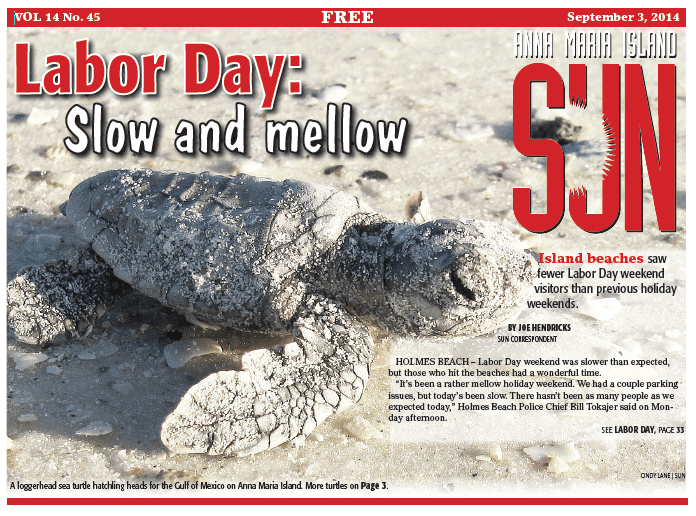

Third Place
Portfolio Photography (The Robert J. Ellison Award)
2014



The Manatee County Commission has toughened an ordinance targeting resort tax evaders.
 Under its provisions, a property owner who fails to pay resort taxes on a short-term vacation rental may now be served a warrant by a sheriff.
Other sanctions include liens placed on the property, preventing its sale until payment is made, garnishment of personal property and wages to pay the tax, a 10 percent fee on unpaid amounts, a 5 percent fee for bounced checks and a three-year recordkeeping requirement.
First Place
State and Local Tax Reporting
The Florida TaxWatch Award
2014
Violations are a first degree misdemeanor, with a $1,000 fine and up to one year in jail.
Under the ordinance, the tax collector can investigate several types of evidence, including records of condominium or homeowners associations, property management companies, and guest gate entry or parking passes and guest golf or tennis membership records.
The ordinance was spearheaded by Manatee County Tax Collector Ken Burton Jr., who said he foresees using it sparingly, primarily against European investors who advertise high-end rentals to tourists overseas. It strengthens the previous 25-year-old law that has been revised only twice, Burton said, adding, “Our goal is to keep a level playing field.”
Commissioner and former Holmes Beach Mayor Carol Whitmore said that tourists paying $25,000 a month for a home on the Island “need to pay the tax. This is not the little guy. This is someone who rents their house out for a business.”
Tax dollars that are going back to Europe “should stay here,” commissioner and former Bradenton Beach Mayor John Chappie agreed.
Burton’s staff works to track tax evaders door to door and online – about 81 percent of the county’s 6,600 properties subject to the resort tax are single family homes or condos, often advertised on do-it-yourself vacation rental websites, he said, adding, “Educating new and existing property owners is a challenge.”
Manatee County’s 5 percent resort tax, or tourist development tax, is required to be paid to the county by owners of accommodations rented for six months or less, who charge the tax to their guests. With the state’s sales tax of 6.5 percent, tourists pay a total tax of 11.5 percent on lodgings.
The resort tax requirement is detailed on flyers included in every property tax bill mailed to property owners in the county, Burton said.
By state law, resort tax proceeds can only be used for certain tourism-related projects, including beaches, fishing piers, sports arenas and tourism advertising.
About 53 percent of the county’s 2014 anticipated resort tax collections are budgeted for tourism marketing efforts by the Bradenton Area Convention and Visitors Bureau (CVB), with about 10 percent allocated to beach renourishment, according to the CVB.
Of the $4.3 million in resort taxes generated on Anna Maria Island from January through October, $2.1 million have been allocated to projects benefiting the Island, according to statistics from the Manatee County Tax Collector and the CVB.
Anna Maria Island generated an average 47 percent of Manatee County’s 2014 resort tax revenues from January through October, the last month for which statistics are available. Holmes Beach consistently leads the Island’s three cities in generating resort tax revenues.
A provision of the ordinance states that owners who rent out their vacation properties must report individually to the tax collector on their resort tax collections. “This requirement shall apply equally to individual property owners, realtors, property managers and other persons who hold themselves to represent multiple properties for benefit,” the ordinance states.
Some property owners charge the tax to tourists but keep it, said Sue Sinquefield, a senior staff member in the tax collector’s office.
An Anna Maria property owner who wished to remain anonymous wondered if some rental agencies collect the resort tax then keep it, and intends to ask for three years’ worth of records to be sure.
A critic of the ordinance told commissioners that it does not address the practice of “lending” a vacation rental to family or friends and accepting a “donation” to escape the requirement of paying the resort tax.
“There’s under-the-table transactions all the time and you’re never going to collect it all. Unless we get tipped or get lucky, it’s very difficult,” Burton said.
The ordinance should encourage people to use a professional to manage their property, said Larry Chatt, of Island Real Estate, adding that he hopes the county will not enforce the ordinance too harshly against new, inexperienced buyers of rental property and will focus on those who are intentionally evading the tax.
“Lots of owners can handle owning a vacation rental, but others shouldn’t even try,” he said. “Those that know they don’t have the time to run a business should hire a professional.”
The ManaSota League will not include vacation rental law reform or returning tourist tax funds to municipalities in its 2015 Legislative priorities.

SARASOTA – Amending the tourism development tax law to allow one cent of the five cents-per-dollar tax revenues to be repaid to the municipalities that generated them will not be a 2015 legislative priority for the ManaSota League of Cities.
The board decided on Nov. 6 to continue to discuss the issue next year, but declined to include it as one of its legislative priorities.
Manatee County’s 5 percent resort tax is collected from owners of accommodations rented for six months or less who charge the tax to their renters, in most cases, tourists. The majority of the tax is allocated to Bradenton Area Convention and Visitors Bureau tourism marketing efforts, with one of the five pennies allocated to beach renourishment.
First Place
State and Local Tax Reporting
The Florida TaxWatch Award
2014
About 43 percent of Manatee County’s September resort tax revenues (the last month available) were generated in Anna Maria Island’s three cities, according to the Manatee County Tax Collector’s office.
“Our concern is that none of that money comes back to cities that are affected most by increasing tourism,” said Holmes Beach Commissioner Jean Peelen, also a Manatee County Tourist Development Council member.
“We get one cent for beach renourishment, but that doesn’t necessarily benefit us in handling the burdens,” she said. “Most of the funds go to increasing tourism in our county. But we have increasing issues with the burden, with police, with keeping our beaches clean, with waste management, code enforcement… the burden on our roads is getting ridiculous.”
“It’s about fairness,” she said. “These funds are being generated by our municipalities and we get nothing back to deal with the increased burden.”
“We have to put up infrastructure, we have police problems, we contribute a lot of this money and we have to put up with controlling the crowds,” Bradenton Beach Mayor Bill Shearon said, adding that spectators and participants who come for the 2017 World Rowing Championships at Nathan Benderson Park, near the Sarasota/Manatee county line, will flood the beaches.
“We’re congested, we’re overpacked and we have to handle that,” he said.
The issue does not belong on the priority list yet, League President Jack Duncan said.
“This could be another piece of legislation like vacation rentals. It truly, truly, truly needs revision,” he said, asking members to begin putting together a proposal for 2016.
The Manatee County tourism brochure says “Come to Manatee County,” but lists Anna Maria Island and Longboat Key as the prime attractions, he said.
“We’re the drawing card, but with that comes expense,” he said, adding that a proposal must be worded in a way that supports tourism.
To League members who deny that the issue is a problem, Peelen warned, “There will be an increased need for short term vacation rentals around the whole Bradenton/Sarasota area, and it may be more important to you then than it is now.”
The League also decided against including further vacation rental law reform on its priority list.
The state Legislature passed a law in 2011 prohibiting municipal regulation of vacation rentals, including minimum stays and frequency, causing city governments to complain that they could not address noise, parking and trash problems at vacation rental properties.
Last year the Legislature tweaked the law, allowing municipalities to regulate rentals for health and safety.
“None of the cities on the Island have taken advantage of the change made last year,” Peelen said, adding that the League may consider the issue again after cities act.
Duncan congratulated outgoing Anna Maria Mayor SueLynn’s progress on the vacation rental issue, which he said he had “thought was DOA.”
The League also decided not to oppose state support for beach renourishment being linked to beach parking access.
WASHINGTON – Some U.S. Supreme Court justices question whether a law designed to prevent documentary evidence destruction passed in the wake of the Enron scandal should have been used to convict and jail Cortez commercial fisherman John Yates for catching undersized fish.
The court heard oral arguments on Nov. 5 in the case, stemming from Yates’ 2011 conviction of destroying evidence in a 2007 federal investigation of 72 undersized grouper discovered on his boat at sea by fisheries officers.
Third Place
Breaking News Story
2014
According to trial testimony, he ordered his crew to dispose of undersized grouper at sea, and officers calculated that three illegal grouper were missing when the boat docked at Cortez.
“What kind of a mad prosecutor would try to send this guy up for 20 years or risk sending him up for 20 years?” – U.S. Supreme Court Justice Antonin Scalia
The latter charge was based on the so-called “anti-document shredding” provision of the Sarbanes-Oxley Act, which makes it a crime to “knowingly alter, destroy, mutilate, conceal, cover up, falsify or make a false entry in any record, document or tangible object with the intent to impede or obstruct an investigation.”Yates, 62, was convicted and jailed for 30 days for disposing of evidence to prevent seizure and destroying evidence to impede or obstruct a federal investigation.
Yates’ attorney, John Badalamenti, argued that the provision should not extend to grouper, saying “The phrase ‘record, document or tangible object’ is confined to records, documents and devices designed to preserve information, the very matters involved in the Enron debacle.”
Former Ohio congressman, Michael Oxley, who sponsored the law, filed a friend-of-the-court brief in support of the position.
“If you look against the backdrop of the Sarbanes-Oxley Act, there is plenty of support that Congress was targeting businesses, corporations and publicly traded companies,” Badalamenti said, to which Justice Ruth Bader Ginsburg replied, “Isn’t running a fishing vessel a business?”
“It doesn’t change the fact that ‘tangible object’ doesn’t mean everything,” Badalamenti said.
A grouper is a tangible object, attorney Roman Martinez argued for the government, and the missing grouper were evidence in the investigation, and were knowingly destroyed, according to trial testimony.
“Mr. Yates was given an explicit instruction by a law enforcement officer to preserve evidence of his violation of federal law. He directly disobeyed that. He then launched a convoluted cover-up scheme to cover up the fact that he had destroyed the evidence. He enlisted other people, including his crew members, in executing that scheme and in lying to the law enforcement officers about it,” Martinez said.
“You make him sound like a mob boss or something,” Chief Justice John Roberts said, getting a laugh.
The court grilled Martinez on whether the law would apply to a recreational fisherman who throws a trout into a lake when approached by an officer, or a camper who extinguishes an ember from a prohibited fire, or a hiker who picks a protected wildflower and throws it away.
Prosecutors have discretion whether to charge suspects, he replied. In Yates’ case, prosecutors did not object to a 30-day sentence, a fraction of the potential 20 years the offense carries.
“But he could have gotten 20 years. What kind of a sensible prosecution is that?” Justice Antonin Scalia asked. “What kind of a mad prosecutor would try to send this guy up for 20 years or risk sending him up for 20 years?”
Martinez said that federal justice department guidelines authorize prosecutors to charge the most severe penalty possible for an offense. Scalia responded that Congress should be more careful about the reach of its laws.
“But the point is that you could,” Roberts said, “and the point is that once you can, every time you get somebody who is throwing fish overboard, you can go to him and say, ‘Look, if we prosecute you, you’re facing 20 years, so why don’t you plead to a year,’ or something like that. It’s an extraordinary leverage that the broadest interpretation of this statute would give federal prosecutors.”
“But I think the key point is Sarbanes-Oxley prohibits the destruction of fish,” Martinez replied, “and if you stop someone on the street and ask them ‘Is a fish a tangible object?,’ the answer would almost certainly be, would be ‘Yes.’ ”
The justices also probed the attorneys on how far the law might reach, debating whether other things could be considered “objects” under the act, from a photographic print of a fish or a catch log recording a fish’s catch to information stored in the cloud.
At the end of Martinez’ argument, Justice Anthony Kennedy quipped, “Perhaps Congress should have called this the Sarbanes Oxley Grouper Act,” prompting laughter.
It’s no joke to John Yates, who has not been able to make a living commercial fishing since the day in 2007 his boat was boarded.
He did not attend the hearing, but talked about things on Saturday that have always bothered him about the case.
The fish were not properly measured, he said, citing a difference between measuring them from the lower lip or the upper lip, and saying that the officer pushed on the mouths of the fish, making them appear shorter. He also has maintained that the fish measured shorter on the dock after being on ice than they were when they were measured at sea.
Yates said he doesn’t understand why he could be convicted for throwing fish overboard when the lower court found him not guilty of a third charge, lying to a federal officer about throwing fish overboard.
He suspects the credibility of a witness that testified that Yates ordered the crew to throw fish overboard because the witness said during proceedings that he didn’t want to go to jail.
Yates said he no longer fishes because “There’s a target on my back.” He runs a shop with his wife in Cortez called “Off the Hook.” The appeal is not costing him anything, he said, because he’s represented by a federal public defender.
Yates’ wife, Sandy Yates, and their daughter attended the hearing.
Sandy Yates said her impression after seeing the court in action was that the justices were “indignant” when Martinez spoke about “throwing the book” at her husband.
“The whole court seemed livid,” she said, adding that it seemed the case may go their way. “By the tone of it, I can’t see it going any other way, but you never know. You can’t predict them.”
A decision is expected by spring/summer 2015.

PASSAGE KEY – Now a peaceful bird sanctuary, Passage Key was a bombing and aerial gunnery range during World War II, and the military plans to explore it for unexploded munitions within the next year.
The U.S. Army Air Corps at MacDill Field (later called the U.S. Air Force at MacDill Air Force Base), used Passage Key as a target during World War II, leaving behind several items that were discovered in 1998 that interested the Army, said Amanda Parker, public affairs officer with the U.S. Army Corps of Engineers, declining to disclose what the items are.
Second Place
Community History
2014
The key – visible from the north end of Anna Maria Island in Tampa Bay – was underwater until recently, and its reemergence has made the site accessible to the Army Corps, although the public is still prohibited from landing on the key, which is a National Wildlife Refuge.
The Army Corps will work with the U.S. Fish and Wildlife Service during the project to avoid injuring or killing birds, Parker said.
If you find munitions on the beach, or anywhere, practice the three “R”s – Recognize, Retreat and Report to 911.
Passage Key is one of about 800 defense sites in Florida under investigation by the Army, which will begin digging on the key and searching its underwater perimeter within a year, she said, adding that public meetings will be scheduled on the project in the future. A meeting last week on the project, scheduled at the Anna Maria Island Community Center, was relocated and closed to the public and the press.
In 1757, when Tampa Bay was called Bahia del Espiritu Santo (Holy Spirit Bay), the Spanish named Passage Key “Isla de San Francisco y Leon” (Saints Francis and Leo Island). The English renamed it “Burnaby Island” in 1765; it was also known as “Pollux Key.”
In 1783, it was renamed again, to “Cayo del Paseje,” or Passage Key.
In the early 1830s, Capt. William Bunce operated a fishing rancho on the key. In 1836, the U.S. schooner Grampus and the cutters Washington and Jefferson anchored at its small dock.
In the 1850s, a survey estimated the key’s land area at about 100 acres, Parker said.
It was only 60-plus acres by Oct. 10, 1905, when Pres. Theodore Roosevelt, at the urging of the National Audubon Society, established Passage Key National Wildlife Refuge as a sanctuary for seabirds and shorebirds.
At the time, the key had a freshwater lake and the largest population of royal terns and sandwich terns in the state.
In 1910, Capt. Asa Pillsbury and his family, who homesteaded on Passage Key in 1908, reported 102 species of birds on the key. Pillsbury worked for the Audubon Society as the part-time warden of the key until it was destroyed by the hurricane of 1921, before hurricanes were named.
Natural sand flow rebuilt the key in time to be used as a bombing range during World War II in the 1940s.
In 1970, Passage Key was designated a wilderness area, and remains one of the only undeveloped barrier islands in Tampa Bay. More than 50 species of birds roost and nest on the key, now a 4-acre sandbar.
Since 1991, Passage Key has been closed to the public, although photography and fishing are allowed outside the boundaries of the refuge, much of which is underwater. Boaters routinely violate the law, contributing to erosion with boat wakes, boat beachings and hiking.

ANNA MARIA – The vacation rental issue has sprouted new branches, but new state legislation may be necessary next session to keep them trimmed, according to local officials.
Online vacation rentals, such as Vacation Rentals By Owner (VRBO), airbnb and HomeAway, are depriving the community of resort tax funds, Anna Maria Mayor SueLynn told the Barrier Island Elected Officials last week.
Other tax evaders are residents who rent out rooms in their homes to tourists, and group homes for recovering alcoholics, drug addicts and gamblers, sometimes called “sober” homes, she said.
First Place
State and Local Tax Reporting
The Florida TaxWatch Award
2014
SueLynn said there are at least two airbnb rentals in Anna Maria, and between five and seven in Holmes Beach and Bradenton Beach; other estimates show at least 50 rentals are advertised on airbnb Islandwide.
They are not easy to identify, even for the experts, said Sue Sinquefield, tax analyst and auditor for the Manatee County Tax Collector’s office, where the staff combs websites for vacation rentals in Manatee County that may be evading the five percent resort tax.
“There has been a lot of litigation in the state” about online vacation rentals, but “judges feel there isn’t enough teeth in the statutes, which were written before reserving rooms online took place,” she said.
“Usually what happens is the judges rule in favor of the online transaction,” she said, adding that courts say that legislation is needed before they can enforce the resort tax against online rental companies.
For that reason, the tax collector’s office has had conversations with VRBO, but has not started a campaign to collect yet, Sinquefield said, adding that the staff has not yet registered on airbnb.com to investigate.
Other revenue evaders – sober homes – are not licensed or regulated, Holmes Beach Commission Jean Peelen said, adding that there is a home for recovering gamblers on the Island.
“Investors buy run-down homes, fix them and run them as boardinghouses” with no staff, SueLynn said.
“It’s déjà vu,” said Anna Maria Commissioner Dale Woodland, suggesting that if the cities don’t regulate sober homes now, the Legislature may take away their ability to do so, as happened with vacation rental regulation in 2011.
Commissioners Dale Woodland and Chuck Webb disagreed on whether group homes are allowed in Anna Maria, with Webb stating they are not allowed.
Code enforcement is looking into whether group homes in Holmes Beach have business tax receipts, Peelen said.
Officials discussed the difficulty of identifying when a residence has changed into a group home or a vacation rental.
“We have 70 percent more rentals than we knew existed,” Longboat Key Vice Mayor Jack Duncan said, adding that the city only finds out about it when someone complains about noise, trash or parking.
With no relief in sight from the 2011 state vacation rental law that prohibits municipal regulation of rentals, Peelen urged officials to regulate what they can – health and safety violations, which were allowed under an amendment to the law last year.
“I don’t want us to throw away the opportunity,” she said.
Peelen said she will ask state Legislators this month to allow the county to return one fifth of the five percent resort tax to the three Island cities, which consistently produce more than half the county’s tax receipts each year.
At least one legislator is considering the proposal, SueLynn said.
County commissioner Carol Whitmore mentioned that a bill that that would have allowed northwest Florida counties to use tourist tax funds to pay lifeguard salaries was voted down last year.
Holmes Beach Mayor Carmel Monti suggested that cities are “sitting on potential revenue” by not charging for parking, adding, “I don’t think you’re going to lose any tourists, but we’ll have a million dollars.”
“This won’t ease congestion,” Peelen said.
The issue could be a subject of the upcoming Urban Land Institute study, he suggested.
SueLynn told the BIEO that the ULI study may be rescheduled from February to April or May, prompting Peelen to say, “Too bad; we wanted it to be in season so they could see what it looks like.”
The three Island cities had asked for the ULI study, which was recently funded by the Manatee County Commission with beach concessions funds.
At a recent Council of Governments meeting, SueLynn said she hopes the ULI study will show people “how huge the problem is,” referring to oversized vacation rentals and the resulting congestion.
“We don’t have a problem with people coming but you cannot push the residents out. They don’t realize how ticked off people are,” she told the council. “If it continues as it’s going, this Island will be a hotel destination and there won’t be a community. You’re going to lose your churches and schools and citizens who work in the community.”
Anna Maria commissioners are scheduled to discuss the issue on Thursday, Oct. 23 at its regular board meeting, she said.
To anonymously report a rental owner who may not be paying the resort tax, call 941-741-4809 or visit www.taxcollector.com.


Third Place
Spot News Photo
2014

In an effort to save pelicans from fishing hooks, Manatee County Commissioner Carol Whitmore is asking local government officials to consider passing an ordinance similar to one used in Naples, publicized by The Sun in May, shortly after it was enacted.
“Reporter Cindy Lane is a true friend of nature. Her fine reporting spotlights important protection awareness issues for readers,” the judges wrote.
Whitmore said she plans to raise the issue at a Barrier Island Elected Officials meeting scheduled on Wednesday, July 16, at 2 p.m. at Holmes Beach City Hall, 5801 Marina Drive in Holmes Beach.
In a letter to county commissioners and local city mayors, Whitmore said she is responding to an outcry from local citizens and organizations rescuing pelicans and other birds entangled by and ingesting fishing lines with multiple hooks.
Second Place
Outdoor and Recreation Reporting
2014
The efforts of Wildlife Education and Rehabilitation Inc. in Bradenton Beach and of Holmes Beach resident Jeannie Holmes Bystrom and her family and friends have been featured in The Sun, which also publishes Bystrom’s “Don’t Cut the Line” public education campaign.
At Whitmore’s request, Assistant Manatee County Attorney Bill Clague researched Naples ordinance 14-13439, which prohibits the use of “fish hooks, lures and bait having two or more hooks sharing a single shank.” The ordinance applies only to the Naples-owned fishing pier, probably because Florida Statutes 379.2412 gives the state the power to regulate the taking or possession of saltwater fish, he wrote Whitmore in an e-mail.
According to Clague, the statute generally prohibits local governments from regulating saltwater fishing – except on property owned by the local government, such as piers, parks or preserves.
“If the county wished to impose a regulation like the one established by the City of Naples, it could legally do so for fishing on county-owned property, such as the beach parks on Anna Maria Island and the county-owned preserves,” Clague wrote. “The rules governing fishing in county parks are set forth in subsection 2-24-6(3) of the County Code of Ordinances, which can be amended by ordinance to incorporate the regulation.”
“If there is a way we can look at something like what they are doing in Naples on a smaller scale, we may be able to save birds from something we may have never thought can kill so much wildlife,” Whitmore said.
Fishing line also entangles and is ingested by sea turtles, dolphins and other species.
The Conservancy of Southwest Florida, an environmental group, pushed for the Naples ordinance after spending $100,000 on pelican surgeries last year, according to Roger Jacobson, code enforcement manager for the city of Naples.
Naples funds the enforcement of the ordinance with non-resident beach parking fees, which pay for a seven-day-a-week pelican patrol on the city pier to educate fishermen and rescue hooked pelicans. Parking fees also pay for a fulltime ATV beach patrol to enforce safety and environmental violations, such as fishing without a permit, he said.
Whitmore said she has notified members of the state legislative delegation, Sen. Bill Galvano and Reps. Jim Boyd, Greg Steube and Darryl Rouson, about the problem, adding that she plans to meet with them before next year’s Legislative session to form proposed state legislation.