Tag: Anna Maria Island fishing

Reel Time: Innovators – The architects of modern saltwater fly tackle

No two people are more knowledgeable about the origins of modern saltwater fly tackle than Lefty Kreh (passed in 2018) and Flip Pallot. I was fortunate a few years ago to interview these two living legends about the early days of saltwater fly fishing, and the development of the tackle we enjoy today.

The modern saltwater fly angler has a problem, just like his predecessor in the early days of the sport. Back in the late ’50s and early ’60s, when competitive anglers were discovering the remarkable variety of saltwater species from Miami to Key West, their problem was finding dependable tackle. Today’s anglers, on the other hand, are hard-pressed to keep up with all the innovations in tackle. There are literally hundreds of rods, reels, lines, and gadgets available. Exotic rod labeling systems denote rod stiffness and flex. Fly reels feature advanced sealed drag systems with space-age materials and are filled with computer designed fly lines which are available in mind-bending quantities. In short, saltwater anglers today have to figure out what to use, anglers in the ’60s had to find something to use.

Less than fifty years ago, there was essentially no specialized equipment available to the pioneers in the field. The innovations that we enjoy today are the results of their determination and love of the sport, combined with a healthy dose of competitive spirit.      Flip Pallot grew up fishing the waters of South Florida from Miami, to the Florida Keys. He witnessed first hand the fabulous angling opportunities and experienced the advancement of fly tackle beginning in the late ’50s.

Lefty Kreh came to Miami in October of 1964 to run the Metropolitan South Florida Fishing Tournament (MET). He helped the local pioneers realize the potential of fly fishing in saltwater while contributing to their awareness of casting to angling success. Both men lived, fished, and experimented with the anglers who fostered the innovations that have led to our modern tackle.

Reel Time Flip and Lefty
Lefty Kreh & Flip Pallot were best friends and are fly fishing legends. – Rusty Chinnis | Sun

Kreh and Pallot both agreed that the MET was the driving force behind most of the advancements. The MET was the brainstorm of the Miami Beach Rod & Reel Club. The tournament was established in 1935 to promote local angling opportunities and would send pictures of prize-winning anglers to papers throughout the nation in the hopes of convincing people to move to south Florida. The MET was the only public record keeping body in its day.

Several fishing clubs, including the Tropical Anglers, the Miami Sport Fishing Club, and the Miami Beach Rod & Reel Club, were composed of blue and white collar workers who competed every 6 months in three divisions: spin, plug, and fly. There were no cash prizes at the time, but winners received press and appeared on television. Most of the techniques and tackle developed in the “Hey Days,” from 1960-70, were the result of competition between these anglers. Florida Keys guides like George Hommell, Stu Apte, Jimmy Albright, Cecil Keith, and Jack Brothers, advanced their methods of locating and catching saltwater game fish using the ideas and innovations provided by the light tackle clubs, their competitions, and clinics.

Many of the local club members including Pallot, Norman Duncan, Norm Jansik, John Emory, and Chico Fernandez would come to Lefty’s house and practice casting in the street. The first rod the anglers used was a resin impregnated bamboo rod from Orvis called a “G2AF Shooting Star.” The first fiberglass rod they used (as a fly rod blank) was developed by Henry Orr, and was known as the “Spinmaster.”

Lee Cuddy was one of the most influential innovators of saltwater fly rods during the ’60s and ’70s. Kreh, Pallot and other fly anglers would frequent his rod component store, J. Lee Cuddy’s, on Coral Way in Miami. Cuddy supplied the anglers the raw materials (blanks, reel seats, guides and cork) they used to build rods. Kreh, Pallot, John Emory (who worked at the store), and other local competitive anglers in the area, would constantly build and experiment with rod designs.

Since there were no pre-made rods available, anglers had wrapping machines and would build their own rods from blanks made by US Fiberglass. Kreh and Pallot remember how they would take a blank, wrap the guides, glue the individual cork rings, turn and sand them on lathes, and head to the street to try them out. It was a common practice to make a few casts, find the rod too whippy, or a guide that trapped line, and immediately break them apart and rebuild them. By constantly experimenting with different guides, blanks, and other components, they essentially advanced the technology of rod building. Many of the spin and plug casting rods they built gave them ideas that they incorporated into fly rods. Companies like Shakespeare and Fenwick were aware of these pioneering anglers, who competed for twelve months of the year and had representatives like Ben Hardesty work closely with them, making the new innovations in rod design available to the angling public.

More Reel Time:

Reel Time: Release program promotes fishery recovery

Reel Time: Pothole savvy, Part 2

Reel Time: Fly fishing strategy – pothole savvy

Reel Time: Release program promotes fishery recovery

Reel Time: Release program promotes fishery recovery

On Tuesday, Feb. 26, the Coastal Conservation Association (CCA), in conjunction with Duke Energy and the Florida Fish and Wildlife Conservation Commission, released adult and juvenile redfish at Robinson Preserve in Manatee County. The redfish were donated by Duke Power and raised at its Mariculture Center in Crystal River, Fla. There are a number of releases scheduled in southwest Florida, which will include about 2,000 juvenile fish and 25 to 30 adult redfish per county, all of which will come from the Duke Energy Mariculture Center. In February, the group also released redfish in Pasco, Hillsborough, Pinellas and Sarasota counties.

Additional tentative release dates and locations include Lee County, March 12 at 11 a.m.; Tropical Point Park, 3401 Tropical Point Drive, St. James City, Fla.; Collier County, March 15 at 11 a.m.; Shell Island Boat Launch, 10 Shell Island Road, Naples, Fla.; Charlotte County, March 19 at 11 a.m.; and Ponce De Leon Park, 3400 Ponce de Leon Parkway, Punta Gorda, Fla.

Brian Gorski, CCA Florida executive director, weighed in on the effort. “We’re extremely excited to release these fish now that the waters are determined to be safe,” he said.  “Between these releases, encouraging anglers to catch-and-release and promoting conservation, we’re going to see this fishery improve and we’re honored to be a part of it.”

Catherine Stempien, Duke Energy Florida president, stated that “Duke Energy is committed to helping protect and preserve Florida’s natural environment.” She added, “Our Mariculture Center advances environmental stewardship throughout the state by partnering with state and local agencies and universities on restoration projects. The redfish we are donating will have long-term positive environmental impacts in the affected areas and we’re proud to play a small part in the solution to the recent red tide occurrence.”

Eric Sutton, FWC executive director, also was proud to be a partner. “We are thankful for the leadership and efforts of CCA and Duke Energy on making this redfish enhancement possible,” he said. “The efforts to help struggling fisheries in the aftermath of such an intense and devastating red tide is welcome, and anglers should do their part by adhering to the closure and respecting size and bag limits. They can go further by handling their catches responsibly and practicing catch and release after the closure is lifted. All the partners in the effort are to be commended for not only adding to depleted fish stocks but also raising awareness.”

The CCA has come a long way since it came into Florida as the FCA in the early 80s. In 1985, I joined a few local residents, including Captain Scott Moore, Captain Jim O’Neil, Pete Turner, Jim Knowles and Cindy McCartney, and met with Gulf Coast Conservation Association organizer Bruce Cartwright. That meeting of six concerned citizens led to the formation of the Manatee Chapter of the then-FCA. I attended the Manatee CCA Banquet last Thursday night at the Manatee County Convention Center, where more than 1,000 members and guests showed their support for fisheries conservation.

The exponential growth of an organization concerned with the health of our waters and fishery is a reason for optimism but points to a larger issue that can’t get lost in the media buzz of hatchery releases. If we truly want a healthy habitat and robust fishery we have to address the root of the problem. While it is often mentioned that the red tide is a natural occurrence, what you don’t hear is that the occurrence and severity of red tide are 15 times greater than it was 50 years ago. More often the natural occurrence storyline is parroted by groups, corporations and state agencies responsible for the increase of nutrients and lack of enforcement of common sense laws that help feed the red tide.

The most recent red tide event may have hopefully awakened citizens and lawmakers to the severity of the issue. A new state administration taking action is encouraging. While significant funds are becoming available to address the problem, as long as the emphasis is on mitigating and killing red tide instead of addressing point (sewage spills) and nonpoint (agricultural runoff) source pollution we’ll miss an important opportunity to begin taking effective action towards a lasting solution.

Related coverage

https://amisun.com/2019/02/26/redfish-released-for-red-tide-recovery/

More Reel Time:

Reel Time: Pothole savvy, Part 2

Reel Time: Fly fishing strategy – pothole savvy

Reel Time: New dimensions in trolling motors

Reel Time: Pothole savvy, Part 2

Reel Time: Pothole savvy, Part 2

Last week I wrote about the anatomy of potholes and how to approach them. Depending on conditions, you will want to tailor your strategy when fishing them. When the water is clear enough for you to spot fish, they will often be traveling between holes. When possible, make a cast into the fish’s path with at least a 5-foot lead and let the fly settle to the bottom. As the fish approaches, bump the fly to imitate a baitfish or crustacean that has been surprised. Fish lying right over sand in a pothole are the hardest to make a presentation to. The cast must land far enough away not to be noticed and stripped so the fly doesn’t approach them.

Match flies to whatever forage is most prevalent. Generally speaking, use smaller flies and fish them slower in the winter. In the warmer months, switch to a larger pattern and work it a bit faster. Patterns with lead eyes, like Clousers, are very effective in the winter. In the warmer months try flies that mimic baitfish like the Lefty’s Deceiver, a bend back pattern. Whether you’re fishing from a boat or wading, make an effort to use the elements to your advantage. Keep the sun at your back for the best visibility.

On an incoming tide, fish will naturally stage at the edges of a flat and move into the potholes and slues as the tide rises. If the fish are hard to approach, try stationing yourself in an area where you have a good view of a pothole or series of holes. Stay off to the side in the grass where you’re less visible and keep a low profile.

By staying a long cast away, you can easily see the fish when they enter a hole or pass across the white sandy bottom. By just waiting them out, you can target reds, trout and snook as they wander the flat. It’s important to be able to land the fly line and the fly softly and not rip the line off the water for the next cast. Stand still, be observant and make your casts low and slow. It takes patience but can be very productive.

In most cases, there are few obstructions on a flat allowing you to use a light 6- to 8-weight outfit. Lines and leaders can be varied according to the conditions. On a shallow, clear flat, use a floating line and a long leader. A 12-foot leader with a 30-pound fluorocarbon bite tippet is standard. If the fish are particularly wary, drop down to a 20 or even 15-pound bite tippet. When fishing holes with deeper water, 6 to 8 feet, switching to a sink-tip fly line with a 10-foot leader might be more productive.

Potholes on a flat concentrate fish for fly anglers. They provide cover for predators and a way for them to enter and exit a flat. Learn to fish them according to their unique topography, the time of the year, tides and local conditions, and they’ll consistently provide action to the savvy angler.

More Reel Time:

Reel Time: Fly fishing strategy – pothole savvy

Reel Time: New dimensions in trolling motors

Reel Time: Clams restored to Manatee County waters

Reel Time New dimensions in trolling motors

Reel Time: New dimensions in trolling motors

Most anglers I’ve talked to have a love-hate relationship with their trolling motors. Some have sworn off electrics altogether, using a push pole exclusively. My first electric trolling motor was mounted on the bow of my first flats boat. That motor proved as unreliable as it was unwieldy. When it was working properly, which wasn’t often, it was cumbersome and constantly shedding paint from the lower unit.

Next, I graduated to two trolling motors complete with air switches, the current latest technology, mounted on the stern. The upgrade allowed me to keep my hands free for fishing but resulted in twice the number of problems and a whole lot more complexity.

Freshwater boats, particularly bass boats, have been equipped with trolling motors for years and featured foot pedals that left the angler’s hands free for casting. When motors were adapted for saltwater use it was destined to be a learning experience for manufacturers and anglers alike. The first saltwater motors suffered from the corrosive environment and were unreliable at best. For many fly anglers, they weren’t worth the trouble.

Over the past few years, manufacturers have focused their research and development on creating saltwater trolling motors that are reliable and incorporate technological innovations that make them more user-friendly for anglers. The new generation of motors has been redesigned to handle the rigors of saltwater. The list of innovations that followed allowed saltwater anglers more reliability as well as allowing them to control their boat hands-free.

This was a welcome innovation, as there are times when a push pole just can’t take the place of a trolling motor. Most fly anglers have shied away from electrics because they want their fishing to be uncomplicated. The new generation of saltwater trolling motors is digital, far more reliable, easier to control and don’t require a degree in electronics to keep running.

Minn Kota, one of the major players in the field, was the first to encapsulate its electronics in urethane, a giant step towards reliability in the saltwater environment. Its Riptide (saltwater) line combined carefully proportioned materials and a patented sacrificial zinc anode to protect motor components from galvanic corrosion.

The Minn Kota line evolved with the innovation of an autopilot system, the Copilot, followed by a 3X tiller design. The first AutoPilot systems operated via a foot pedal and compass system, allowing a course to be set based on a landmark or heading. Once set, the motor continuously made adjustments to keep a boat moving in the desired direction. This innovation allowed anglers to concentrate on their casting, freeing them from the foot pedal. The next generation of trolling motors came with more innovations. Minn Kota’s i-Pilot used an internal motor compass to keep your boat on the chosen heading. Now you can also record a track and run it automatically with GPS while you fish. There is Bluetooth technology, mobile apps and a whole lot more. One of the latest advances allows anglers to remotely deploy and retract the motor, eliminating a major hassle. Other manufacturers, including Motor Guide, are also worth a look when you’re deciding on a trolling motor.

Today’s trolling motors have a lot more to offer anglers. Competition and innovative digital technology have produced a quantum leap in reliability. The available brands, with their array of options, should appeal to every angler’s needs. It’s just a matter of matching your trolling motor system to your fishing style.

When choosing a motor remember to consider the placement of batteries as they can affect the trim of today’s super light skiffs. Make sure you have a mounting system that suits your needs as well. Mounts are available that can be easily removed should you want to keep the bow open when fly fishing and push polling. Finally, make sure you have a shaft length that fits your needs. A bow mounted motor intended to be operated in the open ocean or Gulf will need to be long to avoid cavitation. Take your time, analyze the available options and enjoy the fish catching potential of trolling motors.

More Reel Time:

Reel Time: Clams restored to Manatee County waters

Reel Time: Push poles – a must in skinny water

Reel Time: A new direction for Florida’s marine environment

Reel Time: Push poles – a must in skinny water

Push poles are as essential as rods and reels to anglers who stalk the flats. They have evolved from wooden poling oars hewn from solid timber to technological wonders of carbon fiber, Kevlar and graphite. In the early years of flats fishing, short poles were all that were needed as anglers’ hunted fish in shallow waters, poling from the deck and the motors of their boats.

As flats boats evolved, elevated platforms allowed anglers to peer into deeper water, requiring longer poles to reach the bottom. Long wooden poles were too heavy and cumbersome and anglers searched for lighter poles to propel them across the flats. Tubular aluminum and Fiberglas poles were developed with Fiberglas becoming the material of choice.

Technological advances in rod design shifted from Fiberglas to graphite, and it wasn’t long before graphite push poles began replacing Fiberglas. Graphite is light, causes the angler to expend less energy and allows a skiff to be poled faster. This material is able to store more energy under a load, giving it a much faster recovery rate that puts energy into propelling the boat. Fiberglas poles have a lot of flex and recover more slowly. Graphite poles can be made stiff with much less material, creating a lighter, more dynamic product.

Push poles are critical when stalking fish early and late in the day. – Rusty Chinnis | Sun

Initially, these new poles were crafted of pure graphite, but due to the cost and problems with breakage, products were developed that blended graphite with Fiberglas. Now the carbon fibers are blended with epoxy resin. The new push poles incorporate the strength of fiberglass with the lightness and dynamics of graphite. It also lowered the price point of the pole. The two most popular lines are manufactured with cutting edge materials including Kevlar and carbon fiber, incorporating techniques that allow them to be made strong without Fiberglas.

One of the most popular brands on the market is made by Carbon Marine in Tampa, offering three models of push poles. The Mangrove is the company’s entry-level push pole manufactured from 56-inch sections of carbon fiber and epoxy resin tubing. The Mangrove is its least stiff push pole and the company claims it gives anglers the lightweight advantage of carbon fiber, compared to Fiberglas.

The mid-range push pole, the G2LR is considered the work-horse class push pole. It’s built from 8-foot sections of stiffer carbon fiber and epoxy resin. The G2LR is one of Carbon Marine’s stiffest push poles. It provides one-piece push pole performance at a lower price-point.

The G3LR is the top of the line, one-piece push pole. G3LR push poles are cured in an autoclave resulting in an extremely lightweight, strong push pole.

Another top contender is Stiffy Push Poles. The company claims the Stiffy brand push poles are the strongest on the market. Stiffy makes a full line of push poles for flats guides as well as kayakers. Its top of the line push pole, the Stiffy Guide Series, comes in sizes from 12 to 22 feet. The 20-foot model weighs in at 3 pounds, 1.25 ounces.

The points and forks of most major push poles do not vary significantly. Most are made from a specially formulated abrasion resistant plastic for longer wear. The majority of forks are a simple Y design. A better option is a fork with a tapered mud bar that runs between the legs of the fork. The best are cupped, widened in the center for support and designed to shed mud better than standard forks. They allow the angler more latitude when poling over a soft bottom, so less effort is expended pulling the pole out of the soft bottom.

Anglers who pole over hard bottoms can opt for a metal tip that screws into the end of the point. The tip grabs bottom, wears longer, and is easier to push into the bottom to hold the boat. An appropriate length of the push pole is best determined by the depth of the water generally encountered and the size of the angler’s boat. Eighteen to 24-foot poles are most common.

Push poles are one of the most important components of the modern flats boat. There are a wide variety of push poles on the market for every budget. Check the warranty and make sure that you can get quick service if you ever need to repair or replace the pole. The most expensive poles can cost $1,000 plus each so it’s a good idea to actually try a push pole before investing in one.

Push poles help you approach fish quietly – a big advantage as more and more boats ply the flats making fish more skittish and harder to approach. For more information, visit Carbon Marine’s site and Stiffy’s website.

More Reel Time:

Reel Time: A new direction for Florida’s marine environment

Reel Time: The miracle of Matlacha

Reel Time: Sarasota Bay seagrasses take a big hit

Reel Time: Preparing for fall fishing

Fall is here even though it may not feel like it. We still have the windows and doors closed and the AC on, but the light and the cool mornings are teasing us with the promise of change.  The golden lining is the coming cooler weather, the passing of the red tide and hopefully some of the season’s best fishing. When you read this, a front will have just passed through and as water temperatures drop, schools of bait should migrate inshore with pelagic species like kingfish, Spanish mackerel, false albacore, cobia and tripletail hot on their trail.

Now is a great time to prepare for the promise of fall, getting tackle in order and keeping an eye to the sky for diving birds and on the water for breaking fish. Fortunately, all of these species can be found right off our Gulf beaches and some even enter the bays. All of these species will take live bait, lures or flies and can be caught on spinning, baitcasting or fly tackle. With the possible exception of king mackerel and cobia, most are able to be landed with light tackle, which adds to the excitement.

Depending on the species you’re targeting you’ll want to rig accordingly. Since it’s possible to encounter such a plethora of fish in a single outing, multiple outfits are a good idea. One of the main considerations will be rigging your bite tippet and leader. Options include wire, monofilament, long-shanked hooks or a combination of these. It’s possible to catch a kingfish without wire, but your odds aren’t good.

The same applies with certain exceptions to Spanish mackerel. Mackerel can sometimes shy away from wire. That’s the time to switch to a long shank hook or a heavy (60 pound) monofilament leader. Even then it’s possible to get cut off but you’ll get more action that way.

When using wire an eight- to 12-inch trace can be tied to monofilament using an Albright Special knot (best) or a swivel. If you use a swivel use a black as opposed to silver one to prevent fish from mistaking it for forage.  American Fishing Wire makes a product called Surflon Micro Supreme that is extremely flexible and kink resistant. This wire can be knotted to your lure, hook or fly like monofilament; it also provides greater flexibility and less stretch than monofilament. Umpqua makes a product that’s ideal for fly anglers. Their Re-Twistable Haywire Twist wire is reusable and will allow you to change flies in a snap. This is the quickest and most painless system to rig wire for toothy fish.

Wire is less likely to deter a bite under low light conditions like early morning, overcast days and late in the day.

One of the most effective ways to find schooling fish in the fall is to look for surface action and diving birds in the inshore gulf waters. Predators can also be present without revealing themselves around structure, reefs and wrecks. When you find feeding fish you can approach them by trolling, drifting or with the use of a trolling motor. Whatever method you employ never let your boat pass through or get too close to the action.  With more and more boats and anglers pursuing feeding fish they are likely to sound and move away. The best bet is to stay outside the action but within casting distance. If trolling, make wide turns so only your lures pass through the action.

Live bait anglers target schooling fish in a number of ways. By anchoring up current from a likely area they may deploy a chum bag and then toss wounded live baits to draw fish into casting range. This can be an extremely effective method. Those that prefer artificial lures find spoons particularly effective as well as jigs like the DOA CAL or the Berkley Gulp. One of the most exciting and effective types of lures are top water models like the MirroLure Top Dog, the Heddon Zara Spook or Rapala Saltwater Skitter Pop. Not only is the strike visual and often explosive, but their action can attract target species.

Fly fishing is also an effective and exciting way to target fall species from cobia to triple tail, Spanish mackerel and even kingfish. The same rigging applies and top water flies like the Crease fly or Garthside Gurgler can produce some memorable strikes. Clouser Deep Minnows are also a great choice for Spanish mackerel and false albacore. This would be a good time of the year to have a 10 or 11 weight rod rigged with a big black fly should a cobia make an appearance.

Whatever your fishing style, take advantage of the great action you’ll find in area waters this fall. If you’re new to the game, consider hiring a guide. This is a great way to learn the ropes and a great value when shared with a friend. Good fishing!

More Reel Time:

Reel Time: The Zen of fishing

Reel Time: Yaz Crossing

Reel Time: Reflections

Reel Time: The Zen of fishing

The ancient word and concept of Zen have been co-opted to refer to things as diverse as a nail salon and a burger bar. The term comes from (massively oversimplified) a form of Eastern Meditation that stresses mindfulness and meditation but for our purposes, we’ll use the commonly accepted definition “absorption.” How you might ask does an ancient Chinese concept apply to fishing? Let me explain.

Over the years we’ve all noticed that there are more anglers on the water and, in many cases, there appears to be fewer fish to go around. When fish are present, say redfish, they are spookier and harder to approach. Over the years I’ve written about staking out holes on the flats and letting the fish come to you. More and more I’m reminded that this is a good way to find and entice fish as well as making the fishing day more relaxing. It’s amazing what you can notice when you slow down and become absorbed in the experience rather than running from place to place.

Reel Time The Zen of Fishing
This redfish fell for a stealthy, Zen-like approach on a flat in Tampa Bay. – Rusty Chinnis | Sun

I was reminded of this principle during the past month on a trip to the mountains of North Georgia. Over the years I have trout fished a “trophy” trout stream at Smithgall Woods State Park near Helen. The stream, Dukes Creek, is managed by the State of Georgia and anglers in limited numbers are only allowed to fish there three days a week. The park is also an excellent place to bike and during my most recent trip there I did an afternoon of biking on a day when anglers weren’t on the water. Several times I parked the bike near the stream and just sat next to a tree and observed. It only took about five minutes for the section of stream I was sitting by, seemingly devoid of fish when I arrived, to suddenly come alive as smaller and then larger trout swirled into view, taking up stations at the edges of the eddies and along undercut banks. Any other day I would have probably waded into the stream slowly but not mindfully. Then and there I resolved to change my fishing procedure both in Georgia and in the home waters around Anna Maria Island.

Here’s a way of incorporating this principal when fishing local waters. When you find an area you intend to fish be methodical about covering the region. First anchor your boat at least a hundred yards from where you intend to fish. Then try a combination of slow wading and standing in place motionlessly where you have a good view of the flat. It’s critical to make as little noise as possible so don’t rattle the anchor chain or bang around in the boat. Take your time getting to the area you intend to fish. Move slowly to avoid pushing a wake and a pressure wave. When casting start by working the near side of a hole and pay special attention to the ends that generally feature deeper water over grass. Although they tend to be harder to fish, partly cloudy days are generally better than bluebird skies. If it clouds up stand still and wait for a patch of sunshine to light up the flats. Remember fish move around and just because you don’t find them on a particular tide doesn’t mean they won’t show up.

There are no sure things as far as I know but fish or not I’m guessing you will be more relaxed at the end of the day and more insightful. Turn the ancient art form of Zen into a well-reasoned outing. The worst-case scenario? You’ll burn less fuel!

More Reel Time

Reel Time: Yaz Crossing

Reel Time: Reflections

Reel Time: Sarasota Bay Watch active during red tide

Reel Time: Captains for Clean Water protecting resource

When we’re not fishing we love to read about fishing. We devour articles, books, websites and blogs for enjoyment and to learn about new fisheries and ways to increase our catch. We spend a lot of time on piscatorial pursuits and a fair amount of money on our boats, tackle, flies and all the other thing we anglers just can’t live without.

I don’t see that changing anytime soon, but I do see the necessity of investing some of our time and money to help protect our passion. Fortunately, there are a lot of committed anglers out there that have our back. The other night, I was introduced to one organization of anglers that is literally fighting for the life of some of Florida’s most significant and storied fisheries.

I was attending the monthly meeting of the Mangrove Coast Fly Fishers and the program that night was a presentation by Captains for Clean Water. Co-Founder Captain Chris Whitman and Port Charlotte-based West Wall Outfitters’ owner Josh Greer laid out the mission of the organization and its importance to fishermen, tourists, residents and business owners alike.

Captains For Clean Water
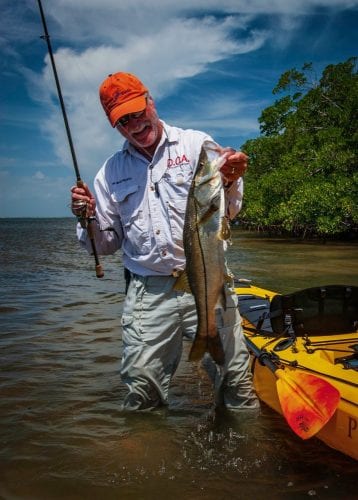
Captain Mark Nichols, of DOA Lures, with a nice snook he landed in a healthy Indian River Lagoon near Sailfish Flats during a DOA Writers and Guides Outing. – Rusty Chinnis

The problem they are addressing revolves around the excess of water that has been created by years of misguided re-plumbing that was done by the Army Corp of Engineers on the sheet flow of water that traditionally flowed from Lake Kissimmee to Lake Okeechobee and then into the Everglades and Florida Bay. This natural flow was dubbed The River of Grass by author and celebrated conservationist Marjory Stoneman Douglas.

While the scope of this article is too short to address the full issue, the problem stems from an excess of water that is channeled from Lake Okeechobee to the St. Lucie Estuary, Indian River Lagoon on the east coast and to the Caloosahatchee Estuary, Pine Island Sound near Fort Myers on the west coast. In a strange twist, that water which is devastating the fishery and habitat on both coasts is starving the Everglades and Florida Bay of the fresh water that is critical for the balanced salinity necessary for the proper functioning of those estuarine ecosystems.

Whitman, a Florida native and USCG licensed Master Captain, delivered a compelling case for all anglers and concerned citizens to get involved in reaching an equitable solution to this dire problem. He had a thorough understanding of the complex ecological, political and economic issues involved and punctuated his presentation with some sobering facts.

In the past year, more acreage of seagrass was killed in Florida Bay than exists in Pine Island Sound. On the east coast, a once-vibrant seagrass area inside St. Lucie Inlet known as the Sailfish Flat is now a bare sand flat and yielding catches of fresh water tilapia. I have personally experienced these areas and remember vast seagrass flats that yielded impressive catches of sea trout, snook, tarpon and bonefish.

Greer, a third-generation Floridian, angler and business owner, punctuated the presentation with the economic impact a healthy fishery and environment have on the Florida economy. Each year, fishing, tourism and related industries generate over $76 billion in revenue and are responsible for more than 1,300,000 jobs. All are linked to the health of Florida’s estuaries and the Everglades.

Fortunately, there is a solution that will insure the health of the estuaries, the Everglades and Florida’s economy. Whitman and Greer laid out the necessary steps that can effect this change. To learn more about the problem, the solution and to lend your support, go their website. The continued vitality of Florida’s estuaries and environment depend on the involvement of passionate anglers who value this threatened resource.

Related Coverage

Casting for recovery

Cleaning up the Sister Keys