

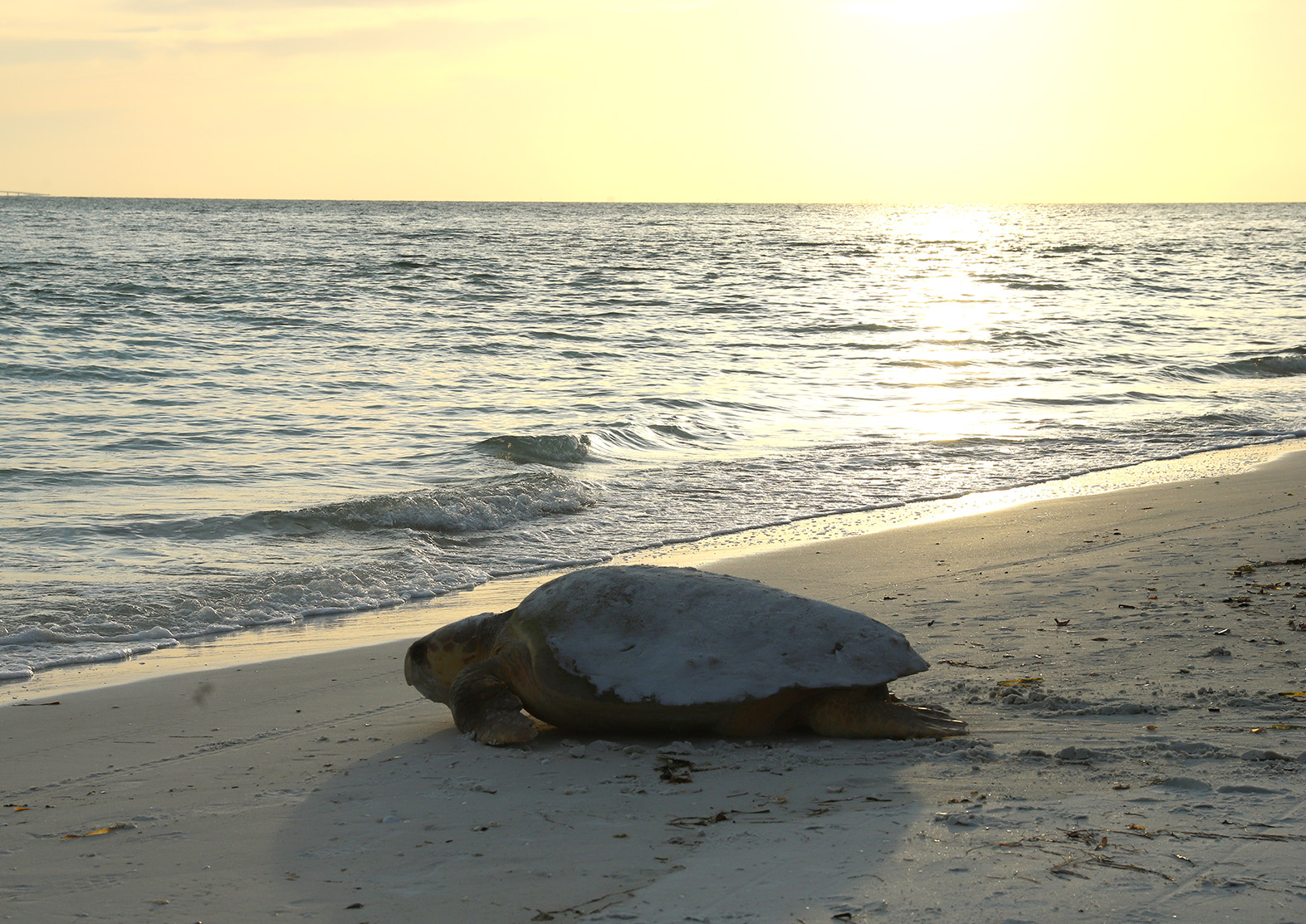
ANNA MARIA ISLAND – On the morning of Monday, June 29, or Tuesday, June 30, at approximately 8 a.m., a nesting sea turtle fitted with a satellite-monitored transmitter will be released into the Gulf on an Anna Maria Island beach.
The exact release date and location will be announced the night before the release happens. Those hoping to attend the release event can check the Sea Turtle Conservancy Facebook page or the Anna Maria Island Turtle Watch and Shorebird Monitoring Facebook page Sunday night or early Monday morning to see if the release will occur on Monday – again Monday night or Tuesday morning, if needed.
The night before the release, a sea turtle that has finished nesting on an Anna Maria Island beach will be captured, temporarily detained, outfitted with a small shell-mounted transmitter and released the following morning into the Gulf. Many researchers, volunteers and interested residents and visitors are expected to watch the turtle slip into the Gulf to begin one of nature’s oldest migratory journeys.
The transmitter-outfitted turtle will then “compete” in the Sea Turtle Conservancy’s 18th annual Tour de Turtles race that functions as the conservancy’s annual turtle migration tracking event.
According to the Tour de Turtles website, a small, low-wattage platform terminal transmitter will be attached to the turtle’s shell and used to monitor the turtle’s location and create a tracking path of each competing turtle’s travels.
According to Sea Turtle Conservancy Research Biologist and Sea Turtle Grants Program Administrator Dr. Daniel Evans, the Sea Turtle Conservancy launched the Tour de Turtles in 2008 as a satellite-tracking research initiative.
Each summer, the Gainesville-based nonprofit organization attaches transmitters to nesting female turtles at various locations across the Western Hemisphere. On Anna Maria Island, the Sea Turtle Conservancy partners with another nonprofit, the Anna Maria Island Turtle Watch and Shorebird Monitoring organization.
The race “winner” is whichever turtle swims the farthest during the three-month race window that begins on Aug. 1 and ends on Oct. 31. During and after the race window, the progress of this year’s competitors (and some previous competitors) can be viewed at the Sea Turtle Conservancy website by using the STC phone app.
Sponsored by Hurricane Hanks restaurant in Holmes Beach, last year’s Anna Maria Island Tour de Turtles entry was named Winnie. The loggerhead turtle was estimated to be 25 years old and she was released at Coquina Beach on June 23. By the time the race officially began in August, Winnie had already logged more than 100 miles in the Gulf.
In an email to The Sun, Evans said the turtle’s shell is first cleaned of algae and barnacles, lightly sanded, and wiped with rubbing alcohol to create a clean bonding surface. The transmitter is then placed toward the front of the shell and secured using a combination of epoxy putty and fiberglass. The transmitters feature a hydrodynamic design that minimizes drag and are often painted with anti-fouling paint. The total weight of the attachment remains under 5% of the turtle’s body weight. While all tags collect location data, more advanced versions can also track dive profiles, water temperatures and GPS data.
Evans said the attached transmitter is designed to be temporary and will eventually fall off naturally when the turtle sheds its outer shell layers as it grows, which typically happens every six to 12 months. While some tags can remain attached for up to two years on loggerheads, the goal is to secure a medium-term tracking device that does not have a permanent impact. Battery life generally lasts over a year, but antenna damage or biofouling can occasionally shorten the transmission window.
Evans said the transmitters are tracked by the same polar-orbiting satellite network that the National Oceanic and Atmospheric Administration (NOAA) uses to monitor global weather.
Evans said a single satellite fix can be off by miles, but over time, the pattern shows researchers where a turtle feeds and how she navigates between her birth beach and her adult foraging grounds. Loggerhead turtles use the Earth’s magnetic field as a compass, returning to nest near where they hatched decades earlier.
Evans said each turtle is also assigned a conservation cause or a threat to the sea turtle’s survival that her journey highlights. Those threats include light pollution, marine debris, illegal egg harvest, boat strikes and climate change.
The data collected from the satellite tags helps researchers track the turtles’ movements long after they leave the beach, and some of that information has changed what scientists now know. Evans said past tracking data from turtles previously released at the Archie Carr National Wildlife Refuge along Florida’s east coast revealed a previously unknown northern migration corridor. This discovery overturned assumptions that turtles mainly migrate south.