BRADENTON BEACH – The Bradenton Beach City Commission has tentatively agreed to increase the annual stormwater fee from $4.40 per 100 square feet of property to $8 per 100 square feet of property.
Mindful of the need to fund city stormwater and drainage improvements and projects, and to meet the matching fund requirements for the pursuit of state and federal funds, city commissioners, during their June 23 work meeting, voted 3-1 in favor of raising the stormwater fee to $8. Commissioner Ralph Cole opposed the fee increase and Commissioner Robert Talham was absent.
The proposed fee increase is scheduled to be formally presented in the form of a city resolution during the commission’s Thursday, July 16, meeting. At that time, a formal and final commission vote on the fee increase is expected.
According to the 2026 stormwater assessment evaluation prepared by Infrastructure Solution Services, the increase to $8 per 100 square feet would increase the city’s current annual stormwater revenues from $290,985 to $434,940, resulting in a one-year increase of $143,955.
According to the assessment evaluation, the average annual fee increase would be an additional $78.49 for the owner of a mobile home or a single-family home. The fee increase for the owner of a duplex or multifamily home would be $197 annually. The fee for shared common areas would increase annually by an average of $1,170. Commercial properties would experience a $707 average annual fee increase.
In past years, the city used a stormwater fee calculation method devised by former city engineer Lynn Burnett that included square footage and, in some cases, also included additional property-specific variables.
The average residential lot size in Bradenton Beach is approximately 5,000 square feet. If the city transitions to a simple square-footage-based stormwater fee calculation method, the owner of a 5,000-square-foot property would pay an annual stormwater fee of $220 if calculated at the current rate of $4.40 per 100 square feet of property. If the fee is raised to $8 per 100 square feet and the simple square-footage-based calculation method is used, the owner of a 5,000-square-foot residential property would pay an annual stormwater fee of $400, which would be a $180 annual increase.
Drainage projects
The assessment evaluation lists eight potential stormwater projects and the top four are ranked in order of priority.
Item 1A calls for the replacement of 150 linear feet of pipe blocks in the Community Redevelopment Agency district that extends from the southern side of Cortez Road to the southernmost property lines along Fifth Street South at a present-day cost of $75,000.
Item 1B calls for the replacement of 700 linear feet of pipe blocks throughout the city at a present-day cost of $350,000.
Item 2 calls for the purchase and installation of drainage filter inserts to be inserted at various locations at a present-day cost of $56,250.
Item 3 calls for a flood resiliency project between 9th and 12th streets north at a present-day cost of $1.88 million.
The four remaining projects on the list are a $3.12 million Avenue B flood resiliency project, a $2.53 million Avenue A flood resiliency project, a $2.75 million Avenue C flood resiliency project and a $2.77 million flood resiliency project from 22nd to 26th streets north. The assessment evaluation also lists the projected cost increases through 2031.
Commission discussion
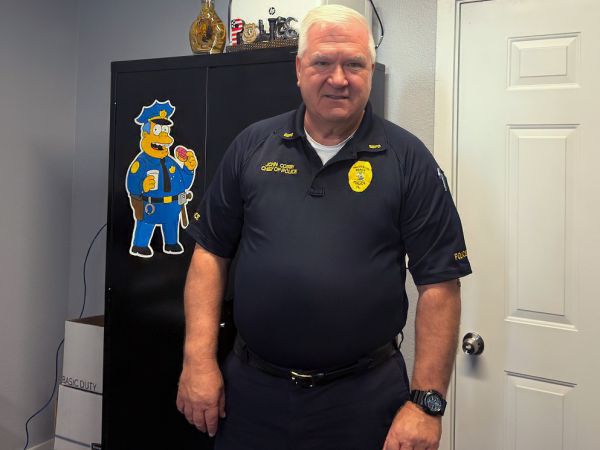
“We have not increased the rate since 2017,” Police Chief and Public Works Director John Cosby said during the work meeting.
Cosby suggested raising the fee to $8 per 100 square feet. He said with the current $4.40 stormwater rate the city is basically collecting enough revenue to cover the cost of the stormwater-related operating expenses.
Cosby mentioned the pursuit of Southwest Florida Water Management District (SWFWMD) grants that require a 50% match from the local government seeking the grant.
Regarding the city’s current financial position as it pertains to stormwater and drainage improvements, Cosby said, “There is no money for projects. Either we do something and try to move forward and get some matching money from SWFWMD and complete some of these projects, or we keep it the way it is and we just sit and let the flooding continue.”
“Have we thought about asking the county for money on this?” Cole asked. “Our taxes keep going up and we’re losing more residents. Manatee County needs to give us more of our money, or we wouldn’t be raising this right now.”
Commissioner Deborah Scaccianoce noted the property tax referendum proposed by the Florida Legislature and Gov. Ron DeSantis will be on the November ballot.
“I think Manatee County is worried about having to tighten their belts and I think asking them for money is not going to go anywhere at this point,” she said.
Scaccianoce spoke in favor of raising the rate.
“I think we need to consider the condition of the city during a storm and after a storm,” she said.
Commissioner Scott Bear mentioned the drainage improvements made in recent years on the north side of the city.
“The people in the avenues around us, even the folks that own rental properties, they see what the Avenue B project has done to improve Avenue B, so they want to see more of that,” Bear said. “When they ask about it, the question I ask is how much more are you willing to pay for that? Because right now, we can’t afford it. They see how it does improve the drainage in the area. I think they’d be willing to pay a little bit more.”
Bear mentioned the need to have shovel-ready projects planned when pursuing grants.
“We have to have shovel-ready projects and we don’t have any,” Bear said.
Regarding the fee increase, Cosby said, “That will give us some money to put aside and also go toward the projects. It will also give us the money to direct HR Green (the city’s engineering firm) to go ahead and do the work for those first three projects and get all the engineering plans ready to go.”
Cosby said the additional projects could be looked at next year or during the following year.
“By then we will have enough put away, hopefully, that we’ll have a better chance of getting a 50-50 SWFWMD match,” Cosby said.
Regarding the filter inserts included on the projects list, Cosby said, “A nice thing about the baskets and the drains is that if we know we are going to get a heavy downpour we’re just going to remove them. Everything will drain as fast as it can and as soon as it’s cleared up, the baskets will go back in.”
Bear noted the design and engineering work needed to create a shovel-ready project is generally between 6% and 10% of the total project cost.
“That’s going to be money the city has to come up with,” Bear said.
City Engineer Devyn Brown said some grants cover engineering costs and SWFWMD will accept grant applications for projects with plans that are 30% conceptually completed.
Cole said he is not willing to double the stormwater fee. He feels that with Gulf Drive being a state road, the Florida Department of Transportation (FDOT) should contribute to the stormwater expenses associated with that roadway.
“I think it (the funds) should come from a higher place,” Cole said.
Cole, who is not seeking reelection this fall, said a stormwater fee increase will not be popular.
Mayor John Chappie, Bear and Scaccianoce voted in favor of a motion to move forward with raising the fee to $8 to allow the city to put together some shovel-ready stormwater and drainage projects and to move forward with grant applications.
“This will be coming back at our July 16 meeting,” Chappie said. “It will be set up for assessments for stormwater fees for the 2026-27 fiscal year in the budget.”
When contacted on June 25, Chappie said, “Right now, we’re not receiving enough income to build up the reserve funds to do projects, or to have enough possibly for a match – and 99% of the time one of the first questions I’m asked about appropriations is whether we have skin in the game. We’re not asking for handouts. We know we have to have skin in the game and we do. It gives us a better opportunity for grants if we have a match.”
Matching grant percentages
According to the grant summary provided by Infrastructure Solution Services, SWFWMD cooperative funding initiatives require a 50% match from the city. The Florida Division of Emergency Management’s Hazard Mitigation Grant Program requires a 25% match from the city. Florida Department of Environmental Protection (FDEP) Resilient Florida Grants require a 50% match. U.S. Environmental Protection Agency (EPA) Clean Water Act grants require a 40% city match and FEMA’s Flood Mitigation Assistance Program requires a 25% city match.
FDEP water quality improvement grants and nonpoint source management grants do not require a city match, but local commitment of funds or cost-sharing gives grant applications a higher priority. FDEP water quality restoration grants require a 50% match.
The city has secured $262,000 in Community Development Block Grants that can be used as matching funds for other grants.
Related coverage: Divided Holmes Beach Commission increases stormwater fee