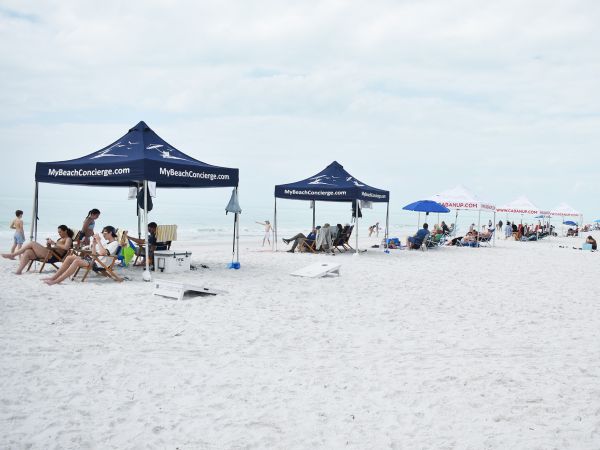
ANNA MARIA – Beach yoga classes and group yoga sessions were a topic of discussion during a Jan. 5 city commission workshop that focused largely on creating city regulations for beach cabana rentals and other commercial activities conducted in the city of Anna Maria’s parks and public beaches.
The commission is also revising the code of ordinances that currently prohibits dogs in most city parks, while already allowing dogs in City Pier Park. Dogs will remain prohibited on all city beaches.
The agenda for the Anna Maria City Commission’s Jan. 5 workshop stated the commission would discuss a draft ordinance that would revise Chapter 38 of the city’s code of ordinances – the chapter of city code that regulates parks and recreation.
The revised ordinance will be presented to the commission for the first of two readings and public hearings on Thursday, Jan. 22, which starts at 1 p.m.
Regarding recreational activities conducted in city parks and on city beaches, the proposed ordinance says, “Passive recreation involves low-intensity, non-motorized, non-organized outdoor activities that have minimal impact on the natural environment, focusing on relaxation, observation and enjoyment of nature. Passive recreation generally does not include any equipment. If equipment is involved, it is generally small, hand-held equipment such as binoculars, fishing poles, yoga mats, cameras or similar.”
When reviewing the proposed ordinance with the commissioners. Mayor Mark Short said passive recreational activities conducted in group settings would be limited to 15 people.
Commissioner Kathy Morgan-Johnson said she participated in beach yoga classes/sessions with up to 30 people and that didn’t cause any problems.
When asked if there was a fee to participate in those beach yoga sessions, Johnson said there was no fee, but the instructor sought donations.
“There’s profit there. You have to consider that,” City Clerk Amber LaRowe said.
LaRowe said an organized group activity with more than 15 participants requires a city-issued special event permit, which includes a permit fee.
City Planner Ashley Austin said an activity that involves yoga mats and recorded music would not be considered a passive activity.
“A yoga mat is the equipment necessary to run a function,” LaRowe said.
LaRowe said her previous employer, the city of St. Pete Beach, regulates yoga classes on the beach and it’s not uncommon for those events to mirror the special event permitting process because they’re essentially a special event. LaRowe said she’s also researching how other similar-sized coastal cities in Florida regulate beach yoga in a group setting.
“It’s regulated in some way, shape or form,” LaRowe said.
Commissioners Chris Arendt and John Lynch said they’d be interested to hear LaRowe’s findings.
Commission Chair Charlie Salem said he’s not aware of the city ever receiving a complaint about people doing yoga on the beach and he too would like to learn more about how cities handle this.
“How much regulation do we want to get into for something that hasn’t been a problem?” Salem said.
LaRowe said it could become a problem in the future. She said 10 years ago the city didn’t envision beach cabanas as something that could become a potential problem.
LaRowe said she wants to provide the commissioners with more information so they can make an educated decision.
Commissioner Gary McMullen said the city’s beach activity regulations should mirror the city’s special event permitting process and there shouldn’t be a conflict between those two processes.
Short said the number of participants allowed to participate in passive beach activities like beach yoga sessions would be added to his to-do list for additional research and discussion.
Sgt. Brett Getman, from the Manatee County Sheriff’s Office Anna Maria Unit, said a large group of people doing yoga at a beach access point can impede access for emergency personnel and first responders.
“Don’t block the beach accesses,” he said.
DOGS IN PARKS
Regarding dogs in parks, the revised, multi-faceted parks and recreation ordinance still says, “It shall be unlawful for the owner or keeper of any domestic animal to allow or permit any such domestic animal on any beaches or coastal barrier sand dunes.”
The proposed ordinance removes existing language that said City Pier Park was the only city park that allowed dogs, but not during the city-hosted Memorial Day and Veterans Day events held there.
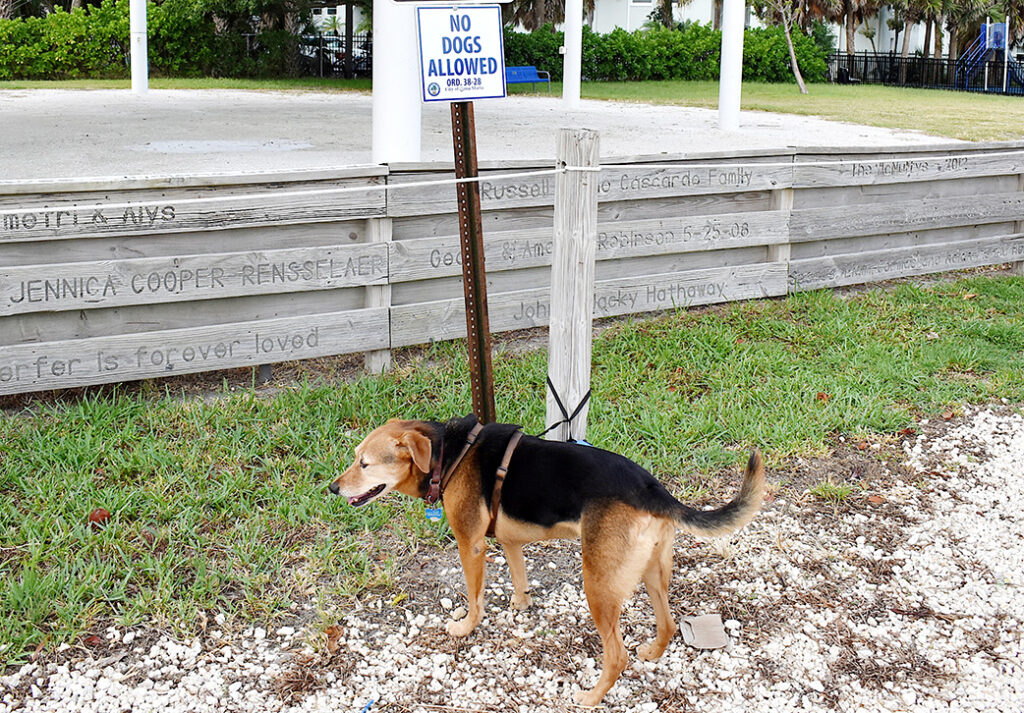
Short said he expects the revised parks and recreation ordinance to take effect March 1, which would then allow dogs in Bayfront Park and other city parks where they’re currently prohibited.
“You can walk your dog through a park now (when the ordinance takes effect), but not on the beach,” Short said.
“I like that. I’ve been run out of the Gulf Front Park roundabout for having a dog sitting with me on the bench,” McMullen said.
MORE PARK, BEACH REGULATIONS
The current definition of “parks” has been revised as follows: “Parks means and includes Bay Front Park, located on Tampa Bay from Lake La Vista Channel on the southerly end to Hibiscus Road on the northerly end; Gulf Front Park, located on the Gulf of Mexico/America from Oak Avenue on the southerly end to Magnolia Avenue on the northerly end; City Pier Park, located from the intersection of Pine Avenue and North Bay Drive to Lake La Vista Channel; and City Hall Park, being the land surrounding the Anna Maria City Hall, bounded by Spring Avenue, Gulf Drive and Pine Avenue.”
The city owns Bayfront Park, but the county maintains it according to a long-standing city/county agreement.
The proposed ordinance now defines the city’s park hours and says, “Except for emergencies, inclement weather and unless otherwise posted, all park areas are to be open to the public every day of the year from dawn to dusk.”
The proposed ordinance includes a revised prohibition on vending in city parks that says, “No person, persons, organization or other entity shall expose or offer for sale, rent or trade any article or thing; or station or place any stand, cart or vehicle for the transportation, sale or display of any article or merchandise within any city park.”