

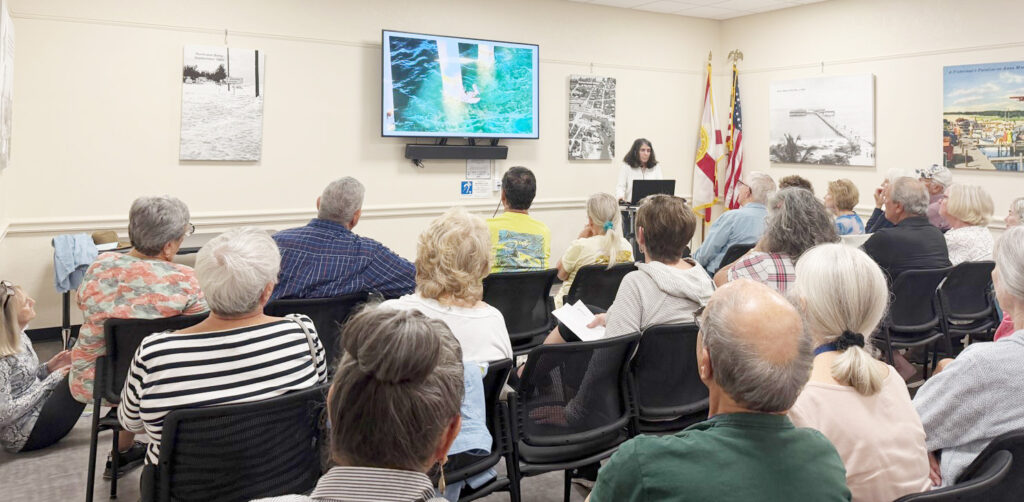
HOLMES BEACH – More than 70 people attended a Jan. 22 presentation by Friends of the Pelicans Inc. founder Jeanette Edwards.
The presentation was given at the Island Branch Library and those who attended learned about the characteristics of, and the perils to, brown pelicans.
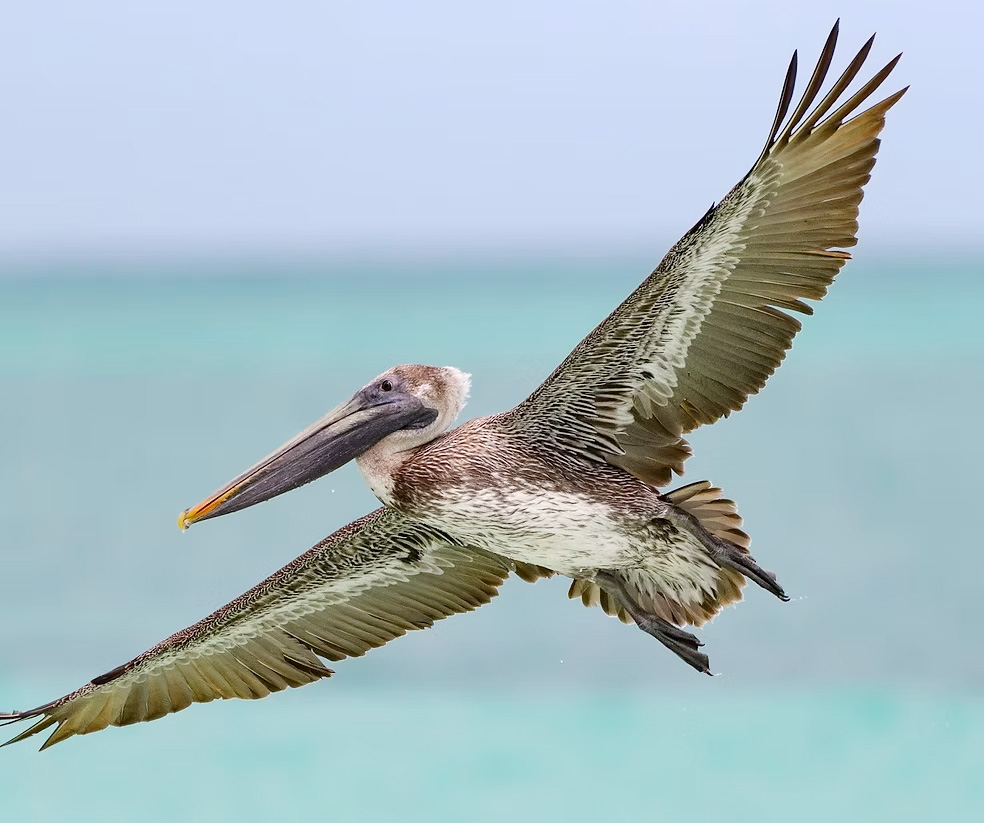
Edwards described the changing appearance of brown pelicans during their lifetime.
“A juvenile pelican is full-sized when they leave the nest. They are all gray with very white bellies and they stay like this for the first few years,” she said. “An adult pelican has a silver body, a very black belly, a white head and a white neck; and the interesting thing is, when they are ready to mate the top of their head turns yellow. After they mate, the top of their head goes back to white and they get a brown neck. It’s kind of like a wedding ring.”
Brown pelicans hover up to 100 feet in the air and their wingspan is eight feet.
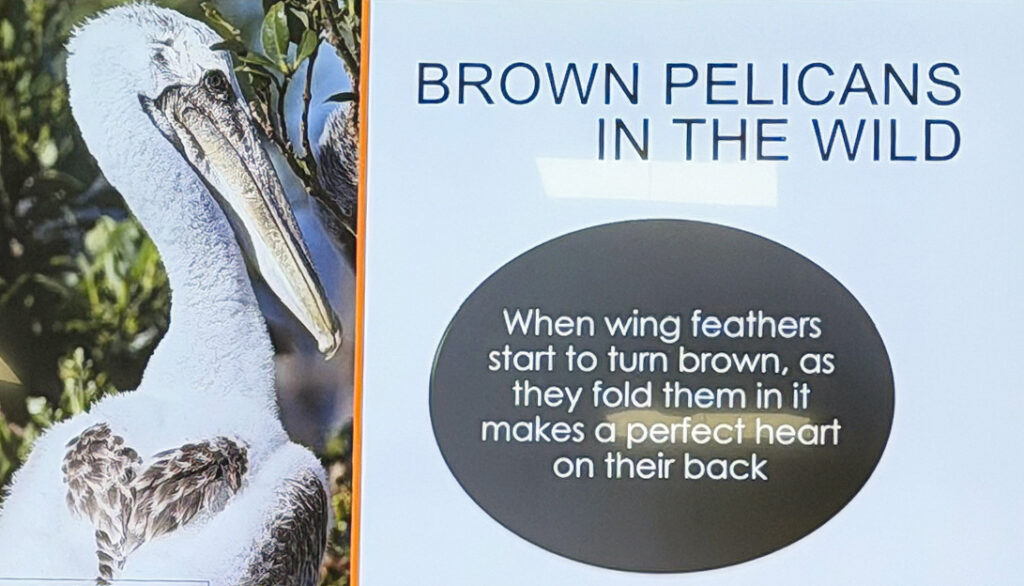
“As their wing feathers change color, when folded in they make a perfect heart,” Edwards said.
“A healthy pelican weighs between four to six pounds, but the ones that we rescue are more like two to three pounds,” she said. “They’re very underweight and often dehydrated.”
One of the perils to the brown pelican is fish carcasses found at fishing piers and boat ramps.
“Their bills act like a cast net as they gather the tiny bait fish into their mouth and they drain all the water out so they can swallow the meal whole,” Edwards said. “Unfortunately, because they have a large bill, they can eat large fish. The carcasses and large fish get lodged in their throat. They can’t get them down and they end up starving to death. If they manage to get a small part down, then often it punctures their stomach and they can die.”
She noted it’s illegal to throw carcasses and fish to pelicans, but that law is rarely enforced.
“That’s something we want to get working on – trying to get a law that says it’s illegal to throw carcasses in the water. Hopefully, that can help with the problem,” Edwards said.
Pelicans can live for 40 years, but Edwards said 30% of them won’t survive their first year.
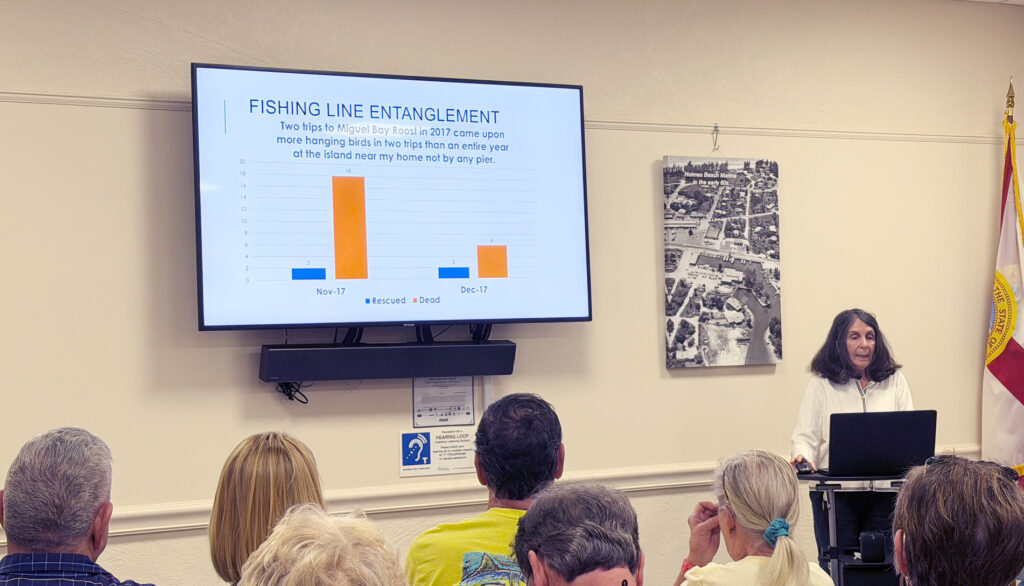
“The reason is fishing line entanglements are the number one cause of death of brown pelicans,” she said. “They make their homes in the rookeries in the islands along the coast of Florida. They have a specific home and will try to go back, even when they’re tangled up in line or dragging a fishing pole.”
She said bait is most abundant at fishing piers, which is where most entanglements in fishing line happen.
“The longest and highest fishing piers in the country are the Sunshine Skyway fishing piers,” Edwards said. “Every day, pelicans are hooked and entangled at both the north and south pier. We’ve estimated that 10 pelicans a day are hooked.”
Edwards showed videos of pelicans she and volunteers have rescued at Miguel Bay, near the south Skyway fishing pier.
“After being entangled at the fishing pier, brown pelicans go home to their rookeries. This is a sight most people never see, and what we hope to prevent is the way they suffer and die alone and struggling,” she said.
Edwards’ presentation was part of the Friends of the Island Library “Lecture and Travel Series” that takes place each Thursday afternoon through February.
For more information about pelicans, visit friendsofthepelicans.org.