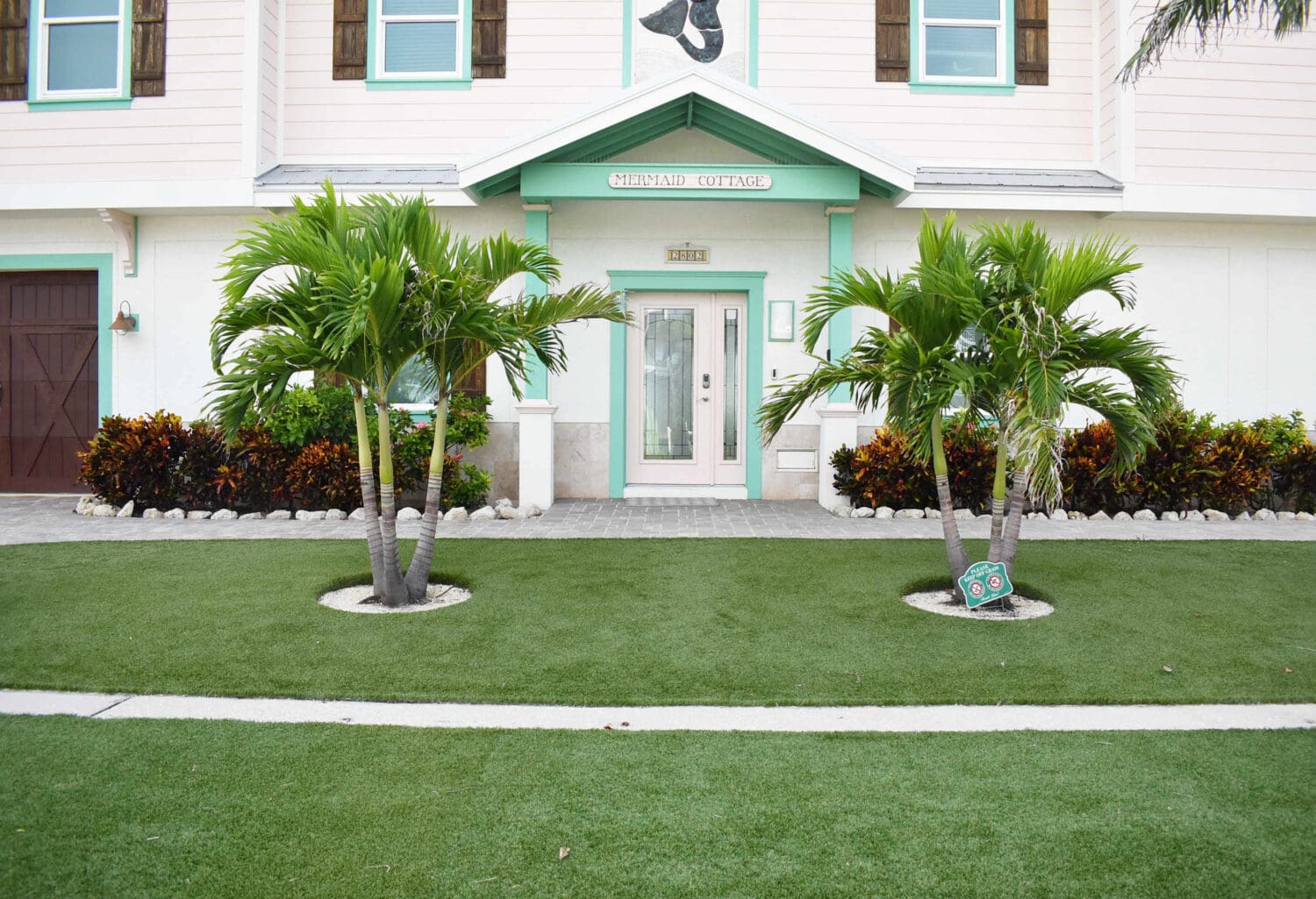
HOLMES BEACH – The city’s ability to prohibit artificial turf in front lawns and require artificial turf permits will soon be eliminated by a new state law.
The law was created by the Florida Legislature’s adoption of Senate Bill 712 and House Bill 683. Gov. Ron DeSantis signed the legislation into law in June and the new state law will take full effect when the Florida Department of Environmental (FDEP) adopts the specific rules and regulations that local governments must follow.
According to Florida Statute 125.572, “synthetic turf means a manufactured product that resembles natural grass and is used as a surface for landscaping and recreational areas.”
The new law requires the FDEP to adopt minimum standards for the installation of synthetic turf on single-family residential properties 1 acre or less in size. The standards must take into account material type, color, permeability, stormwater management, potable water conservation, water quality, proximity to trees and other vegetation and other factors impacting environmental conditions of adjacent properties.
Upon FDEP adoption of the state’s new synthetic turf rules, a local government may not:
- Adopt or enforce any ordinance, resolution, order, rule or policy that prohibits, or is enforced to prohibit, a property owner from installing synthetic turf that complies with FDEP standards which apply to single-family residential property; or
- Adopt or enforce any ordinance, resolution, order, rule, or policy that regulates synthetic turf which is inconsistent with the FDEP standards adopted pursuant to this section which apply to single-family residential property.
Prior to the adoption of city ordinance 22-24 in January 2023, the city of Holmes Beach did not regulate the use of artificial turf. Artificial turf front yards installed before the city ordinance took effect were allowed to remain as legal, non-conforming uses.

The city’s current artificial turf regulations apply to all residential zoning districts and also to the C-1, C-2 and C-3 commercial-zoned districts. Artificial turf installations currently require a city-issued permit and a post-installation inspection.
According to current city code:
- Artificial turf is allowed in rear and side yards, but not to exceed 10% of the total pervious surface area of the lot;
- Artificial turf shall not be allowed in any front yard areas, unless confined to parking and driveway areas and placed between paver blocks or similar items where the artificial turf does not exceed 4 inches in width;
- Artificial turf shall consist of green lifelike individual blades of grass that simulate the appearance of live turf, organic turf, grass, sod or lawn; and
- Artificial turf shall be lead free and flame retardant.
FDEP rules
Holmes Beach Director of Development Services Chad Minor discussed the new state law with planning commissioners on Aug. 6 and provided them with copies of the FDEP presentation given during the synthetic turf standards public rule-making workshop FDEP conducted the previous day.
The FDEP presentation says, “Per Florida Statute 125.572(2), the FDEP standards must take into account material type, color, permeability, stormwater management, potable water conservation, water quality, proximity to trees and other vegetation and any other factors impacting the environmental conditions of adjacent properties. Turf materials must be lead-free, must be disposable under normal conditions at any Florida landfill and rubber materials cannot be used infill.
Public input was taken during the FDEP workshop and written comments are being accepted through Aug. 19 by email at DWRA.Rulemaking@FloridaDEP.gov.
Minor said he provided the FDEP with a copy of the Holmes Beach ordinance and the city’s contracted lobbyist also communicated with the state agency. Minor said the lobbyist asked the FDEP to “tread carefully” when developing the state’s new artificial turf rules.
“It impacts more than you think,” Minor said.
Minor said FDEP didn’t provide an estimate as to when the new synthetic turf rules will be implemented.
Local impact
“We spent months developing an artificial turf ordinance,” Minor said of the 2022 and 2023 regulatory efforts that included insights provided by industry experts and University of Florida experts.
“The Legislature has now adopted rules that preempt the city from requiring a permit for installing artificial turf for single-family homes under 1 acre, which is 90% of the property we have in the city,” Minor said. “As soon as those rules are adopted by FDEP, our ordinance is essentially negated.”

Minor said a city permit won’t be needed to install artificial turf and he doubts FDEP will require a permit.
“We are not going to be able to ask for anything,” he said, noting the city will still retain some regulatory authority for artificial turf installations at duplexes and other multi-family residential structures.
Planning Commissioner Gale Tedhams wondered why the Department of Environmental Protection would support these measures.
“Let’s put plastic everywhere,” she lamented.
Minor noted the Legislature imposed the new law and rule making process on the state agency.
Tedhams asked whether the city’s pervious/impervious surface drainage regulations could be used to regulate artificial turf. Minor said the city attorney doesn’t feel there’s much the city can do to offset the new state law.
“Well, that’s sad,” Tedhams said. “That’s why I question the title of ‘Department of Environmental Protection.’ They don’t protect anything.”
According to the Municode website, the cities of Anna Maria and Bradenton Beach do not regulate artificial turf.