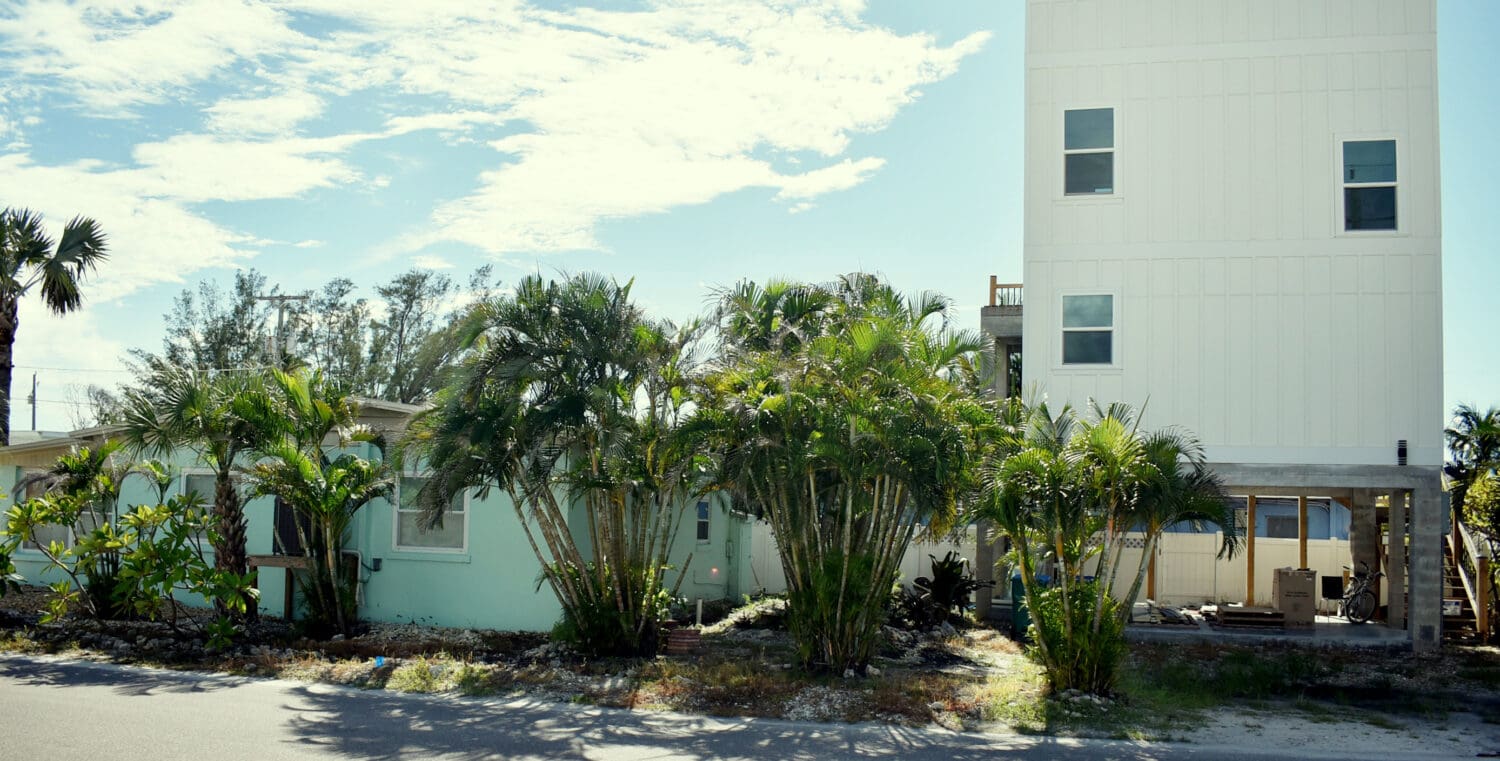
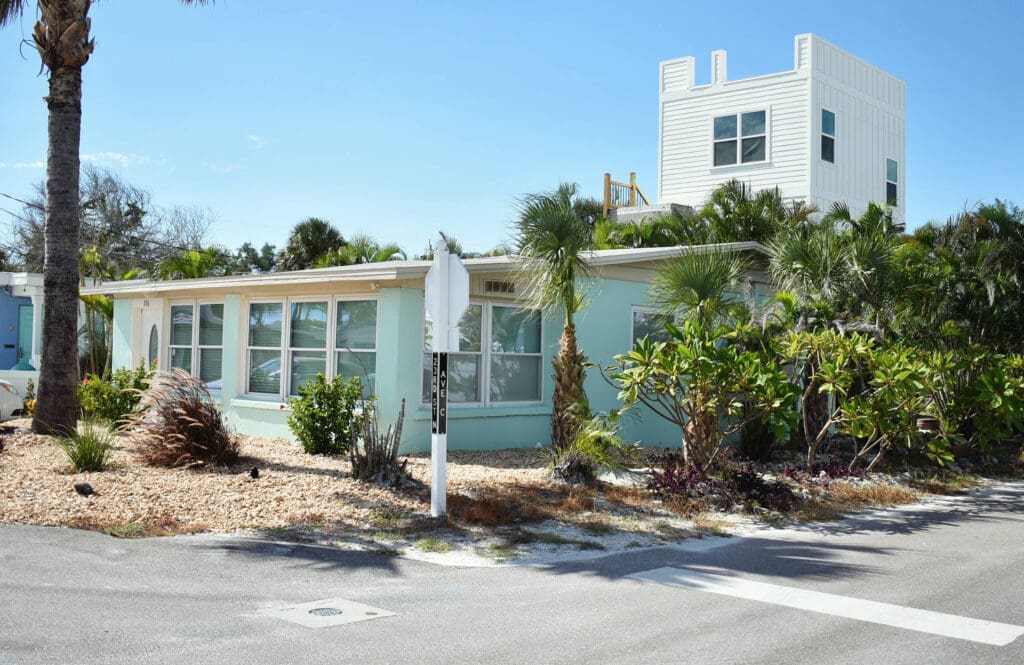
BRADENTON BEACH – Following discussions that spanned several city commission meetings, commissioners tentatively approved a separate but attached structure at 106 23rd St. N. as a non-compliant use at the Sept. 18 meeting.
The addition, which was constructed in place of a garage that was removed, had been permitted by the former city building official and land planner and was nearly completed when city Building Official Bill Palmer said it did not meet city code.
Palmer deemed the new structure as a utility building but said homeowner Neal Morse did not want utility occupancy, and instead requested it to be approved as living space.
“The utility building fits very well because it’s a bonus room and a game room. The only limitations are that it can’t be used as a dwelling,” Palmer said at the Sept. 18 commission meeting. “You can’t live in it, you can’t sleep in it and it can’t be a permanent residence.”
Palmer said for the structure to be classified as a duplex, there would need to be a common roof.
“You couldn’t attach a new building to an existing building and say that’s a duplex,” Palmer said. “The sticking point is that he plans on using this as a dwelling.”
Palmer also said the maximum lot coverage limit was exceeded and could be remedied if some pavers were removed from the 4,200-square-foot lot.
“The rooms are listed as a game room and a bonus room,” Palmer said. “The Land Development Code requires two parking spaces for the first 1,200 square feet plus one parking space for each additional portion of 600 square feet, so basically for those structures we would need two parking spaces for each unit.”
Attorney Scott Rudacille, representing Morse, spoke to commissioners at the Sept. 18 meeting.
“It’s not going to be a perfect solution but there needs to be a solution to move it forward,” Rudacille said.
Rudacille described the background of the project.
“This is a process that started several years ago when Steve Gilbert was the building official,” he said. “The concept of having living space in a separate structure, because you have to remember, here is an existing ground level cottage, there was an existing ground level garage that had a non-conforming unit in it, and the options to add living space are limited by FEMA restrictions.”
He said prior to construction, the project was reviewed not only by Gilbert, but by City Planner Luis Serna and former Building Official Darin Cushing.
“And the concept was, separate structure but same dwelling that can’t be rented separately, it’s all part of the residence,” Rudacille said. “And that was the way it was constructed. The property was surveyed to demonstrate it met all the setback requirements. There was a question about the height. There was concern about having two electrical meters, so the property owner has agreed to have electrical service relocated so that it can run through the cottage.”
“I don’t understand the issue; the property owner has also agreed that the two structures will be treated as one. They agree they won’t be rented separately,” he said. “They’ve got enough parking spaces even if you count those as bedrooms.”
Vice-Mayor Deborah Scaccianoce expressed concern about how the dwelling is designated.
“If it’s a bonus room and game room, OK,” she said. “If they were going to replace the garage that was damaged from the storm they would not have been allowed to put a non-conforming dwelling on top of it again. They would have been allowed to build a garage. I want to make sure we’re clear on what the use of this is going to be. I’m not comfortable with it being used as a dwelling or sleeping accommodations.”
Commissioner Scott Bear said, “I have concerns as well since we’re not labeling either of the spaces as a bedroom. If it was listed as a bedroom, then there would be a limitation of how many people per room.”
“The concerns I’m hearing sound more like concerns with your vacation rental ordinance that with this property,” Rudacille said. “They could have cleared the lot and have built the exact same space with bonus rooms and bedrooms. They have the same amount of square footage there as if they had started from scratch.”
Rudacille said the added space will be used in conjunction with the house, and is living space, but not a separate dwelling unit.
“You can say it’s R-2, it’s residential, but they didn’t permit it that way,” Scaccianoce said. “I don’t think it was handled correctly. Now we’re changing all that on the fly.”
“If it was connected none of these things would be an issue. The only reason we’re discussing any of this is because there’s a gap between the buildings,” Rudacille said.
Mayor John Chappie said he was concerned about setting a bad precedent.
Commissioner Ralph Cole noted that a permit for the project was issued by the city.
“In fairness, I think it should be deemed a non-compliant building with some stipulations,” Cole said.
Scaccianoce asked if the permit could be amended so it reflects the actual use of the property.
“It depends on how you want to go. If you want it to be an R-2 occupancy type, then it would require bedrooms and kitchen,” Palmer said.
Chappie recommended that Rudacille and the city attorney create language so there is a clear understanding that if approved, it is a non-compliant structure and if the building is destroyed, it would have to be brought back into full compliance.
City Attorney Ricinda Perry, since retired, weighed in.
“The question is how can the city protect from setting precedent to have what was approved by our building official after Steve Gilbert reviewed it and said you can’t have two residential dwelling units on one substandard lot,” she said. “We have the new set of plans and as Debbie Scaccianoce pointed out, it didn’t have anywhere on the plans that it said bedrooms. There are two residential dwelling units per our building official on this property.”
“I can give you a solution to avoid setting precedent,” Perry said. “Non-conforming structures do that. You can’t add on. The other part about a non-conforming structure is if something happens to it, you have to come into compliance with the codes.”
She said if all parties are agreeable to setting limitations on the property, a settlement agreement between the city and the homeowner can be drafted to spell out details.
“You clearly spell out what this building should have been, what it is, what the unusual circumstances are and what the limitations are on it,” Perry said. “My recommendation is you accept it via a resolution. It lays out it’s an unusual set of circumstances, and is not intended to set precedent moving forward. I think the city would be in a good position to say no to the next one that walks in the door.”
Palmer said he would be comfortable having the structure classified as an R-2 occupancy as long as the additional rooms are labeled as bedrooms.
Commissioners reached a consensus agreeing to have a settlement agreement drafted that spells out all stipulations.