

Tag: Unicoi Outfitters

Reel Time on the Road: A Drift on the Chattahoochee

Reel Time on the Road: A Drift on the Chattahoochee

“Eventually all things merge into one, and a river runs through it.” Norman Maclean, “A River Runs Through It”

I have always had a fascination with rivers. As an angler more at home in saltwater, rivers are an enigma of sorts. Flowing rivers are often metaphorically used in life by spiritual masters like Buddha and Gandhi. One of those rivers, the Chattahoochee, flows near our cabin in Sautee.

I have fished the upper reaches of the river for years but only recently was introduced to a “lower” section of the river about 15 miles downstream from Helen, Georgia. Last week, my wife and I floated the river from the Highway 115 bridge to Wildwood Outfitters at the foot of the Duncan Loop Bridge. The trip along the river is like a liquid hike, showcasing some of the most picturesque features of the Unicoi Mountain foothills.

Dense forests cascade down steep slopes lined with garlands of mountain laurel, wild roses and multicolored wildflowers. The river has exposed metamorphic and igneous rock that date from the Precambrian to the early Paleozoic period, approximately 1 billion to 450 million years ago. The tapestry of brightly colored flowers, trees flush with springs green leaves and the ancient boulders wrapped in lichens were a feast for the eye and a bit of a distraction for an angler.

Our guide, Wes McElroy, of Unicoi Outfitters in Helen, introduced me to the river a couple of years ago (as reported in Reel Time in 2022). Since then, it has been on my A-list when we visit the area; and on this trip, I wanted to introduce my wife, Christine, to the river’s natural bounty. We didn’t plan this as a fishing trip, as I have always done before, because I wanted to enjoy the beauty of the float as well as get in a bit of fishing too.

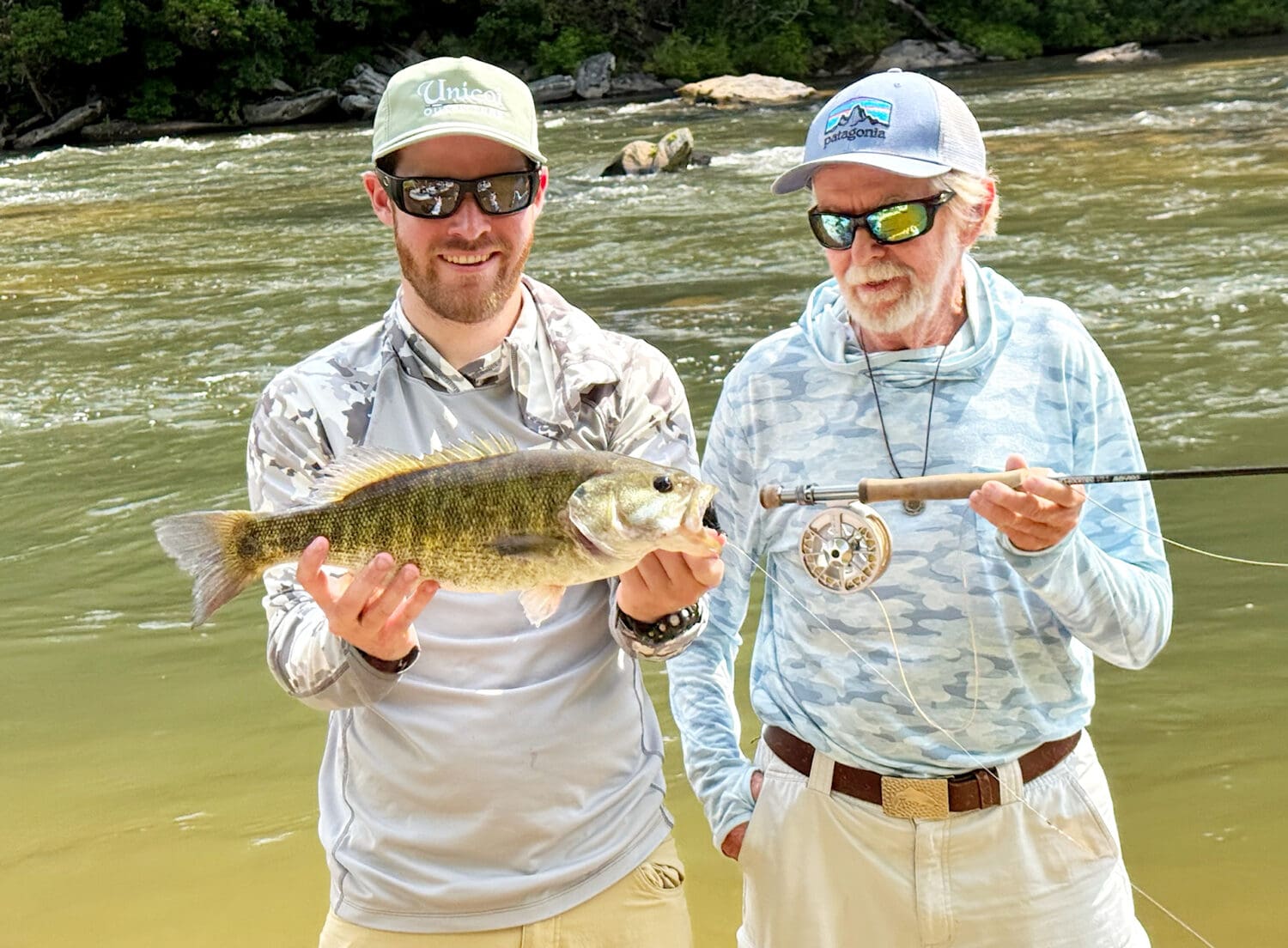
The shole bass we targeted on this part of the river are bedding in May and require the knowledge of a seasoned guide like McElroy to locate. As a native Georgia freshwater fish species, shole bass are primarily found in the Chattahoochee and Flint rivers and are often confused with largemouth bass. When the bass are on the bed guarding their new brood, they don’t feed actively but a well-placed cast will elicit a defensive strike. McElroy has developed a keen eye for the areas where shole bass make their beds so we interspersed some targeted casts along the way. Over a four-hour float, we managed to get a number of strikes and caught two large shole bass.

One of the catches happened as I was casting from a sandy bank where we had beached the boat. I hooked a nice male that spit the hook; and figuring it was guarding a bed, I made another cast in the same direction. On the retrieve, I felt a tap and suddenly saw a large female tracking my lure up the sand bank. It made several lunges before it tipped up and took the imitation. Following McElroy’s advice, I waited a split second before setting the hook. The fish made several short hard runs before thrashing at the surface and giving McElroy an opportunity to net it. After several quick pictures, we revived the fish and set it free.

Getting a chance to actually sight-fish a shole bass in the river’s swift current was an experience I’ll never forget, and a fitting end to a beautiful day in the mountains of north Georgia. If you ever find yourself in this part of the world, I highly recommend a float down one of the south’s most beautiful rivers.

To get information on fishing the area, or to book a trip, contact McElroy at Unicoi Outfitters, 706-878-3083 or check out their web site, www.unicoioutfitters.com.

Here’s a short video from Rusty’s Chattahoochee River drift.

Carpe diem

Carpe diem

The sound wasn’t exactly deafening but it enveloped me as I stepped out of the car at the boat ramp. Located on the South Carolina side of Lake Russell, an impoundment of the Savannah River, the forest that surrounded the border between Georgia and South Carolina was humming with the sound of cicadas. These insects, known as Brood XIX, have a 13-year life cycle and provide a rare opportunity for fly anglers in the Southeast. Their numbers, truly biblical in proportion, have been estimated in the trillions and when some inevitably fall into the water, carp rise to feed on them.

My wife, Chris, and I had just arrived in Sautee on a yearly vacation to northeast Georgia when I got the call from Unicoi Outfitters owner Jimmy Harris to join him and store manager Wes McElroy to fish for carp. While I was aware of fly anglers targeting carp, this was the first time I had ever had the opportunity and I jumped at the chance. Readers of this column will have heard of McElroy and Harris, both of whom have provided me with some unique opportunities over the years, including fishing for stripers in the Chattahoochee and Lake Lanier and shoal bass on several local rivers. This trip was going to be special.

The weather this spring has been particularly wet, and while I was concerned about the forecast 80% chance of rain, I’ve learned never to cancel a trip based on the weather guessers. As it turned out, it never rained a drop while we were on the water, and we experienced one of the most beautiful days of the trip. McElroy is an excellent fly angler and fly tier and he extensively researches every species he pursues. For this trip, he had tied two dozen flies that almost perfectly matched the brood that would litter the water and bring carp to the surface to feed. We began by slowly moving along the edges of the lake looking for cruising carp. During the first hour, the carp seemed concentrated in certain areas, and we only boated a couple of fish. As the day wore on and the forest warmed, the cacophony intensified, and carp began to rise at almost every cove we visited. The next challenge for me was to time the strike after a carp had taken my fly, a task that proved a bit perplexing. I’m familiar with waiting a split second after a snook hits a top water fly but carp take this patience to a new level. The trick turned out to be to strike only after they had inhaled the fly and turned away. It was such a long wait that we joked about getting a hit, having lunch and then setting the hook. For the balance of the afternoon, we took turns throwing at carp and had some incredible action. In the end, we boated close to 20 fish ranging up to 10 pounds. We left the lake late that afternoon satiated with the action and relived the day on our way back to Clarksville.

If you’re ever in the area, make a point of visiting one or both of Unicoi Outfitters’ excellent shops and inquire about the fishing. There is excellent trout fishing nearby on their private water at Nacoochee Bend as well as other local rivers and lakes. Plan a trip by visiting their website at www.unicoioutfitters.com. Check out the action in this YouTube video: https://youtu.be/zHYhls4VXxY?si=dWGT4hSftCup34US

Reel Time on the Road: The Chestatee

Reel Time on the Road: The Chestatee

Over the years I’ve had the pleasure of fishing many of the finest trout streams in north Georgia, like the Soque and Chattahoochee as well Duke’s and Noontotla Creek. Always looking for a new adventure, I was intrigued when I overheard a conversation a couple of years ago at Unicoi Outfitters in Helen, Georgia. Two of the guides were talking about floating the Chattahoochee River for shoal bass.

Shoal bass are in the sunfish family and a member of the black bass family. It wasn’t until 1999 that they were reclassified as a unique species, having been considered a red eye bass. Shoal bass are similar in body shape to a largemouth bass but, unlike the largemouth, they have scales on the base portion of the second dorsal fin, their first and second dorsal fins are clearly connected, and their upper jaws do not extend past the eye. Shoal bass also lack the dark lateral band that largemouth have with vertical stripes which resemble tiger stripes.

Although historically found as far south as the Apalachicola and Chipola Rivers in Florida, habitat degradation has all but eliminated shoal bass from those rivers proper. Now their range is limited to tributaries including the Chattahoochee, Flint and Chestatee. They primarily eat crayfish but will also eat a variety of fish and insects. Shoal bass are primarily found among river shoals with fast-moving water and can also be found in the deeper pools containing limestone formations above and below the shoals.

In the spring of 2022, I booked McElroy to experience a Chattahoochee float and quickly fell in love with this type of fishing. This led to another trip with McElroy and Unicoi Outfitters owner Jimmy Harris, and I was hooked. On those two trips our primary target were shoal bass, although we also landed a nice striper.

On a recent trip to Georgia, I had the opportunity to float the Chestatee with McElroy and my friend Bob Seeger, a transplant from Longboat Key now living in Blue Ridge, Georgia. We started the day meeting McElroy at the takeout point where we moved all our gear into his truck and drove approximately 15 miles upstream to a launching point. After unloading the raft, McElroy guided the raft down a very steep embankment to the edge of the river. At this point in the river there was a very significant rapid that we decided to watch McElroy shoot and then joined him a short distance downstream. Unfortunately, there had been a fairly significant rain the night before our trip and the river was high and muddy. We had been warned in advance that these conditions all but shut down shoal bass from feeding. Despite the condition of the water, over the course of the next six hours we enjoyed a beautiful float past riverbanks festooned with flame azaleas, dogwoods and mountain laurel under a deep blue sky with puffy, white clouds floating overhead. And despite the odds, Seeger managed to land his first-ever shoal bass. This a trip I highly recommend. To experience it for yourself, contact Unicoi Outfitters at 1-706-878-3083 or visit their website.

Reel Time: The land of shining water

Reel Time: The land of shining water

Noontootla is a word derived from the language of the Cherokee Nation in northeastern Georgia. The translation, “land of shining waters,” perfectly describes Noontootla Creek, an 11-mile tributary of the Toccoa River that originates in the mountains near the southern terminus of the Appalachian Trail on Springer Mountain.

Reel Time: The land of shining water
Chuck Head, left, and Bob Seegar prepare for a day on Noontootla Creek. – Rusty Chinnis | Sun

The small mountain stream is managed as a “natural” stream and holds the healthiest population of “bright” rainbow and brown trout I have encountered in the east. Last week I had an opportunity to fish the creek where it passes through Noontootla Creek Farms, a thousand-plus acre property that was converted from a large farm operation and private hunting club. The property is now open to the public and features excellent trout fishing, quail hunting and an impressive sporting clays course.

The property has been on my list of places to fish for a few years, but it was this trip to Georgia when it all came to fruition. I booked with Unicoi Outfitters in Helen, Georgia just outside of Sautee Nacoochee where our cabin is located. I’ve fished with owner Jimmy Harris and his excellent staff of guides over the years and depend on them to set me up with a knowledgeable guide. I’ve always been pleased, and this trip was no exception. I fished with my friend Bob Seegar from Blue Ridge, Georgia. Bob and his wife, Judy, relocated to North Georgia after many years in Longbeach Village and we have made it a ritual to go fishing when we reconnect in Georgia and Florida. Our guide for the day was Chuck Head, a third-generation area native who guides fly fishers in Colorado during the summer.

https://youtu.be/gM5t-sC7Xgw


                                                                                                                     Video by Rusty Chinnis

We met Head at 7:30 a.m. and were on the stream fishing at 8:00 a.m. Seegar fished a double nymph under a strike indicator while I elected to try a dry dropper, a dry fly that doubles as a strike indicator for the nymph. It didn’t take long for me to convert as Seegar had landed three fat rainbow trout before I had a hit. That’s why Head originally suggested the double rig under an indicator. The stream’s fast-flowing water required split shot to get the flies down to the bottom where the trout feed on the aquatic stages of various insects. A dry fly wasn’t buoyant enough to support the added weight. After re-rigging, I was into fish immediately. What made these fish special was their beautiful colors and strong fight. They very closely resembled the bright native trout found out west. I almost always fight trout by hand, but after a couple of break-offs, I started clearing the line and fighting them on the reel. This experience was a perfect opportunity to test my new Hardy 5-weight fly rod and reel. The smooth drag and fast rod made the fight a blast.

Reel Time: The land of shining water
The author prepares to release a brightly colored Noontootla rainbow trout. – Submitted

Seegar is fairly new to fly casting, especially since our times on the water are widely spaced, but has always proved a quick study. This was no exception and in the eight hours we fished, we both had what was arguably our best fishing trip ever. Over the course of the day, we landed close to a dozen rainbow trout, each in the 20- to 24-inch range. This was one of those days that fishermen know to savor as the combination of camaraderie, weather and fishing made for a memorable experience, one I look forward to repeating. If you’re ever in this part of the world, I highly recommend contacting Unicoi Outfitters to experience this and their other excellent trout fishing waters. Check them out on their website. The land of shining waters will not disappoint you.

Reel Time: Stripers on the Hooch

The Chattahoochee River has an intimate connection with Florida, one that existed long before I first visited it near its headwaters at Jack’s Knob in northeastern Georgia.

It flows for over 400 miles, merging with the Flint and finally the Apalachicola River at the Florida Georgia border before emptying into the Gulf of Mexico at Apalachicola Bay. Since my first visit nearly 30 years ago, I have enjoyed fishing its upper reaches for rainbow, brown and the occasional brook trout.

Recently, I was introduced to an entirely new fishery by Jimmy Harris, owner of Unicoi Outfitters, and Jeff Durniak, a Trout Unlimited award-winning trout conservationist and Georgia DNR fishery biologist. Striper bass or stripers as they are commonly known are an anadromous (adapted to fresh and saltwater) fish, so in some regions, their upriver spawning migrations led some individuals to become landlocked during lake dam constructions.

Georgia’s Lake Lanier stripers were introduced to control an invasive forage fish. In recent years, abundant rainfall in the southern Appalachians and the subsequent high water has made it possible for populations to travel upstream as far north as the Nora Mill Dam near Helen. As luck would have it, this dam lies right behind Unicoi Outfitters and just 10 minutes from our cabin in Sautee. When I got a text from Harris that he and Durniak were fishing the river for stripers after closing, I jumped at the chance.

While I had heard of fish up to 20 pounds being hooked, I had no idea what to expect. The opportunity to fish with Harris and Durniak was reason enough to don waders that afternoon, but the experience was an eye-opener. We started fishing at the base of the dam at Nora Mill, which forms a barrier to the stripers that migrate up the Chattahoochee from Lake Lanier. This spot, as well as Unicoi Outfitter’s one and a half-mile stretch of the river leading up to it, concentrate the fish on their mission to spawn, search for food and find cooler waters.

I was fishing a seven-weight outfit and a large, flashy baitfish pattern. It only took two casts before I was hooked up with a small striper, and then in quick succession, Harris was hooked up, and then I missed another bigger fish. At Harris’ suggestion, we moved further downriver fishing the deep runs, pools and pockets along the way.

Harris positioned me on a rock that jutted out into the current and showed me how to swing the fly and work it in the swift current. On my third cast, a big striper crashed the fly on the surface and made a downstream run that threatened to have me sprinting after it. Fortunately, I was able to turn him at the last moment, fighting him back upstream from pool to pool. After another two or three spirited runs, we were able to slide the striper up on a shallow ledge where Harris landed and released him. We estimated the fish weighed about 9 pounds.

 Stripers on The Hooch
Jeff Durniak holds a striper taken on the Chattahoochee River just below the Nora Mill Dam. – Rusty Chinnis | Sun

I began to fish the same water again but soon became aware of Harris photographing Durniak, his rod doubled on a nice fish. Hurrying just downstream from the dam, I was able to get some good shots of the striper before it was released. I went back to fishing, but the action had slowed and the light was fading from the river. Durniak and I met Harris as he was returning from the base of the dam where he had hooked a fish that he thought was a rock. After tugging on the obstruction a couple of times, it took off and broke him off. Looking back up at the deck at Nora Mill heath, several bystanders indicated with outstretched arms that the fish had been a big one.

I thoroughly enjoyed my time on the river and the unexpected action on the stripers made it even more special. It’s always a treat to experience a new fishery and especially one that’s new to even those anglers living nearby. The run of striper just adds to the special nature of a place already on my top 10 list. This is partly about the quality of the fishing but also the level of expertise and professionalism exhibited by those associated with Unicoi Outfitters. To reach Unicoi Outfitters and experience the excellent fishing visit their website or call 706-878-3083.

More Reel Time:

Reel Time: Exploring the Ten Thousand Islands

Reel Time: Sister Keys cleanup scheduled

Reel Time: When opportunity meets preparedness