Tag: Manatee County red tide

Red tide health alert issued for three locations

BRADENTON BEACH – The Florida Department of Health in Manatee County (DOH-Manatee) has issued health alerts due to the presence of red tide at the 10th Street Pier, 100 10th St. S. and the Coquina Beach South Boat Ramp, 1465 Gulf Drive S. in response to water samples taken on Nov. 18.

The red tide health alert issued on Nov. 15 for the former location of the Rod and Reel Pier, 875 N. Shore Drive, Anna Maria, remains in effect.

The red tide organism, Karenia brevis, was observed at very low to medium concentrations in Manatee County by the Florida Fish and Wildlife Conservation Commission (FWC) on Nov. 18.

Medium concentrations were reported at the Longboat Pass Boat Ramp. Low concentrations were reported near the former location of the Rod & Reel Pier and at Coquina Beach and Cortez Beach. Very low concentrations were reported at the Palma Sola Bay Bridge.

Fish kills suspected to be related to red tide were reported to FWC’s Fish Kill Hotline over the past week offshore of Manatee County, according to the FWC.

Residents and visitors are advised to take the following precautions if near affected areas:

• Look for informational signage posted at most public beaches and/or check current water quality status at Protecting Florida Together;

• Do not wade or swim in or around red tide. Red tide can cause skin irritation, rashes, and burning/sore eyes;

• Wash your skin and clothing with soap and fresh water if you have had recent contact with red tide, especially if your skin is easily irritated;

• Remain cautious and stay away from these locations, especially if you have chronic respiratory conditions;

• Residents living in beach areas are advised to close windows and run the air conditioner. Make sure the air conditioner filter is maintained according to manufacturer’s specifications; and

• Do not harvest or eat molluscan shellfish or distressed or dead fish from these locations. If caught alive and healthy, finfish are safe to eat as long as they are filleted and the guts are discarded. Rinse fillets with tap or bottled water.

Red tide can cause illness and death of other animals, such as pets and livestock. Keep animals away from and out of the water and away from dead marine life. If your pet swims in waters with red tide, bathe it with soap and water as soon as possible.

Local crews keeping beaches clean

Local crews keeping beaches clean

ANNA MARIA ISLAND – After more than three weeks of west winds pushing red tide and subsequent dead fish toward local Gulf of Mexico beaches, an easterly wind shift on Thursday gave some beachgoers a slight respite.

“We’ve been fighting the west wind for weeks,” said Mark Taylor, Manatee County Natural Resources employee and the operator of a mechanical beach-cleaning rake. “We appreciate a little break, the east wind is our friend.”

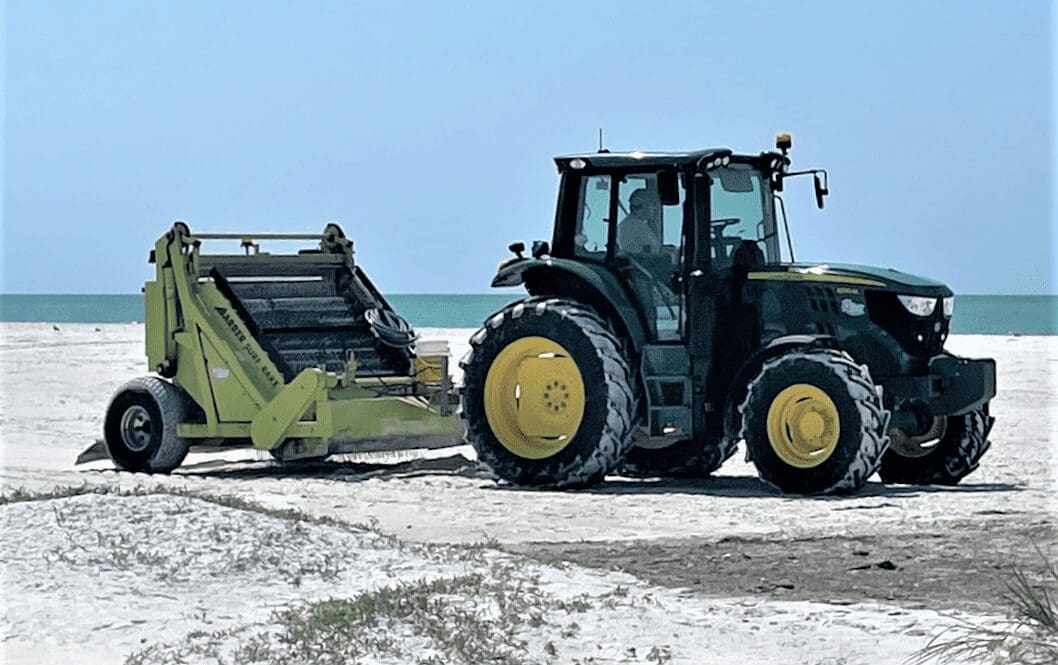
The beach rake that Taylor drives along the beaches has a spring-loaded conveyer with stainless steel tines that scratch the surface of the sand and pick up debris, including dead fish.

“We try to do the public beaches first,” he said. “That’s our priority always. They populate early with fish and it’s been a heavy amount of them.”

The fish go up the belt and are dumped into a 2-yard hopper on the back of the apparatus.   When the hopper is full, Taylor backs up the vehicle to dumpsters at Manatee Beach, Coquina Beach and Bayfront Park and empties the load.

Rather than doing his normal run along Manatee and Coquina beaches, Taylor was sent to the northwest end of Anna Maria Island on Thursday, where the beaches were littered with dead fish.

“The wind is pushing it in today to Bean Point from the rocks and to Bayfront Park,” he said Thursday.

The predominant types of fish Taylor is seeing on the shore are catfish, pinfish and baitfish.

“The eels, the catfish and the baitfish come first,” Taylor said. “I’m seeing Spanish mackerel, pelagic, and grouper. Today I dumped a load of fish and one large grouper was in there, probably about 3-foot long.”

At Bean Point on Thursday, dead fish were scattered from the shore to the dune lines more than 60 feet away.

“The full moon we had recently and the huge tides washed the fished up to about a 100-foot span,” said Liza Click, supervisor of the Manatee County Property Management Grounds Division. “We’re seeing sheepshead, trout, catfish, dogfish, a lot of mullet and an occasional big grouper washed up on the sand.”

The county has four rakes to cover the local beaches and has been operating three of them recently.

“This past Sunday we had three beach rakes going off,” Click said on Thursday. “Winds play a big part in our day. Today was a great day.”

Click, who operates a beach rake, said her day begins at 4:30-5 a.m.

“The good thing is, we’re not in turtle season so I can get out there early,” she said. “I start at Coquina and once I get to Cortez, I’m closer to the buildings and I can get done by 6 or so.”

Click said the dumpsters where the fish are disposed of are emptied three times a week, and the county is getting ready to put down lime under the dumpsters to alleviate the odors of dead fish.

Taylor said that so far the fish kills are less than he saw during the heavy red tide of 2018.

“It’s not as bad as ’18 was,” he said. “In ’18 we had much larger quantities of fish on the beach.  We’re able to manage right now. We had to bring everybody out in ’18. I worked 28 12-hour nights and days then.”

In 2018, Taylor said there was a run of dead horseshoe crabs along with the fish.

“What’s interesting is at Bayfront is primarily bay species. It’ll be mullet and trout and sheepshead,” he said. “And then out front (in the Gulf), you’ll get the grouper and the mackerel and maybe a pompano even.”

Taylor said thus far, the fish cleanups have been manageable for county crews.

“At some point, we have the beach clean each day right now,” he said.

Red tide intensifies

For the first time this year, some local waters are showing high levels of red tide.

Water samples taken on March 10 at Longboat Pass showed high concentrations of the red tide organism Karenia brevis, according to the Florida Fish and Wildlife Conservation Commission (FWC). High levels can cause respiratory irritation, shellfish harvesting closures, probable fish kills, water discoloration and detection by satellite.

Red tide levels were reported as medium at Kingfish Boat Ramp on Anna Maria Sound just east of Anna Maria Island and at the Rod and Reel Pier in Anna Maria. Medium levels can cause respiratory irritation, shellfish harvesting closures, probable fish kills and detection by satellite.

Palma Sola Bay registered low levels of red tide.

According to the FWC, red tide was observed at low to high concentrations in 12 samples collected in Manatee County, background to high concentrations in 38 samples collected in Pinellas County and background to high concentrations in 51 samples collected in Sarasota County.

For updated information on red tide, visit the Red Tide Respiratory Forecast at RedTideForecast.com, which tells beachgoers what red tide impacts are expected to be at individual beaches at different times of the day. The forecast is also available in Spanish at PronosticoMareaRoja.com.

Beachgoers also can get updates at visitbeaches.org, the Mote Marine Laboratory beach conditions reporting system, which documents respiratory irritation and fish kills at local beaches.

Call 866-300-9399 from anywhere in Florida to hear a recording about red tide conditions throughout the state.


Red tide numbers high south of Manatee County

Red tide numbers high south of Manatee County

ANNA MARIA ISLAND – While the waters off Manatee County show only background concentrations of Karenia brevis, the bacteria that causes red tide, some areas to the south are experiencing high levels of the toxic algae.

Two local water quality experts agree that while predicting whether the bloom will reach local waters is difficult, nutrients in local waters would likely exacerbate the red tide if it does arrive.

“The reality is in just a few days, red tide (in the south) went from low levels to high enough to kill fish,” said Dr. David Tomasko, executive director of the Sarasota Bay Estuary Program. Respiratory irritation suspected to be related to red tide was reported in Sarasota County on Oct. 19-20 at Nokomis, Venice North Jetty and Venice beaches.

“I never predict,” Tomasko said. “Hopefully, this doesn’t get bigger. The wind is out of the west pushing water toward shore – that’s not going to help us. Water temperature has dropped about 10 degrees Fahrenheit, so that might slow it down.”

Hurricane Ian in late September was an unusual event, he said, creating an environment conducive to red tide growth.

“We’ve never seen a storm as big and widespread. It’s hard to tell what’s going to happen,” he said. “We loaded a huge amount of nitrogen into the eastern Gulf. We can make it worse by adding nutrients.”

He said that high levels of bacteria are in the southern part of Sarasota Bay due in part to wastewater discharges following the storm.

“If you have nutrients in the water and red tide comes toward it, you get a bigger red tide,” he said.

Tomasko said that red tide originates offshore and sometimes will stay offshore.

“The lesson learned from Ian is that we have to get our water quality together and if we do, we’ll be experiencing a lesser red tide,” Tomasko said.

Dr. Robert Weisberg, USF professor of physical oceanography and co-director of the Coastal Ocean Modeling and Prediction System, said depending on currents and winds, red tide may or may not impact Manatee County.

“Right now, the cells observed are showing up in the southern part of Sarasota Bay through Venice,” he said. “The circulation is taking it southward.”

Weisberg said the origin of this red tide is offshore about 100 miles on the continental shelf and the next few months will determine how much the bloom will take off.

“The bad news right now is we have a lot of runoff from land,” Weisberg said. “Once there is a red tide, it makes use of nutrients. If red tide is large enough, it kills fish and the decaying fish feed red tide.”

Weisberg said that with Ian driving offshore red tide inshore in southwest Florida, northern counties could be spared.

“The next period of months will determine how much offshore it is and how the bloom takes off,” Weisberg said.

The USF College of Marine Science and Mote Marine Laboratory have each deployed gliders equipped with sensors to better understand conditions offshore, according to the Florida Fish and Wildlife Conservation Commission Center for Red Tide Research. The information collected will help direct future forecasting efforts.