Tag: Greg Steube

Senate Vacation Rental Bill

Vacation rental bill favored by second Senate committee

Watch the meeting here at 3 p.m. Tuesday, Feb. 13.

TALLAHASSEE – The vacation rental legislation now known as CS/SB 1400 has been further amended and reported favorable by the Florida Senate’s Regulated Industries Committee.

The Florida House bill, HB 773, as originally filed by Mike La Rosa (R-St. Cloud) is significantly different from the Senate bill. The House bill was expected to be amended to match the Senate bill before or during the House’s General Accountability Committee meeting at 3 p.m. on Tuesday, Feb. 13.

The Senate committee reported favorably on the bill by a 9-1 margin during its Thursday, Feb. 8 meeting, with Sen. Dorothy Hukill (R-Port Orange) casting the only nay vote.

The Senate bill’s final committee stop will be the Appropriations Committee, where Sen. David Simmons (R-Longwood) intends to again propose amendments that would allow local governments to retain some regulatory control over vacation rental homes.

As amended last week, CB/SB 1400 contains legislation originally proposed by Sen. Greg Steube (R-Sarasota) in SB 1400 and legislation originally proposed by Simmons in SB 1640. Additional amendments were made last week and during the Community Affairs Committee meeting on Jan. 30.

Vacation Rental Steube
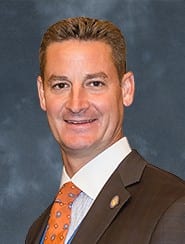
Sen. Greg Steube – www.flsenate.gov | Submitted

The Senate bill currently seeks to preempt all licensing, inspection and regulation of short-term vacation rentals to the state’s Department of Professional and Business Regulation (DBPR). DBPR already requires vacation rentals to be state-licensed, but additional inspections and oversight are strictly complaint driven.

Steube wants the state to have total regulatory control over vacation rentals. If adopted as he proposes, the cities of Anna Maria, Holmes Beach and Bradenton Beach would lose the local vacation rental regulations adopted since 2014. Local rental and zoning regulations adopted before June 2011, would still be preserved.

“There is no constitutional right to run a business in a neighborhood zoned originally as a residential neighborhood.”
David Simmons, State Senator

Simmons is willing to preempt some control to the state, but he wants local governments to retain the ability to regulate detached single-family homes used as short-term rentals. He also wants local governments to retain the ability to inspect vacation rentals for compliance with building, fire and life safety codes.

Senate amendment

Steube is a member of the Regulated Industries Committee that amended the bill last week. Simmons is not and he did not participate in the meeting.

The committee approved an amendment proposed by committee chair Travis Hutson (R-Palm Coast) that ensures home owners associations (HOA) and condominium associations can still restrict or prohibit short-term rentals.

“Any HOAs or condos that are worried about the sanctity of their own neighborhoods have that ability to outright ban, prohibit or do whatever they want to vacation rentals,” Hutson said.

Hutson did not express similar concerns about protecting the sanctity of residential neighborhoods not protected by condominium or HOA bylaws.

“Thank you for allowing me to put the amendment in to protect some of my locals back home,” Hutson said regarding Steube’s support of his amendment.

Amendments pertaining to non-discriminatory rental practices and American Disability Act compliance were discussed but withdrawn.

Simmons amendments

The Senate bill is now headed to the 20-member Appropriations Committee that includes Simmons and Sen. Bill Galvano (R-Bradenton), but not Steube. As of Sunday, that meeting had not yet been scheduled.

Speaking by phone on Friday, Simmons said, “I plan on bringing up my amendments in the Appropriations Committee and we’ll have a very robust and professional debate.

Vacation Rental David Simmons
Sen. David Simmons intends to re-introduce his city-friendly amendments during the yet-to-be scheduled Appropriations Committee meeting. – www.flsenate.gov | Submitted

“There is no constitutional right to run a business in a neighborhood zoned originally as a residential neighborhood. Those neighborhoods that don’t have restrictive covenants that could control something like this don’t have the internal ability to stop the abuses. If you turn them all into vacation rentals nobody’s going to want to live there because you’ve got a bunch of investors from outside the community and nobody with a sense of community.

“It’s important that the local governments talk to their legislators and also come up (to Tallahassee) and talk to the committee so they can explain that this is destroying the fabric of those neighborhoods,” he said.

Simmons represents a portion of the greater Orlando area and a portion of Volusia County.

When asked what impact vacation rentals are having on Florida’s east coast, he said, “Call over to Cocoa. They’ll tell you it’s destroying the fabric of their community. Less and less people want to live downtown or are able to because they’re turning areas close to downtown into a place of non-owner-occupied vacation rentals.”

House legislation

As originally filed, La Rosa’s House bill simply said, “A local law, ordinance or regulation may regulate activities that arise when a property is used as a vacation rental provided such regulation applies uniformly to all residential properties without regard to whether the property is used as a vacation rental, or a long-term rental or whether a property owner chooses not to rent the property.”

La Rosa unsuccessfully pursued similar legislation in 2017.

Bradenton Beach insight

For the second consecutive year, Dave Ramba and the Ramba Consulting Group are serving as the city of Bradenton Beach’s contracted lobbying firm.

Last week, Bradenton Beach City Attorney Ricinda Perry said Ramba told her that he and his team have met with several Senate committee members about the Senate’s vacation rental bill. They are also working behind the scenes in opposition to La Rosa’s House bill.

Perry also said Ramba told her that Gov. Scott does not support the Senate legislation originally proposed by Sen. Greg Steube (R-Sarasota) that calls for all vacation rental licensing and regulation to be handled by the state. Doing so would place additional financial and staffing burdens on the state’s Department of Business and Professional Regulation.

Related coverage

Compromise sought on competing rental bills

City proposes state vacation rental law

Florida House passes rental bill

Committee rules favorably on vacation rental bill

Vacation Rental bills

Compromise sought on competing rental bills

TALLAHASSEE – An amended version of a vacation rental bill filed by Sen. Greg Steube (R-Sarasota) passed through its first Senate committee minus the amendments that Sen. David Simmons (R-Longwood) proposed to retain some regulatory control for local governments.

On Tuesday, Jan. 30, the Community Affairs Committee ruled favorable by 4-2 margin a committee substitute bill, CS/SB 1400. The bill amends Steube’s original bill, SB 1400. The substitute bill does not yet incorporate the city-friendly legislative elements contained in Simmons’ SB 1640.

Steube wants the state’s Department of Business and Professional Regulation (DBPR) to license and regulate vacation rentals.

 Steube
Sen. Greg Steube

Simmons’ bill also seeks to preempt vacation rental regulation to the state, but it would preserve local governments’ ability to regulate non-owner-occupied, detached single-family homes. Simmons also proposes that local governments retain the right to inspect vacation rentals for compliance with building, fire and life safety codes. He does not believe DBPR has the resources to do this.

Last week’s committee substitute bill was the Senate’s attempt to create a single vacation rental bill that can be forwarded to the Regulated Industries and Appropriations committees. If supported there, the legislation could advance to the Senate floor for a final vote.

Competing bills

Steube’s and Simmons’ bills contain many similarities and some significant differences. Both would require that all vacation rental advertisements include the owner or agent’s state-issued license number. This would apply to print advertising and online advertising conducted by individuals, rental companies and home sharing platforms like Airbnb and HomeAway. Failure to include licensing information could result in the suspension or revocation of a state-issued rental license.

Steube said his legislation is an attempt to ensure regulatory continuity across the state, and the committee adopted an amendment he proposed that would require twice-yearly state inspections for those who own more than five short-term rentals.

Steube said local governments could still preserve the integrity of neighborhoods by passing ordinances that address noise, trash, parking or other behavioral issues on a city-wide level, regardless of how a property is used. He also said all short-term rentals would remain subject to existing state or local taxes.

Steube’s original bill sought to eliminate existing grandfathering provisions, but the committee adopted an amendment that committee chair Tom Lee (R-Brandon) proposed to protect rental regulations and restrictions adopted before June 2011, when the state made it illegal to prohibit short-term rentals.

The committee also adopted an amendment proposed by Sen. Jose Javier Rodriguez (D-Miami) that would cap maximum occupancy at the lesser of six persons per bedroom or one person per 150 square feet of livable space.

Holmes Beach lobbyist Cari Roth and Florida League of Cities Executive Director Casey Cook were among the public speakers who expressed a preference for Simmons’ legislation and opposition to Steube’s.

Local impact

If adopted as amended, Steube’s legislation would eliminate local rental regulations adopted in Anna Maria, Bradenton Beach and Holmes Beach after June 2011. This would include recently implemented occupancy limits and registration and inspection programs.

Adopted before 2011, Holmes Beach’s rental-related zoning designations would remain intact. The R-1 zoning prohibits rentals for less than 30 consecutive days and the R-2 zoning prohibits rentals for less than seven consecutive days.

If incorporated into CS/SB 1400, Simmons’ proposed amendments would allow local governments to continue regulating non-owner occupied single-family dwellings and inspect rentals for compliance with building, fire and life safety codes.

Simmons said his intent is to prevent residential neighborhoods from being destroyed by homes used solely as full-time vacation rentals. He said vacation rental owners have property rights, but so do neighboring residents. His legislation would not apply to single-family homes leased through Airbnb and other advertising platforms if the owner remains onsite, but would apply if the owner’s not there.

Simmons
Sen. David Simmons

Filed after Steube’s amendments, Simmons’ proposed amendments to the substitute bill were discussed last week, but time ran out and the meeting ended before they were voted on. Simmons’ next opportunity to present his amendments will be live online before the Regulated Industries Committee on Thursday, Feb. 8 from 12:30-2 p.m.

House companion

At week’s end, House Bill 773 filed by Rep. Mike La Rosa (R-St. Cloud) had not yet been discussed by a House committee. His legislation attempts to make any local regulations that are applicable to vacation rentals equally applicable to non-rentals, including occupancy limits and registration programs.

A House bill mirroring the Senate’s committee substitute has not yet been introduced. The adoption of Senate legislation requires adoption of similar House legislation for passage.

The Jan. 30 Community Affairs Committee meeting can be viewed or heard at the Senate website.

Related coverage

City proposes state vacation rental law
Committee rules favorably on vacation rental bill

Grand Tree Anna Maria

Local tree regulations under attack

Updated Jan. 13, 2018

ANNA MARIA ISLAND – Florida Sen. Greg Steube (R-Sarasota) has filed a bill that seeks to prevent local governments from regulating tree removal and trimming and reserve that authority to the state.

City officials in Anna Maria and Bradenton Beach oppose the legislation and have asked their contracted lobbyists to lobby against it.

Steube filed Senate Bill 574 in October. Rep. Katie Edwards-Wapole (D-Sunrise) and Rep. Jake Raburn (R-Valrico) then co-filed HB 521 as its House companion in November.

Steube’s bill proposes that city and county governments may not prohibit or restrict a private landowner from trimming, removing or harvesting trees or timber located on private property; may not require mitigation including, but not limited to, planting trees or paying a fee to remove trees or timber from private property; or prohibit the burial of trees, shrubs or other vegetative debris on properties larger than 2.5 acres.

“I wonder how, with a clear conscience, he can sit in his gated community and decide that the state should regulate the tree canopy on Anna Maria Island.”
Dan Murphy, Anna Maria Mayor

The state Legislature’s 60-day session began Tuesday, Jan. 9 and is scheduled to end in March. Steube’s bill has been referred to the committees on Community Affairs, Environmental Preservation and Conservation and Rules. If adopted, the new state law would take effect July 1.

Bradenton Beach opposition

Bradenton Beach’s land development code includes grand tree protections and tree replacement requirements. Steube’s bill was discussed at the City Commission’s Jan. 4 meeting when Scenic WAVES Committee member Betty Rogers presented a letter the committee wanted to send to Steube.

Bradenton Beach Tree Protections
Betty Rogers and the rest of Bradenton Beach’s Scenic WAVES Committee oppose Greg Steube’s proposed tree removal legislation. – Joe Hendricks | Sun

“This is brought about by Sen. Steube for basically taking away our home rule over our tree trimming,” Rogers said.

“We are writing to you to voice our opposition to SB 574 as drafted. We strongly encourage you to reach out to us and other constituents who are educated in the value of maintaining and enhancing tree canopy in our communities,” the letter says.

“We believe it is not a one-size-fits-all issue. Our local governments are best positioned to balance individual property rights with economic, ecological and social benefits of the trees in our community. Canopy coverage in the city of Bradenton Beach provides an annual value of $46,133 in air pollution removal and carbon removal/sequestration,” the letter says.

“I don’t understand some of the things Sen. Steube does,” Mayor John Chappie said. “Yes, there are some things the state and federal government need to do, but telling us how we can trim our trees in little old Bradenton Beach is not one of them.”

The commission authorized the Scenic WAVES letter and asked for a similar letter to be sent on its behalf.

 Anna Maria opposition

“I wonder how, with a clear conscience, he can sit in his gated community and decide that the state should regulate the tree canopy on Anna Maria Island,” Anna Maria Mayor Dan Murphy said.

Planning and Zoning Board chair Jon Crane agrees.

“I am troubled by this proposed bill for a number of reasons. Municipalities understand why the preservation of some local trees is important to their constituents far better than Tallahassee does. The proposed bill will clearly lead to the indiscriminate removal of trees whenever it makes development cheaper and easier – and the environment be damned. The proposed bill would be one more step in the centralization of government. The proposed bill appears to benefit the Senator’s donors without regard for the wishes of his electorate. And by way of observation, the untrammeled development in the Senator’s district in Sarasota is creating a charmless, treeless concrete corridor,” Crane said.

In November, Anna Maria commissioners approved a request to remove two of the three grand trees located on an undeveloped lot on North Shore Drive. The commission insisted the third tree remain standing.

Anna Maria’s tree ordinance designates grand trees as those that are at least 24 inches around when measured at 4½ feet above ground, and removal of a grand tree requires commission approval.

Holmes Beach workshop

The city of Holmes Beach does not have a grand tree ordinance. Nor has its commission discussed Steube’s proposed legislation. Commission Chair Judy Titsworth became aware of the bill on Friday, when she received a legislative update from the Sen. Steube.

“It hasn’t come up at all, but we plan to workshop a proposed grand tree and native landscaping ordinance in March. We may have to move it up,” Titsworth said.

Steube’s position

Tree bill Greg Steube
Steube

The newsletter Steube distributed Friday featured his op-ed that was published in the Orlando Sentinel on Thursday.

“Many cities and counties in this state require you to obtain permission from them to cut down a tree, your tree, on your property. To me that flies in the face of your constitutional rights,” Steube wrote.

“I have heard from countless constituents who have been abused by these outrageous and unreasonable ordinances,” he added.

He mentioned a property owner being fined $16,000 for cutting down a dying tree without a permit, counties allowing pines to be cut down but not oaks, a citizen forced to replant and maintain a tree after he sold his property and another who was told to cut down a 50-year-old tree because it was an invasive species.

“My goal through this legislation is to stop the overreach of our counties and cities and return control back to the property owner pursuant to their inalienable rights provided in Florida’s Constitution,” Steube concluded.

Email the tree removal bill sponsors at:

  • Steube.Greg@flsenate.gov;
  • Katie.Edwards@myfloridahouse.gov;
  • Jake.Raburn@myfloridahouse.gov.

Email Bradenton Sen. Bill Galvano and Bradenton Rep. Jim Boyd at:

  • Galvano.Bill@flsenate.gov;
  • Jim.Boyd@myfloridahouse.gov.
vacation rental

Committee rules favorably on vacation rental bill

TALLAHASSEE – The vacation rental bill filed by Florida Sen. Greg Steube (R-Sarasota) cleared its first obstacle Tuesday afternoon when the Florida Senate’s Regulated Industries Committee ruled favorably on the bill.

Steube said that Senate Bill 188 is intended to protect private property rights and ensure that all residential properties are treated equally whether used as short-term rentals, long-term rentals or permanent residences.

Before the committee vote, legislators amended the bill to allow cities to continue to regulate activities of a property used as a vacation rental, but those regulations must apply to all residential properties, including permanent residences.

If the Legislature adopts the bill as law, cities could still impose occupancy limits and require annual registration and owner/agent contact information, but those requirements would also apply to permanent residences.

Anna Maria Mayor Dan Murphy traveled to Tallahassee to express opposition to the bill and the proposed amendment.

“The bill strips away our ability to solve problems locally,” he told the committee, noting that the vacation rental ordinance his city adopted in 2015 includes no noise or parking provisions, fines or building requirements specific to vacation rentals.

“All the rules apply equally across the board except we have two problem solving tools: One is registration and the other one is occupancy limits. Senate Bill 188 would strip away these important problem solving tools,” Murphy said.

Senate Bill 188
State Sen. Greg Steube (R-Sarasota) discusses his vacation rental bill Tuesday afternoon.

He was also among the speakers who said applying existing rental regulations to all residential properties would place inordinate burdens on city resources. Holmes Beach lobbyist Cari Roth expressed similar concerns.

Watching the meeting online left Holmes Beach Commissioner Jean Peelen feeling frustrated.

“I tried watching, but the arrogance and misinformation were overwhelming,” she said.

Bradenton Beach Vice Mayor John Chappie said, “I was of course disappointed. I thought Mayor Murphy did an excellent job in representing all of us on Anna Maria and I appreciate the fact that he made the trip and fought for the Island cities.”

Regarding the adopted amendment, Chappie said, “This uniformity absolutely does not work in residential neighborhoods.”

SB 188 must also pass through the Community Affairs Committee and the Rules Committee before being voted on by the Senate as a whole.