Tag: Gloria Dei

Gloria Dei rezoning application submitted 

HOLMES BEACH – The city has received an application to rezone the Gloria Dei Lutheran Church property in a manner that would allow for the construction of up to 17 single-family homes. 

On May 12, Marshall Robinson, a land planner with the Bradenton-based Grimes Galvano law firm, submitted the land development application that lists himself and attorney Kyle Grimes as the agents acting on behalf of the property owners. 

The application lists Gloria Dei Evangelical Lutheran Church of AMI as the property owner and lists a Tampa address for that entity. Dated May 15, the accompanying affidavit of ownership/agent authorization is signed by Bishop Pedro Suarez. 
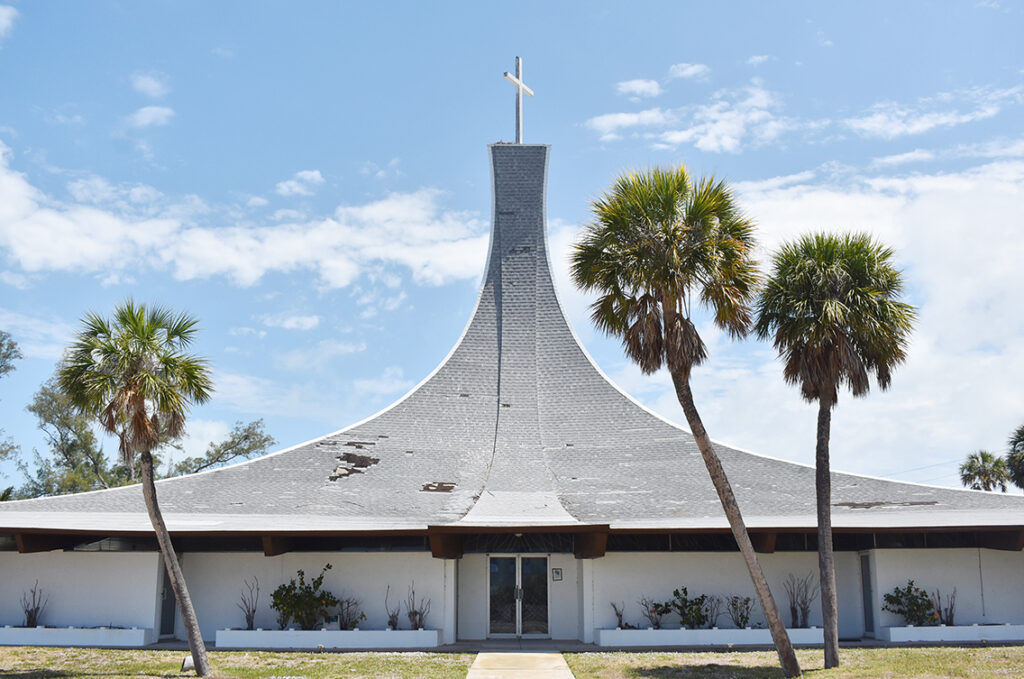
The Gloria Dei church building is iconic in its architectural design. – Joe Hendricks | Sun

The land development application lists a comprehensive plan text amendment, a comprehensive plan map amendment and the rezoning of the property as the desired city approvals. The application notes the current zoning designation is PSP (public/semi-public) and the proposed zoning classification is R-1 (single-family residential). 

The application lists “single-family detached residential dwellings” as the proposed activity or use. 

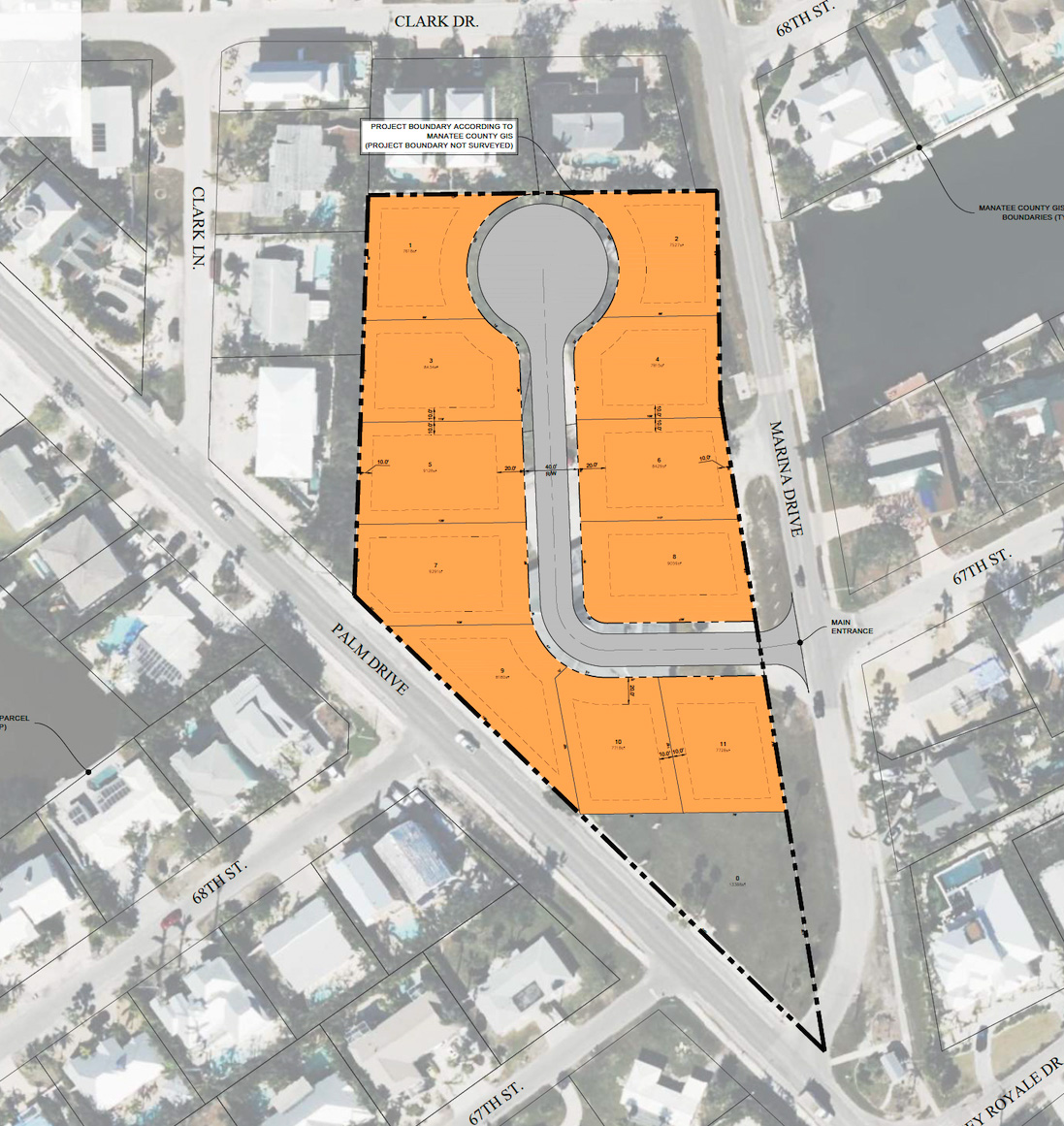
“The proposed request is up to 17 SF (single-family) detached dwellings on 2.96 acres,” the application says.

The draft concept plan submitted by the applicants shows the church property divided into 11 lots, with an interior access road running through the residential development and a circular cul-de-sac located at the north end of the proposed development.

When contacted on May 1, Holmes Beach Director of Development Services Chad Minor confirmed that he, Mayor Judy Titsworth, Public Works Director Herb Raybourn, Development Services Coordinator Kim Charron and Robinson had recently participated in a pre-application discussion regarding the potential rezoning of the Gloria Dei property.

When contacted on May 29, after the land development application was filed, Minor said the city was not yet close to scheduling a date for the first public hearing on the property owners’ requests. 

“I have asked the city attorney to put together a flow chart of the process, as it is a little different with a comprehensive plan and rezone concurrently. Any rezone will require an ordinance and public hearings,” Minor stated in his email response to The Sun. 

DRAFT NARRATIVE

On April 8, Robinson sent Minor an eight-page draft narrative letter that details the rezoning and comp plan amendment requests.

“On behalf of the applicant and owner, Florida-Bahamas Synod of the Evangelical Lutheran Church in America, Inc. (formerly known as Gloria Dei Evangelical of Anna Maria Island), we wish to file applications for a comprehensive plan map amendment, comprehensive plan text amendment and a zoning map amendment to be reviewed as companion applications,” Robinson stated in his letter.

“The applicant requests approval of two comprehensive plan amendments and a zoning map amendment for approximately 2.96 acres of land located at 6608 Marina Drive. The subject property consists of three contiguous parcels currently developed as a church,” Robinson stated.

The draft narrative letter notes the property owners seek a zoning map amendment from public/semi-public (PSP) to R-1 (single-family residential). 

“The proposed entitlements allow for up to 17 single-family residential units consistent with the maximum gross density permitted under the future land use category. A conceptual plan has been prepared to illustrate a potential layout; however, final design will be determined at site plan approval,” the letter says.

“The subject property is designated PSP on the adopted future land use map and zoned PSP. The property is currently developed with a 6,437 square foot church building on 1.94 acres that takes direct access from Palm Drive. The remaining acreage of the subject property consists of two vacant parcels adjacent to the north consisting of approximately 1.02 acres.

“The low-density residential future land use category allows a maximum density of up to 5.8 dwelling units per gross acre,” Robinson wrote. 

His letter stated the 2.96-acre property would support a maximum gross density of 17 single-family dwellings with a gross density of 5.74 units per acre. 

“The subject property is surrounded by existing residential development. To the north and northwest are medium-density residential uses with R-2 zoning. To the west, across Palm Drive, are additional R-2 zoned properties. To the east and southeast, across Marina Drive, are existing low-density residential uses zoned R-1. The proposed future land use category and R-1 zoning is compatible and consistent with the surrounding development pattern,” Robinson wrote.
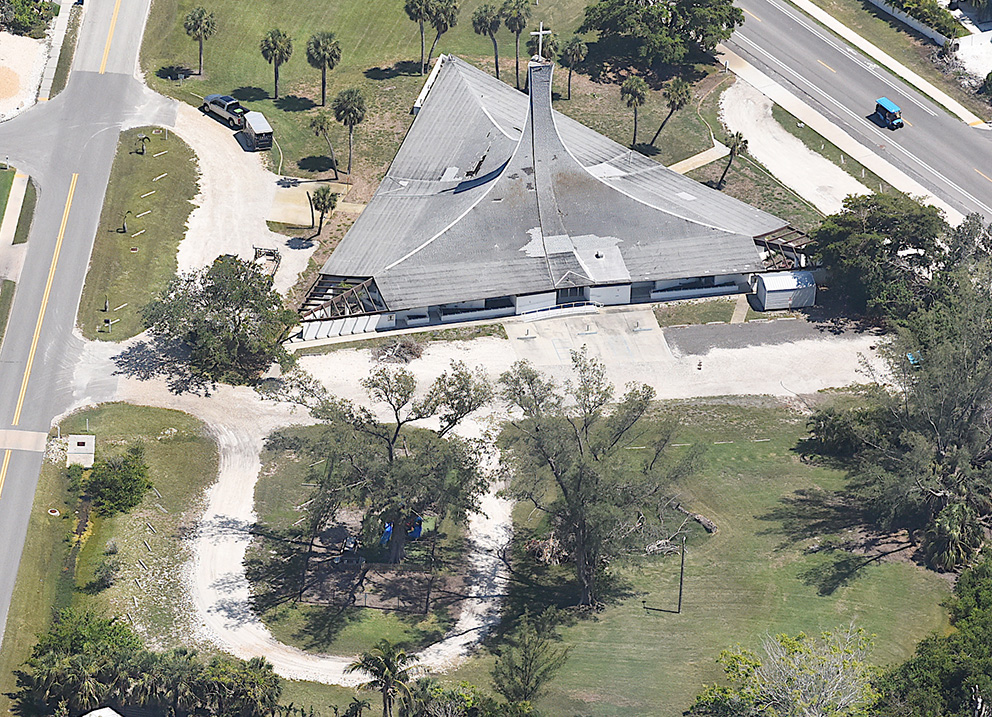
City officials hoped to purchase the church building and property and preserve it for public use. – Joe Hendricks | Sun

“The Gloria Dei Lutheran Church in Holmes Beach was founded on August 3, 1958. The existing church building was completed in 1959 and was in continuous operation until its final service on January 18, 2025. Over time, fewer and fewer members of the church’s congregation were willing or able to travel to Anna Maria Island to attend the church services. 

“Accordingly, for the good of the church, the decision was made to move the church off the Island. At that time, the church structure was utilized as a daycare until the hurricanes of 2024 and the church has remained vacant and unused since that time. Due to the designation of the PSP future land use category, there are no reasonable uses of the property that are permitted by the city’s comprehensive plan available to the owners at this time,” the draft narrative letter says.

“The proposed comprehensive plan amendment is consistent with the future land use element, which emphasizes the protection of the city’s predominantly single-family residential character and the compatibility of land uses,” Robinson wrote.

Regarding compliance with the comp plan, “The proposed amendment supports Goal 1 by changing the subject property from public/semi-public to low-density residential, and by aligning the subject property with the surrounding residential development pattern. Moreover, as the current PSP, one is very limited with regard to permitted uses; and as the existing church use is no longer a viable option, there is no reasonable use of the property available to the current owner under the existing future land use designation.” 

The proposed low-density residential will permit the property to be redeveloped with additional, sustainable and resilient housing options, rather than leaving the property vacant, unused and deteriorating,” Robinson wrote

CITY’S INTEREST

In May 2025, after receiving two valuation appraisals, the city commission authorized Mayor Judy Titsworth to make a $3 million offer for the church building and property. The appraisals prepared for the city were based on the assumption that the existing PSP zoning and comp plan designations that do not allow residential or commercial development would remain in place. 

City officials hoped to preserve the church building and use the building and the church grounds for public purposes that might have included office and operating space for non-profit organizations, space for the displaced School For Constructive Play preschool to potentially return to the church building, and green space for public use. 

In June 2025, Taylor Rahdert, the real estate agent representing the property owners, sent Minor an email informing him that the Synod Council declined the city’s offer. 

“Unfortunately, I do not see a path forward on an acquisition at this time,” Titsworth said when discussing the Synod Council’s decision.

The Synod Council received a $9.9 million appraisal that was based on the assumption that the property would be rezoned for residential development. After the city’s offer was declined, the church property was put on the market with a $9.9 million asking price.
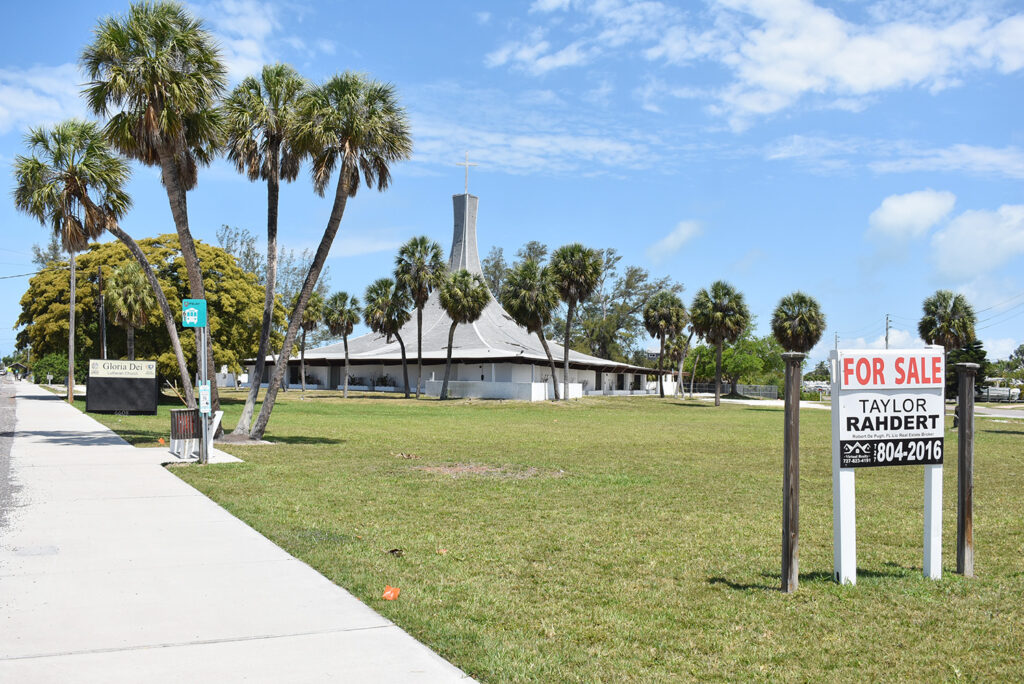
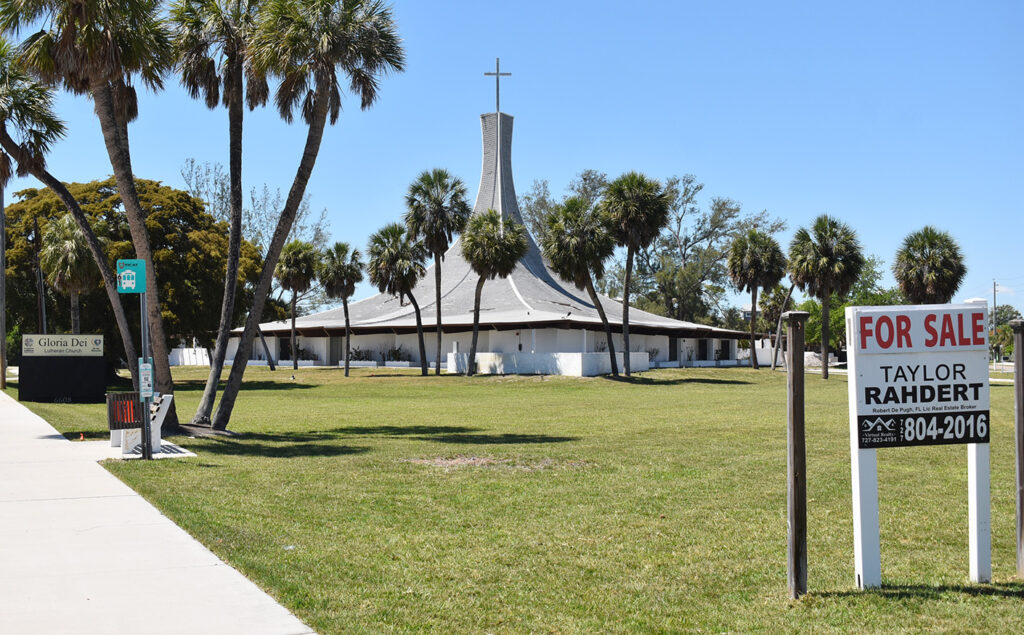
The Gloria Dei Lutheran Church property was listed for $9.9 million. – Joe Hendricks | Sun

In 2018, city officials discussed purchasing the undeveloped portions of the church property, but not the church building itself. That potential $1.3 million sale never transpired. 

In 2016, city commissioners denied a comprehensive plan amendment sought by church officials who wanted to change the future land use designation to R-2 (multi-family residential) for the two undeveloped parcels and rezone those parcels in a similar manner. The church officials hoped to sell the two rezoned parcels for development by someone else and use the sales proceeds to help fund the ongoing church operations. 

PRELIMINARY DISCUSSION

The rezoning request has not yet been presented to the city commission, but it was the subject of informal commission discussion on May 12.

Commissioner Jessica Patel referenced a news story about the city of St. Petersburg’s approach to allowing land zoned for public use to be rezoned for private development. Patel asked if the city of Holmes Beach could stipulate that the church property, if rezoned, could only be used to develop affordable or low-income housing. 

In response, City Attorney Randy Mora said, “It depends. There is never an absolute right to a rezoning or a redesignation in a comp plan. Process is everything and I’ll leave it at that. You have the ability to redesignate properties, but it would be subject to a multiplicity of factors.”

He noted affordable housing and low income are often two very different things.

Mora said there’s a difference between putting a restrictive covenant on a city-owned public property and transitioning that property to private ownership, versus putting a covenant on a privately-owned property that carries a public use zoning designation but is not owned by the city. 

“Our ability to intervene in the private market, where people buy private property with private funds – it’s very unlikely that you’re intruding on that process,” Mora said.

Titsworth said the church building is an “Island landmark” and there’s only so much property in the city zoned for public/semi-public use. 

“It’s also in our future land use map, so it’s part of the comprehensive plan,” Titsworth said. “You might all decide we don’t want to give up any public/semi-public land, which is OK. There’s nothing saying you have to do it. If the site plan meets all the criteria, you almost feel obligated, but this is a zoning change, and it’s a future land use change. This is coming our way. You’ll hear it and you’ll make the best decision based on what’s presented to you.”
Holmes Beach: A planned community 

BY LAUREL NEVANS
SPECIAL TO THE SUN

HOLMES BEACH – When you hear the words “planned community,” they may evoke visions of homeowner’s associations, cookie-cutter houses and things like that. 

But actually, that type of planned community did not become popular until the 1960s, long after the community of Holmes Beach was established. Holmes Beach is a good example of the earlier type of suburban planning utilized after World War II ended in 1945. 

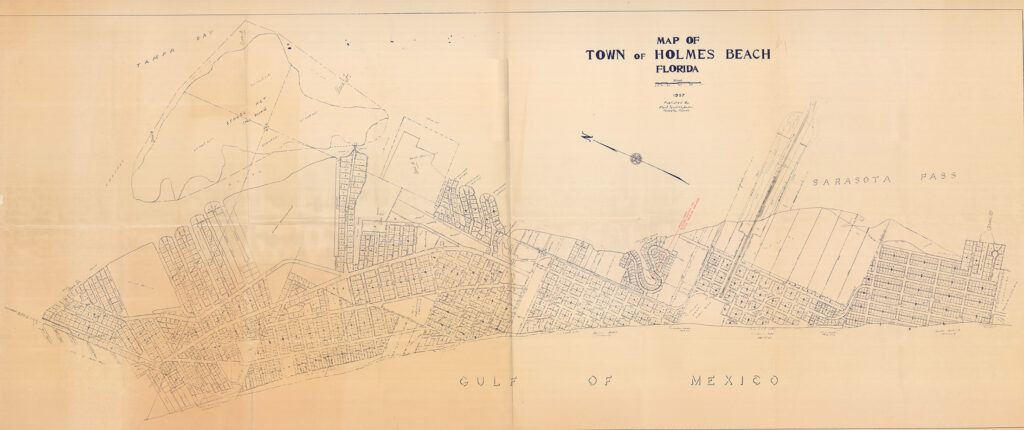
A 1957 plat map of Holmes Beach. – Manatee County Library | Submitted

Urban planning has existed for centuries. Planned in 1791 by Pierre L’Enfant, Washington, D.C. is a notable example. But suburban planning was something that came to be in the 20th Century, gaining popularity after World War II. 

The “Greenbelt communities” represent the earliest examples. During the 1930s, the federal government developed three experimental communities to address housing shortages and unemployment during the Great Depression, and to serve as models for cooperative, garden-style suburban living. Of these three, Greenbelt, Maryland, is perhaps the best known, and it still thrives as a community today. 

Influenced by the European “Garden City” movement, President Franklin Roosevelt’s Resettlement Administration initiated the Greenbelt program. The program focused on creating self-contained, cooperative communities that combine the best features of city and country living. It included ample green space, separated land uses and common ownership. It emphasized affordable, high-quality housing and communal facilities, and design that prioritized safety and community interaction. It included public spaces to foster a stronger sense of community among residents. The Greenbelt towns introduced innovative suburban planning concepts that influenced subsequent suburban development projects. 

Levittown was America’s first mass-produced suburb. It was built by William Levitt in 1947 on Long Island, New York, to meet the post-war demand for affordable housing for returning veterans. Using unprecedented assembly line techniques, Levitt & Sons quickly and cheaply built thousands of identical, modest, single-story homes. With prices affordable to many families, they symbolized the “American dream” of homeownership and suburban life. 

Levittown was the first example of the kind of planned communities that remain to this day – communities planned with amenities that include village greens, playgrounds and shopping areas to create a complete community using principles inspired by the Greenbelt cities.

HOLMES BEACH PLANNING

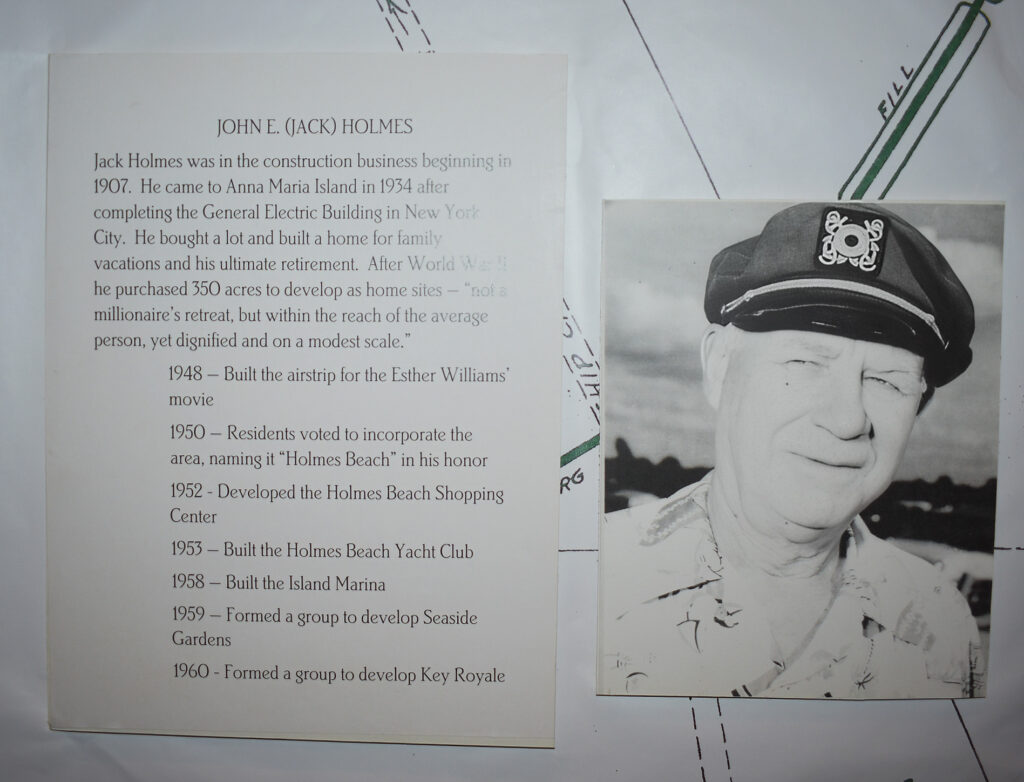
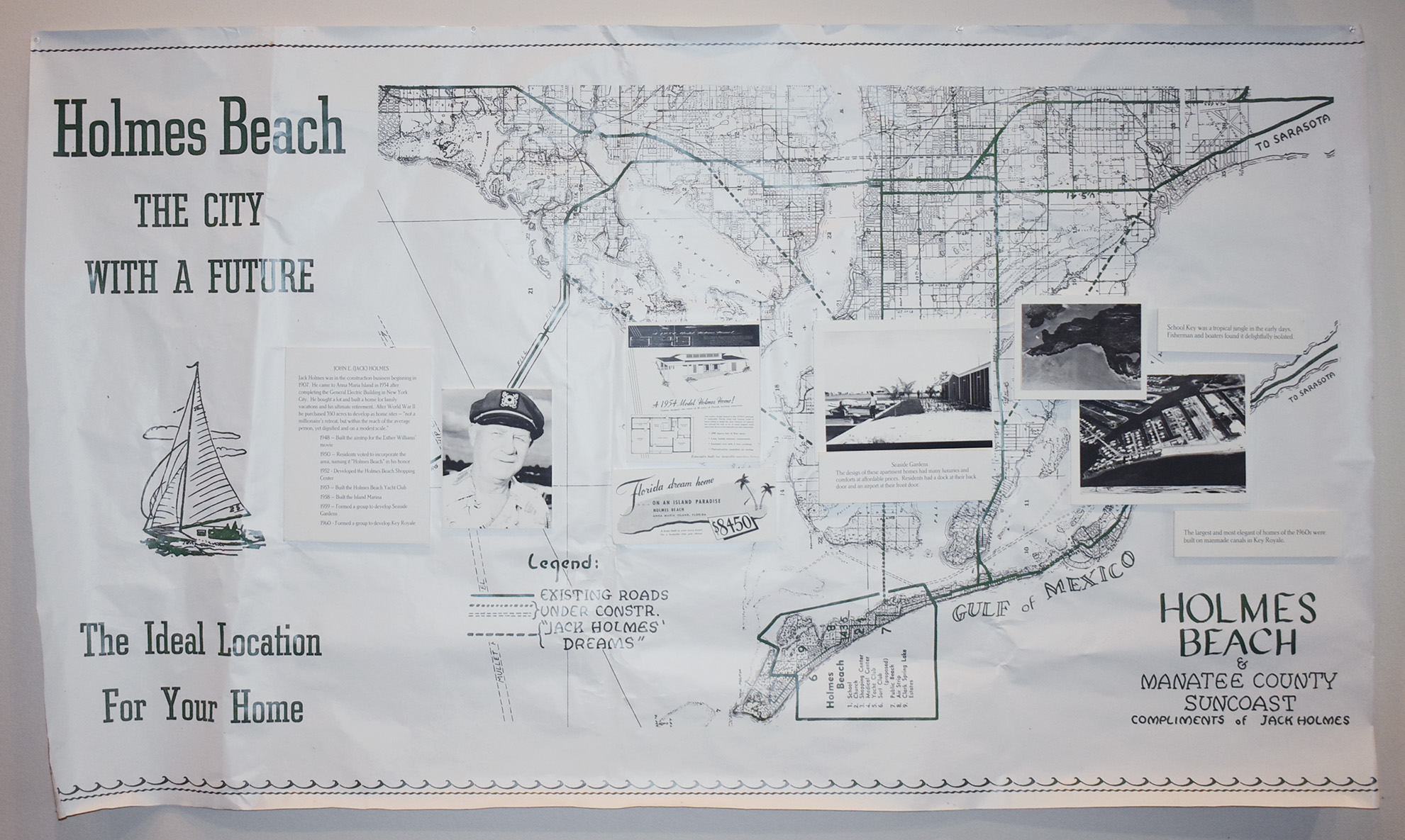
This history of suburban planning inspired Jack Holmes. After World War II, Holmes transformed the area that became Holmes Beach from a sparsely populated settlement into a residential and tourist community that contrasted with the earlier slow, homesteading-based growth. 

Jack Holmes had a vision for Holmes Beach. – Joe Hendricks | Sun

Holmes created a 600-acre master-planned community centered around a marina to attract returning veterans and their families, and he focused on developing infrastructure that enabled suburban living. A significant element of Holmes’ planning was the dredging of canals and bayous, which created waterfront lots and maximized residential density. 

A small airstrip was built in 1947 and the MGM musical “On an Island With You” was filmed there. Holmes soon added a yacht club and shopping centers that catered to both residents and tourists. 

City Field was an airfield at one point in time. – Joe Hendricks | Sun

By the time Holmes Beach was incorporated as a city on March 13, 1950, Holmes had already built and listed for sale over 200 homes in the area.

In contrast to Levittown, Holmes Beach did not encourage “cookie-cutter” architecture. Holmes Beach was built using a variety of builders and developers; and although homes shared certain characteristics, none of the early homes looked identical to their neighbors. Small cottages with yards and gardens dominated the landscape, with some larger, elevated or multi-story homes thrown into the mix.

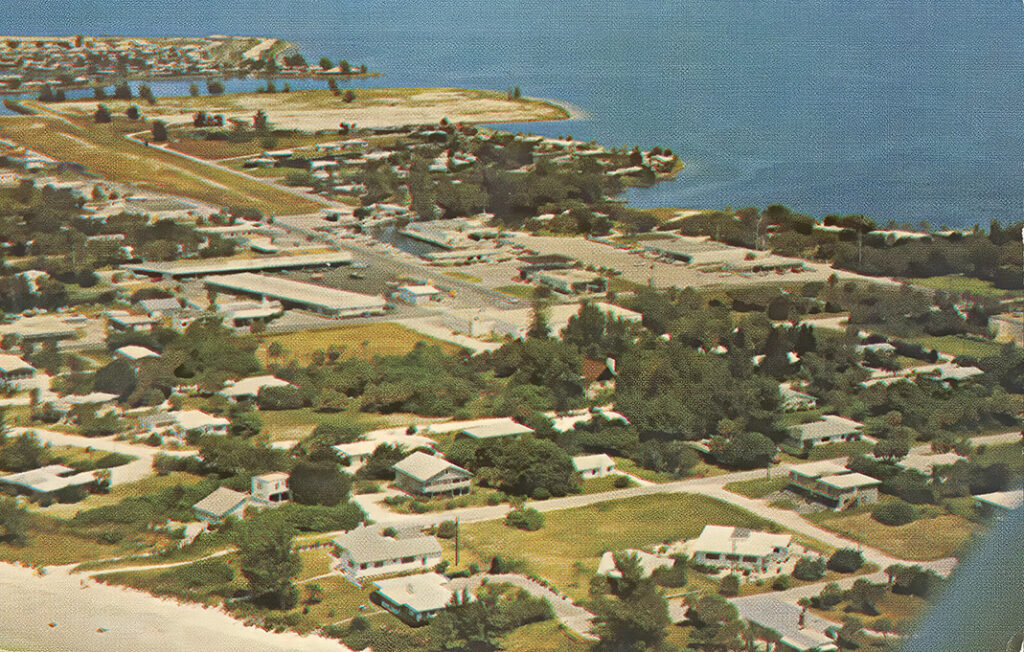
An old aerial view of Holmes Beach. – Manatee County Library | Submitted

When developing his planned city, Holmes envisioned a diverse and inclusive community. Although his vision was for a community that was primarily residential, he also recognized the importance of tourism and part-time residents and he planned for a community that accommodated full-time, part-time and transient residents. 

He also integrated many of the principles first established in the Greenbelt communities of the early 20th Century. One of the biggest differences between Holmes Beach and the Greenbelt communities is that Holmes Beach was designed to accommodate a wide variety of income levels, from working class to the more affluent. This is reflected in the various residential zoning codes that each reflected the character the neighborhood was being designed around. 

Many Holmes Beach homes were built alongside man-made canals. – Joe Hendricks | Sun

Holmes developed a “resort zone” to accommodate transient visitors. Manatee Public Beach was established in 1952 to accommodate “day trippers” – the people who lived on the mainland, came to visit for the day and returned home. In the 1970s, Manatee County took control of the public beach and began operating it as part of the county’s public park system.

ZONING DISTRICTS

Holmes integrated several other aspects of early suburban planning into his new planned community. In addition to residential zoning, he included spaces zoned for Public/Semi-Public Use (PSP,) Private Recreation/Open Space (POS), Public Recreation (REC), Conservation (CON) and Preservation. 

Lots were priced according to their zoning code, with non-residential and non-commercial lots priced so non-profit organizations and houses of worship could be part of the community he envisioned. The now-vacated Gloria Dei Lutheran Church property carries the PSP zoning designation and a similar future land use map designation in the city’s comprehensive plan. 

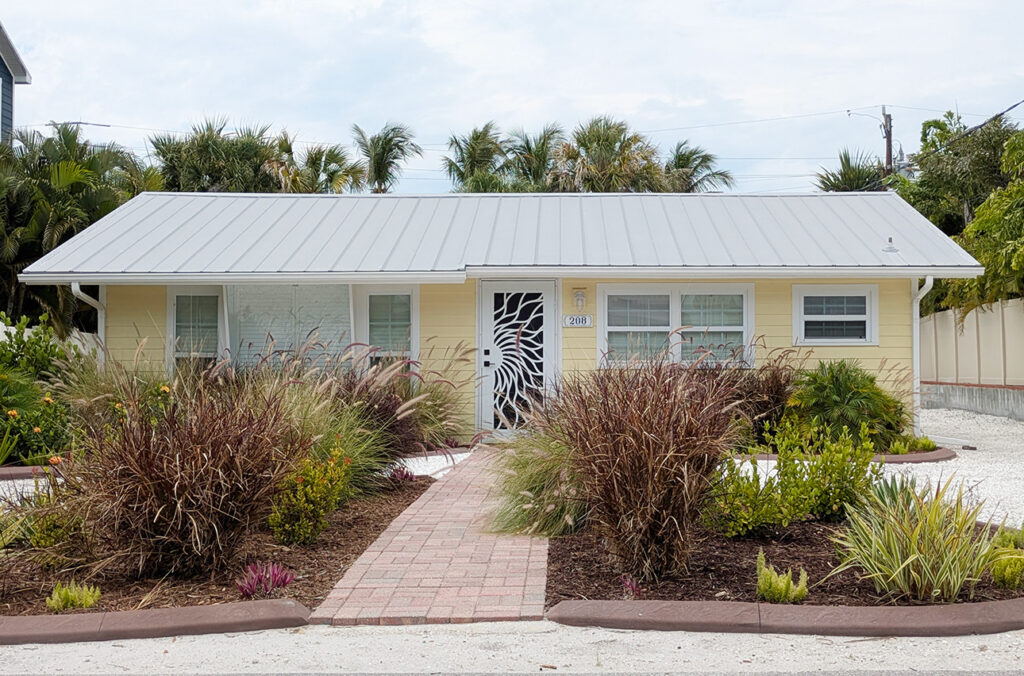
This is one of the smaller homes in Holmes Beach. – Laurel Nevans | Submitted

Holmes planned a downtown in central Holmes Beach that included commercially zoned spaces, and a second commercial zone at the southern end of the city, closest to the highest density resort housing zone (A1). 

The first shopping center was developed in 1952. This zoning was a key component of Holmes’ vision for his new community; and his vision continues to be reflected in modern day Holmes Beach, where every update to the city’s comprehensive plan reflects the principles Holmes established in the mid-20th Century.

The resort/tourist zone was planned to be west of the main thoroughfares, as were the primary parts of the commercial zones. This was done to make the community more walkable and alleviate the need for visitors to cross the main roads to reach the beaches and businesses. The city was also planned to include the amenities families and retirees would desire in a community.

HOLMES BEACH GROWS

Holmes Beach continued to grow through the 1950s and 1960s. In 1950, the Island’s school was moved to Gulf Drive in Holmes Beach. In the early 1960s, the community of Holmes Beach became known as the fastest-growing community in Florida and this contributed to the school’s growing population. 

In 1953, Holmes Beach annexed into the city the northern portion of the former resort community known as Ixelhurst. The Jones and Casanas subdivisions were also annexed into the city.

In 1957, School Key was purchased by Peter Michelson. Michelson dredged the canals and planned the residences along them and created the Key Royale golf community. The last buildable lot on Key Royale was not sold until the early 1980s and the family who purchased it raised a family there and still lives there.

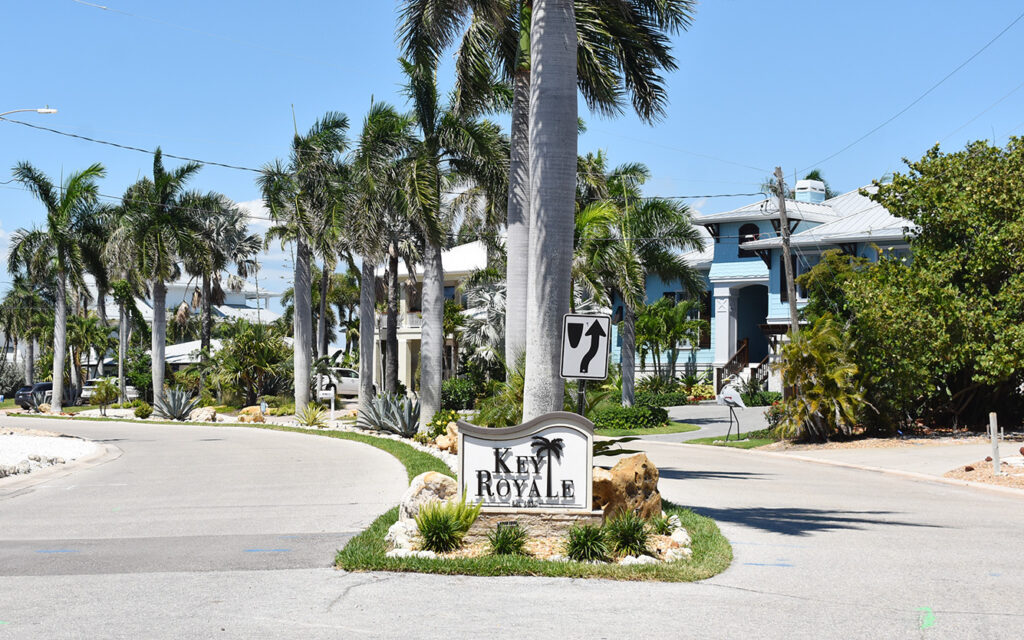
The Key Royale community dates back to the late 1950s. – Joe Hendricks | Sun
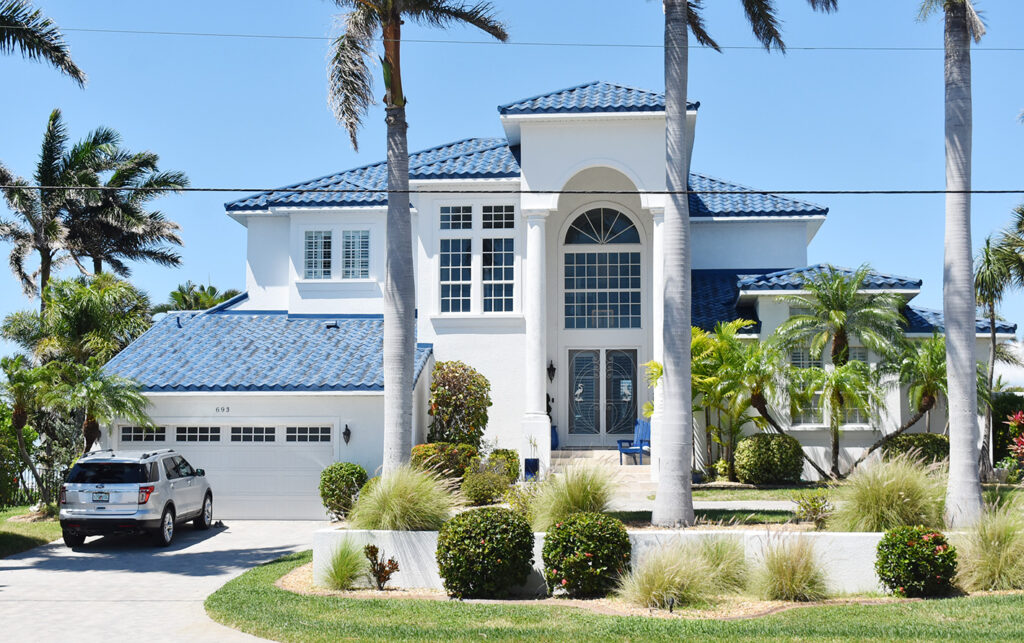
This home is part of the Key Royale community. – Joe Hendricks | Sun
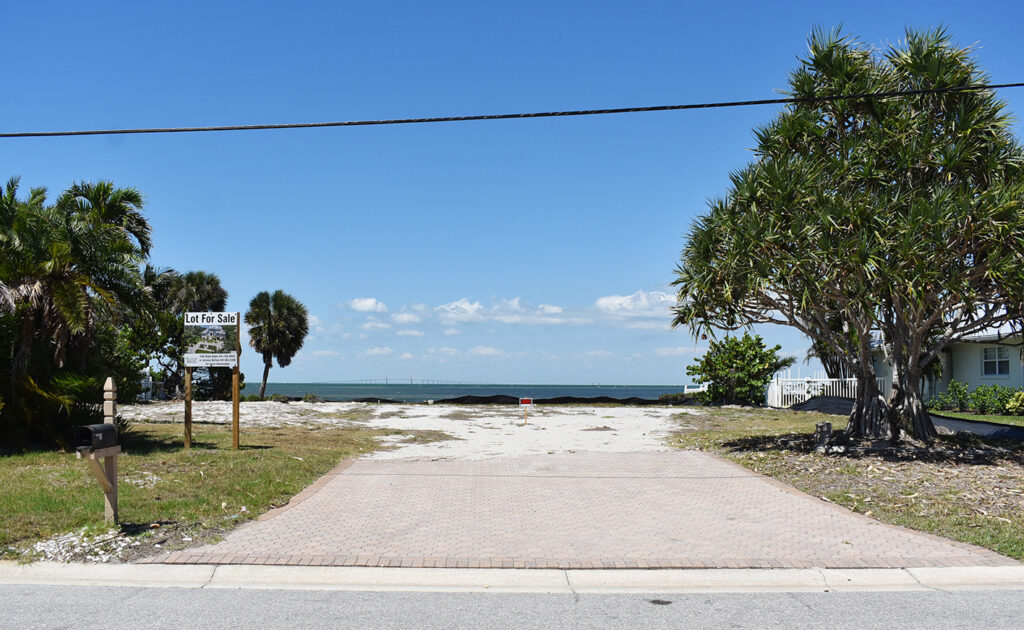
This vacant lot is for sale in the Key Royale community. – Joe Hendricks | Sun

Holmes Beach continued development through the 20th century. As the city grew, so did its mix of residential options. The smaller “mom and pop” motels were built in the A1/Resort Zone. 

Holmes Construction was joined by other local developers who built homes that honored the spirit of Jack Holmes’ vision. 

Condominiums joined the mix. After the first high-rise Martinique condos were built in the early 1970s, local officials enacted the height restrictions that now limit all development to a maximum of three stories. This was done to help preserve the Island’s low-key, “Old Florida” charm. In 2019, the height restrictions were enshrined in the city charter – a document that can only be amended and revised with the approval of the city’s registered voters. 

Most of the condos still standing today were built during the 1970s through 1990s, as was the Seaside Gardens development that utilizes ground-level single-family and multi-family dwellings.

ISLAND CHURCHES

The Island churches also started forming in the 1950s, including the Island Baptist Chapel (now CrossPointe Fellowship), the Episcopal Church of the Annunciation and Saint Bernard Catholic Church. Gloria Dei Lutheran Church was formed in 1959, after one of the last PSP-zoned lots was purchased. Constructed in 1964, the building’s distinctive roof became a local landmark. Due to a shrinking congregation and the damage the church building sustained during the back-to-back hurricanes in 2024, the iconic building and the land it sits upon are currently for sale. 

The owners of the Gloria Dei property hope to rezone the property for residential development. – Joe Hendricks | Sun

Last year, the church ownership group declined the city’s $3 million offer to purchase the building and the property for continued public use. The three-parcel property was then listed for $9.95 million. Discussions recently took place between city staff, the mayor and a representative of the property owner regarding the property owners’ desire to rezone the church property to R-1 to allow for the residential development and a higher selling price for the church property. 

The mayor, the city commissioners and several community members have already expressed a shared desire to preserve this architectural landmark and the green space that surrounds it for future generations to enjoy. The pending rezoning efforts will soon be the subject of city commission discussion, debate and decision making, with the public also weighing in on the property owners’ rezoning request. 

CHANGE OCCURS

Up until the early 2000s, Holmes Beach remained a “hidden gem,” with a population primarily consisting of year-round residents, families, part-time residents known as “snowbirds” and weekend visitors from the Tampa Bay region. Holmes Beach also thrived as a lesser-known tourist destination, with visitors flocking to the variety of accommodations in the resort-zoned areas and enjoying the eclectic mix of businesses and amenities available within the city limits. 

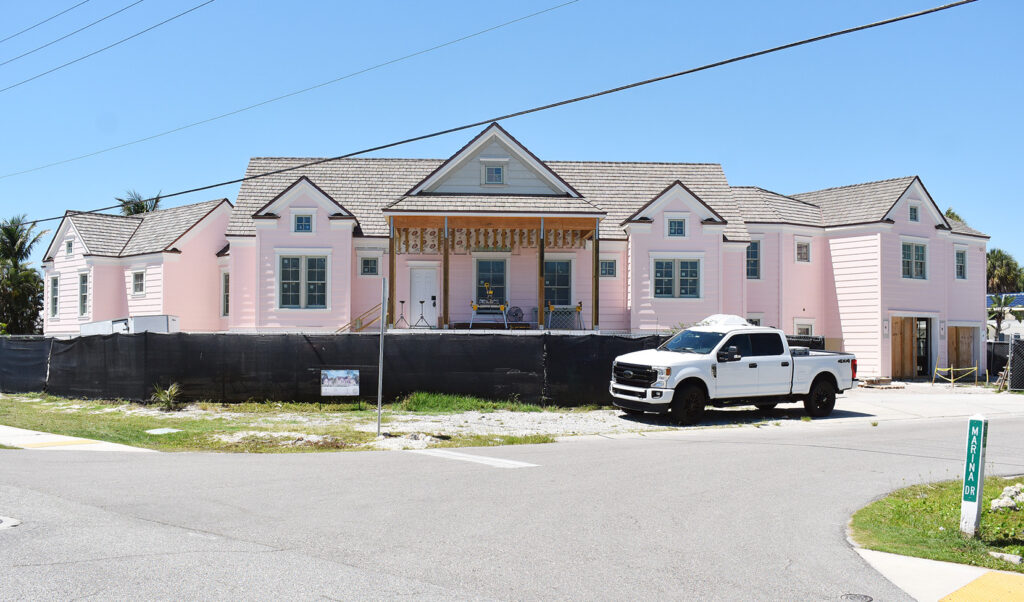
Still under construction, this is one of the largest homes in Holmes Beach. – Joe Hendricks | Sun

As the city’s charm attracted more visitors from all over the world, the character Jack Holmes worked so hard to foster began to change. Outside developers began buying the original houses and razing them in order to build large vacation rental homes. Older ground-level homes that long served as annual rentals and provided homes for working-class families and those who worked on the Island began to disappear, creating workforce housing shortages and affordability challenges.

Over time, the influx of vacation rental homes began to disrupt the balance and residential character Jack Holmes created. In response, the city began tightening its building codes in an attempt to protect the remaining character of Holmes’ planned community.

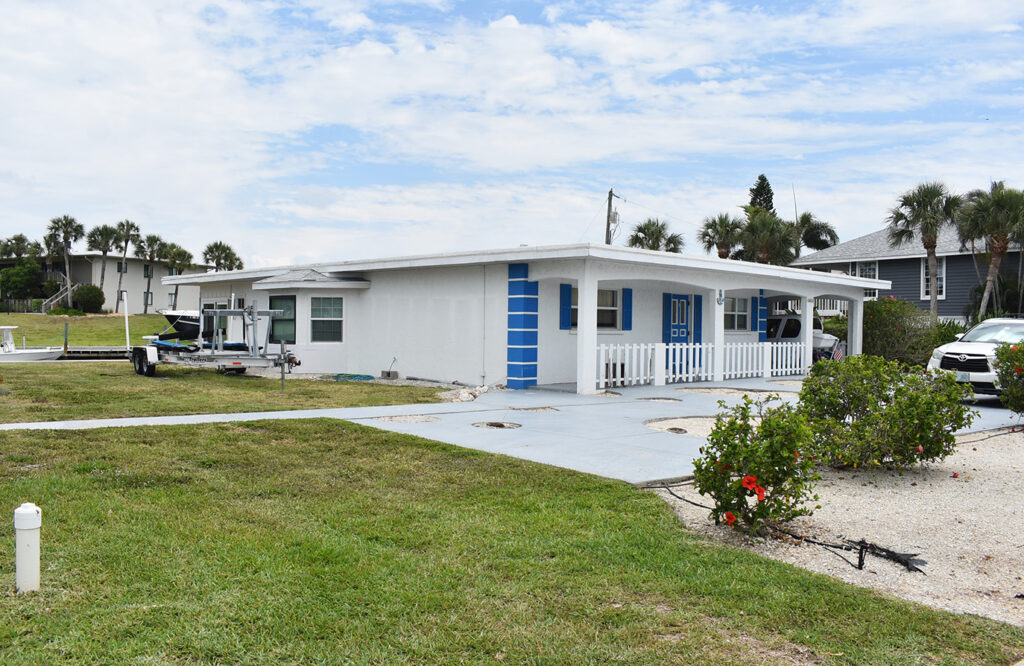
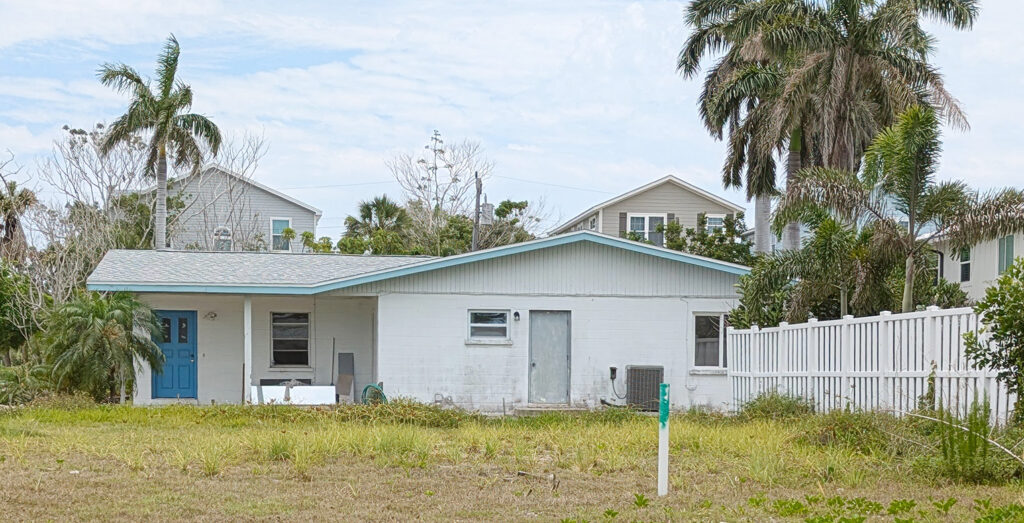
This concrete-block duplex sits next to a vacant lot. – Laurel Nevans | Submitted

City officials also have to contend with the ongoing efforts of the state officials who continue to erode the city’s home rule rights, favoring a “one-size-fits-all” redevelopment approach, rather than a careful, well-thought-out approach to community planning.

These changes have disrupted the residential character and the sense of community that many Holmes Beach residents still want to preserve – and many residents continue to encourage their city leaders to protect what can still be protected of Holmes’ original vision. 

CITY EVOLVES

The city’s comprehensive plan continues to emphasize the principles Holmes Beach was built upon. Revisions to the future land use maps reinforced the planning principles that guided the city’s original development. Zoning codes and city ordinances were tightened and more strictly enforced to help preserve and reinforce the original nature and character of the city. 

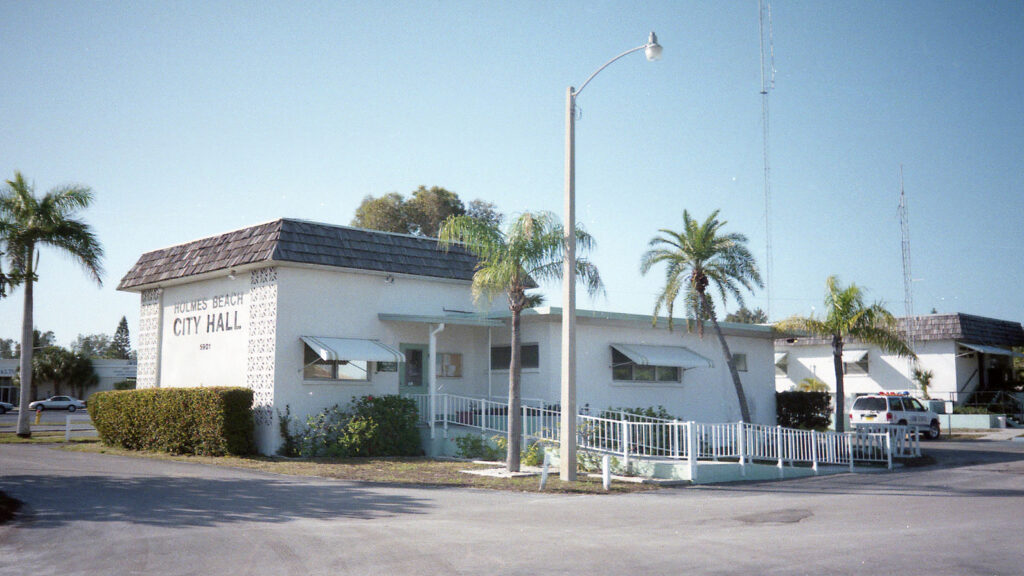
The old Holmes Beach City Hall. – Manatee County Library | Submitted
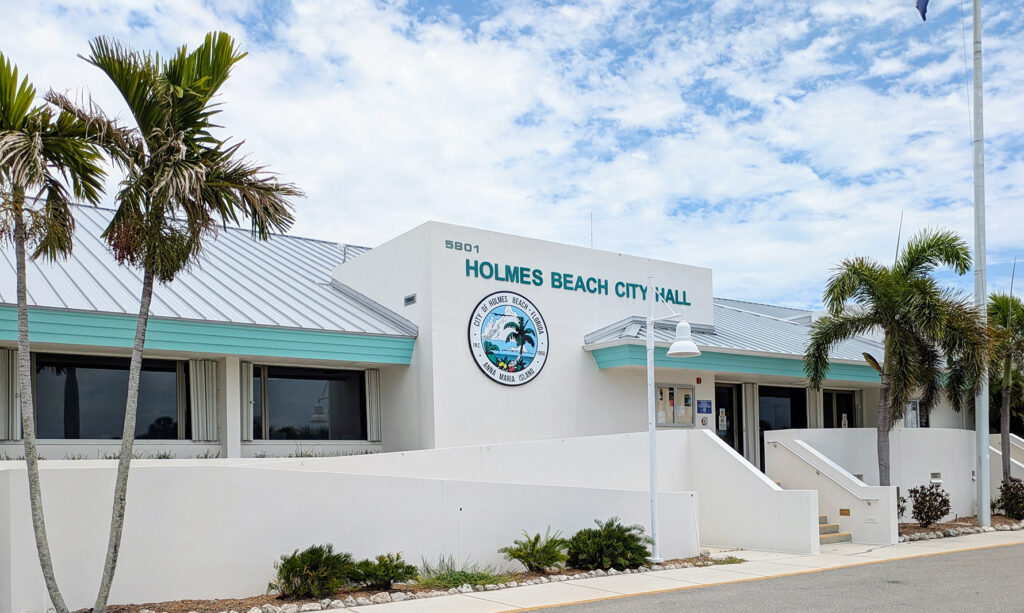
Development regulations and decisions are made inside Holmes Beach City Hall. – Laurel Nevans | Submitted

The Grassy Point Preserve was established to protect the largest tract of undeveloped land that remains within city limits and other public recreation spaces were enhanced. 

New development-related site plans were more thoroughly scrutinized for consistency with the comprehensive plan and the zoning districts.

Today, Holmes Beach is an immensely popular tourist destination that offers a wide range of vacation rental and resort options while also serving as home to permanent and winter residents whose residences range from “Old Florida” charm to modern luxury.

The challenges of modern planning and preserving what remains of the city’s “small-town” feel require city officials to balance the needs of residents with the needs of the tourism industry and the needs of the real estate markets. This includes preserving the non-commercial, non-residential open space, public spaces, recreational spaces and preservation areas that enhance the quality of life for Holmes Beach residents and visitors.

As the city grows, our city officials must continue to work hard to ensure the character and amenities Jack Holmes planned for remain and are updated to reflect the changes this new century has brought with it. This is needed so Holmes Beach continues to reflect the ideals and structure of a planned community, so we can continue to enjoy what makes this community so special. 

This particularly applies to preserving the non-commercial and non-residential elements, rather than allowing open space, public use space, recreational space and preservation areas to fall victim to the whims of modern-day developers who do not focus on community, but rather on how much money can be made.

Holmes Beach has always been a planned community, based on the concept that good planning strengthens a community. Jack Holmes believed private developers could foster human growth and that was reflected in his vision that called for diversity in land use, amenities, architecture and residential development. 

Holmes Beach has never been merely just another “cookie-cutter” beach town. It has always been a thriving residential community that shares itself with visitors, whether they come from two miles away or 2,000 miles away. And continued good planning will help ensure the community and Jack Holmes’ original vision continue to thrive.

Gloria Dei tenting

Termite tenting a harrowing task

HOLMES BEACH – The tent over the sweeping roofline of Gloria Dei Lutheran Church has been removed and so have the termites, hopefully. Earlier this month, Geiger’s Pest Service of St. Petersburg began the daunting task of covering one of the Island’s most unique buildings in terms of architecture.

Gary Geiger, the CEO of the pest control company, said the steeple’s 30-foot height made it a challenge.

“We also had an osprey nest on the very top of the steeple, which made the crew nervous about being attacked by the mother bird,” Geiger said. “The 86-foot boom lift just barely made it to the top of the steeple fully extended.” The ospreys were not harmed.

Gloria Dei media contact Jean Etsinger said the beams inside the church became so infested termite droppings had to be wiped away off the organ console and when people walked around the raised chancel area at the front of the sanctuary they would hear a crunching sound.

Because of Hurricane Irma, Geiger had a hard time finding a straight-bottom boom, or truck lift, to get workers up to the top of the roof but they finally secured one. The church was last tented about 20 years ago, according to an old-timer, who said they used a lot of tarp that time, as well.

The church building was designed half a century ago by “Sarasota School” architect Victor Lundy, who also designed St. Paul Lutheran Church in Sarasota. Both structures feature sweeping, load-bearing beams formed of laminated wood.

“It must have been expensive when the building went up, but it continues to be worth the investment because it was in good shape,” said Jay Poppe, a Gloria Dei property liaison.

Gloria Dei Lutheran Church

Land purchase concerns commissioners

HOLMES BEACH – A potential land purchase by the city is moving forward faster than some commissioners would like.

During their Sept. 26 meeting, Holmes Beach commissioners voted to approve a $5,000 expenditure for two land appraisals. They also voted to give Mayor Bob Johnson authority to enter into an agreement for bond services on the city’s behalf. The reason for both votes is to allow the city to move forward in considering purchasing land from Gloria Dei Lutheran Church. Some commissioners aren’t quite comfortable with the move.

Commissioner Judy Titsworth said she “doesn’t feel the city should be in the land acquisition business.” If a surplus of funds exists, she suggests using them to deal with other issues facing the city.

“I don’t feel comfortable getting into debt at this point,” she said, adding it would be different if the purchase was a need for the city rather than a want.

Commissioner Marvin Grossman said he felt the issue was moving forward too quickly without commission approval of the purchase, public input or adequate information.

“It’s a very difficult decision,” he said. “It’s a funny point now to start talking about it. You don’t hire people before you make up your mind. I feel like we’re doing this in reverse. I’m willing to go along with this to explore it further.”

The rear two parcels of land could be used as a city park or rezoned for single-family homes. – Kristin Swain | Sun

If purchased, the city would own three parcels of land at the church site. Two of the parcels, located in the rear of the church, provide green space. Without a definite plan in place, Grossman and Titsworth want to explore possible uses for the property. The third triangular-shaped parcel in the front of the church property could be used to realign the Palm Avenue entrance to Marina Drive. To alleviate congestion at the intersection, Marina Drive would be aligned further to the north, away from the nearby entrance to Key Royale.

The Gloria Dei land purchase could see this Marina Drive entrance move farther north, away from Key Royale Drive. – Kristin Swain | Sun

The purchase could cost the city more than $1.3 million. City Treasurer Lori Hill said the two agreements approved didn’t obligate the city to anything other than the appraisal costs. If commissioners move forward, $7,500 is due for acquiring the bond. Additional financial costs for the purchase are estimated at $35,000 or less. Despite not needing voter approval for the purchase, commissioners agreed public input is needed.

Grossman said he’d prefer to not pay more than $800,000 for the property.

Resident Jim Kihm said he wants to know the city’s vision for the property. With so much about the transaction unknown, he wants more discussion before city leaders commit.

Commissioner Carol Soustek wants the city to look toward the future when considering the purchase. “We need to move forward with this and give it some more thought,” she said.

Agreeing with Titsworth, Commissioner Jean Peelen said she feels it’s less about providing green space and more about saving the church.

“It colors my feelings about it and not in a good direction,” she said. “Every church on this island is having issues. Congregations are disappearing. I’m not totally comfortable with Holmes Beach and its rationale for going through with something this expensive.”

“It’s not really our problem to save the church,” Titsworth said. “It’s not our role. I do hope they survive.”

With the appraisal expenditures approved, commissioners agreed to continue the discussion once all three parcels are valued. Mayor Bob Johnson said he’d had a discussion with Gloria Dei’s leadership but no offer would be made without commission approval.