CORTEZ – If the current plans for the 65-foot clearance replacement for the Cortez Bridge hold true, the only structural casualty of the project will be a vacant car repair shop about two blocks east of the Seafood Shack, according to an aerial photo provided by Florida Department of Transportation (FDOT) Communications Manager Zachary Burch.
In an email, Birch said, “The bridge ends just past 127th St. W. and matches the existing pavement just west of 124th St. Court W., so it does not impact the historic village of Cortez.”
A video showing the landing points of the bridge may be viewed at the Cortez Bridge project website. Burch said the video is tentative as they don’t have the formal design yet.
BRADENTON BEACH – City commissioners oppose the Florida Department of Transportation’s (FDOT) recent decision to replace the Cortez Bridge drawbridge with a 65-foot-tall, fixed-span structure.
Mayor John Chappie, a former Manatee County commissioner, placed the bridge discussion on the agenda for the Thursday, May 3, meeting so commissioners could share their thoughts in a public setting.
“When I was with the county, Commissioner (Carol) Whitmore and myself were the only two elected officials at the county level that flat-out said no, we did not want a high bridge. We wanted the low one of the three options they had,” Chappie said.
“I was disappointed. The Island has its character and it’s definitely not high structures. As we used to say years ago, ‘The trees are taller than the buildings.’ I know change is going to happen, but sometimes it’s just tough to take, this chipping away at the way things were,” Chappie said.
“I really don’t know if there’s anything we can do about it,” he added, noting that FDOT held several public meetings and gathered public input before making its decision.
Commissioner Jake Spooner suggested sending a letter to FDOT officials. Chappie agreed that it would be a good idea to at least officially voice the commission’s disappointment.
Spooner guessed it would be about 10 years before the funding was available to replace the existing drawbridge. Chappie estimated it might be 5 to 10 years, depending on what the federal government does in terms of passing legislation for infrastructure funding.
The Cortez Bridge was built in 1956.
“None of us want this thing, but what can we do?” Commissioner Randy White said.
White said he spoke with a resident of the Bridgeport condominiums who’s concerned the bridge will butt up against her home.
“Obviously not happy about this,” White said.
“I don’t know anybody who is,” Chappie replied.
White said a large bridge, similar to the Ringling Bridge in Sarasota, doesn’t make sense for a barrier island.
“I feel really bad for the people in Cortez,” he added.
Chappie said FDOT will want members of the Cortez and Bradenton Beach communities to serve on its yet-to-be-formed bridge aesthetics committee. He thinks it’s important for the City Commission and the Scenic WAVES Committee to be represented on that committee.
“Several members of our community should be on that. It’s the entrance to our city and it’s part of the CRA district,” Chappie said.
Commissioner Marilyn Maro said the people she’s talked to are not happy with the decision. She also mentioned the individual meetings city commissioners previously had with FDOT officials.
“They didn’t seem like they were going in that direction. I guess things must’ve changed since they talked to us,” Maro said.
Maro also expressed concerns about bridge users being exposed to higher winds, especially during storms.
“I thought they were leaning more toward the 35-foot mid-rise, with the drawbridge,” Commissioner Ralph Cole said.
“That one was $20-$30 million more. They’re trying to cut costs. They’re going with the cheap bridge,” White replied.
“Obviously they’re going for the maintenance end of it and they don’t have to maintain that span,” Cole added.
White said the fixed-span bridge would also eliminate the salaries paid to bridge tenders.
According to the April 23 press release issued by FDOT, “A fixed bridge is resoundingly the best financial investment for taxpayers. The initial construction cost, including design and construction, saves approximately $23.9 million compared to a new mid-level drawbridge. Over the 75-year life of the bridge, the fixed bridge also saves approximately $11.2 million in operating and maintenance costs compared to the drawbridge.”
CORTEZ – Raymond Guthrie Jr. denies all but one of the 21 allegations in the state’s order to tear down the net camp he built in Sarasota Bay off the fishing village of Cortez last summer.
The Florida Department of Environmental Protection (DEP) filed a complaint in Manatee County 12th Circuit Court on Feb. 6 to have Guthrie remove the 1200-square-foot structure, claiming he built it without permission on sovereign state submerged lands in an Outstanding Florida Waterbody. Other claims include that he may have polluted the water and failed to take proper measures to protect manatees during construction.
Representing himself without an attorney, Guthrie admits in his response to the order only that the property is in Manatee County.
In his response, filed April 27 with the court, he denies all other allegations of the order, including nine responses that he “is without knowledge as to the truth or falsity of the allegations of this paragraph, and therefore denies same,” repeating five times that he “denies the allegations of this paragraph,” and repeating twice that he “is without knowledge as to the nature of FDEP’s action, and therefore denies same.”
The DEP Office of General Counsel is reviewing Guthrie’s response to determine its next steps, according to DEP spokeswoman Shannon Herbon.
Guthrie claims he built the structure on submerged land where his family once had a net camp, said his representative, Joanne Semmer, president of Fort Myers-based Ostego Bay Environmental Inc. Net camps are wooden structures built on pilings in the water where cotton nets – now obsolete – were stored.
He claims that he owns the submerged land under the 1921 Butler Act, which awarded title of submerged lands to adjacent waterfront property owners who made permanent improvements on the submerged lands, she said. The law was repealed in 1957 but continues to affect title to submerged lands improved prior to its repeal.
DEP concedes that historic aerial images show a smaller structure where Guthrie built his structure, but the smaller structure became dilapidated, negating a Butler Act claim, according to Herbon.
Commission, village support
The Manatee County Commission voted in March to support Guthrie.
“Given historic photos documenting the presence of multiple net camp structures, the reconstruction of this single structure to recapture the essence of the historic Cortez fishing community should be supported with the appropriate state permits,” the commission wrote to DEP.
Cortezians Karen Bell, of A.P. Bell Fish Co. – which overlooks Guthrie’s structure – and Capt. Kathe Fannon, who operates a tour boat business at Bell’s Star Fish Co., also support Guthrie.
Fannon calls net camps a “birthright,” recalling numerous net camps in the waters off the fishing village, which is on the National Register of Historic Places.
The net camp could be protected by that designation, and by the Manatee County Cortez Village Historical and Archeological Overlay District. The Cortez Village Community Vision Plan of 2000, included in the district’s design guidelines, supports “maintaining the historic fishing culture of Cortez.”
The net camp also could be protected within the Florida Working Waterfront program; Cortez is one of 24 Designated Waterfronts Florida Partnership Communities, a program created in 1997 to address “the physical and economic decline of traditional working waterfront areas,” according to a DEP publication.
CORTEZ – The Manatee County Commission has voted to support Raymond Guthrie Jr. in his fight to keep the net camp structure he built in Sarasota Bay last year on what he says is submerged land where his family once had a net camp.
The commission voted on March 20 to send a letter of support for the structure to the Florida Department of Environmental Protection (DEP), which has ordered Guthrie, known locally as “Junior,” to tear it down.
DEP claims that a title search shows that the state owns the submerged land under the unpermitted, 1200-square-foot structure in Sarasota Bay, an Outstanding Florida Waterbody.
The DEP has ordered Junior Guthrie’s net camp, far right in water, to be torn down. A restored historic net camp is left of the structure in the water. – Cindy Lane | Sun
Cortez commercial fishermen long used net camps – wooden shacks built on pilings in the water – to mend, clean and store cotton fishing nets; attached net “spreads” were used to hang the nets to dry. They declined in use when netmakers began using polyester, and were made obsolete by the 1994 Florida gill net ban.
“Included in the National Register of Historic Places, the net camps played an inseparable part of the gill and stop net fisheries trade within the historic village. Reconstruction of these historic structures provides the appropriate viewshed to understand the cultural context of the village,” according to the commission’s letter to DEP. “Given historic photos documenting the presence of multiple net camp structures, the reconstruction of this single structure to recapture the essence of the historic Cortez fishing community should be supported with the appropriate state permits.”
According to historic photographs, dozens of net camps once dotted the bay off Cortez, similar to the one built by the Cortez not-for-profit Florida Institute for Saltwater Heritage (FISH) as a historic artifact just east of Guthrie’s structure.
The Florida Institute for Saltwater Heritage (FISH) built this restored net camp off the Cortez fishing village. – Cindy Lane | Sun
That history underlies Guthrie’s claim, which is based on the 1921 Butler Act that awarded title of submerged lands to adjacent waterfront property owners who made permanent improvements on the submerged lands, according to Guthrie’s representative, Joanne Semmer, president of Fort Myers-based Ostego Bay Environmental Inc. The law was repealed in 1957, but continues to affect title to submerged lands improved prior to its repeal.
“We have to prove it was there before 1951, then you can still apply for the footprint,” she said. “It takes a lot of research.”
DEP concedes that aerial images show that a smaller, dilapidated structure existed where Guthrie built his structure, according to a November 2017 order that requires the structure’s removal, assesses $6,500 in fines and costs, and warns that Guthrie could incur up to $10,000 a day in fines.
However, DEP contends that the old structure eventually became unusable, negating a Butler Act claim, spokeswoman Shannon Herbon said.
Like many Cortezians, Karen Bell, of A.P. Bell Fish Co. – which overlooks Guthrie’s structure – joins the county in support of Guthrie.
“I would be thrilled if every single family that had one could build them again,” she said.
DEP’s Office of General Counsel filed a complaint with the Manatee County 12th Circuit Court on Feb. 6 to have Guthrie remove the structure, but DEP was unsuccessful in serving papers to Guthrie because they did not initially have his correct address, Herbon said, adding that after the corrected complaint is served, Guthrie will have 20 days to respond.
The CRC did not select the net ban proposal in its last cut for the November ballot.
CORTEZ – Nearly 25 years after Floridians voted to ban gill nets, commercial fishermen are asking the Florida Constitution Revision Commission (CRC) to let voters revisit that decision in November.
Cortez commercial fisherman Mark Coarsey gave the commission several reasons to place the issue on the ballot at a 10-hour public hearing on Tuesday, March 13 in St. Petersburg that drew 430 people speaking on proposals ranging from greyhound racing to oil drilling.
Second Place
General News Writing
2018
The net ban has undermined the state’s Fresh From Florida seafood campaign because Florida fishermen cannot catch enough fish to meet market demands without the banned nets, opening the door to more foreign seafood imports, said Coarsey, president of the Manatee chapter of Fishing For Freedom.
“The nets we are made to use are not commercially feasible,” he said, catching more unwanted juvenile fish than the outlawed two-inch mesh nets that let smaller fish escape.
He has demonstrated this with the two types of nets at the last two Cortez Commercial Fishing Festivals, where more than 500 people signed a petition to reinstate the banned nets, he said.
Frustrated that commissioners were looking at their phones during the two minutes allotted to him, Coarsey left his notes and spoke informally, making eye contact to regain their attention, he said later, adding that Commission Chair Carlos Beruff left the podium when Coarsey’s name was called. Cortezians vocally opposed Beruff’s planned development, Aqua by the Bay, across Sarasota Bay from the fishing village.
“Let the fishermen run the fishery,” Coarsey told commissioners. “They know what they need to do. They’re more environmentalist than anybody. That’s their livelihood.”
“We need y’alls help. Every time we come up with an idea to get our nets back, they change the law,” he said, referring to Florida court cases on the issue that have been repeatedly decided and overturned.
The net ban was put back into place after appeals with influence from recreational fishing groups and activists with political interests, Nathaniel Anderson, of Fishing For Freedom’s Manatee chapter, told commissioners.
“The legislation was written without using due process or utilizing science-based research,” violating the civil rights of fishermen, he said.
The net ban was passed illegally, having been placed on the ballot using false information, Anderson told commissioners.
Florida voters approved the ban in 1994 after a highly publicized media campaign showing dolphins and sea turtles caught in what were purportedly Florida commercial fishermen’s nets, disputed at the time and later disproved.
Commercial fishermen in Cortez and throughout the state say they have struggled ever since to continue making a living on the sea.
Navigating constitutional waters
Navigating the process of getting the issue on the ballot is not easy, Coarsey said. Fishing For Freedom had to create a proposal, “Protecting Florida’s Traditional Fishermen and Restoring Sound Science and Best Management Practices to Florida’s Fisheries,” which crosses out every word of the net ban amendment, Article X, Section 16 of the Florida Constitution, entitled “Limiting marine net fishing.”
And then there is the politics.
“We were told when we walked in the door that we should have talked to each commissioner first to get put on the agenda,” he said. “We were asked who we are sponsored by. We’re fishermen, we’re not paid politicians.”
The public hearing was the final one before the CRC begins meeting this month to decide which proposals to put on the November ballot.
Once every 20 years, Florida’s Constitution provides that a 37-member commission be created to review the Constitution and make proposed changes for voter consideration. The CRC meets for about a year around the state, identifying and researching issues before recommending changes.
At least 60 percent of the state’s voters must approve a Constitutional amendment to make it law.
Gill net ban, Florida Constitution, Article X, Section 16
“Limiting marine net fishing”
“The marine resources of the State of Florida belong to all of the people of the state and should be conserved and managed for the benefit of the state, its people, and future generations. To this end the people hereby enact limitations on marine net fishing in Florida waters to protect saltwater finfish, shellfish, and other marine animals from unnecessary killing, overfishing and waste.
For the purpose of catching or taking any saltwater finfish, shellfish or other marine animals in Florida waters:
No gill nets or other entangling nets shall be used in any Florida waters; and
In addition to the prohibition set forth in (1), no other type of net containing more than 500 square feet of mesh area shall be used in nearshore and inshore Florida waters. Additionally, no more than two such nets, which shall not be connected, shall be used from any vessel, and no person not on a vessel shall use more than one such net in nearshore and inshore Florida waters.
For purposes of this section:
“gill net” means one or more walls of netting which captures saltwater finfish by ensnaring or entangling them in the meshes of the net by the gills, and “entangling net” means a drift net, trammell net, stab net, or any other net which captures saltwater finfish, shellfish, or other marine animals by causing all or part of heads, fins, legs, or other body parts to become entangled or ensnared in the meshes of the net, but a hand thrown cast net is not a gill net or an entangling net;
“mesh area” of a net means the total area of netting with the meshes open to comprise the maximum square footage. The square footage shall be calculated using standard mathematical formulas for geometric shapes. Seines and other rectangular nets shall be calculated using the maximum length and maximum width of the netting. Trawls and other bag type nets shall be calculated as a cone using the maximum circumference of the net mouth to derive the radius, and the maximum length from the net mouth to the tail end of the net to derive the slant height. Calculations for any other nets or combination type nets shall be based on the shapes of the individual components;
“coastline” means the territorial sea base line for the State of Florida established pursuant to the laws of the United States of America;
“Florida waters” means the waters of the Atlantic Ocean, the Gulf of Mexico, the Straits of Florida, and any other bodies of water under the jurisdiction of the State of Florida, whether coastal, intracoastal or inland, and any part thereof; and
“nearshore and inshore Florida waters” means all Florida waters inside a line three miles seaward of the coastline along the Gulf of Mexico and inside a line one mile seaward of the coastline along the Atlantic Ocean.
This section shall not apply to the use of nets for scientific research or governmental purposes.
Persons violating this section shall be prosecuted and punished pursuant to the penalties provided in section 370.021(2)(a),(b),(c)6. and 7., and (e), Florida Statutes (1991), unless and until the legislature enacts more stringent penalties for violations hereof. On and after the effective date of this section, law enforcement officers in the state are authorized to enforce the provisions of this section in the same manner and authority as if a violation of this section constituted a violation of Chapter 370, Florida Statutes (1991).
It is the intent of this section that implementing legislation is not required for enforcing any violations hereof, but nothing in this section prohibits the establishment by law or pursuant to law of more restrictions on the use of nets for the purpose of catching or taking any saltwater finfish, shellfish, or other marine animals.
If any portion of this section is held invalid for any reason, the remaining portion of this section, to the fullest extent possible, shall be severed from the void portion and given the fullest possible force and application.
This section shall take effect on the July 1 next occurring after approval hereof by vote of the electors.”
CORTEZ – The Florida stone crab harvest begins Oct. 15, and Cortez commercial fishermen are readying traps to drop them in Gulf of Mexico and Sarasota Bay waters around Anna Maria Island.
Wire and plastic traps containing bait are both commonly used to lure stone crabs, which in turn often attract crab-loving octopus, to the frustration of fishermen.
Stone crabs are the only seafood product not killed on harvest – fishermen typically take only one of the crab’s two claws, which must be a minimum legal size, then toss the crab back into the water, where it will grow another claw.
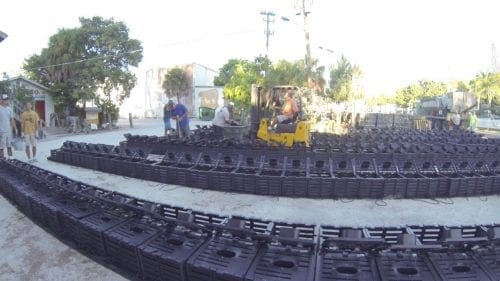
Making crab traps in Cortez - Cindy Lane | Sun
- Cindy Lane | Sun
- Cindy Lane | Sun
- Cindy Lane | Sun
- Cindy Lane | Sun
- Cindy Lane | Sun
Cortez crab traps - Cindy Lane | Sun
- Cindy Lane | Sun
- Cindy Lane | Sun
Cortez net camp - Cindy Lane | Sun
- Cindy Lane | Sun
- Cindy Lane | Sun
Stone crab claws are hitting local menus. - Cindy Lane | Sun
CORTEZ – Residents of the Cortez historic fishing village are reaching out to provide aid to fellow commercial fishermen in Chokoloskee and Everglades City in the wake of Hurricane Irma.
The donation drive kicks off at 9 a.m. Tuesday, Sept. 19, at Bradenton Elks Lodge 1511, 2511 75th St. in Bradenton. Collection will continue through 4 p.m. with items being delivered to a distribution point at the Chokoloskee Church of God on Wednesday morning.
Items needed include cleaning supplies – vinegar, bleach, mops, buckets, work gloves, chainsaws, large garbage bags, generators, power cords, waders and waterproof boots, fuel and fuel cans, personal hygiene supplies – toothpaste, toothbrushes, shampoo, conditioner, razors, feminine products, deodorant, antibacterial soap and contact lens solution, and first aid products – bandages, anti-bacterial cream and sprays, bug bite cream, peroxide, Ace bandages, bug spray, and gauze and wound dressings. Other items requested include underwear and socks.
Cash and gift card donations also are welcome to help purchase needed equipment and other items.
Volunteers also are needed to help collect and package items for transportation during the event along with those willing to travel to the affected area to assist with distribution and cleanup efforts.
For more information or to volunteer, contact Rose Lipke at 941-725-9189.
BRADENTON – Bradenton resident and full-time local charter captain Nate Weissman was among those who traveled from Cortez to Texas last week to assist with the hurricane relief efforts in Texas.
On Sunday, Weissman, who is back home, shared his thoughts on the experience via his Facebook posts.
“I am feeling an emotion I’m not familiar with. In all honesty, I’ve done a lot of crying since we got to Texas Thursday. It’s not sadness, I don’t think. I could be wrong. I’m mostly OK, but I will have moments where I think about how frustrating the whole situation was; and it’ll be a little tear to a complete breakdown. I feel good. I’m in good spirits. I’m home with my wife and dog. I get my kid Tuesday.
“I went to Texas with an expectation and what I got didn’t meet that expectation. That’s where my frustration lies. The most important lesson I’ve learned from this disaster in Texas is don’t wait. I should have had my boat headed to Texas when the urge first struck me on Sunday. Next time I’m hooking my boat and hauling ass to help immediately. I can’t help but think if I got there quicker I could have maybe saved someone that didn’t make it out.”
He and the others can still some solace in the fact that the Cortez caravan of trucks, trailers and trailered boats delivered much-needed supplies to Texans.
“I know we did made a difference; maybe not so much in the numbers of rescues, but with the donation of supplies and all that. But, these supplies would’ve gotten on that truck just as fast without me. Those supplies would’ve got to Texas where they were dropped just as fast without me,” Weissman wrote.
The brief but taxing trip left a lasting impression.
“I went with a few friends, a few acquaintances and a few complete strangers. What I had when I left were brothers and sisters. Some of us are home now for various reasons. Some of us are still there doing good. And some of us are stuck in limbo. Hurricane Harvey taught me a lot about myself and about people. Hurricane Harvey taught me how to handle helping in a disaster and I wouldn’t hesitate to rush to help again.”
CORTEZ – At the edge of the main parking lot at the Cortez Commercial Fishing Festival is a fringe of green, the edge of the 95-acre FISH Preserve, made possible by the modest admission price paid by thousands of festival fans over the past 35 years.
The Florida Institute for Saltwater Heritage (FISH) purchased the last, long-coveted privately owned parcel last summer from Iris LeMasters, of Grand Rapids, Mich., who had offered it at $1.2 million 12 years ago, inviting buyers to “Build your Florida dream home on this one-of-a-kind half-acre bayfront lot completely surrounded by preserve.”
FISH paid $185,000 for the land, making the preserve 95 contiguous acres of uplands and wetlands bordered by Cortez Road to the north and mangrove-fringed Sarasota Bay to the south, serving as a buffer between the historic fishing village of Cortez and development to the east.
The FISH Preserve is now uninterrupted since FISH acquired the last parcel. – Cindy Lane | Sun
The preserve and the 35th anniversary of the festival were only two of the things FISH celebrated this year.
Festival volunteers Peg Miller, Sam Valeris and the Cortez Park crew were honored with awards, along with Capt. Soupy Davis, 90, for his contributions to the fishing industry and his fiddle playing at the Florida Maritime Museum’s monthly Music on the Porch jam sessions.
The pioneer award was presented to the unofficial matriarch of Cortez, Mary Francis Fulford Green.
Mary Fulford Green was presented with a Cortez pioneer award on Saturday. – Cindy Lane | Sun
The granddaughter of Cortez pioneer Capt. Billy Fulford, she graduated from Bradenton High School in 1942 as valedictorian. She attended the Florida State College for Women (later Florida State University) in Tallahassee, earning a doctorate in education.
A great-grandmother, founder of Hope Family Services and longtime community activist, “She has done everything in her power as a mother would to protect what she sees as her special child – this village,” FISH board member Jane von Hahmann said in presenting the award.
CORTEZ – It’s almost time for February’s most salty and delicious local event – the 35th Annual Cortez Commercial Fishing Festival, set for the weekend of Feb. 18 and 19 from 10 a.m. to 6 p.m.
Celebrate “Fishing For Our Future” with eight local bands, including a scurvy group of sea shanty singers, Cortez native Eric Von and Cortez fishing Captain Soupy Davis and his band.
Check out nautical and environmental works by more than 50 artists focus
A touch tank fascinates young festivalgoers. – Cindy Lane | Sun
ed on the historic fishing village’s maritime heritage. Take the kids to the expanded children’s play area and visit the marine life touch tank.
Explore the Cortez Cultural Center, the FISH Boatworks and the Florida Maritime Museum, all free, then head to the commercial fishing docks on Sarasota Bay for dock talks by Florida Sea Grant representatives and demonstrations and interactive displays by Fishing For Freedom.
When you’ve worked up an appetite, set sail for the food court, featuring locally-caught grouper, stone crab and other selections, with menu items for landlubbers too.
Admission is $4, with kids 12 and under free. Proceeds benefit FISH, the Florida Institute for Saltwater Heritage, to restore and expand the 95-acre FISH Preserve east of Cortez village.
To find the festival, head west toward Anna Maria Island on Cortez Road to the entrance at the Florida Maritime Museum, 4415 119th St. W.
Free parking is available east of the village off Cortez Road at the FISH Preserve, a five-minute walk from the gate. Free offsite parking is available at G.T Bray Park, 5502 33rd Ave. Drive W., Bradenton (turn east off 59th Street onto 33rd Avenue Drive) or at Coquina Beach on Anna Maria Island, with a shuttle bus to Cortez ($3 round trip).
For more information, visit www.cortez-fish.org or call 941-254-4972.
CORTEZ – As fishermen from nearby states pull into town with their boats in tow for the annual battle over lucrative mullet roe, Cortez fishermen are reminded of the war they lost 15 years ago this week.
When Floridians voted to amend the state Constitution to ban gill nets in 1994, their aim may have been to save dolphins and sea turtles, but their target turned out to be commercial fishermen and their families who lost their livelihoods.
Third Place
Investigative Reporting
2009
The net ban was proposed by environmental and recreational fishing lobbyists whose scientists testified that mullet were being overfished. The proposal won support with the slogan, “Ban the Nets – Save Our Sealife,” and photographs of dolphins and sea turtles drowned in commercial gill nets.
Caught on the underfinanced end of the political tug of war, commercial fishermen tried to adapt. Some went into bait fishing or crabbing. Some went into dockbuilding or beach maintenance. Some graduated from smoking pot to smoking heroin.
None were left with their lives intact.
And some Cortezians fear they are seeing it happen all over again.
Hook, line, and sinker – the net ban
“It’s hard to dredge it all up,” said Cortez fisherman Thomas “Blue” Fulford, who lost his leg in a fishing accident, and his livelihood when the net ban was passed in 1994.
Now he makes cast nets, which are still allowed. On his business card, he calls himself a “dispossessed net fisherman.”
Blue Fulford, who describes himself as a “dispossessed net fisherman,” makes cast nets. – Cindy Lane | Sun
“I did everything that could be done. Wrote everyone. The Cabinet, the House and the Senate,” he recalled, as a mullet jumped in the canal behind his workshop. “I got one answer, from Secretary of State Jim Smith, who wrote that it was six months before the vote, and I should get to work.”
So Fulford, the former director of the local chapter of the Organized Fishermen of Florida (OFF), went to work, as did his successor, Mark Taylor.
Taylor got flak from both sides, as he explained to friends and family in Cortez that the amendment that would ban their nets was based on hotly-debated evidence that there weren’t enough mullet to go around.
He also explained to a hostile Legislature, many of whom listed recreational fishing as a favorite sport in the 1994 Legislative directory, why the net ban would take food out of the mouths of Cortez residents and everyone else down the economic food chain, to no avail.
Commercial fishermen were an easy target because their activities are obvious and more easily regulated than nitrogen-polluted runoff, mangrove destruction and other causes of fishery declines, Fulford said.
“How many people are willing to stop using plastic bags?” he asked. “Plastic bags kill turtles, too.”
Riding back and forth to Tallahassee, Fulford saw new developments springing up and recalls thinking that Florida newcomers who didn’t know anything about commercial fishing were going to make the decision.
“They swallowed the propaganda, hook, line and sinker,” he said.
Most voters were uninformed, agreed Karen Bell, office manager of the 70-year-old A.P. Bell Fish Co., one of two Cortez fish houses that survived the net ban.
Three months after the November, 1994 vote, she got a call from a recreational fisherman announcing that the fishing was already markedly better.
“The ban didn’t go into effect until July 1 (1995),” she said.
Still angry after all these years
The bad blood between recreational and commercial fishermen goes back to the 1960s, when anyone could sell fish to a fish house, said Cortez fisherman Mark Ibasfalean, who has been selling fish since he was about 12 years old.
“I remember long lines of people at Bell’s, both recreational and commercial,” he said.
After regulations were passed requiring a commercial license to sell fish, recreational anglers were cut out of the loop, he said. Years of finger-pointing over which sector was responsible for overfishing certain species and using bad fishing practices made for constant skirmishes.
By the 1990s, the recreational fishing lobby had found common ground with environmentalists concerned about bycatch – non-targeted species that wound up in gill nets – and funded the successful net ban campaign.
To stay on the water, some commercial fishermen reluctantly switched sides to work in the recreational sector, as fishing guides or tour boat captains.
After all these years, Kathe Fannon is still angry.
First mate Pup Pup, Capts. Kathe and Mike Fannon – Cindy Lane | Sun
A member of a five-generation commercial fishing family, she now offers boat tours around Cortez and Anna Maria Island. Her customers learn about Cortez, its fishing heritage, its wildlife, its rising status as a film location, and her take on the net ban.
“The Bible says ‘Cast your net on the waters,’ ” she said. “It does not say cast your rod and reel.”
Pleading for a lifeline – the longline ban
With gill nets outlawed, some Cortez fishermen turned to longline fishing. Instead of catching fish in a net, they lay out five to 10 miles of line on the sea bed, baited with between 750 and 1,200 hooks, normally reeling it in before any sea turtles that may have been snagged can drown.
One fisherman who left a line out too long earlier this year and killed five sea turtles prompted a federal lawsuit under the Endangered Species Act and an emergency longline ban that began in May, putting fishermen out of work.
The ban was softened last month with an interim rule allowing longline fishing in water 35 fathoms or more with 750 rigged hooks until a permanent rule is implemented next spring. Local fishermen say the rule helps little since they harvest most fish between 20 and 30 fathoms.
Recent debates on the longline ban at hearings of the Gulf of Mexico Fishery Management Council evoke hearings in the early 1990s over the net ban.
Proponents of both the net ban and the longline ban include environmentalists and recreational fishermen. While the citizens of Florida made the net ban decision and regional and federal fisheries regulators are making the longline ban decision, the evidentiary process has been similar.
At public hearings, scientists with doctoral degrees speak in highly technical terms, debating the effect of the gear on marine life, both targeted species and bycatch.
Fishermen often can’t put their experience into words, and feel out of their depth, Ibasfalean said.
“I’m not calling anybody dumb, but a fisherman is not designed to understand highly technical stuff,” he said. “They’re farmers. They’re not scientists.”
During the net ban hearings, scientists and fishermen debated in their different languages whether gill nets were catching too many mullet, making it difficult for the species to propagate.
Fishermen argued that it was in their best interests to avoid overfishing.
“We have to be good stewards,” Fulford said, echoing testimony at several longline hearings this year when fishermen disputed statistics of turtle mortality, saying they had seldom, if ever, caught and killed turtles.
During longline hearings, fishermen pointed to other man-made causes of sea turtle mortality, including nest poaching and illegal artificial lighting, which can kill 100 turtles at a time in a single nest, channel dredging machines that suck up turtles and spit them out in pieces, recreational fishing bycatch, offshore racing collisions, oil spills, coastal development and pollution, beach renourishment and other factors.
Pleading for a lifeline, they asked for alternatives, including gear adjustments, such as shortening the length of the lines, reducing the number of hooks on the lines and banning bait that sea turtles prefer.
They suggested that turtle farming and better enforcement of land-based turtle laws could replenish natural stocks.
They also requested a gear buyback program, which helped a few fishermen who acted quickly after the net ban to cut their losses before the funds ran out.
The final decision, expected in spring, will likely limit longline endorsements to 61 commercial vessels in the Gulf using 750 hooks in 35 fathoms or more during June, July and August, and in 20 fathoms or more the rest of the year, said Glen Brooks of the Gulf Fisherman’s Association, who owns six longline boats in Cortez.
The ripple effect
That’s not enough to keep the industry in business, according to Brooks, who paints a grim picture of the ban’s ripple effect on the local economy.
Unemployed grouper fishermen don’t use bait, so bait fishermen go unemployed, making bait shops flounder. Marinas don’t sell as much ice or diesel fuel. With fewer fish to process, fish houses lay off workers. Truckers who transport fish to other parts of the state are idled.
And, ultimately, consumers see less local fish in markets and on restaurant menus.
“The longline ban is already having the same consequences as the net ban,” Ibasfalean said.
Designed to avoid a “jeopardy call” – the death of a threatened loggerhead sea turtle – the ban is causing livelihoods to become extinct instead, Bell testified at an August regulatory hearing.
“I’m willing to take my chances with jeopardy,” she said. “We’re almost gone anyway. We’re just about ready to close the doors. The boats are in jeopardy, the fishermen, the employees, my family are in jeopardy.”
Where are they now?
The impending longlining rule will undoubtedly leave many fishermen dead in the water, Cortezians say.
Those who own boats might re-rig them to fish with less-effective vertical gear, or use cast nets, or put out crab traps, if they can afford to buy new gear and pay the licensing fees. Crews may have to learn new skills, or get different jobs altogether.
Some may not make the transition.
“The net ban wiped out the old timers,” Ibasfalean said. “There was no grandfathering. People, when they reach a certain point, they can’t adapt.”
After the net ban, some fishermen turned from smoking pot to smoking heroin, Fulford said. Jokes spread about fishermen catching “square grouper,” or bales of marijuana dropped by plane into the Gulf.
But some stayed afloat.
Fannon switched to providing sightseeing tours after the net ban, and now works with her daughter, also a captain. Her father, Frank Tupin, made a living until his death last month catching bait shrimp with her husband, Mike Fannon.
Mark Ibasfalean and his brother, Bryan Ibasfalean, build docks, make independent films and videos, mostly about fishing, run www.TrueHollywoodScreenTest.com, and fish and crab. His wife, Kim Ibasfalean, works as a Bradenton Beach tour boat operator.
Like the others, Taylor went out of business overnight when the net ban was passed.
“I had just hung a $10,000 net that had never been used. Suddenly, it was illegal,” he said. After working as a truck driver and a motorcycle instructor, he eventually landed his present job, raking Anna Maria Island beaches for Manatee County. It’s as close to the water as he could get, he said.
Fulford continues to make cast nets and is chairman emeritus of FISH, the Florida Institute for Saltwater Heritage, which supports the 95-acre FISH Preserve and the Florida Maritime Museum at Cortez, where the local commercial fishing industry may one day be reduced to an exhibit.
Regardless of how fishermen adapt to the impending longline regulations, a bumper sticker on a boat trailer in Cortez says it all.