

Tag: Anna Maria Island fly fishing

Fly casting fundamentals explained

I’ve heard anglers say, “It’s just like riding a bike.” That’s true in the sense that it’s a learning experience that has to be practiced to be mastered. When we learned to ride a bike we often forget that we fell off a few times but persisted until we ditched the training wheels and someone to steady the bike. Then we were on that bike every chance we got and in so doing are able to ride to this day without giving it much thought. In neuroscience, it’s referred to as Hebb’s Rule and states that neurons that fire together wire together, and that’s how we build habits, good and bad.

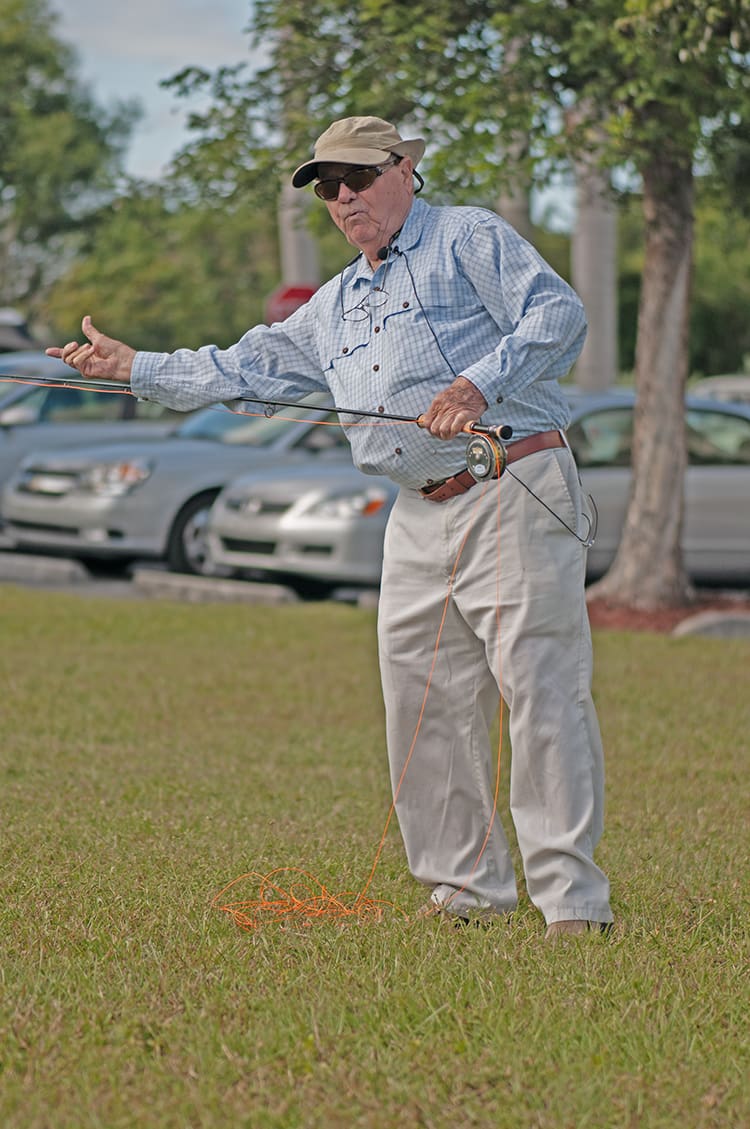
That’s why it’s important to learn and practice proper casting techniques. The basic casting stroke consists of the rod being held in the dominant hand at the base of the fingers with the thumb on top of the cork. The stroke is a combination of moves of the wrist, the forearm and the upper arm. In the “ready” position with the thumb on the cork, the wrist is straight and the butt of the rod is at a 45-degree angle to the forearm. The wrist travels from this “straight” position to a 45-degree down angle then returns to a straight position. The forearm and the upper arm complete the motion.
Fly casting fundamentals explained
The late Lefty Kreh, a fly casting legend, was a master at teaching novices the art of fly-casting. – Rusty Chinnis | Sun

There are five basic movements that are considered essential:

1. There must be a pause at the end of each casting stroke, which varies in duration with the amount of line beyond the rod tip. This allows the line to straighten for the next cast. “Watch your back cast until you’ve mastered the timing.”

2. Slack line should be kept to an absolute minimum. Slack line prevents the rod from loading and applying the proper power to the cast. The most common mistake that creates slack line happens when the rod is started too high, forming a belly in the line between the rod tip and the water. To prevent this, start your cast with the rod tip pointing at the water.

3. In order to form the most efficient, least air resistant loops and to direct the energy of the cast toward the target, the rod tip must move in a relatively straight line. Practice tracing a horizontal line like a roof eve.

4. The length of the casting stroke must vary with the amount of line past the rod tip. If you are making a short cast there is only a small amount of line needed (which only weighs a small amount). As the length of line increases, the stroke must be increased to load the rod.

5. Power must be applied in the proper amount at the proper place in the stroke. In general, the power is applied slowly at first, gradually increasing to a peak at the end of the stroke. There should be a crisp stop at the end of the stroke, forcing the rod to come out of its bend. This is commonly referred to as the “speed-up and stop.”

Like riding a bike, playing tennis or golf, the only way to master fly casting is to practice on a regular basis. Create a practice schedule that you can stick to. Start by practicing short sessions on a regular basis. Regular practice is more important than the amount of time you spend and will build a good habit. Commit to five minutes every day. Any additional time will be a bonus, but the importance of a regular practice schedule cannot be over-emphasized.

We never get as much time on the water as we want and can spend months anticipating a special trip to destinations like the Bahamas, Argentina and Montana. Spending time to master fly casting will pay dividends when you see that fish of a lifetime and raise your rod to make a cast.

Fly casting for beginners

Fly casting and fly fishing are lifelong learning experiences that you can participate in whether you’re 9 or 90. They will introduce you to a whole new way of approaching fishing and a cadre of enthusiasts who love, like traditional anglers, to share their techniques, experiences and perspectives. In addition, you’ll be introduced to a segment of anglers that create their own flies (lures). If you’re thinking of getting into fly fishing or just need to develop your casting skills, consider exploring the Fly Fishers International website. While there’s a wealth of good fly-casting videos on the internet and YouTube, there are also videos that can confuse or misdirect budding fly fishing enthusiasts. The FFI will provide you with videos and information vetted by some of the best fly casters in the world.

Fly casting for beginners
The Fly Fishers International website has a wealth of information on all things fly fishing and casting. Here you’ll find answers to your questions that have been vetted by some of the world’s most respected practitioners. – Submitted

Giving fly casting instruction taught me that being a newcomer to the sport has its advantages. Learning from scratch using the fundamentals (physics) of the cast is often easier than correcting the bad habits of long-time casters. For someone who has been fly casting for a long time but has ingrained, incorrect techniques, it can be harder to correct.

The good news is that long-time casters who have been using improper techniques can “retrain” the brain with dedicated practice sessions.

Besides learning proper technique and practicing, it’s important to realize that there is no right or wrong “casting style.” Casting is governed by physics and the repetition of a correct casting stroke builds what has been called “muscle memory” although wiring neurons into patterns is a more proper characterization. Science has shown that it’s more effective to practice often for short periods than long sessions.

There are essentials that every fly caster must master, although they may have individual skills or styles. This is the difference between the art (style) and science (physics) of the cast. Different people learn at a different pace. Some people pick up casting quickly and then plateau.

Others start slow, but when they finally “get it” they’ve “got it.” The only common requirement is practice. It can be compared to learning how to ride a bike. When we first start, we fall off and are unsteady. When the activity is practiced repeatedly it becomes second nature, like when we jump on that bike and ride off without thinking of the components required to stay upright and move forward. It’s the same with fly casting. To become a good caster you need to practice, but that practice will reward you with a lifetime of pleasure and provide the camaraderie of good friends.

Next Week: The Fundamentals

Reel Time: Learn how to tie your own flies

When I first started fly fishing, I would buy my flies from local fly shops and occasionally, guide friends would supply me with the flies I was using. Eventually, through necessity, I started tying flies and quickly found out how rewarding it was to catch a fish on a fly I had tied myself. While I tied the flies I used locally, I still ordered flies that I would take on my trips to the Bahamas. That habit changed too on a bonefishing trip a couple of years ago.

I had ordered some flies the lodge I was visiting recommended from a “reliable” source, choosing a few old classics as well as a current favorite, the Peterson Spawning Shrimp. As it turned out, the flies I ordered didn’t match my expectations. Fortunately, two friends in my party offered me some of their flies. I got bailed out on that, vowing then and there that the next trip I took I’d have a box of my own home-tied creations. Fast forward to today and it’s less than a month from my next trip. This time I’ll have the flies I have confidence in. And confidence is key!

Reel Time: Learn how to tie your own flies
The Peterson Spawning Shrimp, one of the most dependable flies for bonefish, is adaptable for a host of other saltwater species. – Rusty Chinnis | Sun

In my experience, flies don’t have to be fancy to catch fish. They do have to resemble something a local species feeds on and appear natural in the water. Two of the most reliable patterns mimic baitfish and shrimp. Probably the most basic, and one of the most effective and popular flies, is the Clouser Minnow, created by Bob Clouser. This was the first fly I learned to tie and is still a favorite. Another favorite is the bend back, a streamer tied to be weedless and fished in shallow water. The bend back is also easy to tie and very effective when properly tied and presented. As mentioned, my current favorite fly, one I tied originally for bonefish and now use locally for redfish, tripletail and snook, the Peterson Spawning Shrimp, has me immersed in tying flies and I’m enjoying the process more than ever. Fly tying is like everything else, the more you do it, the better you get. As in fly casting, golf, tennis and any other endeavor, repetition is key, so it’s better to tie often instead of for long periods of time.

If you currently tie, my advice is to master a fly you have confidence in and then work to make a fly your own. I’m constantly thinking of ways to improve patterns I fish and finding my enjoyment of fly fishing enhanced by the experience.

I would strongly advise fly anglers to take up fly tying if they haven’t already. If you want to explore tying but aren’t fully committed, start with a simple but quality travel kit that you’ll be able to use even after setting up a place to tie at home. I think you’ll find that you enjoy the fly-fishing experience even more and, as a bonus, you’ll have better quality flies at a much better price. Instructions on tying every imaginable fly are available on YouTube.

Reel Time: Fly casting mastery

Teaching fly casting has taught me some valuable lessons. Chief among them is the fact that it’s most often easier to learn from scratch using the fundamentals (physics) of the cast than it is to correct bad habits that have been developed over time. That became apparent to me when I gave lessons to someone who had been fly casting for a long time but who had ingrained bad techniques. When I showed them how to properly move the rod tip in a straight line to form a tight, wind penetrating loop, they understood the concept immediately. The eye opener for student and teacher was when they tried to repeat the proper casting stroke and their ingrained bad habit overpowered their new understanding.

This isn’t bad news for long-time casters who have been using improper techniques, but points out the necessity of practice to reteach the brain how to move the rod. The same applies to proficient casters who are learning to cast with their non-dominant hand. Try this and you’ll see what I mean instantly. If you’re a right-handed caster, putting the rod in the left hand is like handing it to your clone where the fundamentals of the cast are understood but the body doesn’t cooperate. The good news is that by learning the fundamentals of the cast and practicing them regularly anyone can become adept.

Besides learning and practicing the essentials of fly casting, it’s important to realize that there is no right or wrong casting style. Casting is governed by physics and there are some essentials that every fly caster must master, no matter what their individual skills or styles. This is the difference between the art (style) and science (physics) of the cast.

Reel Time: Fly casting
Fly fishing legend Joan Wulff demonstrates the casting stroke. – Rusty Chinnis | Sun

Fly casting is a lifelong learning experience that you can practice at 9 or 90. Different people learn at a different pace. Some people pick up casting quickly and then plateau. Others start slow, but when they finally get it, they’ve got it. It can be compared to learning how to ride a bike. To become a good caster you need to practice, but that practice will reward you with a lifetime of pleasure and provide the opportunity of the company of good friends.

Fly casting differs from spin or bait casting where the weight of the lure or bait loads the rod. The rod then transfers the stored energy of the rod to the lure or bait, which carries it to the target. In fly casting, the weight of the line loads the rod, and the line takes the leader and flies to the target.

The basic casting stroke consists of the rod being held in the hand at the base of the fingers with the thumb on top of the cork. The stroke is a combination of moves of the wrist, the forearm and the upper arm. In the ready position with the thumb on the cork, the wrist is straight and the butt of the rod is at a 45 degree angle to the forearm. The wrist travels from this straight position to a 45 degree down angle then returns to straight position. The forearm and the upper arm complete the motion.

There are five basic movements that make up what is referred to as the essentials:

  1. There must be a pause at the end of each casting stroke, which varies in duration with the amount of line beyond the rod tip. This allows the line to straighten for the next cast.
  2. Slack line should be kept to an absolute minimum. Slack line prevents the rod from loading and applying the proper power to the cast. The most common mistake that creates slack line happens when the rod is started too high, forming a belly in the line between the rod tip and the water. To prevent this, start your cast with the rod tip pointing at the water.
  3. To form the most efficient, least air-resistant loops and to direct the energy of the cast toward the target, the rod tip must move in a straight line. Practice tracing a horizontal line like a roof eve.
  4. The length of the casting stroke must vary with the amount of line past the rod tip. If you are making a short cast, there is only a small amount of line needed (which only weighs a small amount). As the length of line increases, the stroke must be increased to load the rod.
  5. Power must be applied in the proper amount at the proper place in the stroke. In general, the power is applied slowly at first, gradually increasing to a peak at the end of the stroke. There should be a crisp stop at the end of the stroke, forcing the rod to come out of its bend. This is commonly referred to as the speed-up and stop.

In my experience, the only way to master fly casting is to practice consistently, preferably committing to two to five minutes every day to train or retrain your brain. Any additional time will, of course, be a bonus, but the importance of a regular practice schedule cannot be over-emphasized. There are lots of resources on the internet to help you perfect your cast and lessons with a caster trained by the Fly Fishers International can be invaluable. Some of the best videos to search for online are those by master casters and instructors Joan Wulff and Lefty Kreh. Locally, anglers can research rods and tackle at AMI Outfitters on Anna Maria Island. There are also some excellent casting videos on YouTube from Orvis and Rio. Learn and apply the fundamentals of fly casting consistently and you’ll be on your way to mastering the cast.