BRADENTON BEACH – Some Pines Trailer Park residents are questioning whether permits exist for a seawall cap built in 2024 at the park that they say may have acted as a dam during the 2024 hurricanes, exacerbating the flooding of mobile homes.
The Sun requested a copy of the permit for the seawall cap on March 13 and the Bradenton Beach permit clerk wrote in an email that she was unable to locate such a permit. The seawall cap is adjacent to another seawall cap reportedly owned by the city.
The Sun asked Bradenton attorney Louis Najmy, who represents Pines Park Investors LLC and its manager, Shawn Kaleta, the owners of the Pines Trailer Park, for a copy of the permit on March 14 and received the following response by text: “While I was not able to confirm if the current ownership did the cap, we’ve confirmed with the city that permits are not required for caps only especially for flood protection when matching neighboring caps,” he wrote.
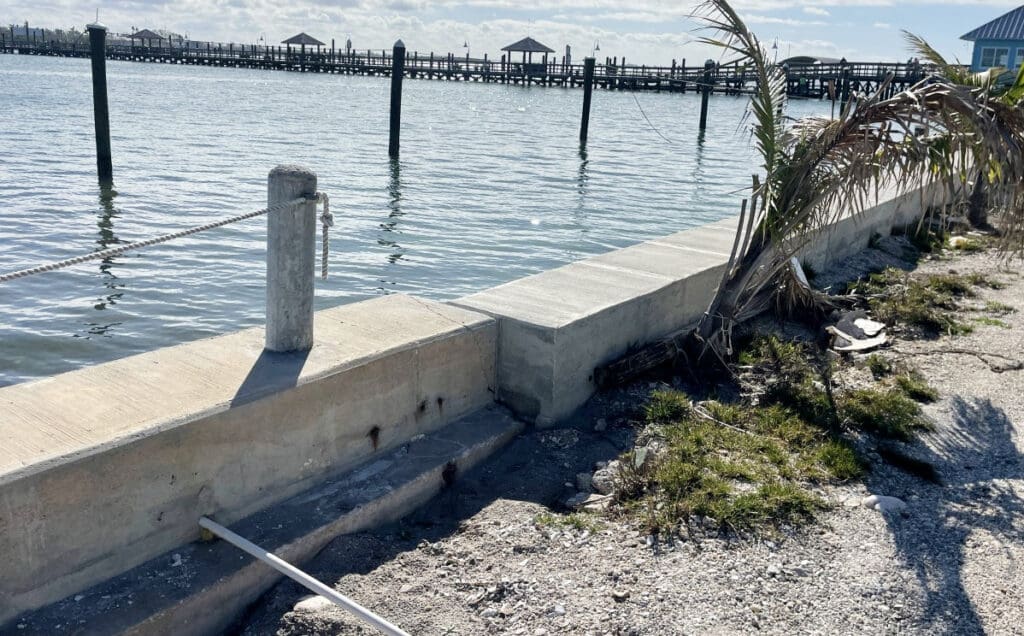
However, Bradenton Beach Building Official Bill Palmer said a permit and inspection is required for a seawall cap.
“I cannot speak to this particular issue since I was not present at the time, but a permit and inspections are required for a seawall cap,” Palmer wrote in a March 17 email to The Sun. “Section 808 of the City’s Land Development Code regulates the repair and construction of seawalls.”
“We saw it being built around March last year,” Pines Park resident Joe Klingler said, adding that during the hurricanes last fall, water came up from the Gulf side and pooled at the seawall.
“Once it hit that filled up,” he said. “The damage was worse because of that – 100%. I’m a farmer. I built three lakes on my farm and there’s real strict rules. When you put a dam on a farm, you cannot put it against the water – it could come up into the neighbor’s property. This is the same thing. He built a dam knowing it was going to flood us.”
“Don’t get me wrong, we still would have had a flood, but we wouldn’t have had it hit the wall, stay and go higher and come back this way and sit here for four hours,” Klingler said. “That’s where you get the seepage and it’s more damage. When the water just comes up and goes away, we wouldn’t have even had to come up and replace our walls.”
He said the sea life that was once abundant beyond the seawall is no longer there.
“No matter what, they made a lake out of this place,” Klingler said. “We used to have manatees and fish at this wall, not anymore. The seagrass there is gone.”
Another Pines resident, who asked not to have his name used, said, “While proving motive in court is difficult, what’s undeniable is that this 200-foot illegal structure acted as a dam, significantly worsening the flooding.”
In his email, Palmer outlined the requirements of permits and inspections: “808.6. Permits. An application for a permit to construct a seawall shall be submitted for review, along with plans and specifications. Permits for construction or repair of a seawall shall not be also a permit to dredge, fill, and grade.
“808.8. Specifications – Caps. Caps shall be cast over tops of the sheet piles and shall be continuous. Caps shall be reinforced by horizontal bars not smaller than No. 4, and shall have a minimum of two (2) inches of concrete cover in all directions. Design, spacing, and reinforcing shall be provided according to the referenced standards for formed in place concrete. When forms and reinforcing bars are in place, the building official shall cause an inspection to be made before the concrete is poured.
“808.9. Tiebacks. Vertical sheet piling bulkheads shall have tiebacks every 12 feet, and the anchor block shall be a minimum of 12 feet from and at right angles to the bulkhead. Tiebacks shall be hot dipped galvanized at minimum and not less than ¾” thick. Backfill shall be placed after tiebacks and anchor blocks shall have been inspected and approved by the city.”