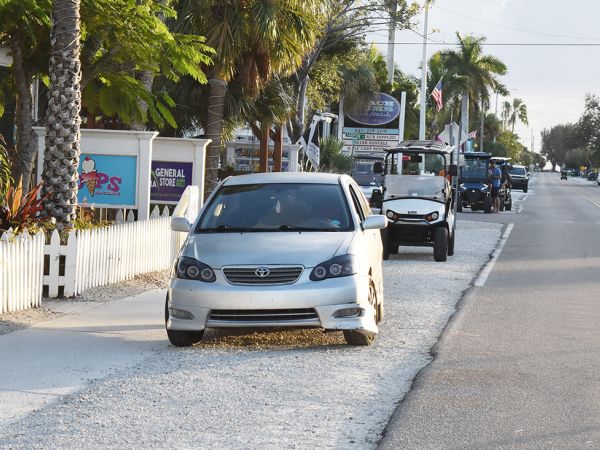


ANNA MARIA – On Nov. 12, Anna Maria Mayor Mark Short and the city commissioners continued their ongoing discussion about implementing a citywide parking management program that at some point will require purchasing enforcement vehicles and other needed equipment and technology.
After multiple discussions, the commission has not yet formally adopted the parking management plan proposed by Short and the WSP consulting firm.
The recommended motion included in the Nov. 12 agenda packet says, “Motion to approve the purchase of parking enforcement vehicles, technology and related equipment as presented, and authorize the mayor to execute all necessary documents, subject to review and approval by the city attorney and compliance with applicable procurement requirements.”
Short did not present any specific expenditure requests for commission consideration that day, but his presentation included a list of proposed parking program expenditures and expenses.
Commission Chair Charlie Salem expressed his concerns that include potential unforeseen costs, the accuracy of the revenue estimates, other Florida cities recently discontinuing their paid parking programs and the Anna Maria City Commission not yet formally approving the proposed parking plan in the form of an adopted city ordinance.
Regarding the adoption of a city ordinance, City Attorney Pamela Cichon said the commission could, at any time, with proper public notice, adopt an ordinance that addresses the parking plan in conceptual terms. She said specific spending requests, the hourly parking rate and other specifics could then be addressed later via city resolutions.
The four other commissioners said they were OK with moving forward with the needed parking program expenditures while the remaining details are worked out.
Salem noted the city of Sarasota recently suspended its paid parking program and the city of Fernandina Beach recently discontinued its paid parking program. He said he doesn’t want that to happen in Anna Maria.
The proposed parking program presented by Short is based on the city using and expanding the parking enforcement system already provided by Passport.
Salem expressed his desire for the city to issue a request for proposals (RFP) seeking bids and information from additional parking management companies before awarding the expanded contract to Passport.
Short noted that Passport’s parent company, Arrive, also owns ParkNow and ParkMobile, as well as several other parking management companies.
After an hour of discussion and debate, Salem asked if any of the commissioners wanted to make a motion regarding the mayor’s general request.
“I’ll motion to approve it,” Commissioner Gary McMullen said, without stating exactly what motion he was making. Commissioner Kathy Morgan-Johnson seconded the motion, and commissioners Chris Arendt and John Lynch also voted in support of McMullen’s motion. Salem cast the only opposition vote.
The adopted motion did not reference the issuance of an RFP, but Annettee Cottrell, the city’s recently hired grants and contracts manager, told the commission she’s already been working on an RFP along the lines of what Salem desires in terms of getting proposals from additional parking companies.
On Monday, The Sun emailed Short and Cichon seeking clarification on the exact motion adopted during the Nov. 12 meeting.
In his response, Short wrote, “The authorization does not mean the purchasing will begin. We did commit to further investigation.”
In her response, Cichon wrote, “A parking vendor still needs to be selected. Further investigation into the type of vehicles needed and finding of a supplier still needs to be done. Contracts will need to be approved by the commission. Purchases will also need to be approved.”
PARKING PRESENTATION
During the Nov. 12 discussion, Short referenced an 11-slide PowerPoint presentation that included a parking management conceptual plan and parking details, revenue estimates, estimated one-time implementation costs, estimated recurring operating costs and a revised parking map.
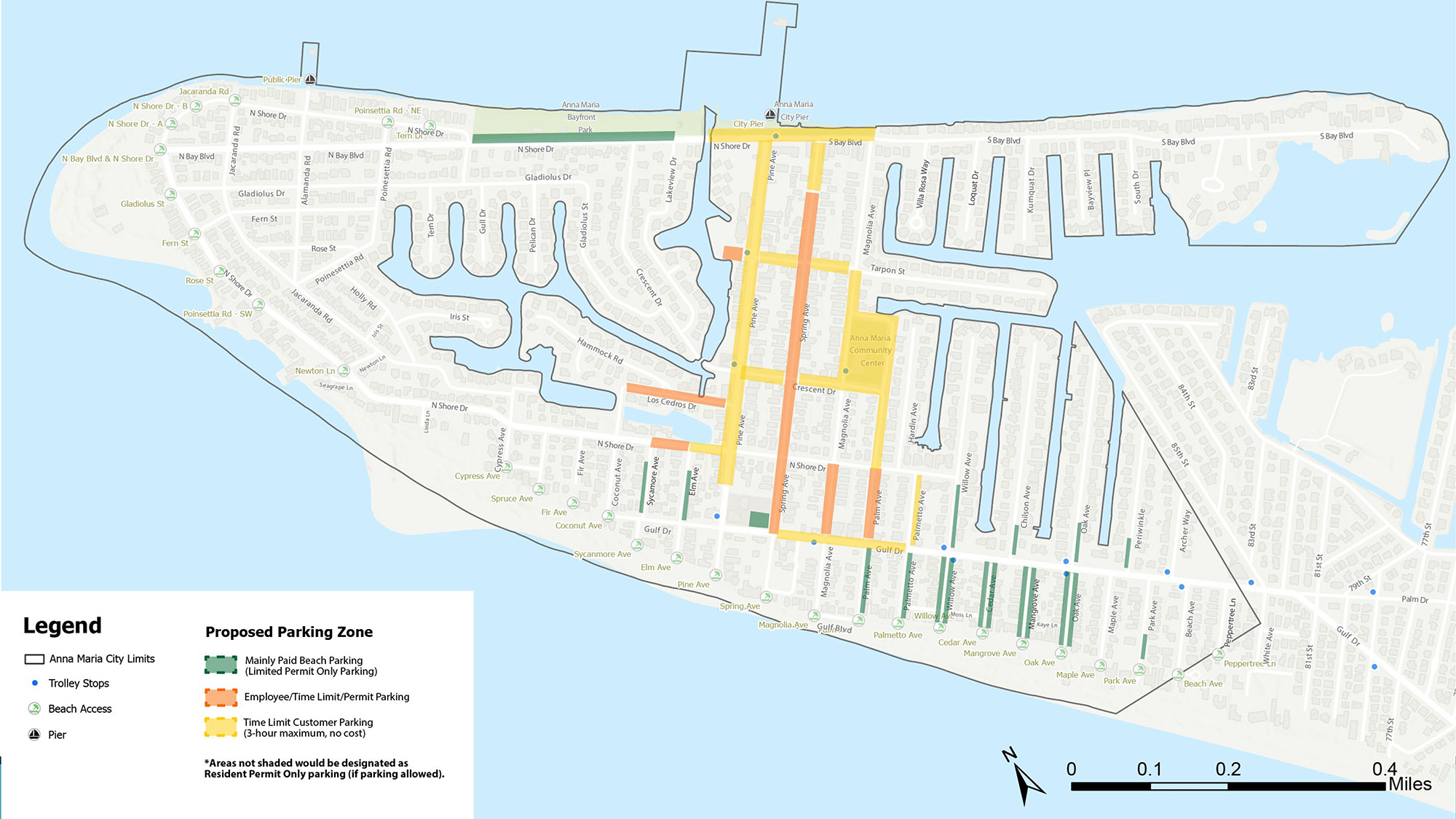
The proposed parking management program would include permit-only parking for residents and property owners; paid parking; free time-limited parking spaces in the commercial areas along Pine Avenue and portions of Gulf Drive and South Bay Boulevard; and parking provisions for employees who work at the Anna Maria businesses.
According to the map included in the presentation, employee parking (for longer time periods) would be allowed in the free timed parking spaces in the commercial areas. Short said the employers would be responsible for registering their employees in the free employee parking program. The employers would also be responsible for adding newly-hired employees and removing former employees who no longer work there.
Short expressed a desire to launch the parking management system no sooner than March 1, but he acknowledged the March 1 start date might not be possible. Salem said he’d prefer the parking program be launched during the slower summer months, and he doesn’t see the need to rush the process.
RESIDENT PERMITS
The parking permits issued to Anna Maria residents and property owners would allow them to park for free in the city’s permit-only areas and also in the city’s paid parking spaces.
Property owners and long-term renters (three or more consecutive months) would be asked to register their vehicles’ license plates and provide proof of homeownership, residency or rental agreement.
The first two vehicles would be registered for free, and a nominal fee would be charged for each additional vehicle, with a limit of four permitted vehicles per property. The proposed permit parking restrictions would be in effect from 9 a.m. to 5 p.m.
Contractors would need identification and job site proof. Residential gatherings that require more parking than the driveway can accommodate would require notifying city hall.
“I know there’s been concerns about gatherings in residential areas,” Short said. “One example given to me was somebody has mah-jongg at their house every Wednesday and there’s a bunch of cars. Well, that’s fine. Once we know every Wednesday a bunch of people are showing up for mah-jongg, we’re not gonna worry about it, and they won’t have to call every week.”
REVENUES
Short said the latest paid parking revenue projections are based on a $4 hourly rate or $25 per day, with the city covering the previously discussed convenience fee. He now estimates 140 paid parking spots and that would include the city-owned parking lot at the Spring Avenue and Gulf Drive intersection, near the Island Players theater.
Short said the parking lot at the city-owned, county-maintained Bayfront Park could provide 90 additional paid parking spots, with those additional revenues to be shared with Manatee County on a 50-50 basis if the city decides to go that route.
Short proposes the paid parking be in effect from 9 a.m. to 5 p.m.
According to his latest presentation, the Gulf Drive to beach access streets impacted by paid parking would be Oak, Willow, Palmetto, Palm, Park, Mangrove and Cedar.
The Gulf Drive to North Shore Drive streets impacted by paid parking would be Periwinkle, Oak, Chilson, Willow, Elm and Sycamore.
The three-hour parking time limit for the estimated 200 parking spaces in the commercial areas would be monitored by virtual “tire chalking.”
Those proposed parking areas would include Pine Avenue from North Shore to South Bay; Gulf Drive from Palmetto to Pine Avenue; North Bay from Pine Avenue to the humpback bridge; South Bay from Pine Avenue to Magnolia; Tarpon Street from Magnolia to Pine; Crescent Avenue from Spring to Pine; North Shore from Pine to Elm; Palmetto from Gulf to North Shore; and Spring Avenue near South Bay.
The 90 timed free parking spaces near The Center of Anna Maria would be located along Magnolia Avenue, Maxine Place, Palm Avenue and Crescent Avenue.
EXPENSES
Short estimated the 140 proposed paid parking spaces, with a 50% occupancy rate, would generate $638,750 in annual parking revenues. He said converting the 90 Bayfront Park spaces to paid parking would generate an additional $123,187 for the city.
According to the presentation, the estimated one-time implementation costs would total $178,750 and include $80,000 for the purchase of two enforcement vehicles (gas-powered trucks or cars), $36,500 for two mobile license plate readers, $10,000 for parking bumpers, $5,000 for parking bollards, $20,000 for staff labor to change out the existing parking signs, $7,500 for the city staff time associated with the parking permit registrations and a $16,250 (10%) contingency fund to cover unanticipated expenses.
The estimated ongoing annual operating costs total $228,040 and include $100,000 for code enforcement (three part-time), $49,210 for processing fees, $24,000 for vehicle maintenance and gas, $20,730 for contingency (10%), $17,100 for the annual mobile link fee and $17,000 for the annual software fee.
Related coverage: Anna Maria parking discussions continue