

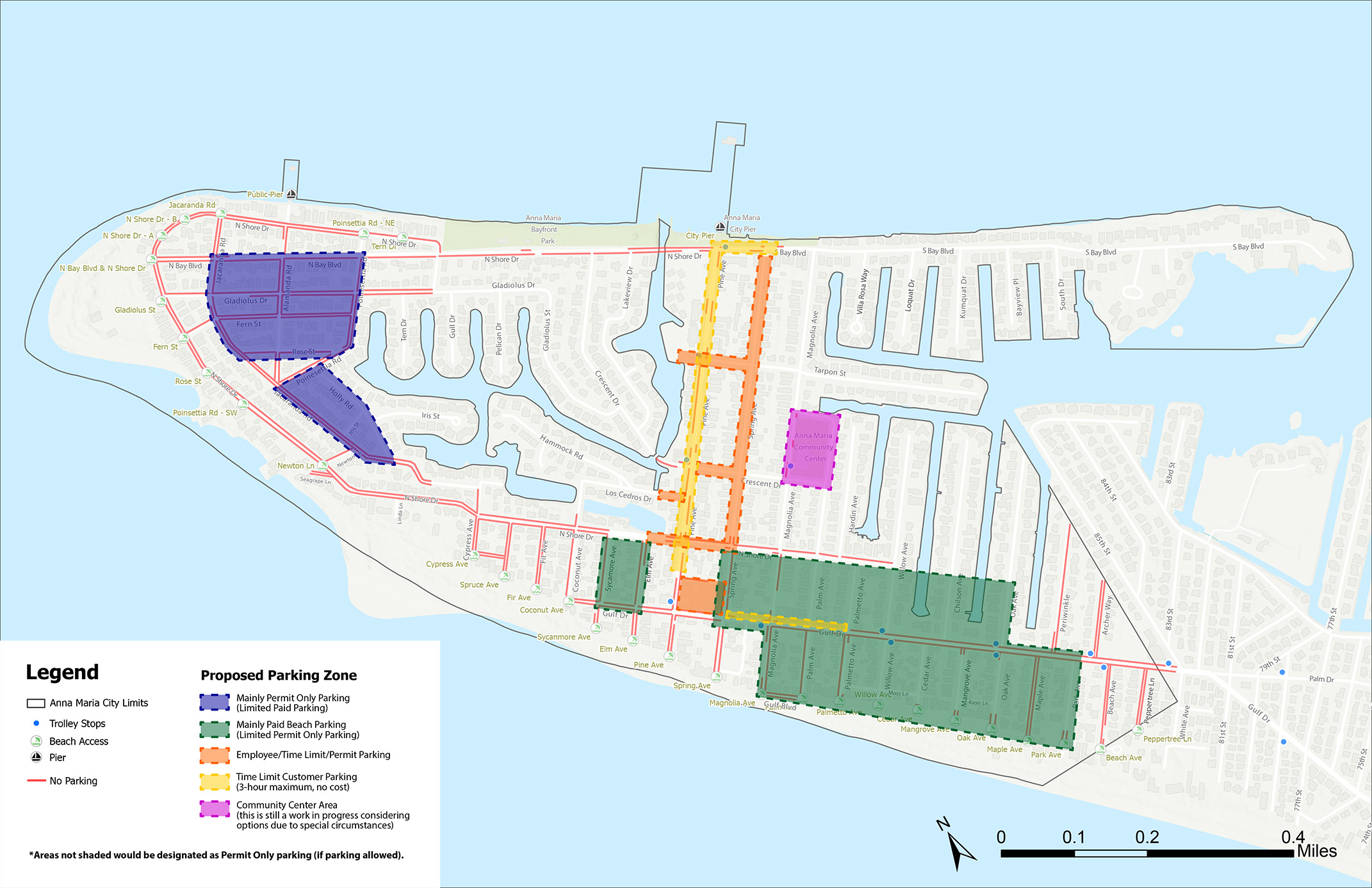
ANNA MARIA – The city of Anna Maria’s ongoing efforts to implement a parking program that includes resident permit parking and paid parking were discussed during the Sept. 23 city commission meeting.
Mayor Mark Short said city staff remains busy with those efforts and staff members have been driving the city streets evaluating the existing parking spaces. Short also said he’d be meeting with business owners and representatives of The Center regarding their parking concerns. Short said he’d be meeting with Manatee County representatives regarding parking at the city-owned, county-maintained Bayfront Park. He said discussions about a potential shared parking agreement with Roser Church officials were also on the horizon.
Regarding the proposed paid parking and resident permit parking programs to likely be implemented early next year, Commissioner Chris Arendt said, “Everything seems relatively straightforward as to how the situations would be handled, except The Center. How are you thinking that it would be handled?”
Short said parking at The Center isn’t a problem during the day, when members are taking classes and working out. Commissioner Kathy Morgan-Johnson noted some Center classes attract up to 100 participants.
Short said there’s not a lot of overflow parking needed during the evening youth and adult sporting events.
“We’ve yet to see a situation where their existing parking was not enough,” he said.
Arendt said a paid parking program might result in some motorists seeking free parking at and around The Center when headed to other nearby destinations.
“We know that, and that’s why we’re meeting with them now,” Short said.
Short and City Clerk Amber LaRowe said the paid parking program would likely take three or four more months to implement. Short said that would include obtaining the automated license plate reading equipment and having the parking program vendor provide the parking signs that will contain a QR code linked to a payment portal.
LaRowe said enforcement would be performed using small, specialized vehicles equipped with license plate readers. She said the city would ideally purchase two such vehicles. Short noted the parking enforcement vehicles were included in the 2026-27 fiscal year budget adopted earlier that evening.
Short said city staff will first seek commission consensus on the hourly paid parking rate, and that would help drive additional decision-making and the drafting of the city ordinances and resolutions needed to implement the proposed parking program.
Commissioner John Lynch noted the high level of public interest in the proposed parking program and he asked about the city’s communication plan.
LaRowe said she didn’t recommend another town hall-style meeting like the one held at The Center in late August, but public input would be allowed during the regular city commission meeting discussions.
She also noted several parking program-related documents can be found on the front page of the city website.
LaRowe said the WSP consulting firm is now on its third iteration of the parking study first presented to the commission in mid-August. She said the next version of the plan would feature street-by-street concepts that are more visual and easier to understand than the parking maps provided thus far.
RESIDENT PARKING
Johnson said she’d like future commission discussion about the number of parking permits issued to city residents.
Short said the current concept anticipates each registered residential property to be allotted two resident parking permits per household, but there might be a need for additional permits for some households. He said there would be a fee for permits issued to third and fourth vehicles.
Using himself as an example, Short said his household utilizes two cars and a golf cart.
“I will guarantee you we will recommend a cap on how many vehicles can be associated with that property,” Short told the commission.
Arendt asked how “onerous” the registration program would be for city residents. Short said it would be similar to obtaining a city-issued emergency evacuation reentry tag – and it will be up to the homeowners to register their vehicles.
Short said registration should be easy and available online, but staff expects many residents will come to city hall and ask to have their registration completed. He said once a vehicle is registered, it remains registered until the city is informed otherwise.
Johnson asked how the parking needs of residents’ visitors would be accommodated.
LaRowe said there will be a separate registration for visitors and city staff is researching how other municipalities handle that.
Short said staff is also weighing hours of enforcement. If commissioners set paid parking for roughly 9 a.m. to 5 or 6 p.m., early-morning beachgoers would be gone before it applied. Staff is also discussing a sunset-based option, and similar time limits for the permit parking.
TIMED PARKING
Regarding the previously discussed free, three-hour parking limits to be established along Pine Avenue, Commissioner Gary McMullen said, “If you’re going to go to a restaurant, you’re not going to be there for three hours. You’re not going to be shopping for three hours.”
Short said three hours isn’t that long for those who want to do some shopping and also eat dinner at one of the local restaurants.
After Arendt mentioned The Waterfront restaurant, Short said the status of the public parking spaces near the City Pier is still being contemplated – and a shared parking agreement with Roser Church (during non-church service hours) could dramatically affect the parking scenarios in that area.
“At the end of the day, whatever we propose, is going to be up to you all,” Short said.
Lynch noted the privately owned paid parking lots in Anna Maria are heavily utilized and the hourly parking rate doesn’t prevent people from using them.
Lynch said the commission needs to use “good judgment” during the parking-related decision-making that lies ahead.
The agenda for the Thursday, Oct. 8, city commission meeting that starts at 1 p.m. includes a Parking Update and Discussion agenda item.