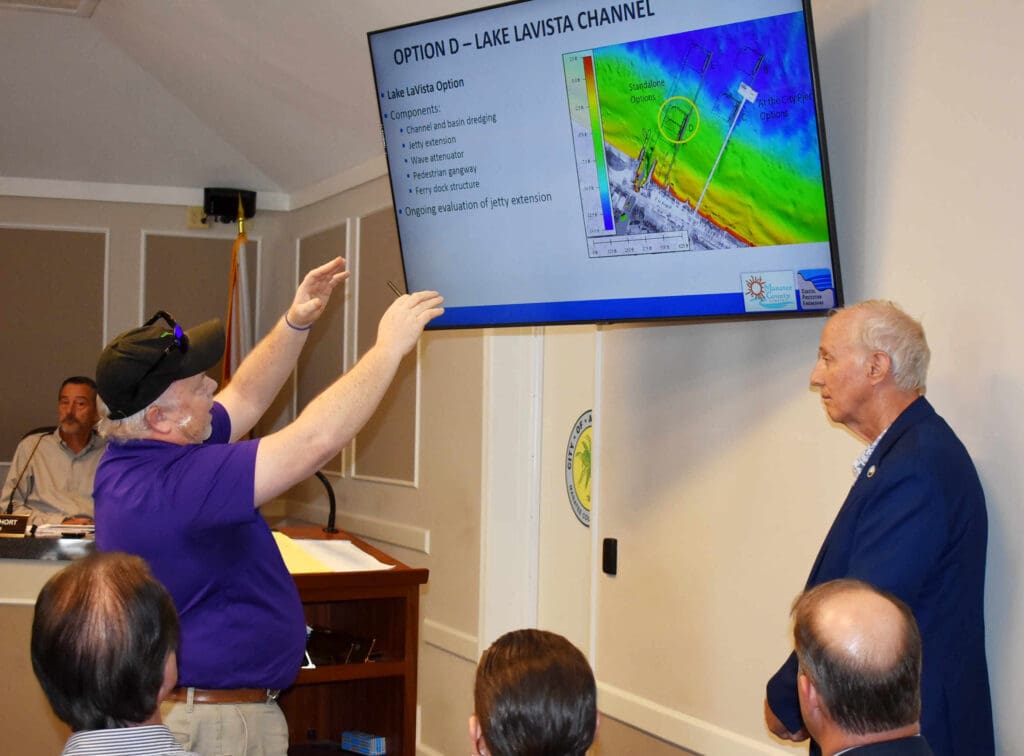
ANNA MARIA – Manatee County and Anna Maria officials spent an hour or so discussing five potential Gulf Islands Ferry landing locations at or near the City Pier.
During the May 8 city commission meeting, the pros and cons of the proposed landing areas were discussed but no decisions were made. A county-funded ferry landing built alongside or near the City Pier requires city commission approval.
Last October, Hurricane Milton destroyed a large section of the City Pier walkway, taking with it the boat landing that had served as the Anna Maria ferry stop since January 2024. Mayor Mark Short and the city commissioners are unified in their belief that replacing the hurricane-damaged pier walkway and reopening the pier is their top priority and the ferry landing is an important but secondary concern. It was stated during a recent TDC meeting that the county-contracted Gulf Islands Ferry Service is not expected to resume in Anna Maria until August 2027.
The ferry service currently consists of two 49-passenger, open-air pontoon boats traveling on the Manatee River and the Intracoastal Waterway between downtown Bradenton and the Bradenton Beach Pier. The county expects to add a larger and heavier boat to the fleet later this summer. The new boat will seat approximately 76 passengers inside and 22 people outside and handle the Bradenton/Anna Maria river route. The two pontoon boats will serve as ‘Island hoppers’ traveling between Anna Maria, Bradenton Beach and Coquina Beach, and potentially Holmes Beach.
Holmes Beach Commissioner, ferry proponent and Tourist Development Council (TDC) member Dan Diggins attended the May 8 meeting but didn’t participate in the discussion.
The county was represented by Bradenton Area Convention and Visitors Bureau Executive Director Elliott Falcione, Natural Resources Director Charlie Hunsicker and county consultants Thomas Pierro and Morjana Signorin.

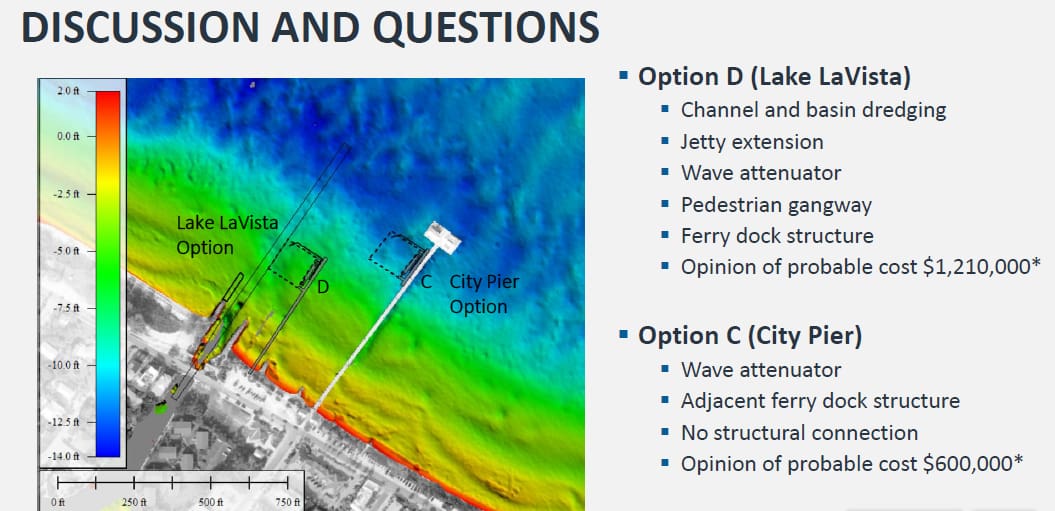
Options A, D and E propose constructing a stand-alone ferry dock near the Lake La Vista channel and jetty. Options A and D are closer to shore and would require dredging. Option E is in deeper water, almost parallel with the T-end of the pier, and would not require dredging.
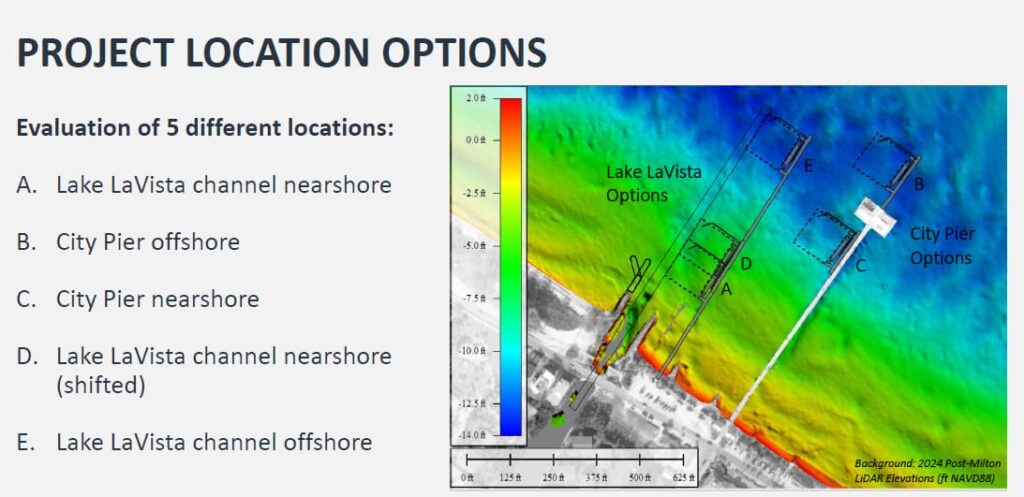
Option C proposes a ferry dock constructed along the northwest side of the pier walkway, between the shoreline and the City Pier Grill building. Option B proposes a ferry dock constructed off the far end of the pier. Options C and B wouldn’t require dredging but would require a gangway that connects the ferry dock and the pier.
All five options propose wave attenuator walls that would help offset the wind, waves, currents and other conditions that impact docking, and all five options were subjected to extensive computer modeling that predicts how each option would be impacted by those natural conditions. Additional factors to consider include water depth, seagrass and marine life habitats, dredging needs, permitting requirements and cost.
The county presentation lists option D (by the jetty) and C (alongside the pier walkway) as the top two options. Using cost figures that are now 18 months old, the county presentation lists an estimated $1.2 million price tag for option D and $600,000 for option C.
Falcione said the county seeks the city’s input on how to proceed and he personally prefers the two pier-based options.
“We’re at a fork in the road,” he said of the ongoing decision making processes.
Concerns, considerations
City officials aren’t sure the City Pier can accommodate a larger, heavier ferry. Participating by phone, Commissioner John Lynch asked how many more passengers would arrive and depart from the City Pier aboard the larger boat. The county representatives didn’t have that information but Falcione said he’d get it. Lynch also questioned how the increased passenger loads might impact the land-based infrastructure near the pier.
During public input, city resident and Planning and Zoning Board member Jeff Rodencal shared similar concerns. Regarding a pier-based ferry landing, he theorized there could be a hundred people getting off the large ferry, a hundred people waiting to board the large ferry and another 30-40 people waiting for a smaller ferry headed for another Island destination. He questioned where all those passengers would sit or stand on the pier while waiting for their boat.
“The logistics of moving people through that period and that time has to part of this project,” Rodencal said.
Pier tenant and City Pier Grill operator Brian Seymour can’t resume his business operations until the pier reopens and he expressed his concern that ferries coming close to shore would endanger manatees, dolphins, sea turtles and other marine life. He also expressed concerns about a landing alongside the pier walkway becoming dislodged during a hurricane and damaging the pier.
“I think B gives us the best option,” he said of his preferred pier-end option.
Regarding stand-alone jetty-based options, Seymour questioned how many ferry passengers would come ashore and then walk 900 feet back out to the T-end of the pier. As a pier-based business operator, he doesn’t see a financial benefit with that scenario.
Raising another consideration, Hunsicker said the county is constantly challenged by non-boaters fishing at county boat ramps and leaving their lines in the water when boats approach. He said this could be a problem on the City Pier unless an “all lines up” policy is in place during ferry arrivals and departures.
Seymour said the L-shaped areas where the pier walkway meets the T-end are heavily fished but “No Fishing Beyond This Point” signs could be placed at the far end of the pier to accommodate the pier-end option.
The discussion ended with Commission Chair Charlie Salem thanking the county representatives for their work and their presentation.
“There’s a lot of stuff to consider here and we’re obviously anxious to get going with our rebuild, but we know this is an important part of restoring ferry service. I look forward to continuing discussion,” Salem said.