Tag: stone crab

Stone crab season is back, are they worth the hype?

Stone crab season is back

CORTEZ – Some people wait months for the return of the claw, the local signature delicacy, while others can’t wrap their head around the love of the pricey stone crab.

While some seafood aficionados clammer for bluefin tuna or their favorite caviar, if you’re in Cortez or on Anna Maria Island between Oct. 15 and May 1, it’s stone crab you covet.

Stone crabs are caught in traps that are baited with fish, and, unlike unluckier crabs, only the claws are harvested. It is legal in Florida for fishermen to remove both claws if they are large enough, but some only remove one claw to give the crabs a better chance at survival. After a legal-sized claw is removed, the crab is returned to the water where the lost claw will regenerate after a few molts. Because young crabs molt up to three times each year, they are more likely to successfully regrow their claws than an older crab that only molts once a year.

The harvest can vary greatly each year depending on a multitude of factors, including weather and environmental conditions.

“In the season of 2018-19 when we had red tide really bad, we didn’t have any stone crabs that season,” said Karen Bell, president of A.P. Bell Fish Co. in Cortez. “This year the catches have been steady, mainly enough for local consumption. We’re shipping a little bit out, like north Florida, we shipped a few hundred pounds yesterday. About 600 pounds are being shipped to Atlanta tomorrow.”

Bell says they are getting an average of 400 pounds of claws a day on average, although they have seen as much as 1,000. According to Bell, red tide doesn’t seem to be much of a factor in this year’s harvest, although it could be playing a small part in harvest numbers that are below those of previous seasons.

One thing that has not changed this season is the incredible demand for a delicacy that is among the most expensive you are likely to find at any seafood counter. Other than bluefin tuna, some rare caviar and less than a handful of other exotic seafood, stone crab claws are some of the most expensive sea treats anywhere. Prices this season range from around $30 a pound for the smallest claws to well over $55 a pound for the largest size, known as ‘colossal’ claws. When you factor in the fact that around 65% of the claw is shell and not edible, the actual price of meat yielded will range from $60 to well in excess of $100 per pound. If you order at a restaurant, you could add as much as 40% above the retail price, depending on the establishment.

“I don’t care what they cost, stone crab claws are as much a part of south Florida as people driving with their left blinker on,” joked Martin Evans, who had just finished a meal at Anna Maria Oyster Bar with his fiancée, both of whom shared a stone crab claw appetizer. “It’s not something you order every time you go out, but they’re here and we love them, so today we treated ourselves.”

Bell says A.P. Bell is selling the claws as fast as they can get them and even though the price is up this season, demand is bigger than ever.

“Our prices are up $4 or more a pound from last year and people don’t seem to even blink at that,” said Bell. “I don’t understand it, but the demand is huge and the boats are doing really well because of it.”

If high-priced stone crab isn’t your cup of tea, there’s another fish that keeps Cortez boats busy in the winter months. After the cooler weather moves in, mullet season begins in south Florida.

According to Bell, mullet is the fish that built Cortez.

“Most of the families that came here from the Carolinas were mullet fisherman in North Carolina that came here in the late 1800s; it’s just always been a staple here. Every Friday the families ate mullet,” said Bell.

It’s not just the meat of the fish that makes mullet a favorite in many cultures; the roe (eggs) is considered a delicacy in cultures around the world. Cortez mullet roe is shipped to Taiwan, Italy, Spain and even Egypt.

Bell also noted that while mullet is seen as a low-grade fish by many in the U.S., that is not the case. Mullet is high in omega oils, and in general is a very healthy fish. A great deal of the fish caught in Cortez go to Haiti, Columbia and other destinations south of Florida. Mullet season typically runs from November to January.

It’s stone crab season on the Island, and although the harvest is not what it has been in years past, they are back to the delight of locals and tourists alike.

Cortez celebrates stone crabs

Cortez celebrates stone crabs

CORTEZ – It’s a feast for all the senses with the sweet smell of stone crab and other delicious food offerings, the sound of live music, vendors offering beautiful arts and crafts and the hands-on experience of eating one of the ocean’s finest delicacies.

The Ninth Annual Cortez Stone Crab and Music Festival is a hit with the thousands of people attending the event outside the Swordfish Grill.

“I had never heard of Cortez, but some people in the condo next to us were coming over here to check it out so we shared a ride and came with them, and I’m glad we did,” said Duane Farley. “I don’t like much seafood, but there is plenty of other stuff to eat, and more than enough drink options. My wife has probably spent a hundred bucks on stone crab claws, I think she may have developed an addiction.”

The Farleys also remarked on how impressed they were with the live music, and how pleased they were that the arts and crafts vendors were selling authentic local merchandise.

“So many times you go to one of these things and it’s a bunch of junk these guys just haul from event to event and it looks like they bought it from China,” said Melissa Farley, Duane’s wife. “This is quality art and we will be picking up a few things to take back to Michigan.”

There are dozens of vendors on hand selling a little bit of everything. Food ranges from stone crab to shrimp and grits, burgers, chicken and more. There is no shortage of cold beer to help move the hips to the 11 bands taking to three stages. 

The event continues until 6 p.m. tonight.

Time to get crabby

CORTEZ – The Swordfish Grill and Tiki Bar at 4629 119th St. W. hosts its Sixth Annual Cortez Stone Crab Festival on Saturday and Sunday, Nov. 11 and 12, from 10 a.m. to 6 p.m. The music will continue after that on the stages at Swordfish Grill and Tiki Bar and the Cortez Kitchen next door.

Stone crab and Florida blue crab will be available as well as cold refreshments.

“With the weather turning cold, we think we’ll have a great harvest,” said Swordfish Grill and Tiki Bar Manager Bob Slicker.

There will be music at three venues, the stage at the Swordfish Grill and Tiki Bar, the gazebo behind the grill, and the Cortez Kitchen. Performers include TC & Randy, TH & C, Jason Haram Group, The Kat Crosby Band, The Dr. Dave Band, Billy Rice Band, Doug Deming & The Jewel Tones, Alowicious, Berry Oakley’s Indigenous Suspects, Twinkle and Rock Soul Radio.

There will also be a kid’s zone and local arts and crafts vendors. A large tent will shade attendees while they dine.

This year’s festival will benefit the Manatee Chapter of Fishing for Freedom, a volunteer organization dedicated to preserving the environment, economy and citizens’ rights through responsible scientific, ecological and biological management. The Manatee chapter spends much of its time fighting against net bans and other legislation that threatens commercial fishing. It also organizes and participates in rallies and coastal cleanup events in Manatee County.

Free parking will be available at the FISH Preserve. Guests should to enter at 116th Street. Island Beach Monkeys (Monkey Bus) and various volunteers also will run shuttles all day. For more information, contact the Swordfish Grill and Tiki at 941-798-2035.

Cortez fishermen ready crab traps for season

CORTEZ – The Florida stone crab harvest begins Oct. 15, and Cortez commercial fishermen are readying traps to drop them in Gulf of Mexico and Sarasota Bay waters around Anna Maria Island.

Wire and plastic traps containing bait are both commonly used to lure stone crabs, which in turn often attract crab-loving octopus, to the frustration of fishermen.

Stone crabs are the only seafood product not killed on harvest – fishermen typically take only one of the crab’s two claws, which must be a minimum legal size, then toss the crab back into the water, where it will grow another claw.

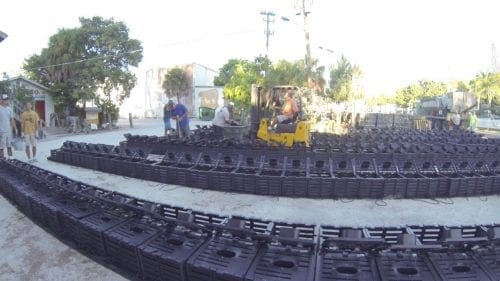
Making crab traps in Cortez - Cindy Lane | Sun

Making crab traps in Cortez - Cindy Lane | Sun

- Cindy Lane | Sun

- Cindy Lane | Sun

- Cindy Lane | Sun

- Cindy Lane | Sun

- Cindy Lane | Sun

- Cindy Lane | Sun

- Cindy Lane | Sun

- Cindy Lane | Sun

- Cindy Lane | Sun

- Cindy Lane | Sun

Cortez crab traps - Cindy Lane | Sun

Cortez crab traps - Cindy Lane | Sun

- Cindy Lane | Sun

- Cindy Lane | Sun

- Cindy Lane | Sun

- Cindy Lane | Sun

Cortez net camp - Cindy Lane | Sun

Cortez net camp - Cindy Lane | Sun

- Cindy Lane | Sun

- Cindy Lane | Sun

- Cindy Lane | Sun

- Cindy Lane | Sun

Stone crab claws are hitting local menus. - Cindy Lane | Sun

Stone crab claws are hitting local menus. - Cindy Lane | Sun

Eat more octopus

There is hope on the horizon for stone crabbers who are fed up with octopus eating the stone crabs right out of their traps.

When he’s not busy developing algorithms for predicting the camouflage patterns of octopuses, new Mote Marine Laboratory researcher Dr. Noam Josef is studying the octopus/stone crab relationship.

On the surface, it’s pretty straightforward.

An octopus spots a stone crab in a trap, realizes it can’t get away, slithers into the trap and gobbles it down.

Third Place

Humorous Column

2016

It’s a fate far more final than being pulled out of the water by a fishermen and having an arm snapped off before being tossed back into the water to grow a new one.

Unless they’re deep fried, local stone crabbers hate octopuses, which pay absolutely no attention whatsoever to state wildlife laws that prohibit tampering with traps.

Second Place

That is so… Florida

2017


Josef hopes to come up with ways to deter the lawless thieves from bellying up to the captive crab buffet.

But it won’t be easy.

Octopuses are smart. Very smart, Josef says.

They are the only invertebrates that solve problems on their own. They can even be trained for multiple complex tasks.

Eating a stone crab in a trap is like shooting fish in a barrel to an octopus.

Josef will be talking to local fishermen to find out how many of their stone crabs octopuses eat, how, when and where they eat them and how to stop them. In scientific terms, that’s quantifying, characterizing, strategizing and exterminating the slippery little devils.

He will spy on octopuses with video recorders positioned at crab traps to see how they get in and out of the underwater fast food swim-throughs.

And he plans to run an experiment (however obvious) on whether declawed stone crabs are more vulnerable to octopuses than crabs with claws.

At the same time, with Florida Institute for Human and Machine Cognition researcher David Fries, he will be working on developing flexible and biodegradable electronic displays that mimic octopus camouflage, which Mote says could be used in fashion (a shirt that goes from stripes to polka dots?), recreational diving (a wetsuit that blends in with its surroundings?), and even the military (a cloaking device for Jeeps?).

Octopuses and other cephalopods have complex skin with cells that contain pigment sacs which expand to display color and contract to hide color. Beneath the sacs is a protein layer that reflects, absorbs and diffuses light like a backlit LED screen.

The octopus controls the cells with its brain, so its color and pattern can change as fast as he can think it – one-tenth of a second – far faster than the laid-back chameleon, which uses hormones to change color.

With all that built-in technology, brainpower and sheer cunning, it seems a shame to fry up an octopus for dinner.

But when you’ve got no crabs, you’ve got no choice.

Pass the lemon butter.

Coast Lines: Octopi and golf balls – a perfect match

It doesn’t surprise John Labash to pull yet another stone crab trap out of the Gulf of Mexico and find an octopus has gobbled up his profits.

He just bags the octopus and sells it to Bell Fish Co. in Cortez, where it will be sold as a Mediterranean dinner entrée, and that’ll teach it, by golly.

What did raise an eyebrow, and his curiosity, was the golf ball that an octopus apparently brought into the trap with it.

Third Place

Humorous Column

2010

The first time.

Then it happened again. And again – five times, he says. So, even if you take into account the Mark Twainish exaggeration of any fish story, that’s at least a couple or three times.

Apparently, octopi view plastic stone crab traps like HGTV fans view the annual designer home giveaway – it’s chic, it’s free and you want to put your own personal touch on it – in this case, a dimpled plastic ball filled with environmentally incorrect rubber string.

Octopi bring shells and rocks into crab traps to make cozy nests, Laba

sh says, so from the octopus standpoint, a golf ball may be the perfect home décor item – a perfectly round objet d’art with clean lines, very modern, they give it a 10. If it was stainless steel, they’d put it in their kitchen.

“They just throw them in there and set up shop,” he says.

Are octopi just nearsighted, mistaking golf balls for sea turtle egg appetizers?

Or are they obsessive/compulsive janitors of the Gulf, whisking up what humans leave behind and cleverly putting the trash into a trap that another human will clean up?

And what’s up with people golfing into the Gulf, anyway?

There oughtta be a law.

As a matter of fact, the state litter law (FS 403.413) lists garbage, refuse, trash, cans, bottles, boxes, containers, paper, tobacco products, appliances, mechanical equipment, building material, machinery, wood, motor vehicles, vessels, aircraft and lots of other things as litter.

But, says Capt. Carol Keyser of the Florida Fish and Wildlife Conservation Commission, “There’s nothing that references golf balls.”

However, she’s quick to add, “That doesn’t make it morally right” to golf into the Gulf. “We encourage people not to do that. Can’t you just go to a golf course?”

There’s one conveniently located in Holmes Beach, by the way, where the city code is also devoid of Gulf golfing regulations.

“It is something that probably should be brought up” to the city commission, Holmes Beach Code Enforcement Officer Nancy Hall said.

The Anna Maria code also is as silent as a putting green at Augusta.

“Who would have thought anyone would do that?” Code Enforcement Officer Gerry Rathvon wondered.

Sgt. Dave Turner of the Manatee County Sheriff’s Office in Anna Maria said that if an officer saw someone golfing on the beach, “We would ask them to stop, and take their name.”

Bradenton Beach police would speak to a hacker practicing his sand trap maneuvers too, but there’s nothing in the city code about it, an officer said.

But golfers beware of Jay Moyles, Manatee County’s chief lifeguard.

“If someone’s out there with a golf club playing ‘Caddyshack,’ we’re going to say ‘no way,’ ” at least on Manatee and Coquina public beaches, he said. What if the golfer slices and hits someone at the concession stand?

Golfers will even go out on boats equipped with green artificial turf on the stern, he said, an idea inspired by cruise ships with driving ranges. To heck with the effect on the residents of the Gulf.

In an old Seinfeld sitcom episode, George Costanza saved a beached whale by taking a golf ball out of its blowhole.

But in real life, last April, a golf ball was found in the stomach of a beached whale near Seattle. It probably didn’t kill him, but it didn’t do him any favors, either.

That same month, oil began to gush into the Gulf from the Deepwater Horizon well.

In comparison, golf balls are small things.

But the cumulative effect is a concern, says Grea Bevis, chief of the law enforcement division of the Florida Department of Environmental Protection.

“It’s a litter violation for sure. It’s solid waste, because the golfer has no intention of retrieving the ball,” he said.

It’s the first time DEP has heard of such a thing, and the department plans to take an educational approach before filing charges against golfers, he said.

So, golfers, how about sticking to the sand at the golf course?

And enjoy that octopus on the menu at the clubhouse.