

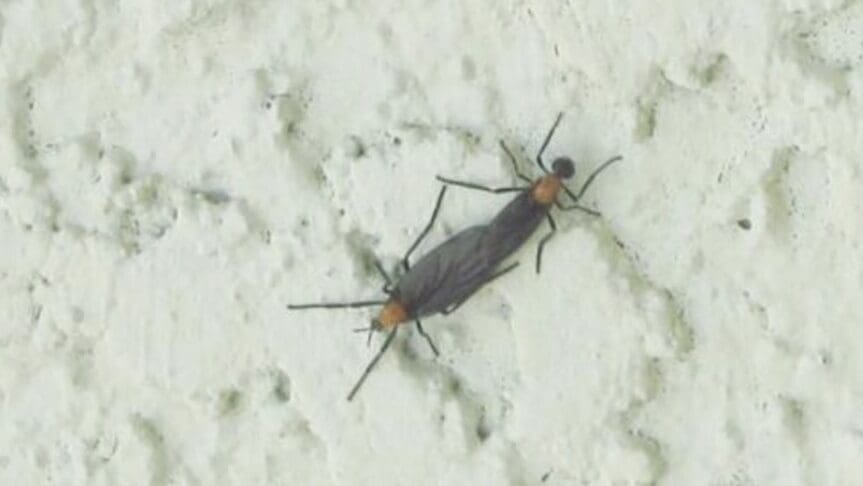
Tag: lovebugs

Nobody loves lovebugs but other lovebugs

Nobody loves lovebugs but other lovebugs

ANNA MARIA ISLAND – Twice a year the area is invaded by a tiny flying pest known as plecia nearctica, better known to Floridians as the lovebug, and once again, they are back.

Car washes love them, but most everyone else finds them to be a nuisance.

Often called the double-headed bug or honeymoon fly, lovebugs don’t actually have two heads, although at first glance it certainly appears so. During mating season, lovebugs can remain attached to each other for many days after mating, causing observers to see them as one creature. Lovebugs are harmless, don’t bite or sting, and are not a health risk to humans. Their sizable numbers do cause real problems during mating season, which occurs from late April into May, then again in late August into September.

There has been an urban legend since the 1950s that an experiment at the University of Florida went wrong and produced the annoying lovebugs. The legend says they managed to escape a UF laboratory resulting in the havoc they wreak on cars and Floridians. While this story is interesting, it has no basis in truth, according to Thomas Fasulo, an extension entomologist with UF’s Institute of Food and Agricultural Sciences.

“I started hearing this story in 1979, my first year as an entomologist in Florida, but other entomologists told me they heard the same story long before that,” Fasulo said. “How it got started we just don’t know.”

The plecia nearctica is actually a fly believed to have migrated through the Gulf coast from Texas through southern states and eventually to Florida. While they annoy just about everyone in their path, the good news is that they only mate twice a year and don’t cause many issues in the remaining months.

Lovebugs’ acidity drops to around 4.5pH, making them very acidic. This means that if left on a car’s surface, they can cause paint damage and also be difficult to remove after only a few hours. Lovebugs can also clog filters and intake systems on cars, so it’s best to wash them off as soon as possible.

Some seasons are worse than others and some areas see higher concentrations than others. There is little that can be done to predict exactly when and where lovebugs will appear in the highest concentrations. Since they only live a few days after breeding, the only certainty is that they will be gone by summer.

Lovebugs are back for spring mating season

They’re called lovebugs, but nobody seems to love them

ANNA MARIA – Car washes love them; most everyone else finds them to be an incredible nuisance.

Twice a year, Anna Maria Island is invaded by a tiny flying pest known to science as Plecia nearctica, but better known to Floridians as the lovebug, and it’s once again time for them to show themselves.

Sometimes called the double-headed bug or honeymoon fly, most people know these creatures simply as the lovebug. They don’t actually have two heads, although at first glance it certainly appears so. A male and a female remain attached, even in flight, for up to several days after mating. Lovebugs don’t bite or sting, and are not a health risk to humans, but their enormous numbers do cause real problems during mating season, which occurs late April into May, then again in late August into September. 

“They’re not native to here, they’re native to Central and South America. They migrated to the Gulf states to mate. The Florida heat is perfect for them,” said Kaeli Dye, the lead keeper at Sarasota Jungle Gardens. “They’re not considered an invasive species, they don’t do damage to crops, or cause damage to local wildlife, they’re just annoying,” added Dye. 

The one thing the love bugs can damage is your car. Because of the massive numbers of these flying annoyances, getting them stuck to your car is inevitable. When alive, the bugs have a neutral acidity, but once they are dead and stuck to your car, their acidity drops to around 4.5pH, making them very acidic. This means that if left on the car’s surface, they can cause paint damage, and also be difficult to remove after only a few hours. Lovebugs can also clog filters and intake systems on cars, so it’s best to wash them off as soon as you can. 

“They love white surfaces, so it may not be a great idea to wear white during mating season,” said Dye. Other things that seem to attract these pests include freshly painted surfaces, shiny metallic surfaces and hot asphalt. At the peak of mating season, it is virtually impossible to avoid them, and there isn’t much any pest control company can do to get them out of your way. The best that can be hoped for is dry weather, which can cause fewer eggs to hatch. 

Some seasons are worse than others, and some areas see higher concentrations than others. There is little that can be done to predict exactly when and where lovebugs will appear in the highest concentrations. Since they only live a few days after breeding, the only certainty is that they will be gone by summer.