

On a trip to Cape Cod for a family wedding in July, my wife, Christine, and I were invited by Jeanne Leszczynski to tour the Center for Coastal Studies in Provincetown. Leszczynski, a friend from Longboat Key, is a longtime supporter of the Center and serves on the executive committee.
Founded in 1976 by Dr. Graham Giese, Dr. Charles “Stormy” Mayo, and Dr. Barbara Shuler Mayo, the three scientists brought together their expertise in geology and marine biology to establish a member supported nonprofit dedicated to understanding, preserving, and protecting marine ecosystems and coastal environments through applied research, education and public policy.
The Center grew from a small attic-based science program in 1971 to a 12,000-square-foot state-of-the-art marine laboratory that employs 40 staff members and is sustained by dozens of adjunct and citizen scientists today.
During that time the Center has branched out from wave and erosion studies to seabed mapping, whale biology, seal and fisheries monitoring, water quality monitoring, marine debris response and entanglement rescue. Some of the CCS’s premier focus is currently on whale research and includes:
- Humpback Whale Studies: One of the world’s longest-running baleen whale monitoring programs;
- Right Whale Ecology: Critical work studying North Atlantic right whales, a species with critically low population numbers (fewer than 372 individuals). They see 80% of them annually in Cape Cod Bay;
- MAER (Marine Animal Entanglement Response): Globally recognized whale-and-sea-turtle disentanglement team operating 24/7; they train other nations’ responders and design tools used worldwide; and
- Marine Debris and “Ghost Gear” Removal: CCS coordinates cleanups across Cape communities, tracks trash via “Beach Brigade” volunteers and received $2.7M NOAA funding for debris recovery across the Gulf of Maine.
Another focus of the Center is on education and community engagement. They offer guided nature programs like “Science in the Harbor” aboard Dolphin Fleet boats blending sonar mapping, marine wildlife, habitat data and coastal history. They also host public outreach events (e.g. Massachusetts Right Whale Day), winter lecture series, school programs and hands-on field walks reaching over 20,000 people annually.
The tour was led by the Center’s Development Director Sue Nickerson, who has been very instrumental in the organization’s outreach and growth. “As luck would have it” Suncoast Waterkeeper’s newest board member and the new development committee chair Tom Waite (who has a summer home in Mashpee) was able to join us for the tour.
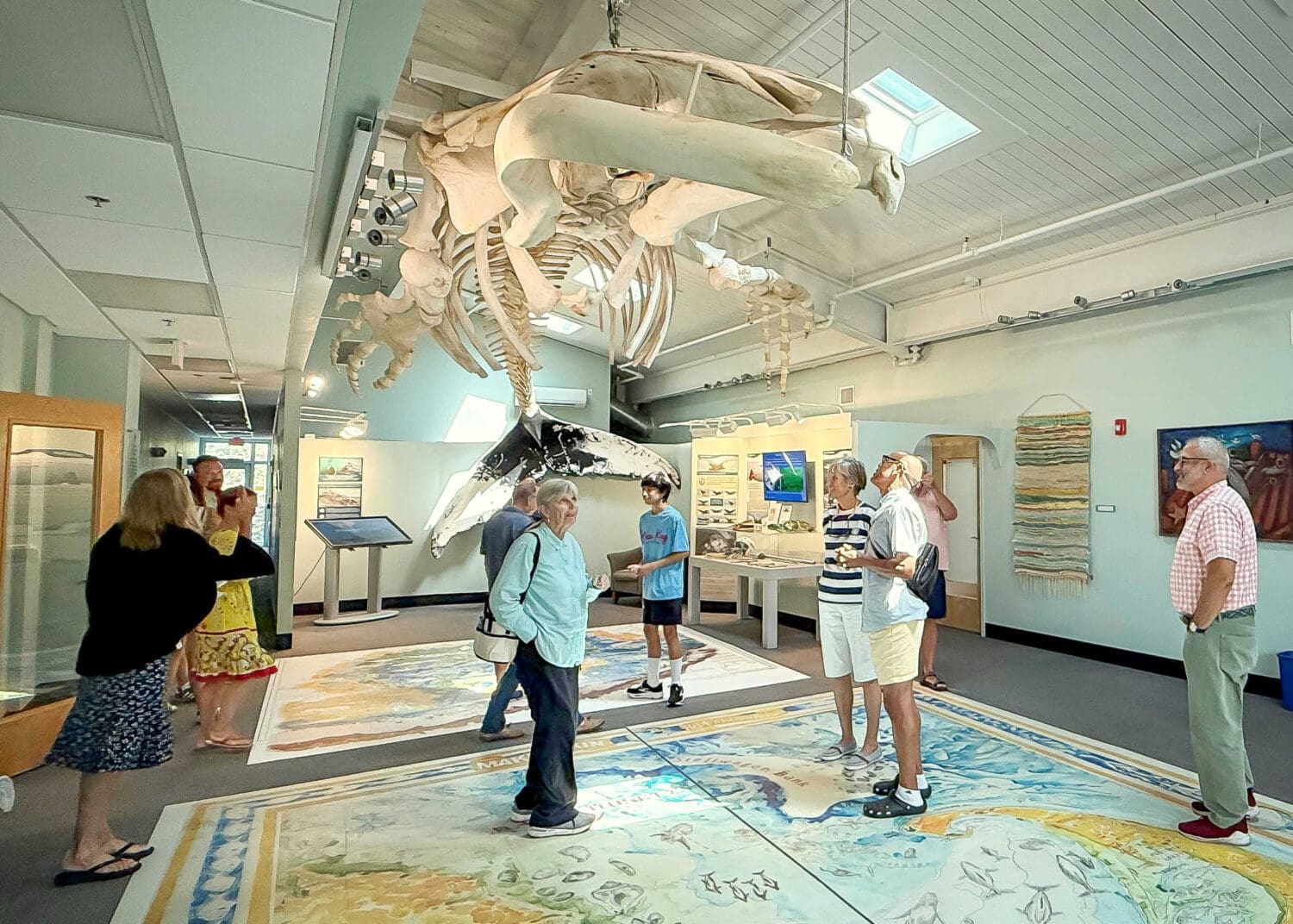
The Center, located at Five Holway Avenue in Provincetown, houses the Hiebert Marine Laboratory and features an impressive 37-foot skeleton of a humpback whale named Spinnaker. The whale, which was found dead after being disentangled multiple times by the Center’s staff is a poignant reminder of the Center’s critical work.
During the tour we got an inside look at the Center’s current work and were hosted by the lead scientists in the different departments. Everyone was impressed by the dedication of the those working there and the science being done. If you’re on the Cape, a visit to the Center is an experience you won’t soon forget, one that will inspire you to be part of the effort to preserve our marine world for current and future generations.