

HOLMES BEACH – The Holmes Beach-based Clean Water Ad Hoc Committee heads into 2026 riding a wave of positive momentum created in 2025.
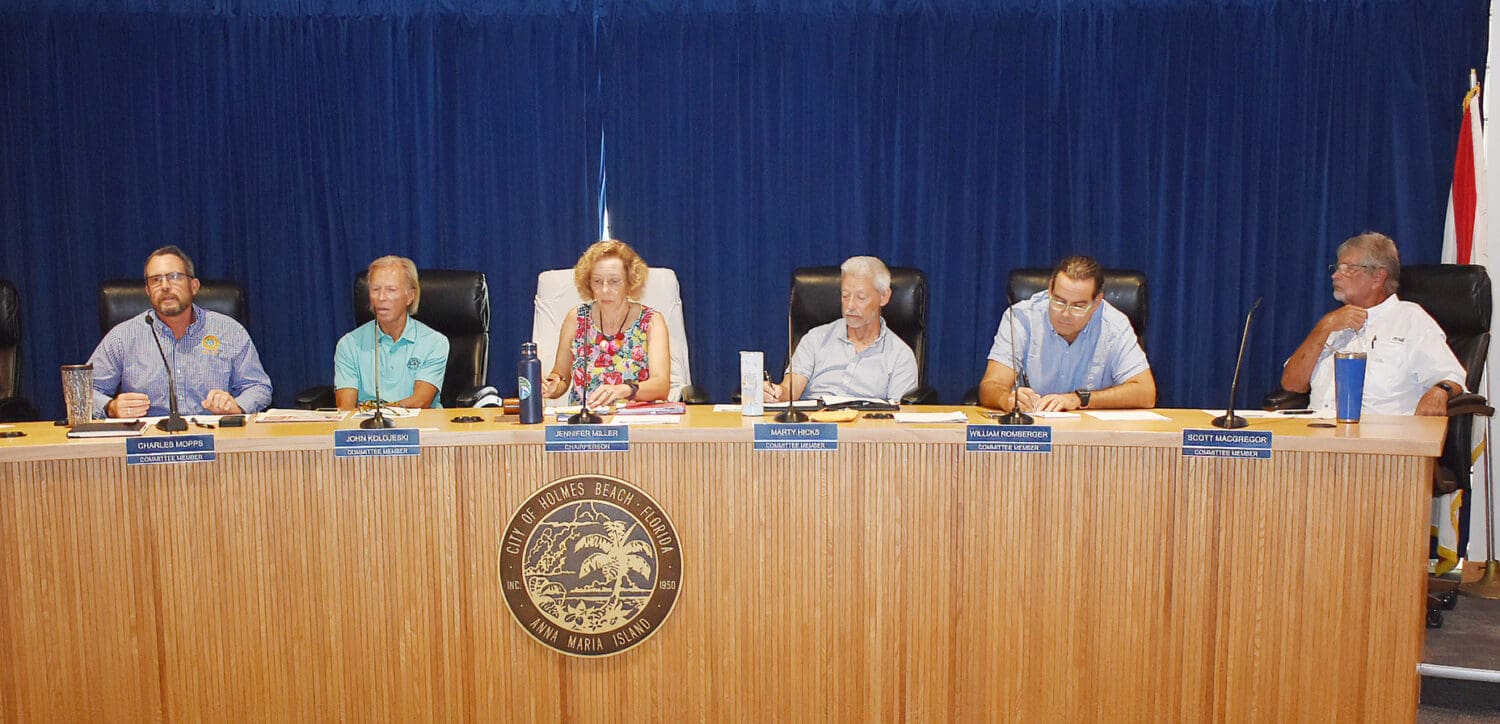
Working in unison with the city-funded Islanders 4 Clean Water initiative, the city-funded volunteer committee is chaired by Holmes Beach resident and retired chemist, Dr. Jennifer Miller. The committee includes Holmes Beach residents Marty Hicks, Mike Pritchett and Bill Romberger, Anna Maria residents John Kolojeski and Scott MacGregor and Longboat Key Public Works Director Charlie Mopps.
City Commissioner Terry Schaefer serves as the commission’s committee liaison. He attends the committee’s monthly meetings at city hall and later provides the commission with meeting recaps.
Adopted in September, the city’s 2025-26 fiscal year budget contains $15,000 for Clean Water Committee expenditures.
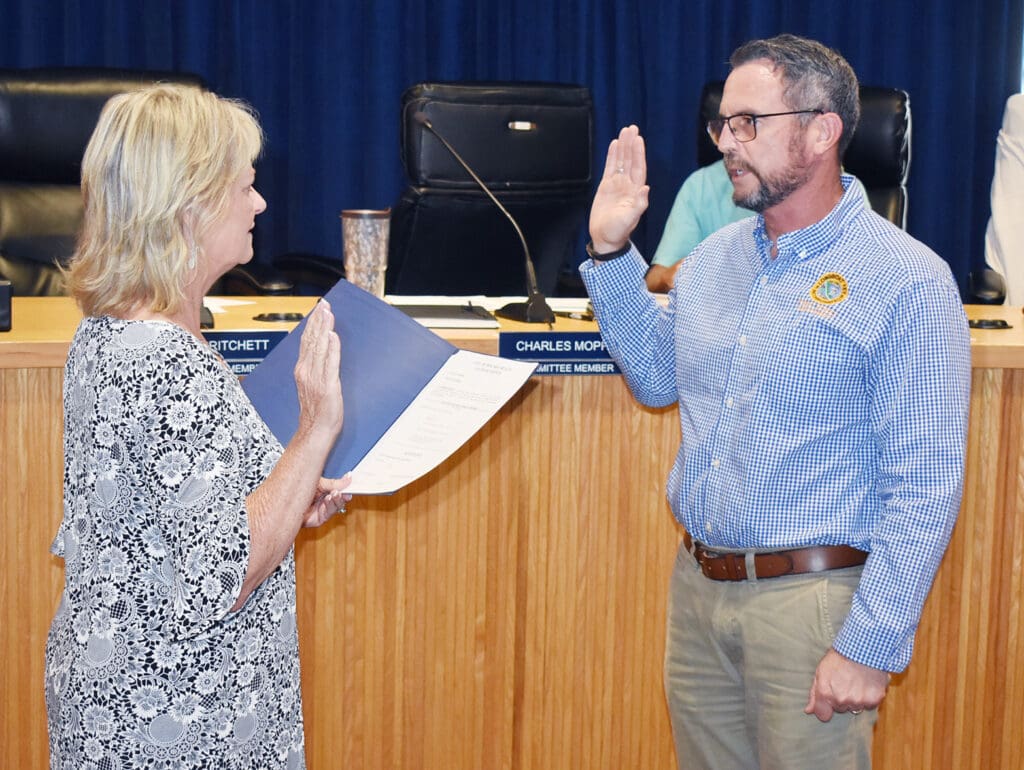
Each committee member brings different water-related expertise and experience to the committee. Mopps, who was appointed to the committee in mid-2025, along with MacGregor (a retired marine biology teacher), provides the committee with a wealth of knowledge about water-related and environmental issues and the inner workings of municipal governments.
Dating back to its 2021 inception, the committee’s primary mission remains: “To research means by which to sustain and improve upon the condition and purity of the natural waters and drinking water around Anna Maria Island.”
The Clean Water Ad Hoc Committee’s monthly meetings sometimes feature guest presenters and the 2025 presenters included Sarasota Bay Estuary Program Executive Director Dave Tomasko in May and a trio of University of Florida researchers in September who spent nearly two hours discussing in great detail the PFAS chemicals present in drinking water and natural waters.
PFAS
The University of Florida researchers provided the committee with a 59-page presentation on the “forever chemicals” known as PFAS (Per- and Polyfluoroalkyl Substances).
The trio included Dr. John Bowden, an associate professor at the University of Florida and the founder and namesake of the university’s Gainesville-based Bowden Laboratory. He was joined by fourth-year PhD candidate Tommy Sinkway and second-year PhD Student Isabella Cioffi. Much of their work involves collecting and analyzing drinking water samples and natural water samples. They also collect and analyze flesh samples taken from fish.

According to their presentation, 98% of the U.S. population has PFAS in their bodies. PFAS chemicals are found in tap water and natural waters and the potential health hazards include higher cholesterol, liver damage, kidney cancer, a higher risk of testicular cancer, developmental effects for unborn children, lower birth weight and reduced response to vaccines and more.
Bowden said PFAS chemicals have been around since the 1930s and their early uses include non-stick cookware and the the development of the hydrogen bomb as part of the Manhattan Project.
PFAS chemicals are now used in pesticides, propellants in various sprays, fast food packaging and wrappers, pizza boxes. clothing, cosmetics, popcorn bags, candy wrappers, shampoo, cleaning products, weather resistant clothing, non-stick cookware, nail polish, paints and solvents, eye makeup, dental floss, Band-Aids, toilet paper, plastic watchbands and much more.
“We don’t like products that leak, we don’t like things that stain. Because of this demand, all these chemicals were made. Unfortunately, once we’re done using those products they get disposed, end up in landfills, get reduced to run-off and wind up in our environment,” Bowden said.
He said the chemical bonds in PFAS are among the strongest in chemistry. He said the chemical properties that make PFAS great for the products they’re used in also make them bad for the environment because they take a very long time to break down and essentially stick around forever.
He said the most egregious use of PFAS is probably the fire-fighting foam used at airports and military bases to extinguish intense fires. Through rain and runoff, the PFAS contained in the foam later makes its way into the natural waterways.
Bowden said in the past 20 years or so scientists began researching the negative health effects of PFAS; and in the past decade or so, PFAS has been identified in drinking water sources.
“We’re exposed through our drinking water, we’re exposed through our food,” he said.
Bowden said water treatment plants only remove about 10% of the PFAS chemicals and a lot of PFAS-contaminated affluent materials end up in natural waterways too.
Bowden said he’s also growing increasingly concerned about airborne PFAS, because high levels of PFAS have been found in dust collected in air conditioning filters. He said the higher quality filters remove more of the potentially harmful airborne PFAS.
“There are a lot of concerns for PFAS. This is a problem that’s not going to go away,” he said. “Everybody in this room has PFAS in them. What’s unknown is what that means for your health.”
Bowden said the researchers use crowdsourcing to increase public awareness and garner assistance from volunteers. Bowden’s team developed standard operating procedures that instruct volunteers how to collect drinking water samples using kits provided by the Bowden Lab.
The presentation included several color-coded maps that identify PFAS hot spots, frequent spill areas and more. The maps show the Tampa Bay area as a PFAS hot spot and Bowden and his team plan to study the greater Tampa Bay area, which by proximity also includes Manatee County and Anna Maria Island.
Bowden and Kolojeski noted one of the drinking water taps with the highest concentration of PFAS was found at Manatee Beach in Holmes Beach.
Mopps noted Manatee County provides the drinking water to Longboat Key and the three Anna Maria Island cities. He suggested testing the drinking water at the mainland point of origin and testing the water again when it comes out of the residential taps on the barrier Island cities to see if the PFAS levels increase as the water travels through the county’s water pipes.
Mopps said the drinking water transferred to Longboat Key spends time in holding tanks and the town further enhances the water treatment done by the county.
“I have plenty of public drinking spots where you can collect samples of your own at our parks,” Mopps told Bowden.
Kolojeski, a longtime proponent of in-home reverse osmosis water filtering systems, said, ‘I would never allow a child or anyone of child-bearing age, male or female, to drink my tap water until I had reverse osmosis to eliminate the PFAS.”
When asked if plastic water bottles release PFAS into the water they contain, Bowden said, “That’s a good question. I don’t know if it’s from the water or the bottle.”
Kolojeski recommends drinking water bottled by companies that use reverse osmosis. He said those companies include Coca-Cola, Pepsi-Cola and Nestle.
“Some of those ‘so-called’ very expensive spring waters do not use reverse osmosis. You’re paying a lot of money and you’re still getting PFAS,” Kolojeski said.
Sinkway’s portion of the presentation focused primarily on the increased presence of pharmaceuticals, prescription drugs and “drugs of abuse” found in natural waters. His research also focuses on the greater Tampa Bay region – an area he said includes multiple airports, a military base and has been subjected to multiple sewage spills.
“That heat map is bright red,” he said of the Tampa Bay area.
Fish & PFAS
Cioffi’s research focuses primarily on the presence of PFAS in fish consumed in the United States, and particularly in Florida.
Cioffi noted commercial and recreational fishing and seafood consumption is a large part of the Florida economy and the national economy – providing more than 121,000 full and part-time jobs and an estimated $24 billion economic impact.
“There’s not a lot of information on PFAS and fish,” Cioffi said. “I fish. I grew up fishing. That’s a big part of my life. I don’t want us to stop eating fish. I want us to be able to eat fish in a way that’s healthy. We have healthy fish and Florida should be known for having healthy fish.”
“We just want people to know which fish are safe to eat.” Bowden added.
“We still eat fish with mercury in it, but we have consumption advisories that say only eat this type of fish once a month, every two weeks or whatever it is,” Cioffi said, noting that her goal is to one day see data-supported, risk assessment-based consumption advisories issued for fish species containing high levels of PFAS.
Cioffi’s research includes analyzing 86 species of fish found in Florida waters. She said recreational anglers, charter captains and seafood markets have been contacted and crowdsourcing is being used to gather additional fish samples from anglers.
Cioffi said the lab has already collected 4,000 fish samples and she still seeks more. Her portion of the presentation included a chart of the 86 species to be analyzed. She already has enough samples for 45 of those species but she still seeks additional samples for the remaining species; and she particularly seeks additional samples of four species: Atlantic tripletail, mahi-mahi, Gulf flounder and southern flounder.
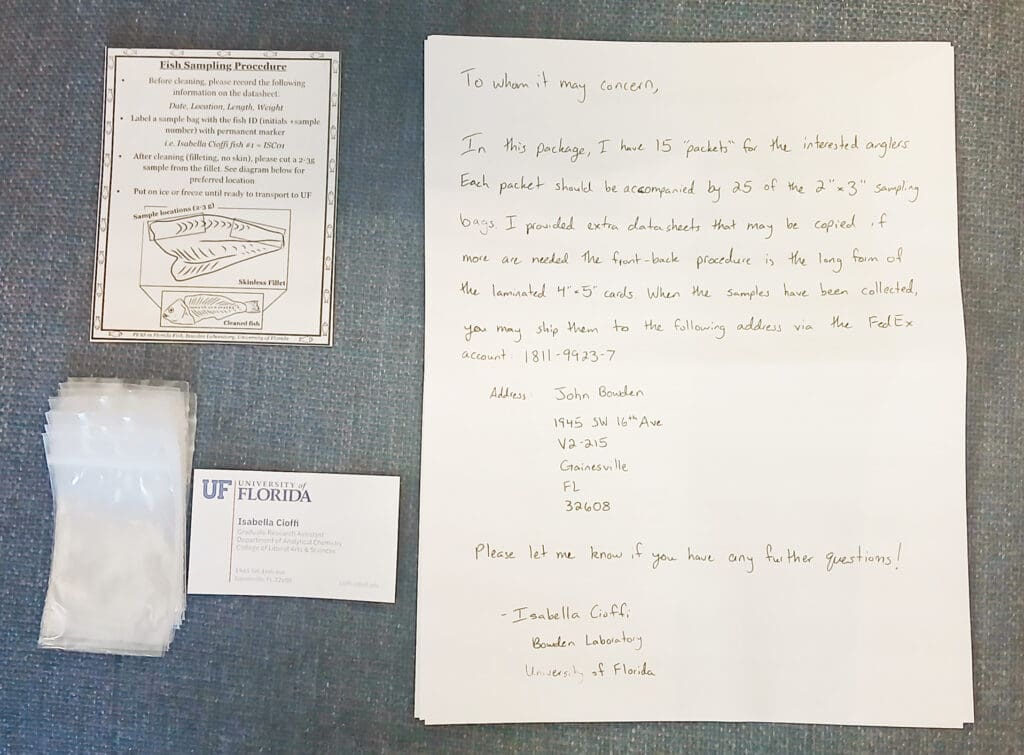
Cioffi said the fish samples only need to be 2-3 grams per fish and should be taken from the fatty muscle tissues rather than the organs.
The collected fish samples shipped to the Bowden Lab at the lab’s expense are freeze-dried, pulverized, extracted and concentrated as part of the data processing efforts.
Romberger suggested the Bowden Lab send the city fish sampling kits to be made available to local anglers. A short time later, the Holmes Beach city clerk’s office received a couple dozen sampling kits that are now available to local anglers and fishing captains at no cost. Interested angers can learn more at www.bowdenlaboratory.com/florida-fish.
“We need more knowledge on this,” Cioffi said
Regarding PFAS as a whole, Bowden said, “If we have a better educated community, you can better educate your politicians and maybe get them to understand why this isn’t just a flavor of the month. This is something that’s going to affect your kids, it’s going to affect your pets, it’s going to affect anything exposed to them.”