

Tag: North Shore Drive

Kapok tree relocated to Anna Maria

Kapok tree relocated to Anna Maria

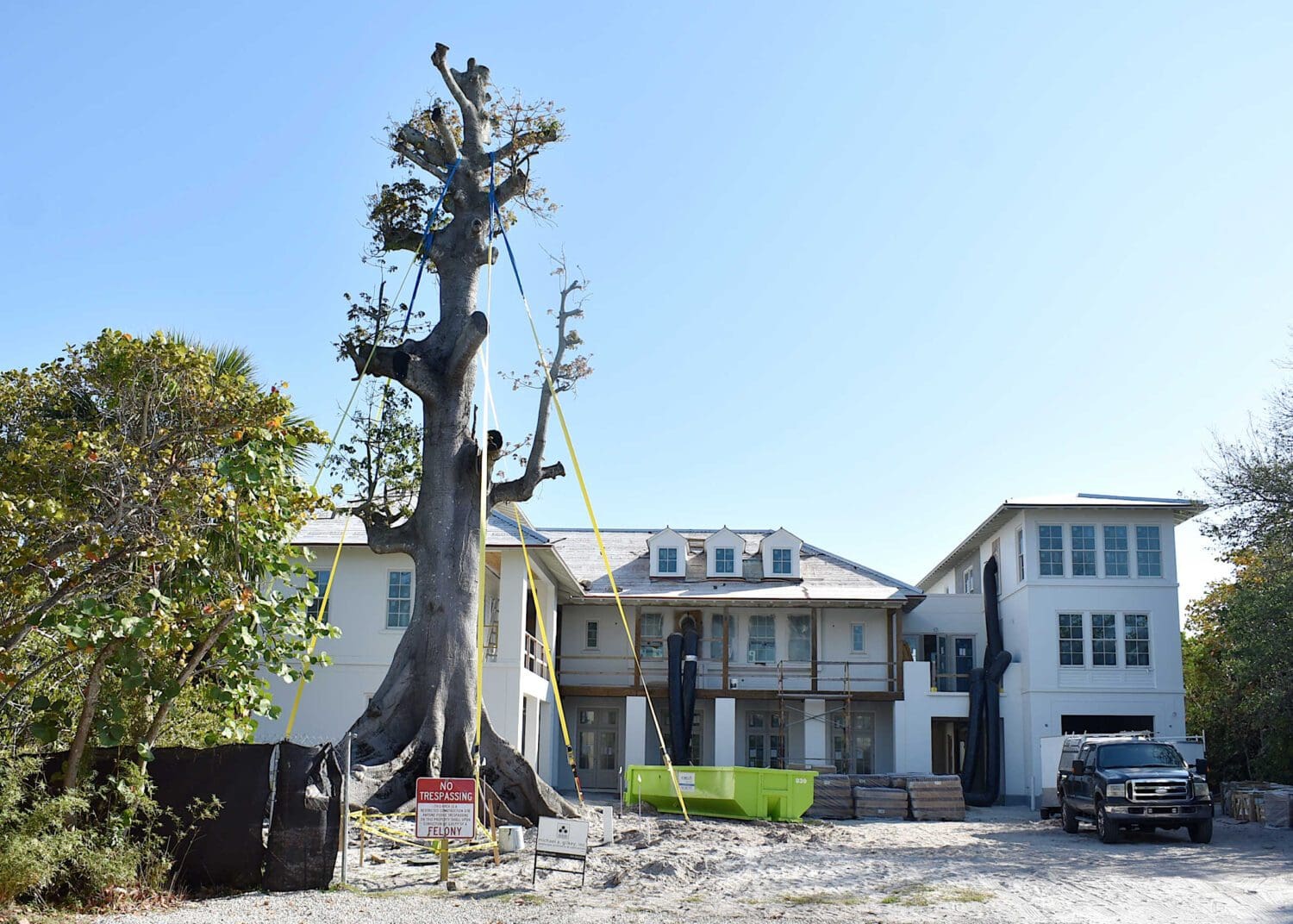
ANNA MARIA – A large kapok tree now graces a residential construction site along the 700 block of North Shore Drive.

The new beachfront home is being built by Ross Built Custom Homes with Max Gazzo serving as project manager, Jake Ross serving as superintendent and Michael Gilkey serving as the landscape architect and landscape contractor.

Gilkey owns the Sarasota-based Michael A. Gilkey Inc. landscape architect and contracting firm that has clients on Anna Maria Island and other barrier Islands from Boca Grande to St. Petersburg.
Kapok tree relocated to Anna Maria
Michael A. Gilkey Inc. serves as the landscape architect for the ongoing residential construction project. – Joe Hendricks | Sun

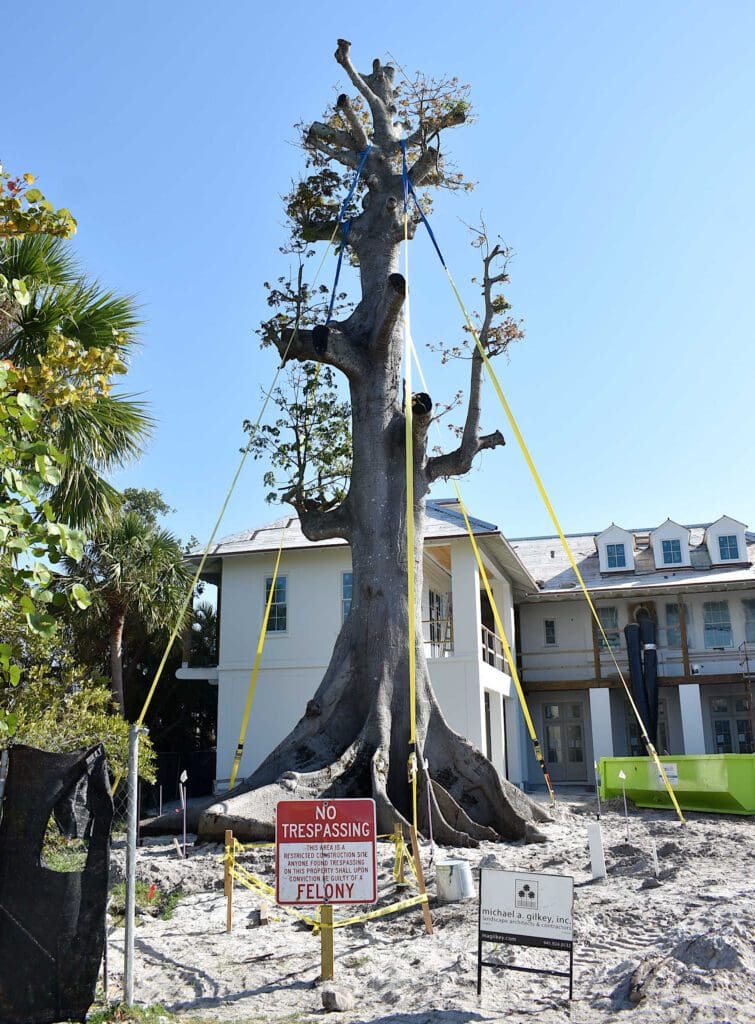
Gilkey said the kapok tree now standing along North Shore Drive is 60 to 80 years old. It came from Pahokee, Florida, on the southeast rim of Lake Okeechobee, and is approximately 57 feet tall – as tall as it can be for transportation purposes.
Kapok tree relocated to Anna Maria
The transplanted kapok tree stands more than 57 feet tall. – Joe Hendricks | Sun

Extensive preparations preceded the tree’s recent relocation to Anna Maria.

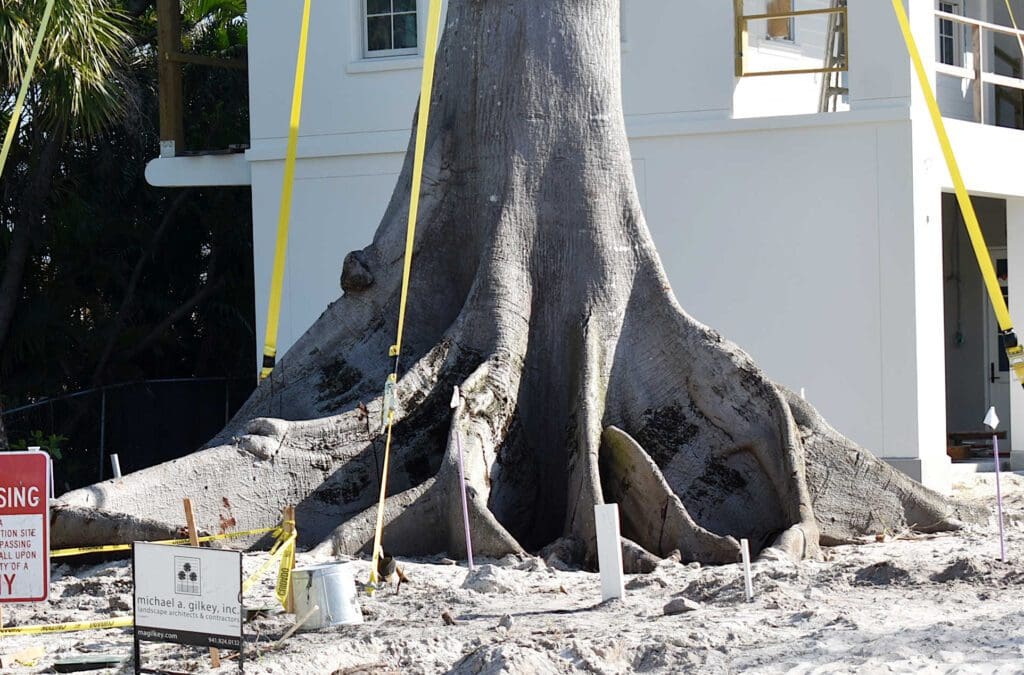
“The tree has been being prepared for about three years for the move, with extensive preparations happening over the last six months,” Gilkey said. “Initial pruning started three years ago. Initial root pruning started three years ago. In the last six months, getting ready for transport, the majority of the heavy pruning took place. The day before the move, they cut the buttress roots, or the flared roots, off the tree and labeled and numbered them to the corresponding parts on the tree. The tree came on a separate truck from the roots. We got it on-site and pinned it all back together using large stainless-steel screws.”
Kapok tree relocated to Anna Maria
The kapok tree and its buttress roots were reconnected after arriving in Anna Maria. – Joe Hendricks | Sun

Gilkey said transporting the massive tree required permits from the Florida Department of Transportation and the Florida Highway Patrol, with escort vehicles accompanying the trucks transporting the tree and the tree’s root system.

“A crane and about 20 people were involved on-site with the planting and logistics to get it in. It was a massive effort,” Gilkey said.

Relocating the kapok tree was just the start of a lengthy and ongoing process.

“It’ll take about five years to get the canopy looking normal. We won’t trim it for the first year. The tree’s going to be using its leaves and branches for its health and nutrients, but after the first year we’ll start reducing the number of sprouts for the purpose of making strong connections,” Gilkey said, noting he’ll remain involved in that process.

“The tree will have an arborist overseeing its pruning twice a year for five years. Over time, you want to thin those new branches down from the 20 branches that may sprout to the most viable branches to make those strong connections,” Gilkey said.
When asked if kapok trees are common in this area, Gilkey said, “I wouldn’t say they’re common, but they’re out there. Selby Gardens (in Sarasota) has a real beautiful one people are probably familiar with and there’s a big one on the bayfront in St. Pete as well.”

Gilkey said transplanting this kapok tree was the result of the homeowners wanting to have some large established trees on their property.
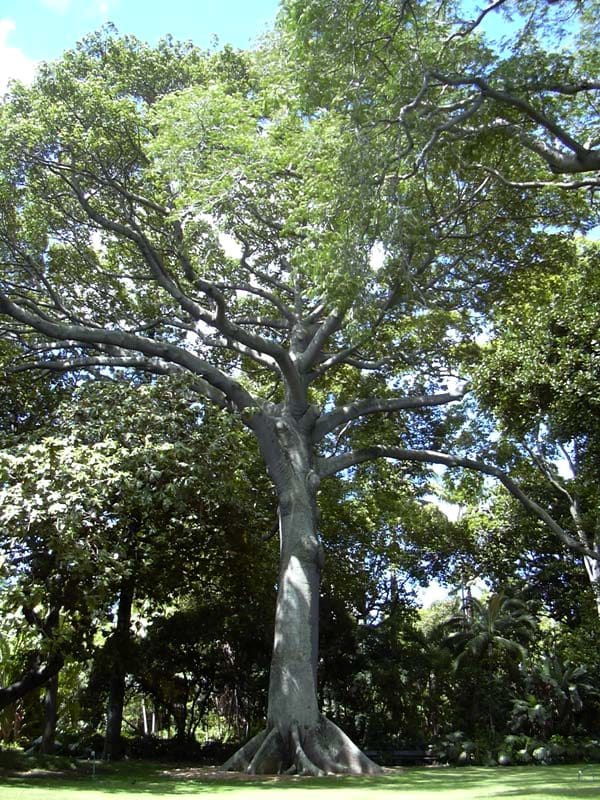
Kapok tree relocated to Anna Maria
A mature kapok tree provides an extensive shade canopy. – Wikipedia | Submitted

“Over the years, I’ve planted several trees this size or bigger and we were able to accommodate them,” Gilkey said. “With new construction, a lot of times it’s hard to save existing trees on a site; and sometimes it takes five, 10, 15 years to get appropriate scale to a new house, especially a two-or-three story house. It’s cool to be able to plant trees that give you an immediate sense of scale. We’re able to give this house scale and context of landscape.”

According to Wikipedia, a kapok tree’s flowers provide nectar for bees and bats and an oil can be pressed from its seeds. The kapok tree is considered a sacred symbol in Mayan mythology and is considered a sacred tree in some religions.
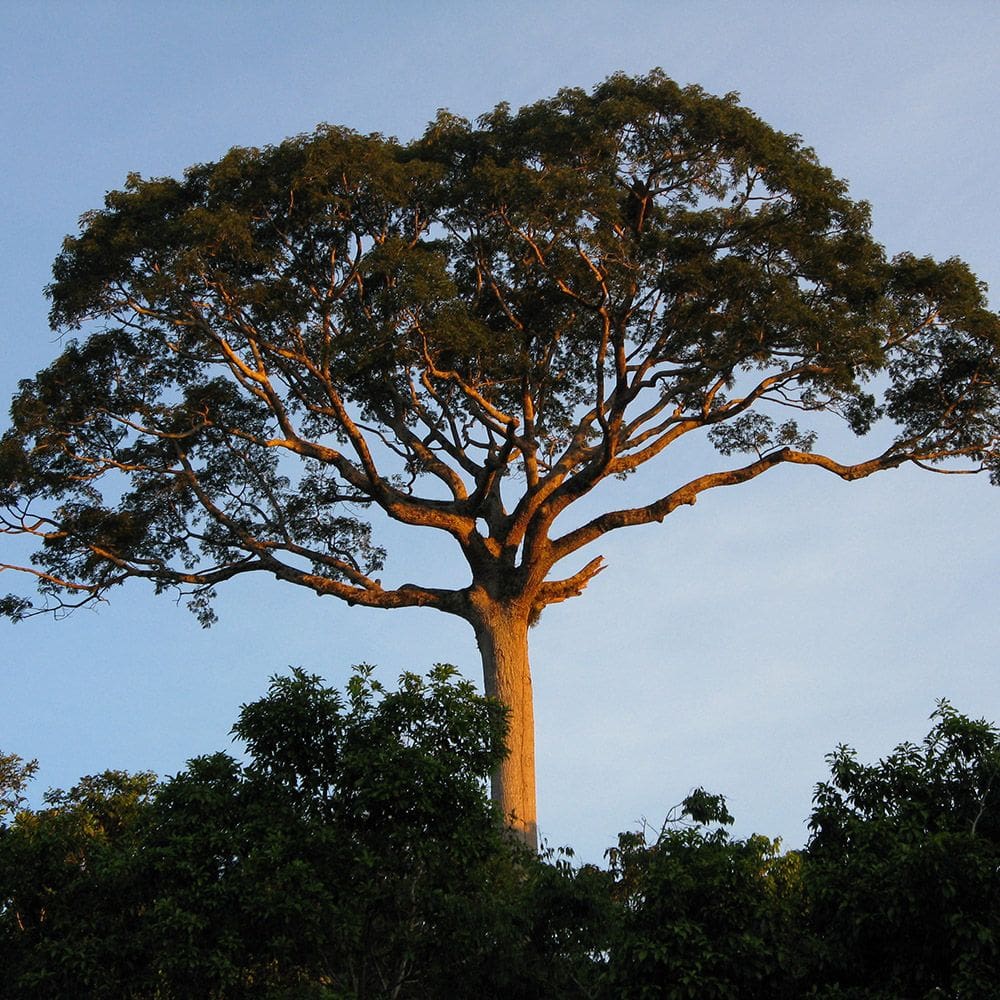
Kapok tree relocated to Anna Maria
Kapok trees are among the most majestic tree species. – Submitted

Greg and Lee Ross own Ross Built Custom Homes. The couple have long been fixtures in the Anna Maria Island construction community and the Island community as a whole.

After noting the homeowners wish to remain anonymous, Lee Ross said, “She is in love with the home and the tree is his baby.”

Regarding Gilkey’s work, she added, “He is one of our go-to landscape designers. He’s very professional and always a pleasure to work with. The moving of this giant tree was as smooth as you could possibly expect it to be.”

Anna Maria formalizes public parking reductions

Anna Maria formalizes public parking reductions

ANNA MARIA – The city of Anna Maria’s previous elimination of 88 public parking spaces has been formalized by the adoption of Ordinance 20-877.

Thirty-seven of the permanently eliminated parking spaces were located along North Shore Drive.

The city commission adopted the amended parking ordinance during the Tuesday, Nov. 24 meeting that served as the make-up date for the Nov. 12 meeting canceled due to Tropical Storm Eta.

During Tuesday’s meeting, Mayor Dan Murphy referenced a white paper he provided commissioners regarding the parking reductions. The white paper notes the three primary factors that drove the parking reductions were public safety, drainage and the previous elimination of public parking spaces in Holmes Beach.

“We’ve eliminated a net of 88 parking spaces. It’s been 15 years since we visited the parking ordinance within the city of Anna Maria. It was time to relook at it,” Murphy said.

Murphy said North Shore Drive has become a heavily traveled thoroughfare in recent years, but the street hasn’t gotten any wider. During peak periods, cars were parked on both sides of the road with children present, car doors opening in the roadway and construction taking place.

“It was an accident waiting to happen. We eliminated 37 spaces along North Shore, and it was all under the auspices of public safety,” Murphy said.

“We also eliminated spaces for drainage. People were parking on top of our drainage,” Murphy said in reference to the city’s granite- and lime rock-covered vertical infiltration trenches.

“And lastly, we were impacted by the changes made in Holmes Beach. We have pretty much recovered from all those changes. I think it’s a total of about eight spaces associated with the Holmes Beach changes,” Murphy said.

Anna Maria formalizes public parking reductions
Public parking spaces have been eliminated along Archer Way, at the south end of Anna Maria. – Joe Hendricks | Sun

Murphy said 110 public parking spaces were eliminated earlier this year, but 22 were later restored.

He said the public feedback he received from residents has been positive, and some residents asked him why more spaces weren’t eliminated.

“If we can’t justify it for public safety, if you can’t justify it on drainage and it has nothing to with the Holmes Beach changes, there’s very little motion to take those away. Not wanting cars in front of your house, I get it, but these are the three factors we used,” Murphy said.

Murphy recommended reevaluating the impact of the parking reductions early next year, after the peak tourist season.

Beach renourishment requirements

Earlier this month, Manatee County Commissioner Kevin Van Ostenbridge threatened to attempt to withhold future beach renourishment funding for the city of Holmes Beach if that city’s public parking capacity is not returned to pre-COVID levels.

Anna Maria Commissioner Jon Crane asked Murphy about potential county pushback in response to Anna Maria’s parking reductions.

“Will the county lean on us? I’ve had preliminary discussions with two of the new county commissioners. I don’t anticipate anything from those two, but I can’t tell you about others,” Murphy said.

Murphy said Manatee County Parks and Natural Resources Director Charlie Hunsicker asked him to provide the county’s consulting company with a copy of the city’s revised parking plan.

“I sent them our plan a month ago and I have not heard anything since. We more than meet beach renourishment requirements,” Murphy said.

Murphy said the 2005 beach renourishment plan called for 70 public parking spaces within the renourishment zone that stretches from Cypress Avenue to the southern city limits.

“There’s no danger of us losing federal funding for beach renourishment. The rest of our beaches are all privately-owned and they don’t qualify for beach renourishment,” Murphy said.

Commission Chair Carol Carter noted Anna Maria only has a quarter-mile stretch of public beach that would qualify for potential future beach renourishment.

Commissioner Joe Muscatello asked when beach renourishment last occurred in Anna Maria.

Murphy said that occurred in 2005, and only for the beach area that extended south from Cypress Avenue.

Commissioner Mark Short noted Murphy’s white paper stated the city currently has 571 available parking spaces in that area.

“The fact that there are 571 available spots to me is something extremely important to point out,” Short said.

“I feel very strongly this is the right thing to do for public safety. It’s the right thing to do for our drainage. It is the right thing to do for the city of Anna Maria,” Murphy said.

While standing outside her home along North Shore Boulevard, city resident Lou Ann Williams said she was glad the parking spaces in front of her home were eliminated.

“I love the fact that they can’t park here anymore, for the simple fact that it is a hazard and there’s too many people. With so many people parking in my front yard, my family had nowhere to park,” Williams said.

Wheels off pavement

The city commission was also presented with the first of two readings on another ordinance that, when adopted, will further clarify the city’s existing requirements that street-side parking occur with no wheels on the pavement.

The city’s code of ordinances already provides parking exceptions that allow landscaping trucks and other service vehicles to park in no parking zones. At the discretion of code enforcement officers, service vehicles are also allowed to park with tires on the pavement while actively providing service.