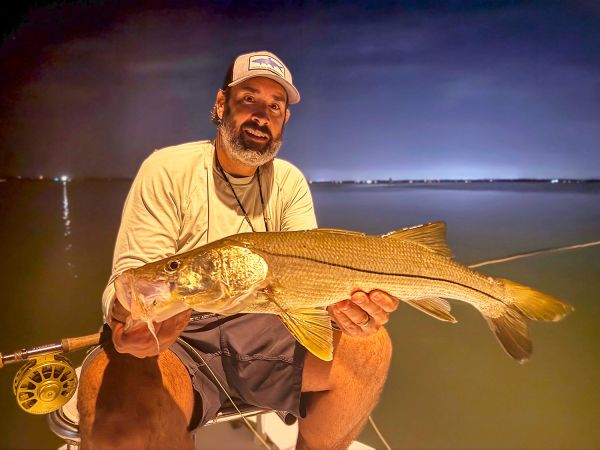


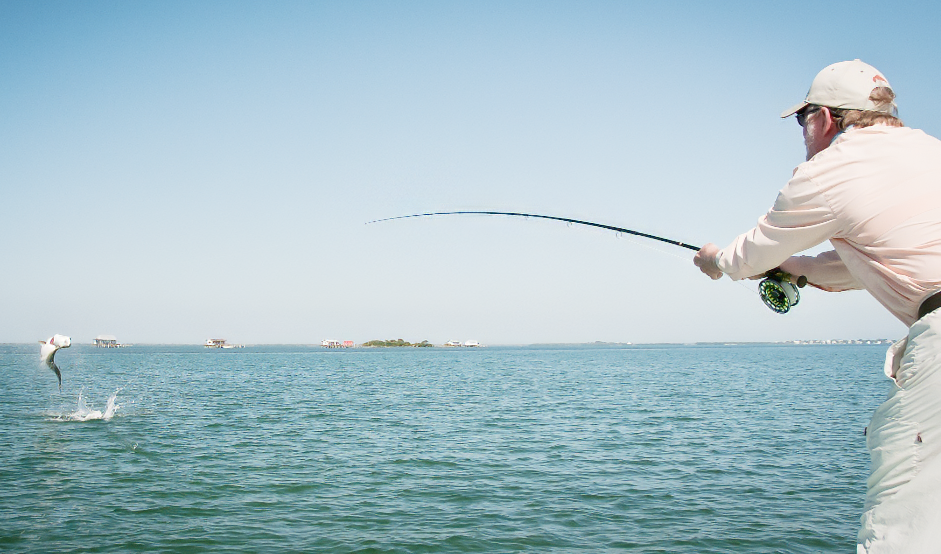
Tarpon are one of the premier gamefish that swim local waters and are a noble adversary on any tackle. The fish that frequent our beaches during the months of May through August can weigh over 200 pounds and average from 80 to 100 pounds.
I’ll always remember the way John Kip, a guide I fished with in the Keys, described fly-fishing for tarpon as the “Apex of Angling.”
Local anglers are blessed with some of the finest tarpon fishing in the world and local sandbars, beaches and bays host worldclass fly-fishing for these silver-plated giants. Our region is also bookended by the legendary flats of Homosassa to the north and Charlotte Harbor to the south, providing fly anglers a proliferation of promising prospects. This isn’t a game of numbers; and to the anglers who pursue tarpon on the fly, it’s the pursuit and the possibility of pulse-pounding action that keeps them on the bow for hours in the sweltering summer sun.
Fly tackle should match the size of the quarry and most anglers opt for a 12-weight outfit and 70-to-80-pound bite tippet. While it might seem like a difficult task to land a tarpon on the fly, an angler who knows the limits of their tackle can actually land a tarpon in a surprisingly short time. The key is to apply maximum pressure from the hookup and never let up. Too many anglers “baby” their tarpon in a misguided attempt to land them. The truth is that the longer you fight a tarpon the better chance you have of losing them.
A properly knotted and tapered tarpon leader usually runs between 10 and 12 feet and includes a class (weakest link) tippet from 16 to 20 pounds. Flies vary from the classic splayed feather “Key’s” style to more complex designs like the Toad and Palolo worm. Key to the whole equation is a razor-sharp hook that can penetrate a tarpon’s rock-hard mouth. Many seasoned tarpon anglers are not concerned with actually landing a tarpon, preferring to just enjoy the hunt, the hook up and the jumps that usually follow the hook set. They use light bite and class tippets which allows the tarpon to work through the leader with their abrasive mouths.
The key to hooking a tarpon on the fly is accuracy. The fly must be placed perfectly and moved in a precise direction relative to the fish and at the proper depth (the fish’s depth). Even when all of these factors come together, there’s still about a 50% chance that the tarpon will reject the fly.
Patience is a critical factor when fly-fishing for tarpon. Some anglers prefer to locate the edge of a sandbar or other underwater feature that tarpon track, anchor in casting range and wait. Other anglers prefer to be on the poling platform to make short moves to give their anglers a better angle for a presentation. Sometimes tarpon come at a steady rate, but just as often there are long periods of time when the only thing to look at is the water and the bottom. This really separates the great anglers from the good anglers. There are times when you need to move but knowing when and where is a skill that is developed, if never mastered.
Once set up, the angler must be able to make a 40-to-60-foot cast to a location the size of a dinner plate. Placement of the fly cannot be overemphasized, because tarpon will seldom vary a foot or two from their path to eat a fly. Although there is always the rare exception, a fly must never travel in a path towards a fish. A tarpon’s prey species wouldn’t survive long if it moved towards its aggressor, and the tarpon know it. When a tarpon is tracking their fly, seasoned anglers know how to read the fish by moving the fly to attract their attention and then varying the speed to keep them interested.
Note – This story was previously published in 2025.