





Reel Time: A New Winter Strategy
Winter can have a chilling effect on local anglers and limit their quarry, but those who know how to mine the riches of any season turn their attention to the species that actually thrives in cold water.
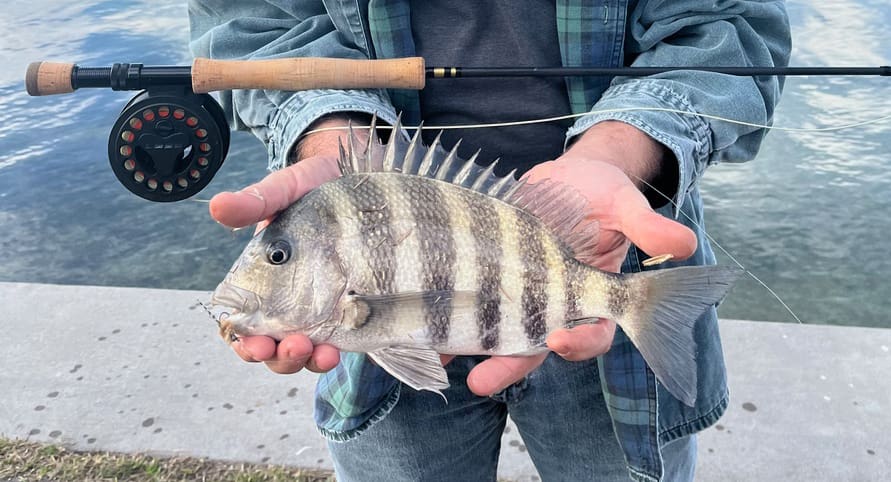
The best example locally are known for their bait stealing prowess and the stripes they dress in. Sheepshead, while shunned by some anglers, are hard fighting, challenging to hook and excellent to eat. Savvy anglers’ target sheepshead around structures like bridges, hard bottoms, oyster bars and dock pilings, where they feed on barnacles, crabs and other crustaceans. They know to use small, stout, sharp hooks; and for best success, they (tongue in cheek) advise to set the hook a split-second before they bite!
As a fly angler, I’ve caught a few sheepshead over the years, all accidentally while fishing for other species. The times I’ve seen them and actually made a presentation, they never seemed to respond to my efforts.
When Ryan Gandy, the new executive director of the Sarasota Bay Estuary Program, recently mentioned he targeted them with a tiny fly I was slightly skeptical and all ears. Last week, Gandy and his son, Kyle, joined me for a day on the water and a chance for him to show me his technique.
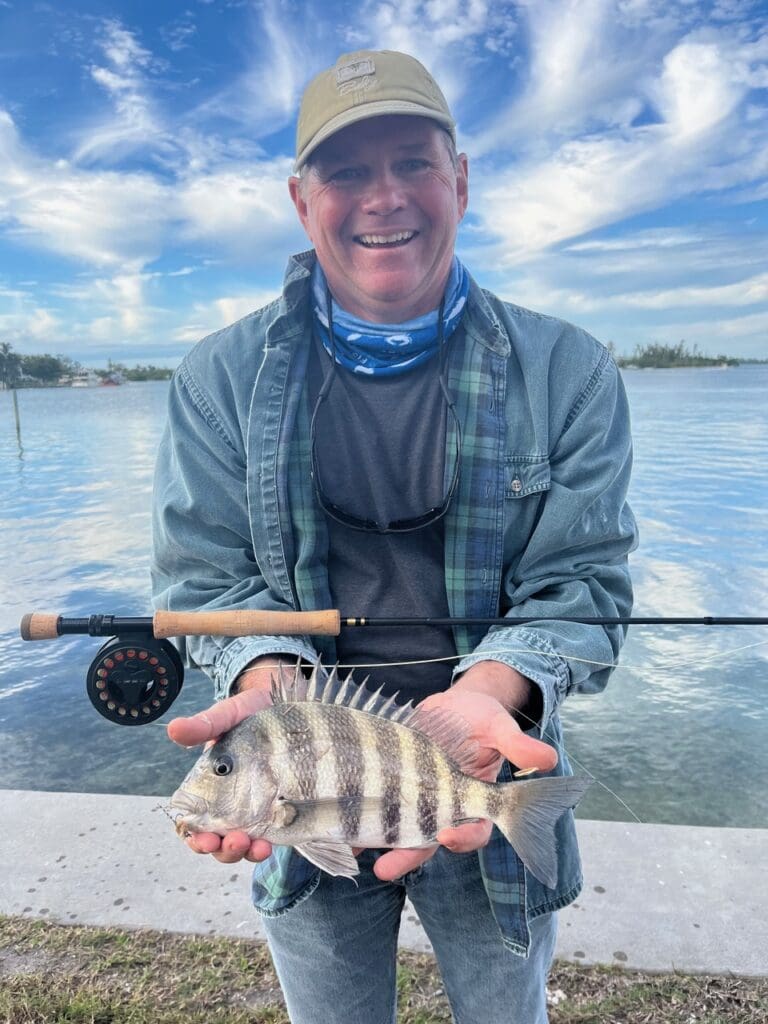
We started the day fishing the edge of Long Bar Point in Sarasota Bay, but a south wind had roiled the water, making it off-color and hard to spot fish. The tide was low and incoming all day, so we moved north where the water along the eastern shoreline was clear. For the next four hours, we were plagued by scudding clouds that made spotting fish hard, but we still managed three redfish and a trout.
The sheepshead we did find were spooky, and most were not seen until we were so close Gandy had to make a roll cast presentation. While we did get a few follows, the sheepshead that seemed interested were spooked by the boat before making a commitment.
After fishing a number of spots, I mentioned that I had seen some sheepshead in shallow water just off a seawall near where I launched the boat, so we decided to try and make that a learning opportunity.
Luckily, the sheepshead were obliging; and after two casts, Gandy got a take and landed a sheepshead just as he had predicted. In the process, I was given a first-hand demonstration of his technique. Key to his strategy was making a cast close enough so the sheepshead could spot the fly, but not too close to avoid spooking them. He mentioned what good eyesight they had and how they could spot a fly at a distance.
He demonstrated this by casting about three feet past the intended target and then slow stripping it until the sheepshead spotted it. When the fly was spotted, it rushed over to inspect the perceived prey and that’s when the next critical move, or lack thereof, was employed. Stopping the fly and letting it sink to the bottom mimicked a crab trying to hide from a predator it knew it couldn’t outrun. When the sheepshead rushed over and tipped up on to the fly, Gandy moved it with a small strip. Doing this allowed him to determine if the fly had been taken; and if not, would mimic a crab that had been discovered and was attempting to flee. This happened twice, and on the third strip the sheepshead was hooked.
This was a perfect opportunity to see his strategy in practice; and it reminded me of how a fly angler teases a permit, which is one of the hardest fish to entice to a fly. It also made me aware that sheepshead are predators; and, like when fishing for permit, patience and persistence are key.
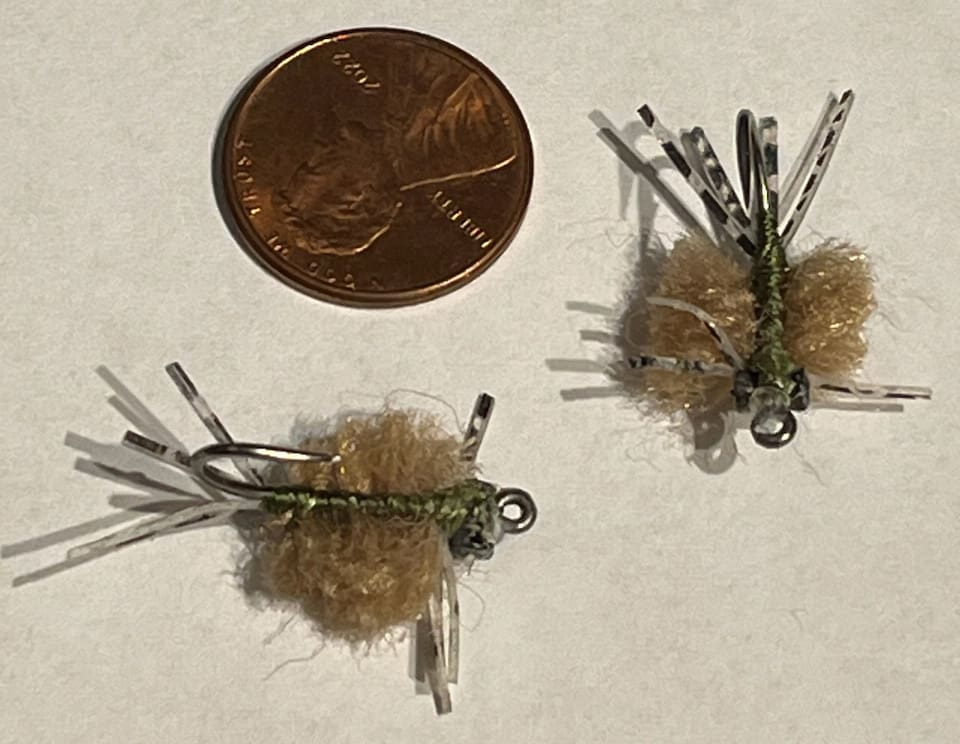
Gandy ties a small version of the Merkin (a time-tested permit fly) on a #4 hook. Other flies, like the Alphlexo crab, are also effective.
It great to get insight on a new angle on sight fishing after so many years of fly fishing. If you haven’t been targeting sheepshead with a fly, I encourage you to give this technique a shot. I saw it in action and can’t wait to give it a try. Use your senses, experiment, be persistent and you can experience a whole new challenge during our cooler winter months.

