Tag: residential development

Gloria Dei rezoning application submitted 

HOLMES BEACH – The city has received an application to rezone the Gloria Dei Lutheran Church property in a manner that would allow for the construction of up to 17 single-family homes. 

On May 12, Marshall Robinson, a land planner with the Bradenton-based Grimes Galvano law firm, submitted the land development application that lists himself and attorney Kyle Grimes as the agents acting on behalf of the property owners. 

The application lists Gloria Dei Evangelical Lutheran Church of AMI as the property owner and lists a Tampa address for that entity. Dated May 15, the accompanying affidavit of ownership/agent authorization is signed by Bishop Pedro Suarez. 
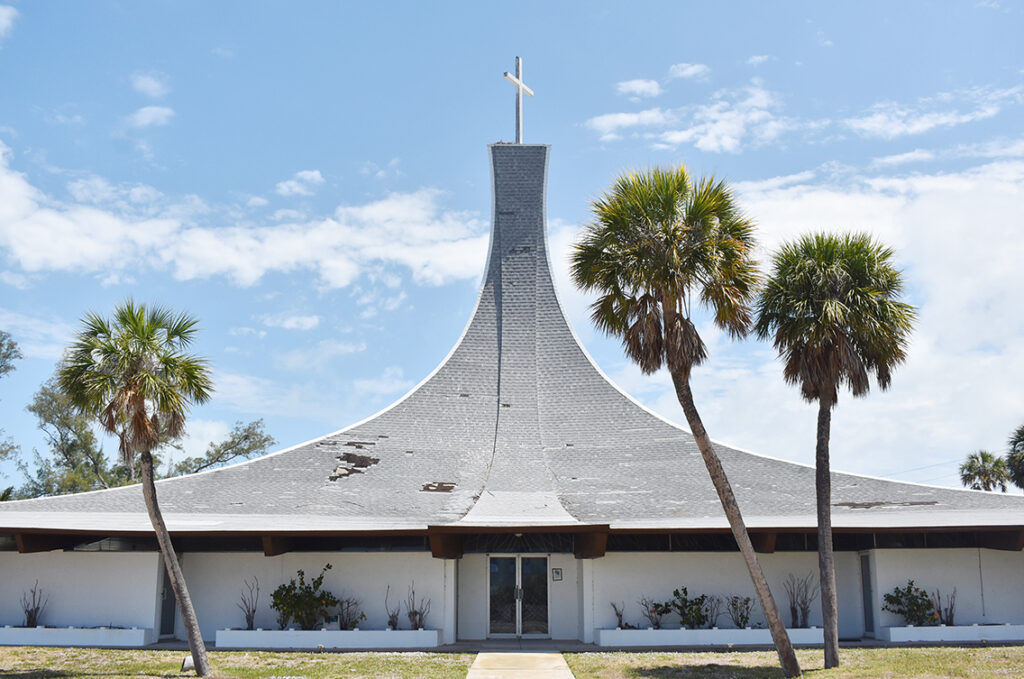
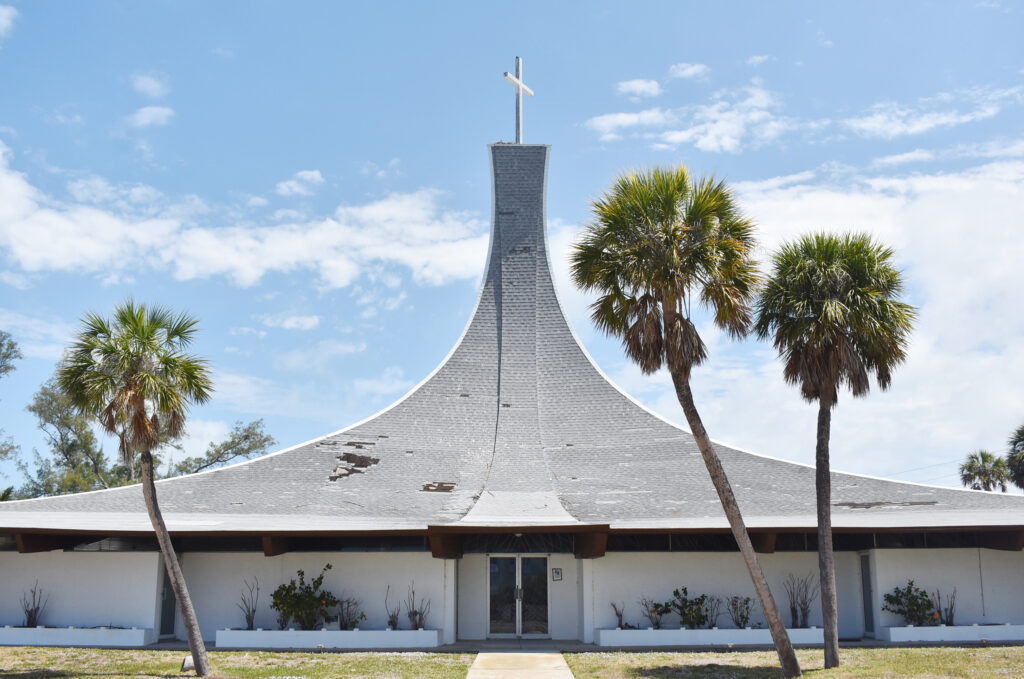
The Gloria Dei church building is iconic in its architectural design. – Joe Hendricks | Sun

The land development application lists a comprehensive plan text amendment, a comprehensive plan map amendment and the rezoning of the property as the desired city approvals. The application notes the current zoning designation is PSP (public/semi-public) and the proposed zoning classification is R-1 (single-family residential). 

The application lists “single-family detached residential dwellings” as the proposed activity or use. 

“The proposed request is up to 17 SF (single-family) detached dwellings on 2.96 acres,” the application says.

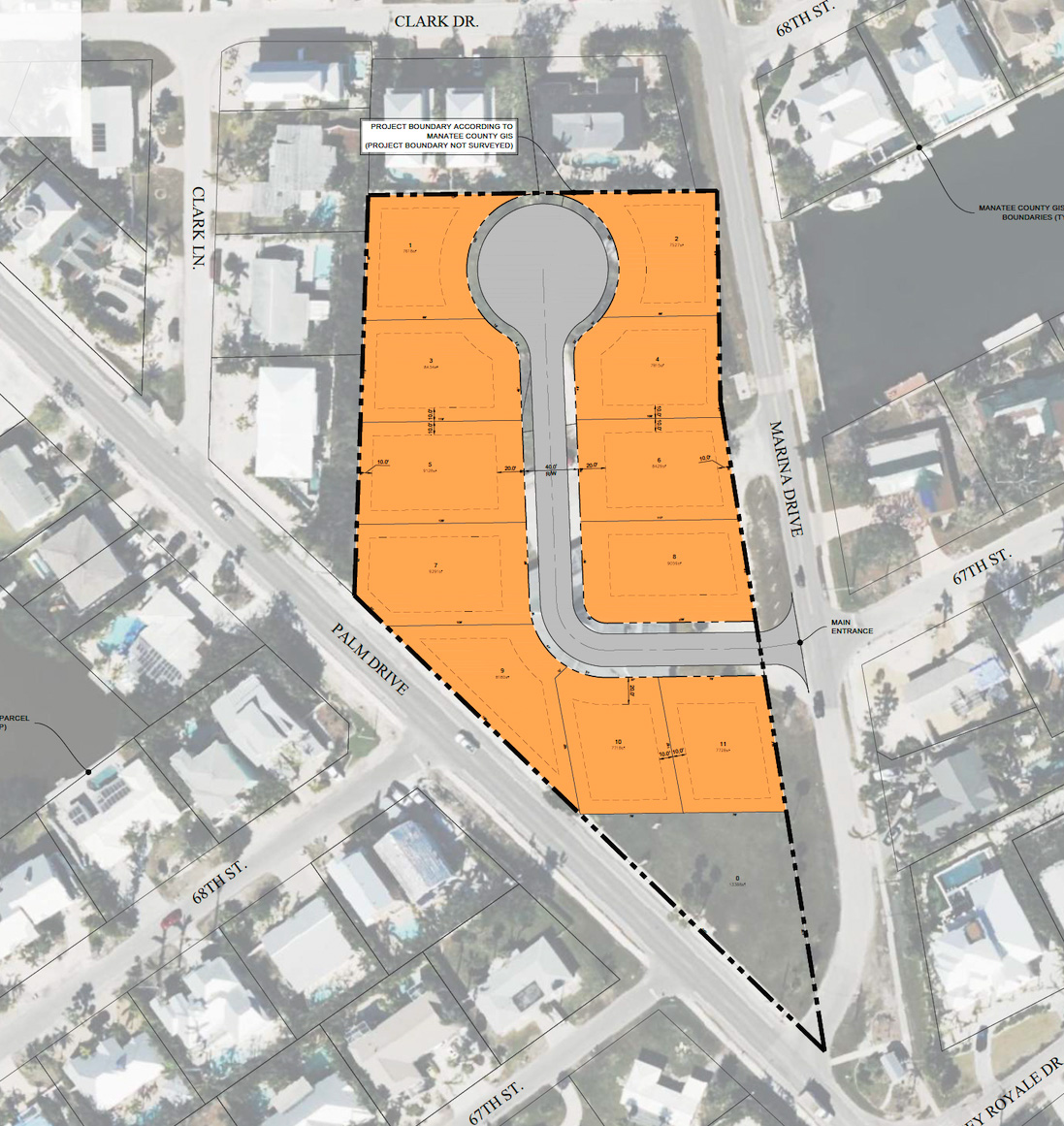
The draft concept plan submitted by the applicants shows the church property divided into 11 lots, with an interior access road running through the residential development and a circular cul-de-sac located at the north end of the proposed development.

When contacted on May 1, Holmes Beach Director of Development Services Chad Minor confirmed that he, Mayor Judy Titsworth, Public Works Director Herb Raybourn, Development Services Coordinator Kim Charron and Robinson had recently participated in a pre-application discussion regarding the potential rezoning of the Gloria Dei property.

When contacted on May 29, after the land development application was filed, Minor said the city was not yet close to scheduling a date for the first public hearing on the property owners’ requests. 

“I have asked the city attorney to put together a flow chart of the process, as it is a little different with a comprehensive plan and rezone concurrently. Any rezone will require an ordinance and public hearings,” Minor stated in his email response to The Sun. 

DRAFT NARRATIVE

On April 8, Robinson sent Minor an eight-page draft narrative letter that details the rezoning and comp plan amendment requests.

“On behalf of the applicant and owner, Florida-Bahamas Synod of the Evangelical Lutheran Church in America, Inc. (formerly known as Gloria Dei Evangelical of Anna Maria Island), we wish to file applications for a comprehensive plan map amendment, comprehensive plan text amendment and a zoning map amendment to be reviewed as companion applications,” Robinson stated in his letter.

“The applicant requests approval of two comprehensive plan amendments and a zoning map amendment for approximately 2.96 acres of land located at 6608 Marina Drive. The subject property consists of three contiguous parcels currently developed as a church,” Robinson stated.

The draft narrative letter notes the property owners seek a zoning map amendment from public/semi-public (PSP) to R-1 (single-family residential). 

“The proposed entitlements allow for up to 17 single-family residential units consistent with the maximum gross density permitted under the future land use category. A conceptual plan has been prepared to illustrate a potential layout; however, final design will be determined at site plan approval,” the letter says.

“The subject property is designated PSP on the adopted future land use map and zoned PSP. The property is currently developed with a 6,437 square foot church building on 1.94 acres that takes direct access from Palm Drive. The remaining acreage of the subject property consists of two vacant parcels adjacent to the north consisting of approximately 1.02 acres.

“The low-density residential future land use category allows a maximum density of up to 5.8 dwelling units per gross acre,” Robinson wrote. 

His letter stated the 2.96-acre property would support a maximum gross density of 17 single-family dwellings with a gross density of 5.74 units per acre. 

“The subject property is surrounded by existing residential development. To the north and northwest are medium-density residential uses with R-2 zoning. To the west, across Palm Drive, are additional R-2 zoned properties. To the east and southeast, across Marina Drive, are existing low-density residential uses zoned R-1. The proposed future land use category and R-1 zoning is compatible and consistent with the surrounding development pattern,” Robinson wrote.
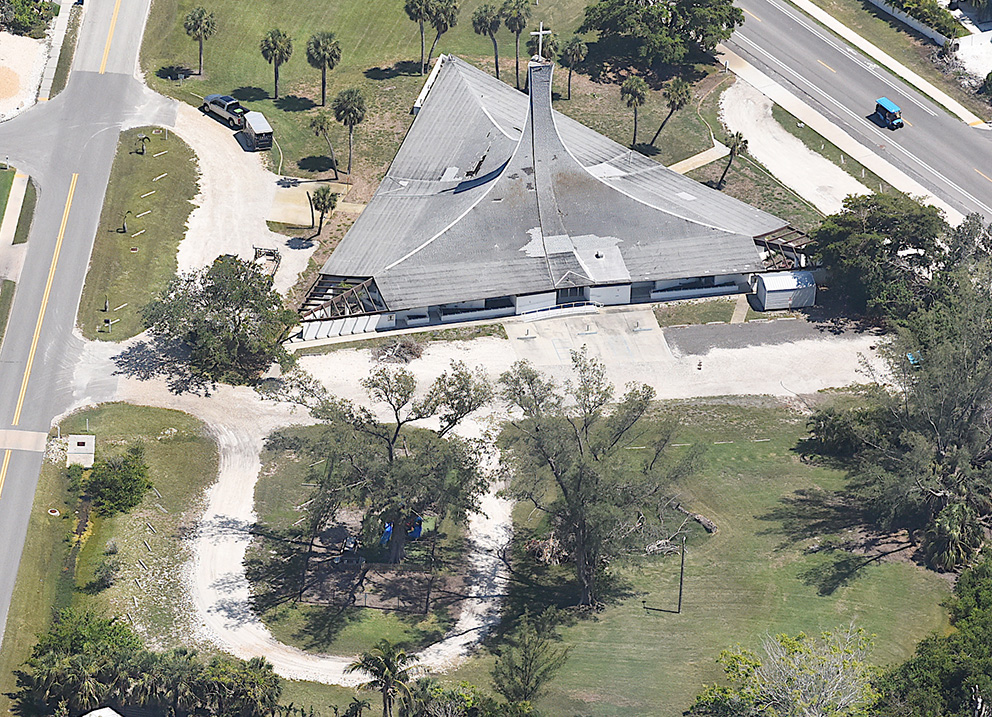
City officials hoped to purchase the church building and property and preserve it for public use. – Joe Hendricks | Sun

“The Gloria Dei Lutheran Church in Holmes Beach was founded on August 3, 1958. The existing church building was completed in 1959 and was in continuous operation until its final service on January 18, 2025. Over time, fewer and fewer members of the church’s congregation were willing or able to travel to Anna Maria Island to attend the church services. 

“Accordingly, for the good of the church, the decision was made to move the church off the Island. At that time, the church structure was utilized as a daycare until the hurricanes of 2024 and the church has remained vacant and unused since that time. Due to the designation of the PSP future land use category, there are no reasonable uses of the property that are permitted by the city’s comprehensive plan available to the owners at this time,” the draft narrative letter says.

“The proposed comprehensive plan amendment is consistent with the future land use element, which emphasizes the protection of the city’s predominantly single-family residential character and the compatibility of land uses,” Robinson wrote.

Regarding compliance with the comp plan, “The proposed amendment supports Goal 1 by changing the subject property from public/semi-public to low-density residential, and by aligning the subject property with the surrounding residential development pattern. Moreover, as the current PSP, one is very limited with regard to permitted uses; and as the existing church use is no longer a viable option, there is no reasonable use of the property available to the current owner under the existing future land use designation.” 

The proposed low-density residential will permit the property to be redeveloped with additional, sustainable and resilient housing options, rather than leaving the property vacant, unused and deteriorating,” Robinson wrote

CITY’S INTEREST

In May 2025, after receiving two valuation appraisals, the city commission authorized Mayor Judy Titsworth to make a $3 million offer for the church building and property. The appraisals prepared for the city were based on the assumption that the existing PSP zoning and comp plan designations that do not allow residential or commercial development would remain in place. 

City officials hoped to preserve the church building and use the building and the church grounds for public purposes that might have included office and operating space for non-profit organizations, space for the displaced School For Constructive Play preschool to potentially return to the church building, and green space for public use. 

In June 2025, Taylor Rahdert, the real estate agent representing the property owners, sent Minor an email informing him that the Synod Council declined the city’s offer. 

“Unfortunately, I do not see a path forward on an acquisition at this time,” Titsworth said when discussing the Synod Council’s decision.

The Synod Council received a $9.9 million appraisal that was based on the assumption that the property would be rezoned for residential development. After the city’s offer was declined, the church property was put on the market with a $9.9 million asking price.
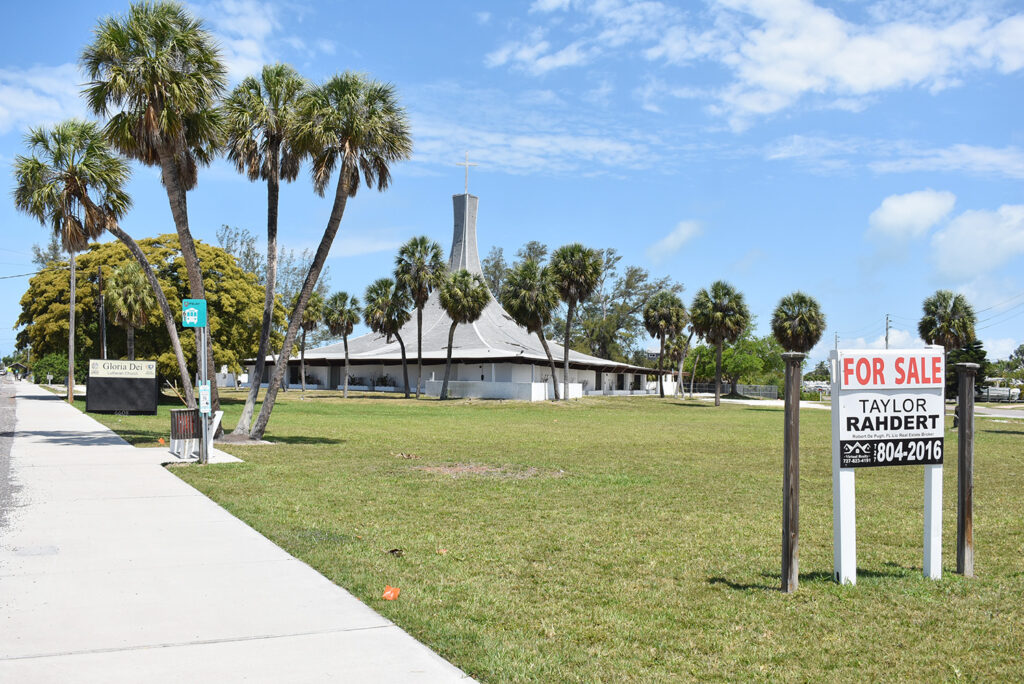
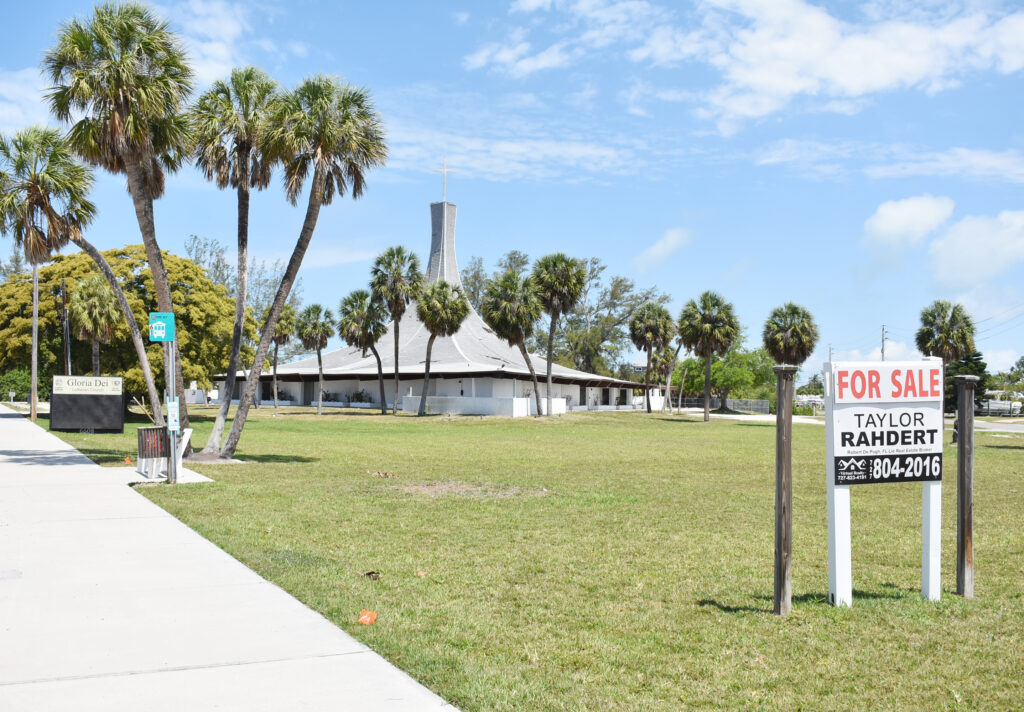
The Gloria Dei Lutheran Church property was listed for $9.9 million. – Joe Hendricks | Sun

In 2018, city officials discussed purchasing the undeveloped portions of the church property, but not the church building itself. That potential $1.3 million sale never transpired. 

In 2016, city commissioners denied a comprehensive plan amendment sought by church officials who wanted to change the future land use designation to R-2 (multi-family residential) for the two undeveloped parcels and rezone those parcels in a similar manner. The church officials hoped to sell the two rezoned parcels for development by someone else and use the sales proceeds to help fund the ongoing church operations. 

PRELIMINARY DISCUSSION

The rezoning request has not yet been presented to the city commission, but it was the subject of informal commission discussion on May 12.

Commissioner Jessica Patel referenced a news story about the city of St. Petersburg’s approach to allowing land zoned for public use to be rezoned for private development. Patel asked if the city of Holmes Beach could stipulate that the church property, if rezoned, could only be used to develop affordable or low-income housing. 

In response, City Attorney Randy Mora said, “It depends. There is never an absolute right to a rezoning or a redesignation in a comp plan. Process is everything and I’ll leave it at that. You have the ability to redesignate properties, but it would be subject to a multiplicity of factors.”

He noted affordable housing and low income are often two very different things.

Mora said there’s a difference between putting a restrictive covenant on a city-owned public property and transitioning that property to private ownership, versus putting a covenant on a privately-owned property that carries a public use zoning designation but is not owned by the city. 

“Our ability to intervene in the private market, where people buy private property with private funds – it’s very unlikely that you’re intruding on that process,” Mora said.

Titsworth said the church building is an “Island landmark” and there’s only so much property in the city zoned for public/semi-public use. 

“It’s also in our future land use map, so it’s part of the comprehensive plan,” Titsworth said. “You might all decide we don’t want to give up any public/semi-public land, which is OK. There’s nothing saying you have to do it. If the site plan meets all the criteria, you almost feel obligated, but this is a zoning change, and it’s a future land use change. This is coming our way. You’ll hear it and you’ll make the best decision based on what’s presented to you.”
Rezoning request anticipated for Gloria Dei property

HOLMES BEACH – Preliminary discussions have occurred regarding the possible rezoning of the Gloria Dei Lutheran Church property for residential development. 

The church operations ceased in January 2025 and the Manatee County Property Appraiser’s Office still lists Gloria Dei Evangelical of Anna Maria Island as the property owner. In June, the Florida Bahamas Synod Council that’s overseeing the sale of the church property declined the city of Holmes Beach’s $3 million offer to purchase the three-parcel, 2.96-acre property at 6608 Marina Drive. 

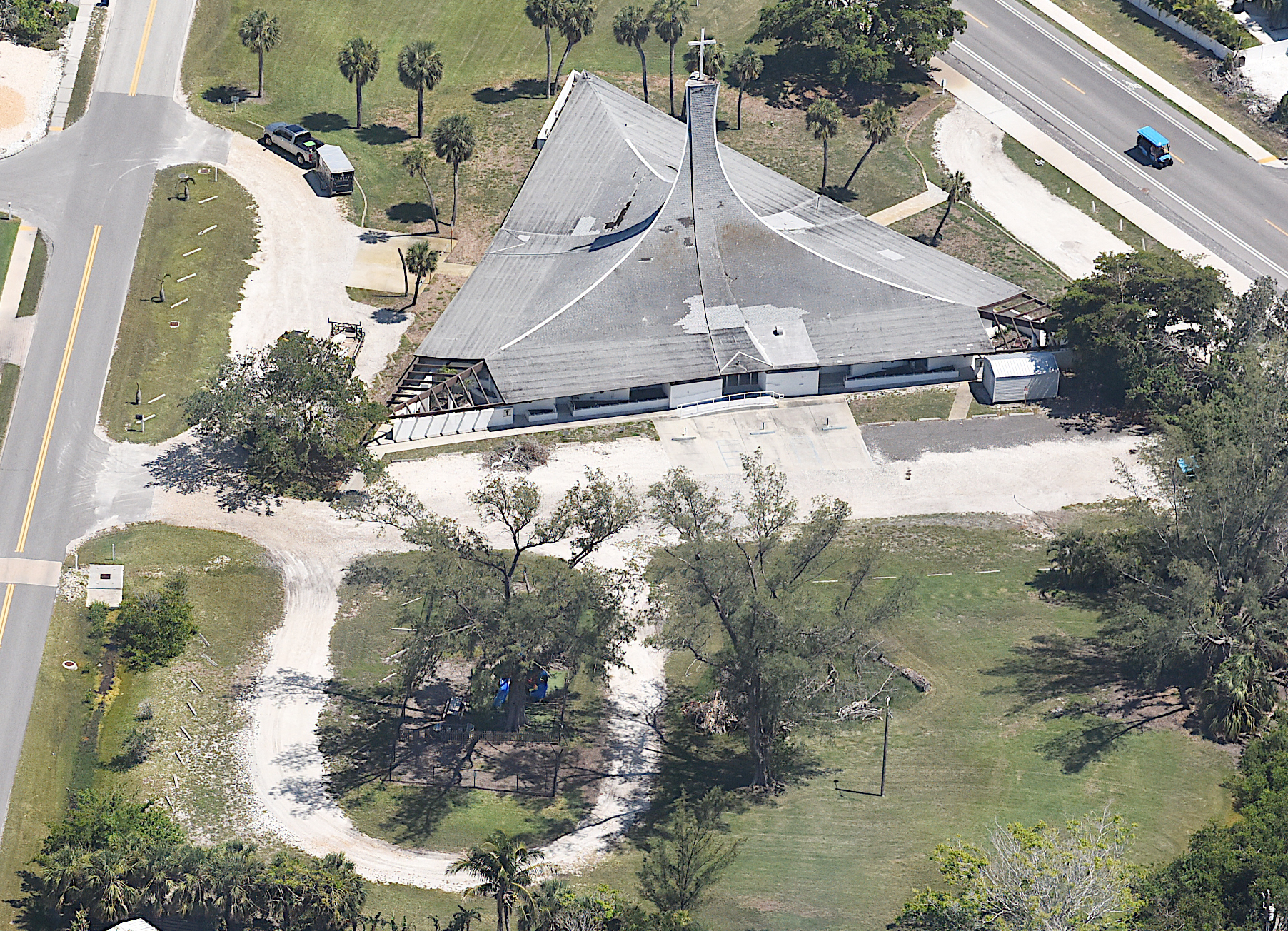
The iconic Gloria Dei Lutheran Church building faces likely demolition if the church property is rezoned for residential development. – Joe Hendricks | Sun

The church property parcels carry the Public/ Semi-Public (PSP) zoning designation and a similar Public/Semi-Public future land use map designation in the city’s comprehensive plan. The PSP zoning designation and future land use designations do not allow for residential or commercial development. 

In accordance with the current zoning designation, the mayor and commission hoped to preserve and repurpose the iconic, triangular-shaped church building and the spacious property that surrounds it for public use and public green space.

REZONING DISCUSSIONS

On Friday, May 1, Holmes Beach Director of Development Services Chad Minor confirmed that on Feb. 24 he, Mayor Judy Titsworth, Public Works Director Herb Raybourn, Development Services Coordinator Kim Charron and the potential applicant’s representative, Marshall Robinson, participated in a pre-application discussion regarding the potential rezoning of the Gloria Dei property. Robinson is a land planner for the Grimes Galvano law firm in Bradenton. Minor said he, Raybourn and Robinson also participated in a follow-up phone discussion pertaining to a traffic study.

Minor confirmed the preliminary rezoning discussions when responding to an email inquiry received from The Sun. Minor said he doesn’t know for certain if Robinson is representing the current property owners, a potential buyer or both. He also said he doesn’t know for certain whether there’s a pending offer for the purchase of the Gloria Dei property. 

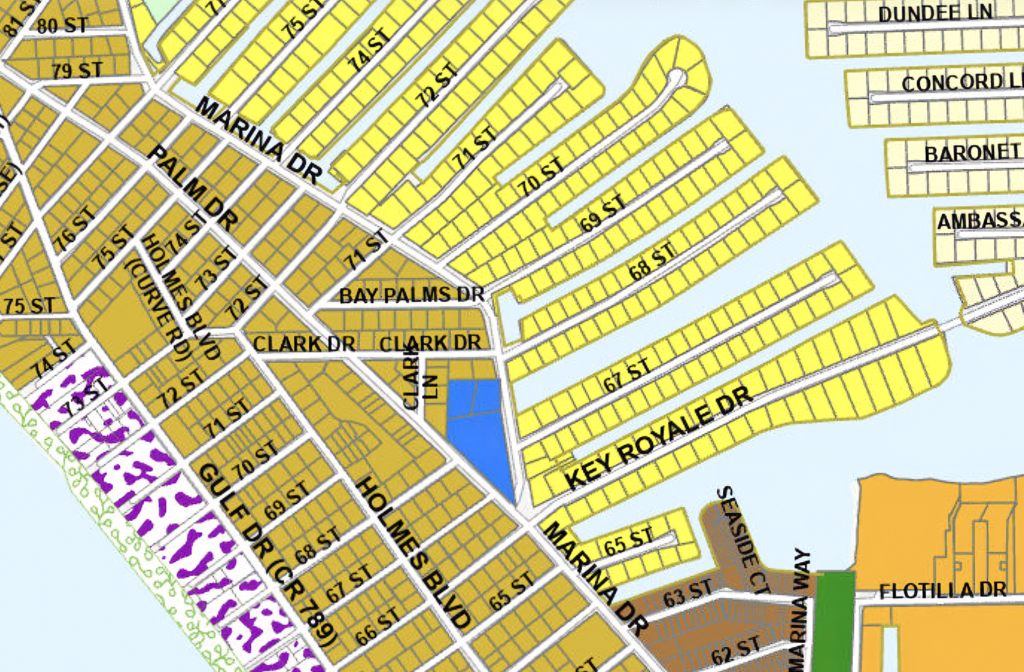
On the Holmes Beach zoning map, the Gloria Dei property (shaded in blue) is surrounded by R-2-zoned properties (shaded in gold) and R-1-zoned properties (shaded in yellow). – City of Holmes Beach | Submitted

According to Minor, Robinson’s client, or clients, desire a R-1 (single-family residential) zoning designation. According to the city’s land development code, the R-1 zoning designation requires a minimum parcel size of 7,510 square feet and allows 5.8 dwelling units per gross acre of land. The R-1 zoning designation allows rentals of 30 days or more and does not allow for weekly or shorter-term rentals. 

The properties directly east of the church property carry the R-1 zoning designation and the low-density residential future land use map designation set forth in the comp plan. The Gloria Dei property is surrounded to the north, west and south by residential properties that carry the R-2 (two-family residential) zoning designation that allows up to 10 dwelling units per acre and rental stays of seven consecutive days or more. Those properties carry a medium-density residential future land use designation.

When asked if the city commissioners must consider the zoning and future land use designations for the surrounding properties when considering a rezoning application, Minor said, “Yes, compatibility is something that the commission considers.”

When asked if the city expects to receive a Gloria Dei rezoning application at some point, Minor said, “Yes.”

As of May 1, the city had not received a rezoning application for the Gloria Dei property.

REZONING PROCESS

Minor said the applicant initiates the rezoning application and then follows the rezoning processes outlined in Section 2.13 of the city’s land development code.

City code requires rezoning applications to be reviewed and voted on during publicly noticed public hearings that allow for public input. Section 2.13 of the code says, “Four members of the city commission shall constitute a quorum and not less than three affirmative votes shall be required for commission adoption of any ordinance amending this ordinance or rezoning of property.”

According to city code, “No amendment rezoning any parcel may be granted unless the city commission finds that such amendment is consistent with the comprehensive plan of the city of Holmes Beach.”

City code says, “In determining whether to approve the rezoning of property or substantial changes in permitted use categories in zoning districts, the city commission shall consider the following criteria:

• “Whether the proposed change is in conformance with all applicable requirements of this land development code;

• “Whether there has been a change in the conditions upon which the original zoning classification was based;

• “Whether the proposed change is consistent with development patterns and is a logical expansion of adjacent zoning districts;

• “Whether the proposed change will increase population density or development intensity in a manner that will have an adverse impact on traffic patterns, public facilities and services, or other infrastructure;

• “Whether the proposed change is compatible with existing development patterns in the area;

• “Whether the proposed change will adversely affect any historic resources or environmentally sensitive lands;

• “Whether the proposed change will adversely affect the health, safety or welfare of the adjacent properties, or of the city of Holmes Beach in its entirety;

• “Any other matters which may be appropriate.”

If submitted to the city, a rezoning application would also be reviewed by the Holmes Beach Planning Commission for compliance with the city’s comprehensive plan. 

According to the comprehensive plan amended and adopted in 2022, “The Public/Semi-Public future land use category recognizes identifiable areas of the community which support public, municipal and semi-public center, community services and facilities – i.e., churches, schools, both public and private.” 

PAST EFFORTS 

In 2016, city commissioners denied a comprehensive plan amendment sought by church officials who wanted to change the future land use designation to R-2 (multi-family residential) for the two undeveloped parcels and rezone those parcels in the same manner. Church officials hoped to sell the rezoned parcels for development by someone else and use the proceeds to fund the church operations. 

In 2018, city officials discussed purchasing the undeveloped portions of the church property, but not the church building, but that potential $1.3 million sale never transpired. 

Last year, the Gloria Dei property was put on the market for $9.95 million. – Joe Hendricks | Sun

The city’s $3 million purchase offer in 2025 was based on two value appraisals that assumed the property would continue to carry the PSP zoning designation. To date, the city has not made another offer on the property. 

After the city’s $3 million offer was declined, St. Petersburg-based Virtual Realty Inc. real estate agent Taylor Rahdert listed the church property for $9.95 million – an asking price based on a value appraisal that assumes the church property would be rezoned for future development. 

Anna Maria prepares to impose impact fees

Anna Maria prepares to impose impact fees

ANNA MARIA – Developers can expect to soon pay impact fees when building new structures or increasing the size of existing structures in Anna Maria.

On Thursday, Aug. 27, Anna Maria City Commissioners will be presented with the second and final reading of Ordinance 20-871, an ordinance that will establish the impact fees previously discussed on first reading on Aug. 13.

According to the ordinance, the intent is “to ensure that new development pays its proportionate share of the anticipated costs of public facilities necessary to provide parks and recreation and roads and mobility protection for the new development.”

According to the ordinance, “The city of Anna Maria parks and recreation impact fees shall only be paid for residential development or increase in size of residential property and shall be assessed at the rate of $1.15 per square foot of interior building space.”

The parks and recreation impact fees will apply equally to new residential structures built for use as family residences and those built for use as vacation rentals.

“The city of Anna Maria roads and mobility impact fees shall be paid for all new development of any kind, or any increase in building size, and shall be assessed at the rate of $0.73 per square foot of interior building space,” according to the ordinance.

When applicable, the two impact fees combined total $1.88 per square foot of interior building space. At those rates, the impact fees for a new single-family home with 5,000 square feet of interior building space would be $9,400. The impact fees for a commercial or other type of non-residential building with 5,000 square feet of interior building space would be $3,650.

Impact fees will not be assessed on existing residential or non-residential structures unless the interior building space is increased.

The impact fees shall be paid when the building permit is issued or at another time specifically provided for in a developer’s agreement with the city.

The ordinance notes the city retained Raftelis Financial Consultants to prepare an impact fee study to determine the proportionate demand that new development generates for additional parks and recreation and road and mobility improvements.

“It has been determined that impact fees are necessary to offset the costs associated with meeting future demands. The impact fees bear a reasonable relationship to the burden imposed upon the city to provide parks and recreation and roads and mobility facilities to new city residents. An essential nexus exists between projected new development and the need for additional parks and recreation and roads and mobility facilities to be funded with impact fees,” the ordinance states.

“The decisions of the city commission as set forth herein are reasonable and prudent steps pertaining to sound growth management, which have been taken for the benefit of the citizens of the city, both present and future,” the ordinance notes.

The ordinance states separate capital fund accounts will be established for the two different impact fees. The monies deposited into each impact fee capital fund account shall be used solely for the purposes set forth in the ordinance and shall not be used for any expenditure that would be classified as an operational, maintenance, repair or replacement expense.

The impact fee ordinance will become effective 90 days after its adoption. If adopted Thursday as anticipated, future development will be subjected to impact fees beginning in late November.

Thursday’s city commission meeting will begin immediately after the 5:30 p.m. budget meeting and public input on the proposed impact fees will be accepted.