Tag: clam restoration

Proposed clam restoration project withdrawn

Proposed clam restoration project withdrawn

ANNA MARIA – Proponents of clam and seagrass restoration projects have withdrawn their $50,000 funding request for projects proposed in and around the city.

The money will instead be used on a water filtration-related maintenance project for the multi-use trail that runs along Gulf Drive from the entrance of the city to Willow Avenue.

The group seeking $50,000 of the city’s $850,000 in federal American Rescue Plan (ARP) funds included local restaurateur and All Clams on Deck initiative founder Ed Chiles, Diatom Initiative founder and Terra Ceia-based clam hatchery operator Curt Hemmel, Gulf Shellfish Institute Executive Director Stephen Hesterberg, Sea & Shoreline aquatic restoration firm President Carter Henne and Dr. Angela Collins from the Sea Grant Florida program.

A final vote on the funding request was expected during the City Commission’s March 24 meeting. Based on previous commission discussions, there did not appear to be commission majority support for the funding request.

Proposed clam restoration project withdrawn
Clam hatchery operator Curt Hemmel was among the funding request presenters during the Jan. 13 meeting. – Joe Hendricks | Sun

On March 18, Hemmel sent a letter to Mayor Dan Murphy and others withdrawing the $50,000 request.

“After input from commissioners, I find our proposal is not suitable for the American Rescue Plan funding opportunity. Although filter feeding bivalves are missing in our environment, in need of restoration, consume red tide and provide numerous documented ecosystem services, I gather the main focus of the ARP funding is for red tide mitigation and not for general environmental improvement. Moreover, a portion of our proposal was intended to advance our knowledge of shellfish biology and ecology, a research endeavor. It was made apparent that research is not the intended use of ARP funding.”

None of the group representatives attended Thursday’s meeting.

Prolonged consideration

In July 2021, Chiles first floated the idea of a city-funded clam and seagrass restoration project. Mayor Dan Murphy noted the commission already earmarked $50,000 in ARP funds for a potential red tide mitigation/water quality improvement project.

On Jan. 13, the group presented its $50,000 request to the commission. Chiles said community support and additional matching funds could produce up to an additional $100,000 for the proposed projects. He also mentioned the ongoing pursuit of state and federal funds for additional clam restoration projects.

Chiles and some of the other presenters claimed clams remove red tide molecules (Karenia brevis) and other harmful elements from the water in which they live, while also enhancing seagrass restoration. Hesterberg said the proposed restoration projects would also provide important research opportunities for marine scientists.

Commissioner Jon Crane said, “I am told that clams and oysters do generally clean water but there is no evidence that clams or oysters remediate red tide.”

Crane requested the funding decision be delayed until the commission heard from Kevin Claridge, vice president of Mote Marine Laboratory’s sponsored research and coastal policy programs. Crane also noted he received a letter from retired marine biologist Dr. Randy Edwards.

Proposed clam restoration project withdrawn
Commissioner Jon Crane is not convinced that clams remove red tide from the water they live in. – Joe Hendricks | Sun

In his letter, Edwards stated, “Although this request has good intentions, it is very unlikely to have much or any positive impact on protecting and conserving the bay. This is particularly true with regard to any impacts on reducing red tide or improving water quality in Sarasota Bay or Tampa Bay.”

Hesterberg then sent a letter to the mayor that stated, “It is empirically well supported that filter-feeding, bivalve shellfish improve water quality, support adjacent marine habitats and eliminate the organism that causes red tide.”

On Jan. 27, Claridge discussed with the commission Mote Marine’s red tide research efforts, but he said he was not qualified to comment on the effectiveness of clams filtering out red tide molecules.

On Feb. 10, Edwards told the commission there is no documented scientific research that indicates clams remove red tide from the water. Edwards recommended using the federal funds on a project that removes algae-enhancing nitrates, phosphates and other nutrients from the rainwater discharged into the surrounding natural waters through the city’s stormwater system.

The commission later discussed using the earmarked ARP funds to build more stormwater infiltration trenches but took no formal action on doing so.

During Thursday’s meeting, Commission Chair Carol Carter said she attended a Holmes Beach Clean Water Ad Hoc Committee meeting on March 8 and heard a presentation given by Dave Tomasko, Executive Director of the Sarasota Bay Estuary Program.

According to Carter’s meeting notes, which she provided to the city clerk’s office, Tomasko suggested property owners use less fertilizer and reroute their rain gutters into the ground. He also feels the public needs to be better educated about the proper disposal of grass clippings and dog droppings.

According to Carter’s notes, a committee member asked Tomasko about the effectiveness of clams regarding seagrass restoration. In response, Tomasko referenced 600,000 clams previously placed in the waters near Port Manatee and said there was no measured difference of seagrass restoration in the test areas where clams were placed and not placed.

The commission voted 5-0 to use the $50,000 to refurbish the drainage system along the multi-use trail. This will include replacing the surface-level lime rocks that get crushed and compressed over time, which reduces their drainage and filtration capacities.

Edwards’ reaction

When addressing the commission Thursday evening, Edwards said he drove for an hour to attend the meeting, spent several hours preparing for it and felt the public should have been notified that the request had been withdrawn.

Proposed clam restoration project withdrawn
Dr. Randy Edwards addressed the commission during Thursday’s meeting. – Joe Hendricks | Sun

Edwards said the claims that clams remove red tide were “scientifically false” and he noted Chiles is among those involved in the pursuit of up to $2.5 million in state funds and $15 million in federal funds for additional clam restoration projects. Edwards said those funding pursuits are based on a “false premise” and lack scientific merit.

State budget

The proposed budget that state legislators submitted to Gov. Ron DeSantis in early March includes a $2.5 million appropriation request sponsored by Sen. Jim Boyd and Rep. Will Robinson Jr. The request form lists Chiles as the requestor and The Gulf Shellfish Institute as the requesting organization for clam and seagrass restoration projects in three southwest Florida estuaries.

“We’re encouraging people to write a letter to the governor and express their support for these important projects that will improve the coastal water quality and help mitigate the nutrient load,” Chiles told The Sun on Monday.

The proposed state budget also includes a $950,000 appropriations request sponsored by Boyd and Robinson and requested by Charlie Hunsicker on behalf of the Manatee County government. The county request is for a water quality improvement project using oysters and clams.

As of Sunday, DeSantis had not approved the budget as presented or vetoed these two line item budget requests.

Final vote pending on proposed clam, seagrass projects

Final vote pending on proposed clam, seagrass projects

ANNA MARIA – A final city commission vote on a $50,000 funding request for proposed clam and seagrass restoration projects is expected on Thursday, March 24.

During the Anna Maria City Commission’s March 10 meeting, Mayor Dan Murphy said he expects to receive by Friday, March 18 a final, formal written proposal from local restaurateur, businessman and environmental activist Ed Chiles and the group that includes representatives from the Gulf Shellfish Institute, The Diatom Initiative and Sea & Shoreline.

The group seeking the funds believes the projects would significantly improve the water quality in the offshore and inland waters where they would be conducted.

Regarding the final proposal and pending commission vote, Murphy said, “We’ve been talking about this for quite some time and it’s time to come to a conclusion.”

First presented to the commission on Jan. 13, the funding request that Chiles said could produce up to an additional $100,000 in matching funds from private donors has been met with continued opposition from Commissioner Jon Crane. Crane questions the effectiveness of clams when it comes to filtering red tide (Karenia brevis) and other harmful elements from the natural waters in which they’re placed.

Final vote pending on proposed clam, seagrass projects
Commissioner Jon Crane opposes the $50,000 funding request. – Joe Hendricks | Sun

The group’s original proposal called for a total of 20,000 southern hard clams and sunray Venus clams to be placed in the proposed project areas in Tampa Bay and Bimini Bay. On Jan. 26, Diatom Initiative founder and clam hatchery operator Curt Hemmel proposed placing 1-2 million southern hard clams in those waters instead, with sunray Venus clams no longer part of the proposal.

Final vote pending on proposed clam, seagrass projects
Retried marine biologist Randy Edwards appeared before the commission in February. – Joe Hendricks | Sun

When appearing before the commission in early February, retired marine biologist Randy Edwards expressed his opposition to the expenditure of American Rescue Plan (ARP) funds for a clam restoration project. Edwards’ opposition is based on his belief that clams possess limited water filtration capabilities and effectiveness.

As an alternative, Edwards recommended using $50,000 in ARP funds on a nutrient removal project that would target nitrates and phosphates from rainwater and tidal waters before they enter the water.

At the request of Commissioner Robert Kingan, the commission later discussed using the $50,000 to install additional vertical infiltration drainage trenches, but no final decision was made regarding the use of federal funds to do so.

Commissioner Deanie Sebring has expressed her continued support for the proposed restoration projects and the funding request.

The March 24 commission meeting will begin at 6 p.m.

Related coverage


Anna Maria Commission discusses nutrient removal project


Marine biologist opposes clam restoration project


Commission considering clam, seagrass restoration request

Marine biologist opposes clam restoration project

Marine biologist opposes clam restoration project

ANNA MARIA – Clams are not the solution to red tide pollution, retired marine biologist Dr. Randy Edwards told city commissioners who are considering a proposed clam restoration project in and around Anna Maria.

Having heard from Edwards during the Feb. 10 city commission meeting, the Anna Maria Commission has not yet made a final decision regarding a $50,000 funding request for clam and seagrass restoration projects recently proposed by local restaurateur Ed Chiles and representatives of The Gulf Shellfish Institute, The Diatom Initiative and Sea & Shoreline.

Led by Chiles, that group seeks $50,000 of the approximately $850,000 in American Rescue Plan (ARP) funds the city has and will receive from the federal government over a two-year period.

Edwards’ appearance at the Feb. 10 meeting served as a follow-up to the letter he previously sent Commissioner Jon Crane. In that letter, Edwards addressed Crane’s concerns regarding the degree to which clams remove red tide cells (Karenia brevis) from the waters in which they live. The toxic algae can cause respiratory irritation, shellfish poisoning and fish kills during its bloom phase.

Marine biologist opposes clam restoration project
City Commissioner Jon Crane has expressed doubts about the effectiveness of clams mitigating red tide. – Joe Hendricks | Sun

After hearing Edwards’ scientific positions and personal views on clams’ impact on red tide mitigation, Commissioner Robert Kingan suggested, and the commission supported, directing city engineers to research potential stormwater mitigation/nitrate reduction runoff improvements as possible alternative uses of the $55,000 in ARP funds included in the city’s current fiscal year budget for water quality/environmental projects.

Edwards’ views

Edwards, a Bradenton resident, told the commission he has nearly 50 years of experience in marine biology and ecology. He said he holds a master’s degree in marine science and earned a Ph.D. based on his study of nutrient dynamics in Florida’s estuaries.

Edwards said he served as a research scientist at the University of Miami, where he directed a large aquaculture/fish species project that included a saltwater fish stocking program. He said he was then hired by Sarasota-based Mote Marine Laboratory to lead Mote’s fish stocking program.

He said he later focused his efforts on research pertaining to the ecology of fish and fish habitats in Florida’s bays and estuaries and directed studies for the Sarasota Bay Estuary Program, multiple Florida water management districts, the Florida Fish and Wildlife Conservation Commission, the National Marine Fisheries Service and the U.S. Geological Survey.

“I have no dog in the fight. I’m free to speak the truth because I have no strings attached,” he said when noting he has no financial stake in the proposed restoration projects.

“I do believe that locally environmentally concerned citizens that have been involved in promoting clams as a way to mitigate red tide and nitrogen pollution actually do so out of very good intentions. The same applies to local organizations such as START (Solutions To Avoid Red Tide) and Sarasota Bay Watch. Almost all really believe that they are doing something very good for the environment. However, the scientific realities are that they have somehow become misinformed, or at least under-informed, and there seems to be some involved partially because of self-interest,” Edwards said.

“But clams are not the solution to pollution. The scientific fact is that even large populations of clams will not remove significant amounts of nitrogen. In some specific situations, clams could increase nitrogen and have negative impacts,” Edwards said, noting that clam waste contains ammonia that other organisms can convert into nitrogen.

“The main problem that we have facing our waters is the increasing nitrogen pollution in our bays, estuaries and coastal waters – nitrogen loading that continues to increase because of man-made increases mainly due to population growth and inadequate pollution control. That nitrogen increase causes severe ecological changes to our bays and estuaries, including increased phytoplankton blooms that shade out seagrasses and reduce water quality. The nitrogen also stimulates the growth of microalgae and seaweeds. That nitrogen increase surely contributes to red tides becoming more frequent and more severe,” Edwards said.

“I can say this with scientific confidence: There has been no scientific validation or evidence that stocking clams can or may significantly impact ride tide. There’s no science behind it. There is no evidence yet that clams have or will provide substantial mitigation. They won’t reduce red tide, they won’t reduce nitrogen,” Edwards said, when calling into question whether the proposed restoration projects are an appropriate use of the federal funds.

Edwards also addressed the assertion that a single clam can filter 4.5 gallons of water per day. He estimated there are approximately 100 billion gallons of water in Sarasota Bay, Anna Maria Sound and the local areas of Tampa Bay. For mathematic simplicity, he postulated that if a single clam could filter and clean 10 gallons of water per day, 10 billion clams would be needed for adequate filtration purposes in those local waters.

He cautioned that placing a large number of clams in Bimini Bay and its surrounding canals could act as a trap for the organic matter clams produce as waste products.

“I don’t think people really want that,” Edwards said.

In reference to Edwards’ comments, Commissioner Kingan said later in the meeting, “Having heard Dr. Edwards today, and knowing the other proposal that we had, it seems to me pertinent to consider talking to our own city engineers and seeing what they might propose for environmental mitigation and runoff treatment. We could ask the mayor to engage with them and see if they have a proposal that would be efficient, effective and something we could do to use this money we have.”

The commission reached consensus in support of Kingan’s suggestion.

Gulf Shellfish Institute Executive Director Stephen Hesterberg attended Thursday’s meeting but did not address the commission. Chiles did not attend the meeting. The group’s funding request was not included on the meeting agenda so no action was taken.

Related coverage


Decision still pending on clam, seagrass restoration funds


Reel Time: All Clams On Deck


Commission considering clam, seagrass restoration request

Commission considering clam and seagrass restoration request

Commission considering clam, seagrass restoration request

ANNA MARIA – The Anna Maria City Commission has deferred for two weeks a decision on a $50,000 funding request for proposed clam and seagrass restoration projects.

The previously discussed request, spearheaded by local restaurant owner Ed Chiles, was presented in more detail to the commission on Jan. 13. Chiles and his associates are requesting the city contribute $50,000 from the approximately $850,000 in federal American Rescue Plan (ARP) funds the city will receive over a two-year period.

Commission considering clam and seagrass restoration request
Local businessman Ed Chiles is passionate about clam and seagrass restoration projects. – Joe Hendricks | Sun

Chiles said a group of private individuals has committed to a dollar-for-dollar match for up to $50,000 in additional funds if donated by community members and others in support of the proposed projects. Chiles said $50,000 from the city combined with $50,000 in community donations and $50,000 in matching funds could turn the city’s $50,000 investment into a $150,000 project, with the Sea Grant Florida program potentially providing some additional funding.

The fundraising efforts for the proposed local restoration projects coincide with the group’s pursuit of state and federal funds for larger-scale bivalve and seagrass restoration projects.

Gulf Shellfish Institute Executive Director Stephen Hesterberg presented the funding request with assistance from Chiles, Sea & Shoreline President Carter Henne, Terra Ceia-based clam hatchery operator, Diatom Initiative founder and Gulf Shellfish Institute co-founder Curt Hemmel and Angela Collins from the University of Florida Sea Grant Florida program.

Hesterberg said clams and other bivalves help filter and clean the water they live in. He said seagrass beds provide habitats for fish and other marine life, support commercial fishing industries and help counteract global warming by sequestering carbons.

Commission considering clam and seagrass restoration request
Gulf Shellfish Institute Executive Director Stephen Hesterberg presented the funding request. – Joe Hendricks | Sun

The presentation included maps that indicate where the clam and seagrass restoration efforts would occur.

The group proposes the Diatom Initiative be contracted to place a total of 20,000 southern hard clams and sunray venus clams in various locations along the Tampa Bay shoreline of Anna Maria and Holmes Beach, including Bimini Bay, which is located near the Anna Maria-Holmes Beach border and encompasses both cities. The clam restoration efforts would include the installation of protective predator netting and quarterly monitoring and reporting for one year.

The group proposes Sea & Shoreline be contracted to place 803 seagrass units and 1,250 sediment tubes in Bimini Bay, including acquiring the necessary permits and three years of monitoring.

The non-profit Gulf Shellfish Institute would disburse the funds and provide third-party oversight and long-term monitoring and evaluation.

Clam restoration

City Public Works Manager Dean Jones asked if the clams could be poached from their new environments. Hemmel said the clams would be subject to predators, including humans, but most would be placed at depths where they can’t be easily removed.

Hemmel also said, “You have one of the few sunray venus clam populations in the country. I would assume thousands of people have gone out and pulled sunray venus clams because they taste so delicious. We propose putting some of those back where the population used to be significantly larger.”

Hemmel said he’s worked with townships in Northeastern states that place clams in the water for residents, visitors and commercial fishers to harvest.

Commission considering clam and seagrass restoration request
Curt Hemmel is considered one of Florida’s pre-eminent clam hatchery operators. – Joe Hendricks | Sun

Commissioner Mark Short asked if the 20,000 clams would breed and produce significantly more clams. Hemmel estimated 5,000 to 15,000 would likely survive, but the long-term goal is to keep those clams reproducing at an exponential rate. Hesterberg said the surviving clams will filter more water as they become larger and help provide sustainability for a growing clam population.

Red tide mitigation

Commissioner Carol Carter asked what impact the proposed projects would have on lessening the impacts of red tide.

Hesterberg said red tide is “a very complex issue” but water quality and clarity are directly tied to making Anna Maria more resilient to red tide. He noted red tide is a microscopic organism that exists naturally in the water column and is filtered out by filter-feeding bi-valves, including clams.

Henne said drift algae also gets into canals and reduces the oxygen in those areas for fish and other marine life.

“Is it going to fix red tide completely? No, but it will reduce the effects by absorbing nutrients and extracting algae out of the water column and reducing the sore spots,” Henne said.

Hesterberg said the Anna Maria projects could serve as a learning ground and a research area for future restoration projects elsewhere in the state and beyond.

Chiles said he hopes some of the funds acquired from additional donors could be used to help Sarasota-based Mote Marine design an exhibit for the pending Mote Educational Outreach Center on the Anna Maria City Pier that highlights the importance of clams and seagrass.

Chiles said the city of Bradenton Beach previously funded a clam restoration project and he hopes the city of Holmes Beach will too.

Crane’s concerns

Commissioner Jon Crane requested the delay of the vote. The meeting packet included a Dec. 24 email he sent to Mayor Dan Murphy regarding Mote Marine’s ongoing red tide remediation efforts.

“I am told that clams and oysters do generally clean water, but there is no evidence that clams or oysters remediate red tide. Before voting on Ed Chiles’ proposal, I strongly suggest that we invite Kevin Claridge of Mote to speak to the commission,” Crane stated in his email.

Commission considering clam and seagrass restoration request
Commissioner Jon Crane sees merit in the proposed projects but questions the red tide mitigation elements. – Joe Hendricks | Sun

During Thursday’s meeting, Crane reiterated his desire that Claridge address the commission before a decision is made regarding the $50,000 request.

“This is a great water quality and restoration project, but I’m told – and we can bring in Mote people to confirm this – that there’s no proof, no evidence, that red tide is mitigated at all in this process,” Crane said.

Crane said Claridge is willing to attend the Jan. 27 commission meeting to discuss Mote Marine’s red tide mitigation and research projects.

Crane noted the commission previously designated $50,000 in ARP funds for red tide mitigation and he asked whether those ARP funds could be used for the proposed restoration projects that may or may not help mitigate red tide.

Murphy said the red tide mitigation designation included in the city’s ARP spending plan was a commission decision and the city is not bound to use the federal funds specifically for that purpose. He said the commission could amend its spending plan to include a water quality project instead.

While agreeing to delay the funding decision, Commissioner Deanie Sebring said she’s researched the positive impacts of clam and seagrass restoration projects. She expressed her enthusiastic support for the proposed projects and the commission as a whole was receptive to the proposed restoration projects.

Related coverage


Reel Time: All Clams on Deck

Clams restored in Sarasota Bay

BRADENTON BEACH – Seventy bushels of hard-shelled (Mercenaria mercenaria) quahog clams were delivered and dispersed near the historic Bradenton Beach Pier today.

The Bradenton Beach Community Redevelopment Agency (CRA) spent approximately $36,000 to purchase 200,000 clams as the initial phase of its ongoing efforts to create a living shoreline project along and near the historic pier.

The CRA authorized CRA member and local restaurant owner Ed Chiles to head up this portion of the living shoreline project that may also one day include finger docks, reef balls, educational kiosks and more. Clams are an important component of the living shoreline project because they naturally filter out waterborne pollutants and Karenia brevis, the red tide organism. Clams also promote seagrass growth.

Chiles turned to Chiles Group Chief Operating Officer Robert Baugh to help lead the efforts. Using the Chiles Group truck, Baugh and his son, Elijah, drove down to Pine Island this morning to retrieve the clams raised by clam farmer Carter Davis. The Baughs delivered the clams to the South Coquina Boat Ramp about 1 p.m.

Aaron Welch III, from Two Docks Shellfish, was among the local clam farmers who helped transport the clams by boat to the designated release areas near the pier, assisted by volunteers from the Sarasota Bay Watch organization. Sarasota Bay Watch acting Past President Larry Stults helped coordinate the volunteer efforts.

Chiles was on hand Saturday, as was Charlie Hunsicker, director of Manatee County’s Parks and Natural Resources Department, and Bradenton Beach Mayor and CRA member John Chappie.

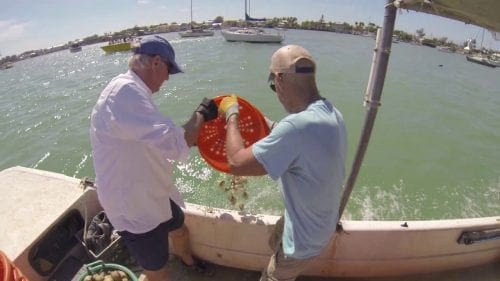
“Being out there on the boat and watching the clams spiral down into the water column was so cool,” Chiles said.

The clams delivered today make up just a portion of the total number of clams to be dispersed near the pier. Baugh said another delivery is scheduled for Saturday, March 9 and will be followed by as many additional Saturday shipments as needed. Chiles guessed it might take six trips to complete those efforts.

Big clams

Chiles said the clams purchased for the CRA project are much larger than the clams typically used for clam restoration projects. He also said the harvesting of clams is regulated and harvesting restrictions are enacted during red tide outbreaks in order to keep the clams in the water where they naturally filter out the red tide and other pollutants.

“It’s been worse down there and his clams get too big,” Chiles said of Davis’ clams.

“The market is for consumption clams – middlenecks, littlenecks, topnecks. Once they get too big and too heavy, they lose a lot of value. These clams have grown during that time of the forced harvesting closure and he hasn’t been able to get them off the bottom. He hasn’t been able to sell them because they’re too big. Those big fat, heavy, hard, mature clams are too heavy to be valuable to restaurants. You don’t sit around and eat a bowl full of large quahogs – you chop them up and put them in stuffed clams. But that calcium-carbon shelled, big, heavy, predator-proof clam, brood stock quahog clam will live another 33 years and produce multiple spawns a year with millions of larvae,” Chiles said.

Davis told Chiles that each of the large clams delivered to Bradenton Beach will filter approximately 20 gallons of water per day, compared to five gallons per day for a littleneck clam.

Chiles said he first became interested in clam restoration about a dozen years ago after reading a newspaper story about Curt Hemmel, the founder of the Bay Shellfish Co. bivalve hatchery in Terra Ceia. In 2015, Hemmel, Chiles and others formed the Gulf Shellfish Institute to help promote the use of best practices for aquaculture projects throughout Florida and the Gulf region.

The Chiles Group truck brought 22,000 clams to the Coquina South Boat ramp today to plant them in Sarasota Bay. - Cindy Lane | Sun

The Chiles Group truck brought 22,000 clams to the Coquina South Boat ramp today to plant them in Sarasota Bay. - Cindy Lane | Sun

Clams are offloaded from the Chiles Group truck on their way to Sarasota Bay. - Cindy Lane | Sun

Clams are offloaded from the Chiles Group truck on their way to Sarasota Bay. - Cindy Lane | Sun

Ed Chiles, John Chappie and Larry Stults helps carry clams to the Coquina South boat ramp today to plant them in Sarasota Bay. - Cindy Lane | Sun

Ed Chiles, John Chappie and Larry Stults helps carry clams to the Coquina South boat ramp today to plant them in Sarasota Bay. - Cindy Lane | Sun

Charlie Hunsicker, director of the Manatee County Parks and Natural Resources Department, hauls clams to the boat at the Coquina South boat ramp. - Cindy Lane | Sun

Charlie Hunsicker, director of the Manatee County Parks and Natural Resources Department, hauls clams to the boat at the Coquina South boat ramp. - Cindy Lane | Sun

Aaron Welch of Two Docks Shellfish gets ready to launch. - Cindy Lane | Sun

Aaron Welch of Two Docks Shellfish gets ready to launch. - Cindy Lane | Sun

Charlie Hunsicker, director of the Manatee County Parks and Natural Resources Department, Bradenton Beach Mayor  John Chappie and Aaron Welch of Two Docks Shellfish take the clams out into Sarasota Bay. - Cindy Lane | Sun

Charlie Hunsicker, director of the Manatee County Parks and Natural Resources Department, Bradenton Beach Mayor John Chappie and Aaron Welch of Two Docks Shellfish take the clams out into Sarasota Bay. - Cindy Lane | Sun

These clams found a new home in Sarasota Bay today. - Cindy Lane | Sun

These clams found a new home in Sarasota Bay today. - Cindy Lane | Sun

Sarasota Bay Watch restoring clams

Sarasota Bay Watch conducted its fourth large-scale planting of Southern hard-shell clams Saturday, June 16. Over 30,000 clams were transported from Pine Island Sound and loaded onto a barge provided by volunteer Larry Beggs of Reef Innovations. Florida Fish and Wildlife Conservation Commissioner Mike Sole and his wife, Jeannie, attended the event to learn about the innovative approach that aims to replenish depleted local stocks while helping to clean the waters of Sarasota Bay.

Adult native clams were collected locally to obtain spawn for the restoration effort. Once plentiful in local waters, the clams proved difficult to locate. Sarasota Bay Watch has a partnership with a professional shellfish hatchery in Terra Ceia Bay on the southern shore of Tampa Bay. Bay Shellfish Company conditioned and spawned the native adult clams in late 2016.

On March 1, 2017, Sarasota Bay Watch purchased, at cost, 330,000 seed clams, each about the size of a little fingernail. A commercial clam farmer was hired to do the first round of what is called grow out in fine mesh bags anchored to the bay bottom. The clam farmer used seagrass beds on submerged land leased from the state of Florida in Charlotte Harbor. This clam farmer grew the seed clams for 70 days in fine mesh bags until they were transferred to larger mesh bags, dispersed on the bottom and overlaid with a protective cover net.

Reel Time clam restoration
Florida Fish and Wildlife Conservation Commissioner Mike Sole pitches in to load clams on the deployment barge while talking to clam farming partner Dr. Aaron Welch. – John Ryan | Submitted

In May 2017, the seed clams were transferred to another clam farmer who maintains a lease in Pine Island Sound. There they grew for 12 months until they reached what is known as top neck size, approximately 2.5 inches or larger. The farmer, Carter Davis, is conducting a series of seven harvests over the summer, with a delivery of each harvest to Sarasota Bay Watch at his dock on Pine Island. Each harvest is about 3,000 pounds of clams totaling around 32,000 clams. The clams come out of the water at about 9 a.m., get transferred to a SBW rental truck at 10 a.m., and are driven to the Sarasota Sailing Squadron where they arrive at noon. Then they get transferred to a Reef Innovations work barge. Volunteers have them back in the water in Sarasota Bay by noon.

The whole program took Sarasota Bay Watch and scientific partner Mote Marine Laboratory approximately 18 months to complete and cost $20,000. Mote Marine Senior Scientist and Benthic Ecology Program Manager Jim Culter has created a series of experimental plots alongside SBW’s clam release areas to test a range of variables including hand planting of the clams versus dropping them on the bottom without planting, cover netting versus none, soft sand bottom versus hard packed sediment, and grassy versus sandy bottoms. From these experiments, the partners hope to learn how to make future restoration cycles more successful.

Sarasota Bay Watch Co-President Larry Stults hopes to scale up the operation in the future and may even grow more than they need, selling the excess in a profit-sharing arrangement with clam farmers. Ultimately, it is Sarasota Bay Watch’s hope that the program can become self-funding.

At the conclusion of Saturday’s restoration, a sustainable seafood lunch was held at the Mar Vista Dockside restaurant on Longboat Key. Attendees included FWC Commissioner Mike Sole and his wife, Jeannie; Dr. Aaron Welch, clam farmer and adjunct professor at the University of Miami; Dr. Bruce Barber, professor at Eckerd College and executive director of the Gulf Shellfish Institute; John Ryan, a SBW founder and Sarasota County natural resources expert; Dr. Larry Stults, co-president of Sarasota Bay Watch, board member of Gulf Shellfish Institute, Science and Environment Council of Southwest Florida and START; Ed Chiles, Mar Vista owner and board member of Gulf Shellfish and START; and Courtland Hunt, SBW volunteer and videographer.

Chef Erik Walker prepared a delicious medley of local seafood including locally grown hard shell clams, mullet with an olive and white grape tapenade, frog legs and stuffed and fried squash blossoms. The meal was topped off with an organic blueberry cheesecake.

During the lunch, there was a wide-ranging discussion of restoration efforts, clam farming, sustainability and other conservation issues. WWSB Channel 40 in Sarasota aired coverage of the restoration before and after the event on the evening news.

Sarasota Bay Watch is planning three more clam plantings over the summer. To volunteer or donate to the cause, go to their website.

Related Coverage

The evolution of Homosassa tarpon fishing

The apex of angling