Tag: Charlie Salem

Anna Maria discusses mangrove regulations

Anna Maria considers regulating mangroves

ANNA MARIA – Building Depart­ment General Manager Dean Jones is leading the city’s efforts to join Holmes Beach, Bradenton Beach and Longboat Key in adopting and self-enforcing local mangrove regulations.

The multi-municipality regulatory efforts were first discussed during the April 17 Coalition of Barrier Island Elected Officials (CBIEO) meeting in Longboat Key. During that meeting, Anna Maria Mayor Dan Murphy proposed that the four barrier island municipalities work together to establish a local mangrove regulation program that would supersede the regulations currently enacted and enforced by the Florida Department of Environmental Protection (FDEP).

Jones also attended the meeting and on April 25, at Murphy’s request, he provided the Anna Maria City Commission with an overview of the mangrove regulation and enforce­ment efforts to be pursued.

Anna Maria discusses mangrove regulations
Building Department General Manager Dean Jones is leading Anna Maria’s pursuit of local mangrove regulations. – Joe Hendricks | Sun

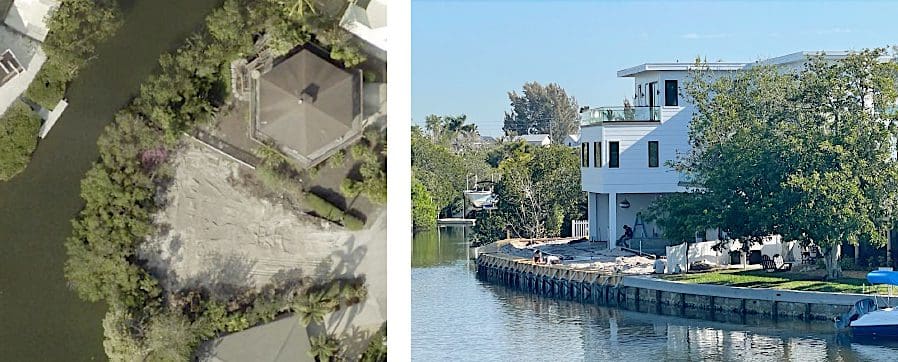
Jones’ presentation referenced a much-publicized mangrove removal event that occurred in late 2023 at a canal-side home at 111 Gull Drive in Anna Maria. The presentation included photos of the property before and after the mangroves were removed to make way for a new seawall.

“Part of what brought this process about was the fact that mangroves had been destroyed by a homeowner from out of state that felt they needed a seawall and didn’t really understand how important mangroves are to our ecosystem,” Jones said.

Another presentation slide listed the five Florida counties, one Florida city and one Florida town that have enacted their own local mangrove regulation and enforcement programs since 1996. Jones said of those seven, only Sarasota County’s mangrove program remains active.

Commissioner Charlie Salem asked Jones why the other mangrove enforcement programs faded away.

Jones said some people he spoke with didn’t even know who started their local mangrove programs and whether they ended due to a lack of resources or a lack of interest.

“The good thing is DEP will allow us to enforce our own mangrove ordinances, but we have to make sure we have the resources to do so,” Jones said.

Jones said he’ll be working in unison with Holmes Beach Planning and Zoning Administrator Chad Minor, Bradenton Beach Building Official Darin Cushing and Longboat Key Planning, Zoning and Building Director Allen Parsons.

Regarding FDEP requirements for local mangrove enforcement, one presentation slide said, “To receive delegation, a local govern­ment must demonstrate that it has sufficient resources and procedures for the adequate administration and enforcement of a delegated mangrove-regulatory program. This does not preclude a delegated local government from imposing stricter substantive standards or more demanding procedural requirements for mangrove trimming or alteration outside of riparian mangrove fringe areas.”

The presentation listed several next steps to be taken. Interlocal agreements must be established with all four participating municipalities and uniform guidelines must be adopted to provide continuity regard­ing administration and enforcement, including the fines and penalties levied on violators.

The municipalities must meet educational requirements and administrative guidelines and enforcement and communication protocols must be developed between the four municipalities to help intercept possible violations before they occur, or in the early stages of the occurrence.

“We need to have continuity across all the cities if we’re going to make this work,” Jones said. “Mangroves are a huge part of our ecosystem. When we remove them, bad things happen. The water gets worse and the wildlife goes away. We have the ability to protect our mangroves locally. We don’t have to let what happened at 111 Gull happen again. We can have some control over it.”

After noting that he also attended the CBIEO meeting, Salem thanked Murphy for his leadership and he suggested gathering more information about Sarasota County’s mangrove regulations and enforcement efforts.

During public input, Anna Maria resident Wayne Patterson thanked Jones and said, “I live right around the corner from that last decimated mangrove effort.” He asked how the city regulates mangroves in conjunction with property owners’ desire to install seawalls.

Commissioner Mark Short noted the city commission adopted a seawall ordinance a couple of years ago that states any new seawall installed must be installed landward of any mangroves that border the property – and doing so doesn’t reduce the total lot coverage allowed.

Patterson noted that didn’t happen at 111 Gull.

“They were removed before the permit for the seawall was applied for,” Short said. “Currently the city has no remedies. We always thought DEP would be the ones to remedy the situation. In my opinion, they’re not doing their job.”

Murphy then said, “At 111 Gull he had a permit from DEP. He did not have a seawall permit yet, but he had a permit to pull out all those mangroves. That’s what we’re trying to do here to preclude that from happening again. Otherwise, it’s going to keep happen­ing,” Murphy said.

“Until we have local control,” Jones added.

Salem then said, “Because DEP doesn’t recognize man-made canals as part of this protection, that’s why they were allowed to remove those mangroves. We would be able to prohibit that kind of removal in those man-made canals.”

When asked what happens if one or more of the barrier island municipalities can’t agree on the mangrove regula­tions and enforcement measures later proposed, Murphy said, “We move right on. We need to get something done. In that meeting there was a pretty thorough understanding of what we needed to do and why we needed to do it. If somebody decides to back out, they’re on their own and the other cities will move forward.”

PAST PRESENTATION

This is not the first time the city of Anna Maria has inquired about estab­lishing a local mangrove enforcement program. In 2020, FDEP representa­tive Hannah Westervelt and the Anna Maria Commission participated in a mangrove trimming workshop.

During the workshop, Westervelt said, “Any local government can get the delegation of authority to regulate trim­ming and alteration of mangroves, but a local agency has to demonstrate they have the resources and the procedures in place. To establish that local program, you have to submit a written request for delegation to the department.”

Related coverage: 

Mayors propose to regulate mangroves

Feds issue approval for mangrove removal

Incentivizing full-time residents presents challenges

Incentivizing full-time residents presents challenges

ANNA MARIA – City officials are still exploring incentives that might be pursued in hopes of retaining current full-time city residents and attracting new ones.

The mayor and city commission have held three discussions on the possibility, legality and financial feasibility of offering property tax breaks, grants and/or additional building use allowances as incentives. In exchange for those incentives, the city would seek from property owners a voluntary restrictive covenant that would prohibit the property from being used as a short-term vacation rental for 20 to 30 years.

On June 22, Commissioner Charlie Salem initiated the first discussion about incentivizing full-time city residents and those who rent their homes to others on a long-term or annual basis, which in turn might provide more on-Island housing for Island employees.

Incentivizing full-time residents presents challenges
Anna Maria Commissioner Charlie Salem is spearheading the efforts to incentivize full-time residency. – Joe Hendricks | Sun

Salem shared a one-page document citing U.S. Census Bureau data that shows Anna Maria’s population declined from 1,814 in 2,000 to 1,504 in 2010 and to 968 in 2020. Mayor Dan Murphy recently stated that 70% of Anna Maria’s residential dwellings are short-term vacation rentals.

Salem proposed including up to $75,000 in the city’s 2023-24 fiscal year budget for a feasibility study that would help determine what could be done to incentivize full-time residency. That expenditure is tentatively included in next year’s budget but a final commission decision is still pending. Salem also proposed a city-initiated marketing campaign that would promote Anna Maria as a destination for full-time residents.

On July 13, City Attorney Becky Vose shared with the commission some research she did in response to the June discussion. She said state law prohibits the city from providing property tax reductions only to certain property owners. The only tax reduction the city can legally offer is a reduction of the annual millage rate that would apply to all taxable properties in Anna Maria and reduce the city’s ad valorem tax revenues. Vose said city-funded grants could be a possible alternative. She also said there aren’t any state restrictions on a city-initiated marketing campaign.

On Aug. 3, Vose told the commission a marketing campaign would be the most risk-free approach and she doesn’t think the city would encounter any legal or legislative impediments in doing so. She suggested the marketing campaign target the growing number of professionals who work at home and no longer report to an office or workplace on a regular basis.

“I no longer go into my office. After COVID, I learned that I was so much more effective working at home; and I think there are an awful lot of people, particularly up north, like that,” she said.

Vose said she knows attorneys who moved to Florida but continue to remotely practice law in New York and New Jersey.

Although city-initiated tax breaks are not allowed, Vose said the city could lobby the Florida Legislature and governor to adopt a new state law that would allow local governments to provide property tax incentives in cities that have lost a certain percentage of permanent residents. She acknowledged that could be a challenging undertaking and she suggested speaking to the city’s contracted lobbyist about the prospect.

She also addressed the possibility of the city giving financial grants to property owners who voluntarily enter into restrictive covenants.

“That would be a very sizable investment,” she said, noting that Florida’s Marketable Record Title Act allows restrictive covenants for up to 30 years, with additional renewals possible.

No specific dollar figures were mentioned while discussing potential grant incentives.

Vose also addressed the city providing additional land use allowances that could include additional lot coverage, living area ratios or parking allowances for those who enter into restrictive covenants. Vose said that’s something the city could try, but she’s concerned that a successful legal challenge could result in vacation rental properties getting greater lot coverage and density than before.

She also addressed the previously-discussed idea of allowing small additional dwelling units to be built in the backyards of residential properties.

“That would have to be tied to a restrictive covenant because we cannot have a living unit in the city that was not permitted to be a vacation rental unless it was through a restrictive covenant,” she said.

“My primary concern about all this is the potential for litigation, which could be expensive to defend. I don’t think there’s any chance of us having any litigation with regard to marketing, but most of the other things would be subject to possible challenges. If they were challenged after we already allowed a lot of additional building, that wouldn’t be good for the city. And there’s always the possibility of the Florida Legislature ruling restrictive covenants prohibiting vacation rentals are no longer legal,” Vose said.

Commission input

Commissioner Robert Kingan said he’s in favor of a marketing campaign as a non-contentious starting point. He questioned what would happen when a property owner who signed a restrictive covenant passes away and the next of kin or next owners are bound to an agreement they didn’t sign.

Commissioner Jon Crane said a marketing campaign would be the least contentious approach, but it may also be the least effective. He said it’s unlikely that photographs of waves crashing on the beach and people enjoying fried fish sandwiches would encourage people to become permanent residents and forgo the potential rental earnings their homes could generate.

Incentivizing full-time residents presents challenges

Commissioner Jon Crane questions the effectiveness of a marketing campaign but is intrigued by a potential legislative effort at the state level. – Joe Hendricks | Sun

Crane said he’s intrigued with the idea of lobbying for state legislation that would allow the city to provide tax breaks to full-time residents. He believes tax incentives would be more effective than trying to seduce permanent residents with a marketing campaign.

Commissioner Deanie Sebring agreed. She also said she doesn’t support allowing property owners to build additional living spaces because they’d likely be used as vacation rentals.

Participating by phone, Salem thanked Vose for her research and legal insights. Salem supports asking the city’s lobbyist about pursuing new state legislation, but he also wants to pursue a marketing campaign and conduct a feasibility study regarding restrictive covenants.

Salem noted the Manatee County Tourist Development Council (TDC) has been incredibly effective at marketing Anna Maria Island as a vacation destination. He wondered whether similar marketing strategies could be used to attract full-time residents.

Crane suggested Salem speak to Bradenton Area Convention and Visitors Bureau Executive Director Elliott Falcione about the marketing techniques and marketing platforms the TDC uses.

“I’ll talk to anyone who’s got good ideas for how to attract permanent residents here,” Salem said.

Incentivizing full-time residents presents challenges
Commissioner Mark Short is concerned about potential backlash from current full-time residents. – Joe Hendricks | Sun

Commission Chair Mark Short said, “If we were to pursue something, I think we could get backlash from the existing residents. Some of them may say this is a great opportunity, but I have a feeling there’s also a good chunk of people that would say ‘Why would we want to add more density?’ and so forth.”

Salem said restrictive covenants could be offered to current residents too.

“That’s the model other cities have used with grants to incentivize permanent residents to remain, and when they sell their house, for it to become a long-term rental or another owner-occupied dwelling,” Salem said.

Short noted no one knows yet what the incentive costs would be for the city.

In response, Salem said, “That’s where we would need to get some expertise from the study, to figure out what the pickup rate could be, what the number would need to be to incentivize people and if it was worth the city’s revenues to encourage that?”

The incentives discussion will continue at a future meeting.

Public input

During public input, Holmes Beach resident Fran Derr offered her insights. Derr said she lives in the Key Royale subdivision and helped establish a welcoming committee for new Key Royale residents.

Incentivizing full-time residents presents challenges
Fran Derr said some Anna Maria residents are moving to the Key Royale subdivision in Holmes Beach where short-term vacation rentals are prohibited. – Joe Hendricks | Sun

Derr said seven of the last eight homeowners who moved into the Key Royale subdivision in 2023 already lived on Anna Maria Island, and six moved from Anna Maria into the Key Royale subdivision that carries an R-1 zoning designation that doesn’t allow rentals for less than 30 days at a time.

The zoning designation Derr referenced was in place before July 1, 2011, when the Florida Legislature and the governor enacted a new state law that now prevents local governments from prohibiting short-term vacation rentals.

The cities of Anna Maria and Bradenton Beach had no such pre-2011 restrictions in place and cannot impose them now.

Derr said she asks new Key Royale residents why they moved to Key Royale and she’s often told it’s because of the 30-day restriction on vacation rentals and the sense of community that fosters.

“We conquered that in our neighborhood because we have an HOA and we don’t allow weekly rentals,” unlike most Island neighborhoods, Sebring said.

City hopes to incentivize permanent residents

City hopes to incentivize permanent residents

ANNA MARIA – City officials are exploring the possibility of using grants and other incentives to attract and retain full-time residents.

City Commissioner Charlie Salem first proposed the idea during the commission’s June 22 budget meeting and he suggested budgeting $75,000 for a feasibility study to help determine what can be done.

Salem proposed possible tax breaks and possible building code allowances for property owners who formally and voluntarily agree to not use their home as a short-term vacation rental. He also proposed marketing Anna Maria as a place for full-time residents to live.

City Attorney Becky Vose said she’d research what can and can’t be legally done before the commission seeks a feasibility study.

On July 13, Vose provided the commission with an update on her initial and ongoing research. She said property tax reductions and rebates are not allowed in Florida.

“The state has preempted the issues having to do with ad valorem taxation, exemptions and assessments. That’s a non-starter, but that does not get rid of the possibility of giving grants to full-time residents or property owners who lease to tenants who are full-time residents,” Vose said.

Vose is still investigating the parameters of a grant program that would include participating property owners voluntarily entering into restrictive covenants that would prohibit their property from being used as a short-term vacation rental for a specific number of years.

Vose said development and building code incentives might also be possible for the construction or redevelopment of dwellings used for full-time residency.

“It’s still being looked into and I’ll come back with a comprehensive report as soon as it’s ready,” Vose said.

Vose said the city can advertise and market Anna Maria as a destination for permanent residents.

According to Mayor Dan Murphy, approximately 70% of the dwellings in Anna Maria are used as short-term vacation rentals.

Salem thanked Vose for her research and analysis and said, “I’m encouraged by the progress that we’re making, even with some changes as to how we might deliver the relief to permanent residents here. It might not be possible to do it through ad valorem (taxes) but there are other avenues we can pursue. The marketing piece is something we can do however we choose to pursue it. That’s something I think we could fast-track if the commission and mayor are interested.”

Regarding a feasibility study, Salem said, “It’s important to do a study because we are in uncharted territory. If we stay focused on the ultimate goal, which is to increase the number of permanent residents we have here and by extension make our community stronger, I think we’ll have something to be proud of.”

Commissioner Robert Kingan asked Vose if she’s aware of any other Florida city using grants to attract full-time residents. Vose said she’s not aware of any other city doing that, but she is aware of cities that use grants to incentivize desired commercial activity. Vose noted that grants, in general, are given to people in the private sector to accomplish the goals of a municipality.

Kingan asked Vose if the state might perceive a grant program as an attempt to circumvent the state’s ad valorem tax restrictions.

“I would not tie the grant to the tax assessments. I think that would be a mistake. There are numerous sources of funds the city receives that are not otherwise obligated,” Vose said.

“I think this is an exciting path to explore. I think it’s a great idea. There are places we can get money to fund a program such as this,” Murphy said.

Vose is still researching whether ad valorem property tax revenues could be used to help fund a grant program.

“It can’t come as a rebate on your property taxes,” Salem clarified.

Vose said that was correct and the incentives would not be related to how much a property owner pays in property taxes.

Salem said he’s aware of ski towns in Colorado that are having trouble finding employees because of the high rent in those areas. He believes grants are being used there to help attract employees and he intends to research that.

Vose said she looked at several grant programs in other states but there aren’t a lot of residential grant programs in Florida.

“It’s a very exciting concept and I’m hoping we’ll be able to be on the cutting edge of this in Florida,” she said.

Related coverage


Incentives proposed for permanent Anna Maria residents

Incentives proposed for permanent Anna Maria residents

Incentives proposed for permanent Anna Maria residents

ANNA MARIA – The city’s 2023-24 fiscal year budget may include a feasibility study aimed at attracting and retaining permanent residents through property tax breaks and building code incentives.

On June 22, with Mayor Dan Murphy absent, the city commission participated in the first of at least three preliminary three budget meetings to occur before the final budget and the yet-to-be proposed millage rate are finalized during two public hearings in September.

Thursday’s 30-minute budget meeting focused on capital outlay projects and other potential miscellaneous expenditures.

The budget proposes $325,000 for road repaving and Commission Chair Mark Short said there are only about four streets left in the city that have not been repaved in recent years.

The proposed budget includes $1.93 million for the Reimagining Pine Avenue safety improvement project that will include new sidewalks, crosswalks and streetlights along Pine Avenue.

The Pine Avenue sidewalk and crosswalk improvements will be funded by a $1.28 million state appropriation approved last year. The Pine Avenue streetlight improvements will be made using $460,000 in remaining American Rescue Plan funds previously provided by the federal government.

The proposed budget includes an additional $1.41 million in recently approved state funds to expand the Reimagining Pine Avenue project to include portions of Magnolia Avenue and Spring Avenue.

Incentives proposed for permanent Anna Maria residents
The budget proposes the design and permitting of a pumping station to address flooding along Archer Way. – Joe Hendricks | Sun

The budget proposes $525,000 for the ongoing maintenance of the city’s existing stormwater and drainage systems, $1.21 million for stormwater-related capital improvements and $75,000 to design a pumping station to address frequent flooding along Archer Way.

Additional projects

The proposed budget includes $1.8 million in additional potential capital projects that will require further commission discussion and decision-making.

Incentives proposed for permanent Anna Maria residents
The budget proposes installing shade sails above the City Pier Park playground. – Joe Hendricks | Sun

The potential projects include $156,486 to install shade sails over the children’s playground at City Pier Park, $79,660 to expand the existing City Pier Park shade sail structure and $69,912 to install shade sails over the T-end of the City Pier.

Incentives proposed for permanent Anna Maria residents
The budget proposes installing shade sails at the T-end of the City Pier. – Joe Hendricks | Sun

The budget proposes $200,000 for improvements to the city hall building that would allow building department personnel to vacate the rented annex building on Pine Avenue and return to city hall, with the Manatee County Sheriff’s Office Anna Maria Unit possibly moving into the annex building.

The budget proposes $275,000 to engineer and permit a permanent solution for the Lake LaVista jetty and canal area that would eliminate the need to dredge that area every two or three years.

The budget proposes $500,000 to construct stand-alone public restrooms on the city-owned property that contains City Hall, the Island Players theater and a public parking lot.

“This has come up because of the number of people using the beach and going into the stores and coming in here (city hall) to use the facilities,” Short said.

The budget also proposes $21,200 to redesign the Island Players parking lot to make it more disabled accessible and to include a designated passenger drop-off area.

Incentives proposed for permanent Anna Maria residents
The budget proposes $500,000 to extend the existing multi-use path along Gulf Drive. – Joe Hendricks | Sun

The budget proposes $500,000 to extend the multi-use path along Gulf Drive that currently extends from the entrance of the city to Willow Avenue.

Incentivizing residents

To retain and attract permanent residents, Commissioner Charlie Salem proposes budgeting $75,000 for a feasibility study pertaining to property tax breaks and building allowances being given to residential property owners who voluntarily agree to deed restrictions that would prohibit them for 25 years from renting their homes out for less than six months at a time.

Salem said Murphy supports the idea, which has also been discussed with City Planner Ashley Austin.

Citing U.S. Census data, the one-page document Salem shared with commissioners noted Anna Maria’s population declined from 1,814 in 2000 to 1,504 in 2010 and 968 in 2020.

Salem cited three primary goals: Retaining existing permanent residents through tax and building code incentives, marketing Anna Maria as a place to relocate for permanent residents and creating a better long-term rental market that allows more Island employees to live in Anna Maria.

To attract new residents and families, Salem suggests enacting building code incentives that include enhanced lot coverage, living area ratio and parking requirements in exchange for a voluntary deed restriction, with property tax relief as another potential incentive. Salem noted more people work from home these days and Anna Maria is an excellent place for that.

To increase the availability of long-term rentals, Salem and Austin suggest allowing code-compliant accessory buildings to be used as long-term rentals of more than six months, with a deed restriction in place.

Salem suggests creating a marketing plan to attract long-term residents and encourage existing residents to take advantage of any incentives given.

“I think it’s an excellent idea,” Commissioner Robert Kingan said, noting the city must be able to recapture benefits given to a property owner who agrees to a deed restriction and later tries to walk away from it.

Short suggested asking the City Attorney Becky Vose to provide her legal insight on Salem’s proposal before funding and conducting a feasibility study.

Vose said she would conduct that legal research because there’s no reason to conduct a study if the proposed deed restriction concept isn’t legally sound.

“This is a pressing issue,” Kingan said. “If it legally passes muster, we should fast-track this because we don’t have a lot of time. A lot of people are leaving.”

The commission reached a unanimous consensus in preliminary support of all the proposed expenditures, including the feasibility study.

Salem appointed to Anna Maria Commission

Salem appointed to Anna Maria Commission

ANNA MARIA – Charlie Salem now serves in the Anna Maria City Commission seat recently vacated by Carol Carter.

Salem will serve the remaining months of the two-year commission term that expires after the city elections in November. Former commissioner Brian Seymour was also considered for the commission appointment.

On Jan. 26, commissioners Jon Crane, Robert Kingan, Deanie Sebring and Mark Short ranked the two applicants according to their own first and second preferences. Crane, Kingan and Sebring ranked Salem as their first preference and Seymour as their second. Short ranked Seymour as his first preference and Salem as his second. The applicants received one point for a first preference and two for a second preference. Salem received five points, Seymour received seven and Salem won the seat with the lowest total score.

Salem appointed to Anna Maria Commission
City Clerk LeAnne Addy swore Charlie Salem into office after the appointment was made. – Joe Hendricks | Sun

City Clerk LeAnne Addy then swore Salem into office before he took his seat on the dais and participated in the rest of the meeting as a voting member.

Applicant presentations

For the first time, the appointment process featured a standalone commission workshop on Jan. 19 that allowed the two applicants to answer 24 questions provided in advance. The workshop also allowed Salem and Seymour to highlight their professional and political accomplishments.

Salem holds a bachelor’s degree in political science and government and a doctorate degree in law. He worked in Tallahassee as a special counsel for the State of Florida’s Office of Planning and Budgeting and then moved to Washington D.C. to run a state office of federal affairs pertaining to Hurricane Andrew recovery efforts in south Florida in the early 1990s. He then served as legislative director and chief of staff for U.S. Sen. Evan Bayh (D-Indiana) and finished his time working in the D.C. area as a public policy director for Microsoft.

Seymour served as an Anna Maria commissioner from late 2016 to late 2019. He owns and operates the Anna Maria General Store & Deli on Pine Avenue and he and his business partners operate the City Pier Grill in a pier space leased from the city.

Salem appointed to Anna Maria Commission

Former commissioner Brian Seymour also applied to fill the vacant commission seat. – Joe Hendricks | SunSalem and Seymour’s presentations helped the four sitting commissioners make their appointment the following week. When filling past vacant commission seats, the applicants were simply given a few minutes to address the commission before the appointment was made using the same ranking process.

Mayor Dan Murphy proposed the new candidate vetting process.

“I think this is a good process. I think it’s a much better process than what we were using in the past,” Murphy said after Salem was sworn in.

“It was great to learn more about the candidates. I think this was the best way to do it,” Short said. Crane and Sebring agreed.

“As a participant in the process, I thought it was well-thought-out,” Salem said.

Kingan thanked Salem and Seymour for putting themselves forward as candidates.

“Either of you would have been a very good addition to this commission. I very much hope, Brian, that you will remain in contention because I think you’re an asset to the community and definitely have what it takes,” Kingan said.

Workshop insights

During the workshop, Salem referenced the recently-expressed desires of State Rep. Will Robinson Jr. and other members of Manatee County’s legislative delegation for a state-funded study regarding the possible elimination or consolidation of the three Island cities and the three city governments.

Robinson and his fellow legislators also announced their pursuit of state legislation that could allow Manatee County to preempt the city of Holmes Beach’s building codes and build a multi-story public parking garage.

“I’m really concerned about our permanent resident population and the ability of our citizens to be able to govern themselves. I have a background in putting together coalitions. I would use that experience to help craft a strategy to work with the commission, the mayor and our lobbyist on this issue,” Salem said during the workshop.

During the workshop, Seymour expressed concerns about the utility grids in Anna Maria and throughout the rest of the Island. He said Anna Maria experiences power outages even on sunny days and Spectrum internet service was recently down for two non-consecutive days, which he said impacts businesses’ ability to process payments.

“How can we partner with FPL and Spectrum to make our grid a little more stable?” Seymour said.

During Thursday’s meeting, Salem referenced Seymour’s concerns and said, “He raised an issue last week around utility liability that I frankly hadn’t considered. I’d like to dive into that a little deeper.”

Salem appointed to Anna Maria Commission

The Anna Maria City Commission consists of Charlie Salem, Deanie Sebring, Mark Short, Jon Crane and Robert Kingan, who work in unison with non-voting mayor Dan Murphy. – Joe Hendricks | SUnDuring the workshop, Salem and Seymour both said they’d seek reelection if appointed. Both will have the opportunity to run in the fall election that will determine who fills the commission seats currently held by Crane, Kingan and Salem.


Related coverage


Salem, Seymour seek city commission seat