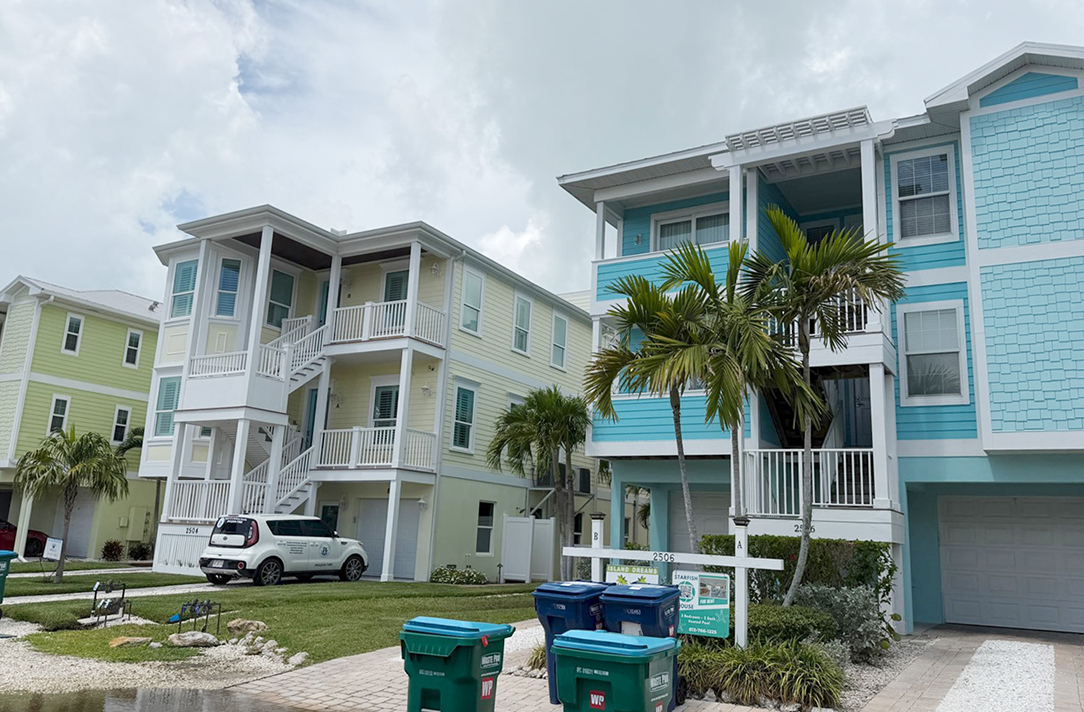
BRADENTON BEACH – City officials are making changes to the rules and regulations governing short-term vacation rentals, noise violations and the issuance of citations.
The Bradenton Beach City Commission first discussed proposed changes during its July 21 work meeting. The first reading of the amended city ordinances took place Sept. 3. The second and final readings are scheduled for Sept. 17.
The TPLE (Transient Public Lodging Establishment) ordinance would amend Chapter 59 of the city code regarding short-term vacation rentals.
The update is part of a review of the city codes that’s being done “to ensure applicability and clarity, and to correct any scrivener’s errors.”
The commission wants to simplify enforcement of the city’s noise ordinance and address concerns about occupancy limits at short-term vacation rental properties.
OCCUPANCY LIMITS
Originally adopted in 2015, the amended TPLE ordinance includes a modified two-plus-two occupancy limit for short-term vacation rentals. That occupancy limit is calculated by multiplying the number of bedrooms by two and then adding two additional occupants. For example, a four-bedroom rental would be allowed to have no more than 10 overnight guests.
The maximum number of visitors to the property would be capped at twice the occupancy limit listed on the property’s license.
The occupancy limits had formerly been attached to the Florida Building Code, but now will be strictly limited by the certificate of occupancy issued by the city.
LICENSING REQUIREMENTS
All short-term vacation rental owners are required to maintain an active license with the Florida Department of Business and Professional Regulation (DBPR).
The city could issue a conditional local TPLE license before an operator’s state DBPR license is finalized, provided the operator supplies proof of the state license within 90 business days. Operators could request one 30-day extension. If proof isn’t submitted in time, the conditional license would become void, requiring a new application and fee.
Applications would be considered pending once filed and fees are paid. All applications would need to be sworn under penalty of perjury, with false statements serving as grounds for revocation of the city-issued TPLE license.
Licenses would remain valid for one year, though the ordinance allows the city commission to authorize two-year licenses by resolution.
ENFORCEMENT AND PENALTIES
The ordinance outlines a suspension schedule for repeat violations, which would be carried out by the city’s special master at the request of the code enforcement officer.
Three violations within one year would result in a three-month city TPLE license suspension.
Six violations within one year would result in a six-month city TPLE license suspension.
Nine violations within three years would result in a one-year city TPLE license suspension.
Properties would not be allowed to host occupants during a suspension period.
Operating a rental without a valid business tax receipt, DBPR license and local license would carry a $125 fine for a first offense, according to the amended ordinance.
NOISE ENFORCEMENT
Changes are also being made to the city’s noise ordinance. Under the proposed changes, anyone found in violation of the noise ordinance would first receive a verbal warning. If the person fails to bring sound levels into compliance within five minutes of that warning, a citation would be issued. Previously, a written warning was required.
The first citation would carry a $200 fine. Any additional citation issued within one year would carry a $500 fine. Citations would be based on a formal complaint, according to the amended ordinance.