

HOLMES BEACH – The city of Holmes Beach seeks $344,500 of the county’s tourist development tax (TDT) revenues to install 92 tide valves throughout the city over a five-year period.
The city proposes splitting the total estimated $689,000 cost of the tide valve project with the county.
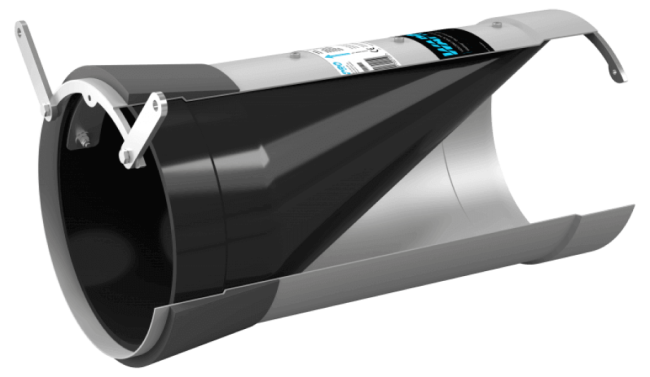
Already used by all three Anna Maria Island cities, tide valves are one-way valves attached to the end of a drainage pipe that discharges stormwater and rainwater into Anna Maria Sound, residential canals and other outfall areas. Tide valves also help prevent king tides and high tides from causing localized flooding.
The city is asking the Manatee County Tourist Development Council (TDC) to recommend Manatee County Commission approval of the city’s request to use county commission-controlled tourist development tax revenues generated by the 6% tourist development tax levied on all known hotel, motel, resort and vacation rental stays of six months or less in Manatee County.
In 2024, the county’s annual tourist tax revenues exceeded $30 million for the first time. State law restricts and regulates how the tourist tax revenues can be used, and in general, tourist tax revenues can only be spent to promote or enhance tourism.
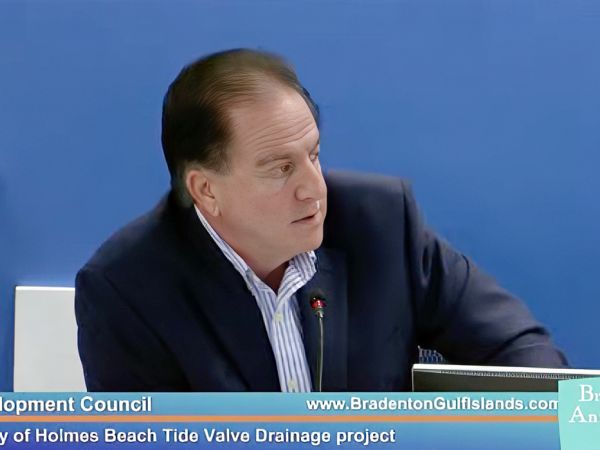
Holmes Beach Public Works Director Herb Raybourn presented the city’s $344,500 funding request to the TDC members during the council’s Monday, Aug. 17, meeting at The Center of Anna Maria Island.
The TDC members expressed preliminary support for the funding request, but they also raised questions and concerns about using tourist tax revenues for an infrastructure-related project. No final recommendation was made, and the TDC members agreed to continue the discussion during their next meeting in October.
CITY’S REQUEST
On Aug. 14, Holmes Beach Mayor Judy Titsworth formalized the city’s pending funding request in an email she sent to Bradenton Area Convention and Visitors Bureau (CVB) Executive Director Elliott Falcione. Although he doesn’t serve as an appointed TDC member, Falcione has a great deal of input on TDC funding recommendations.
Holmes Beach City Commissioner and current mayoral candidate Dan Diggins also serves as a county commission-appointed TDC member. When introducing Raybourn to the TDC members, Diggins noted the long-held and often stated belief among city and county officials that tourist tax revenues cannot be used to help fund city infrastructure projects that include street and road improvements and stormwater and drainage improvements.
Diggins told the TDC members that Holmes Beach City Commission candidate Mark Hebden researched the state laws that restrict tourist development tax expenditures. Hebden’s research indicated that stormwater and drainage improvements could be funded by TDT revenues if those improvements enhanced tourism in a coastal community like Holmes Beach.
LEGAL MEMO
In response to Hebden’s conclusions, the county attorney’s office provided a legal memorandum that supported his findings, and that memo was later referenced during the TDC discussion.
In part, the memo says, “The proposed improvement aims to mitigate tidal backflow flooding, enhance drainage and safeguard public infrastructure crucial for beach tourism and related businesses located within the city of Holmes Beach.”
Regarding the legality of using tourist development tax revenues for a city drainage project, the memo says, “Yes, if the County’s Board of County Commissioners finds that this proposed improvement, i.e. tidal valve installation, is needed to increase tourist-related business activities in the county, the improvement has a life expectancy of five or more years, and if other specific statutory conditions are met.”
Florida Statutes state no more than 70% of the proposed improvement’s total cost can be paid for using TDT revenues, and the remaining funding sources must be identified and confirmed by the county commission as part of the approval process.
The legal memo notes state law mandates that at least 40% of all TDT revenues collected in Manatee County must be spent to promote and advertise tourism in Manatee County. That has long been the primary use of Manatee County’s TDT revenues, but in recent years the TDC has supported and county commissioners have approved millions of dollars of TDT funding being used twice to replace the Anna Maria City Pier after sustaining hurricane damage in 2017 and again in 2024. TDT revenue has also helped fund improvements and hurricane-related repairs to the Bradenton Beach Pier and the floating dock next to the pier.
RAYBOURN PRESENTATION
Raybourn said most of the Island is flat, with elevations ranging from about 13.5 feet to half a foot. Because those land elevations are often lower than incoming high tides, tidal waters often back up into streets that would otherwise stay dry. He said this prompted the city to conduct a quick study of its 143 drainage pipe outfalls. He said the city wants to use tourist tax revenues to install 92 tide valves throughout the city.
Raybourn said tide valves are manufactured to the specific dimensions and character of each outfall pipe.
“Not every 24 inch pipe is identical. Not every situation is identical,” he said.
Regarding the installation timeline, he said it’s easier to install tide valves during low tides.
He said tide valves help mitigate flooding and a 1-foot tidal rise can cause flooding in some areas of Holmes Beach.
“As you increase to one and a half feet, two feet, two and a half feet, three feet, that increase in tide just creates more flooding in the streets, sidewalks, bike lanes, people’s yards and other infrastructure around the city,” he said.
Raybourn said barnacles that form on and in the drainage pipes create additional maintenance issues.
He said protecting the city’s infrastructure helps protect the businesses and the homeowners’ too.
Regarding storm surges, he said, “There’s not much that you can do about it. But those smaller storm surges, having tide valves really would be beneficial for the city as well.”
He said tide valves also protect against the compound flooding that occurs when it rains during a high tide.
He said tide valves help prevent water from the Gulf, the bay and the sounds from entering the drainage pipes and bringing that water into the city, rather than out of the city.
Raybourn said FEMA conducted a case study in Key West in 2021.
“The city of Key West installed tide valves because they were having very similar problem. And what FEMA found in their case study was that prior to the installation of tide valves there was disruption of daily life and disruption to business associated with tidal flooding, very similar to what we see.”
Raybourn said the Key West tide valves drastically reduced tidal flooding and maintenance and cleanup associated with tidal events.
“FEMA estimated that was a savings of $143,000 per year, not only to the city, but also to the local businesses in the area,” Raybourn said.
He concluded his presentation by showing the TDC members an example of what a functioning tide valve looks like.
He also showed them a video of an area where tide valves have already been installed.
“If the water is going into the inlet, that’s great. If it’s coming out of the inlet, that’s not so great,” he said, noting the water shown in the video was flowing into the inlet.
TDC RESPONSE
Cedar Cove Resort manager and TDC member Eric Cairns said tide valves and drainage improvements are needed at the south end of Holmes Beach, near the Bradenton Beach border.
In response, Raybourn said he agreed and the city was already looking at a couple of drainage projects for that southern quadrant of the city.
Hotelier and TDC member Jiten Patel asked if flooding was an Islandwide concern and if similar tide valve studies were conducted in Anna Maria and Bradenton Beach. He said it might be better to approach the tourist development tax funding request as an Islandwide project, with all three cities involved. He said that might be more efficient in regard to addressing flooding on a larger scale.
He also noted there are low areas in Palmetto that experience similar flooding issues and he wondered if a countywide project might be needed.
Bradenton Mayor and TDC member Gene Brown said during his dozen or so years in office he’s learned a lot about flooding, drainage and stormwater systems. He said tide valves can be helpful but they’re not the “silver bullet” that solves all flooding issues.
He said when the tide valves work, people are happy, but when they don’t work, city officials get blamed for not better addressing flood prevention. He said the city of Bradenton has tide valves that work one day and don’t the next. He also noted barnacle growth and intrusion often diminish a tide valve’s effectiveness.
Brown expressed his preliminary support for the Holmes Beach funding request, but he also said he’s concerned about spending tourist development tax revenues on something that may not fully succeed.
He also said the five other cities in Manatee County would likely follow suit and ask the TDC to recommend tourist development tax revenues be used for the other cities’ drainage projects too.
County Commissioner and TDC Chair Amanda Ballard expressed a similar concern.
Citing state law, Ballard also said, “We can potentially spend 60% of TDT funds on infrastructure. If we start moving in that direction, that is what will happen. I’m not necessarily opposed to this project. I think it’s necessary. I think it’s a good thing, but I think it’s a policy question. Do we want to spend 60% of our TDT funds on infrastructure? It definitely impacts tourists.”
Ballard agreed with Patel’s suggestion for an Islandwide tide valve project.
“I think to truly impact tourism in the most positive way, we need an Islandwide solution,” she said.
Ballard noted state law requires a TDC-funded independent study of a proposed project and its benefits on tourism. Diggins said the city paid for a technical study, but he doesn’t know if that qualifies as an independent study.
TDC member Tony DeRusso asked Falcione how much revenue the tourist development tax typically generates per year. Falcione said it’s currently about $38 million.
DeRusso said the TDC members need to make sure tourist tax revenues are being spent on projects that truly affect tourism.